
Ultimate Guide to Custom AI Automation for B2B SaaS in 2026
Learn how custom AI automation helps B2B SaaS companies scale sales, operations, and content workflows with AI agents, internal AI systems, and owned infrastructure.
On this page
- What Is Custom AI Automation?
- Why B2B SaaS companies need AI Automation?
- The Shift From SaaS Tools to AI Infrastructure
- What Are AI Agents?
- The Difference Between AI Automation and Traditional Automation
- Why Generic AI Tools Usually Fail?
- Core Use Cases for Custom AI Automation in B2B SaaS
- Why Ownership Is the Biggest Strategic Advantage?
- Why Forward-Deployed AI Engineering Matters?
- AI Automation vs Hiring Internal AI Engineers
- AI Automation vs SaaS Tools
- What are the common mistakes SaaS companies make with AI automation?
- What does a modern AI Automation stack look like?
- How to know if your company is ready for AI automation?
- What is the future of AI automation in SaaS?
- Conclusion
B2B SaaS companies are operating in a completely different environment today.
For years, growth came from adding more software.
Teams stacked:
- CRMs
- Outbound tool
- Workflow automation
- Analytics platforms
- AI writing tool
- Knowledge management system
- Project management software
- Enrichment tools
- Customer support platforms
The goal was efficiency.
Instead, most companies created operational fragmentation. Sales teams are buried in repetitive tasks. RevOps teams spend hours fixing brittle workflows. Founders pay for dozens of SaaS tools while still relying on manual coordination to keep operations moving.
Now AI has added another layer of complexity.
Most companies are experimenting with:
- ChatGPT
- Claud
- AI SDR tools
- AI outbound platforms
- AI copilots
- Automation software
But very few companies have actually operationalized AI.
That distinction matters. Because using AI tools is not the same as building AI systems. The companies winning right now are not simply buying more software. They are building operational infrastructure powered by AI.
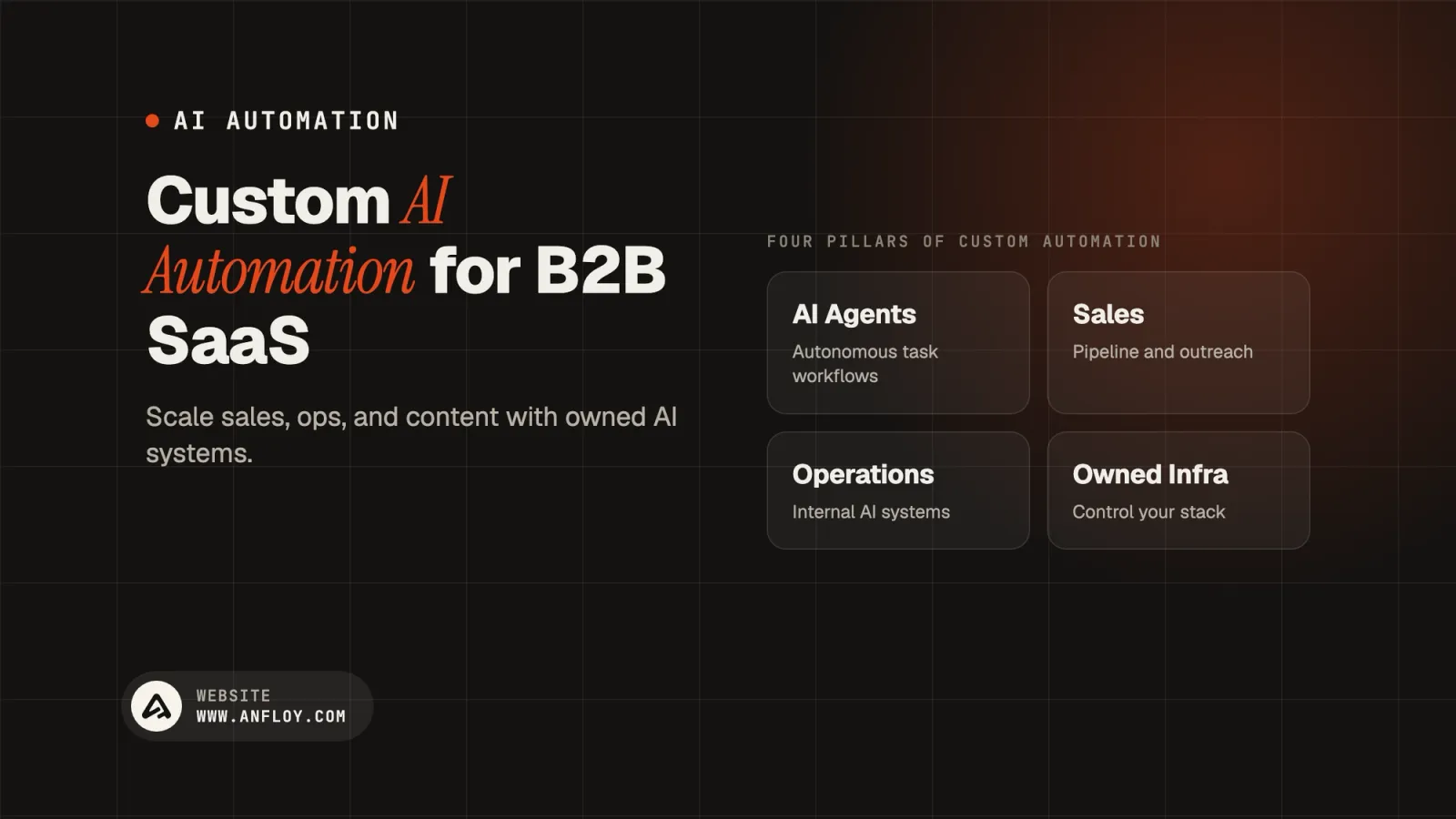
That is where custom AI automation becomes critical. At Anfloy, the focus is not on generic AI SaaS.
The company builds:
- Custom AI systems
- GTM AI agents
- Internal AI operations
- AI content pipelines
- AI workflow automation
- Company AI infrastructure
Most importantly, clients own the systems. No lock-in. No platform dependency. No recurring software hostage situation.
This guide explains:
- What custom AI automation actually means
- Why SaaS companies are moving toward AI infrastructure
- How AI agents work in real business operations
- The difference between SaaS automation and AI orchestration
- How B2B SaaS companies are deploying AI systems today
- Why ownership is becoming a major competitive advantage in AI adoption
What Is Custom AI Automation?
Custom AI automation is the process of building AI-powered operational systems around a company’s specific workflows, internal logic, data structure, and business processes.
Unlike generic AI tools, custom AI systems are designed specifically around how your business operates.
That means the AI understands:
- Your ICP
- Your sales process
- Your operations
- Your workflows
- Your documentation
- Your internal terminology
- Your pricing structure
- Your edge cases
- Your approval flows
- Your execution logic
This is the biggest difference between buying AI software and building AI infrastructure. Most SaaS automation tools force companies into predefined workflows.
Custom AI systems work the opposite way. They adapt around your business. That distinction becomes extremely important once a SaaS company scales beyond simple operational complexity.
For example:
A traditional automation might:
“If lead fills out form → create CRM contact.”
A custom AI automation system might:
- Identify high-intent buyer signals
- Enrich the account automatically
- Analyze ICP fit
- Score buying intent
- Generate personalized outbound messaging
- Update the CRM
- Notify the correct AE
- Trigger Slack alerts
- Launch outbound sequences
- And prioritize the opportunity dynamically
That is not a simple workflow; that is AI orchestration.
Why B2B SaaS companies need AI Automation?
Most B2B SaaS companies eventually hit the same operational ceiling. The company grows. More customers arrive. More tools get added. More workflows appear. Then operational complexity starts slowing everything down.
At first, the inefficiencies seem manageable. Teams patch workflows together with more SaaS tools, more automations, and more manual coordination. But eventually the system becomes fragmented.
This is where operational drag begins.
What are the common signs your SaaS company needs AI Automation?
Growing SaaS companies usually experience the same bottlenecks:
- SDRs manually researching prospects
- RevOps teams are constantly fixing broken workflows
- founders buried in repetitive operational tasks
- Content teams are struggling to scale output consistently
- knowledge trapped across Slack, Notion, and internal docs
- marketing teams manually moving data between platforms
- fragmented reporting across multiple systems
- inconsistent lead qualification processes
- operational bottlenecks between departments
- expensive SaaS stacks with overlapping functionality
Most companies respond by buying more software. But the problem is rarely a lack of tools. The real issue is workflow coordination.
Disconnected systems create operational friction. Teams spend more time managing workflows than executing high-value work.
This is why AI automation adoption is accelerating across B2B SaaS companies. Instead of humans manually coordinating workflows, AI systems orchestrate execution across the business.
That shift changes everything.
The Shift From SaaS Tools to AI Infrastructure
Traditional SaaS tools were designed around static workflows.
Modern SaaS companies do not operate in static environments anymore.
Buyer behavior changes constantly. Outbound messaging evolves weekly. Content strategies shift rapidly. Sales teams need personalization. Operations teams require flexibility.
This is why rigid SaaS products eventually become limiting.
Many growing companies are realizing that:
- No-code tools break under operational complexity
- Generic AI tools create mediocre outputs
- SaaS automation struggles with reasoning and decision-making
- Fragmented systems slow down execution
- Scaling workflows requires engineering support
- Operational logic becomes difficult to maintain across tools
This is where custom AI infrastructure changes the model. Instead of relying on disconnected SaaS platforms, companies build AI systems that:
- Integrate directly into existing workflows
- Operate across multiple tools and platforms
- Reason contextually instead of following rigid rules
- Execute operational tasks automatically
- Learn company-specific logic and processes
- Support internal teams with real-time execution
- Improve operational efficiency over time
This is why more B2B SaaS companies are building internal AI systems instead of depending entirely on third-party AI software.
The future advantage is no longer software access. The real advantage is operational leverage powered by AI infrastructure.
What Are AI Agents?
AI agents are operational systems powered by large language models, workflows, memory, APIs, and execution layers. A chatbot answers questions.
An AI agent performs work that is a massive difference.
Modern AI agents can:
- Research companies
- Qualify leads
- Generate outreach
- Summarize meetings
- Update CRMs
- Execute SOPs
- Coordinate workflows
- Retrieve knowledge
- Analyze intent signals
- And trigger downstream operations
The easiest way to think about AI agents is this:
They act as digital operators within the business. At Anfloy, AI agents are typically organized into three operational layers.
1. Signal Layer
This layer gathers operational intelligence.
Examples include:
- Website activity
- CRM engagement
- LinkedIn activity
- Funding announcements
- Hiring signals
- Product usage
- Outbound engagement
- Internal company data
- Slack conversations
- Support tickets
The signal layer gives the AI system awareness.
2. Reasoning Layer
This is where LLMs evaluate information.
The AI determines:
- ICP fit
- Lead quality
- Operational priority
- Workflow routing
- Content quality
- Personalization strategy
- And execution logic
This is the intelligence layer.
3. Execution Layer
This layer performs actions.
Examples include:
- Sending outbound emails
- Updating CRMs
- Assigning tasks
- Creating report
- Generating content
- Triggering automations
- Booking meetings
- Notifying teams
- And launching workflows
Together, these layers create autonomous operational systems.
The Difference Between AI Automation and Traditional Automation
One of the biggest misconceptions in the market is that automation equals AI automation.
It does not.
Traditional automation platforms like:
- Zapier workflow automation platform
- Make
- HubSpot workflows
- Airtable automations
They are rule-based systems that rely on deterministic logic. While this works well for structured workflows, modern SaaS operations are far more dynamic and not entirely deterministic.
Sales workflows involve:
- Context
- Prioritization
- Personalization
- Decision-making
- And dynamic execution
That requires reasoning.
Custom AI automation combines:
- Workflows
- APIs
- LLMs
- Orchestration
- Memory
- and operational logic
This allows AI systems to adapt dynamically rather than simply following rigid rules.
| Traditional Automation | Custom AI Automation |
|---|---|
| Rule-based | Context-aware |
| Static workflows | Adaptive workflows |
| Trigger → action | Multi-step orchestration |
| Limited personalization | Deep personalization |
| Generic templates | Company-specific logic |
| SaaS dependency | Owned infrastructure |
| No reasoning | AI decision-making |
This is why many SaaS companies eventually outgrow no-code automation.
Why Generic AI Tools Usually Fail?
Most AI products are designed for broad markets.
That creates a major problem.
Generic AI tools do not understand:
- Your buyers
- Your market
- Your pricing
- Your workflow
- Your operational complexity
- Your compliance requirements
- Your sales motion
- Or your internal systems
This is why many companies experiment heavily with AI but struggle to deploy it in a meaningful way. The tool may work well in isolation, but in real-world conditions, the workflow often breaks down.
Examples:
- AI outbound sounds robotic
- AI SDR tools generate low-quality messaging
- AI content lacks positioning depth
- AI support systems hallucinate
- AI automations fail across edge cases
- Workflows require constant human cleanup
The issue is not AI itself; the issue is generic infrastructure.
Custom AI systems solve this by building operational logic specifically around the business.
Core Use Cases for Custom AI Automation in B2B SaaS
1. GTM AI Agents
This is currently the highest ROI AI category for most SaaS companies.
GTM AI agents automate:
- Lead sourcing
- Enrichment
- Outbound personalization
- Intent monitoring
- Account research
- CRM management
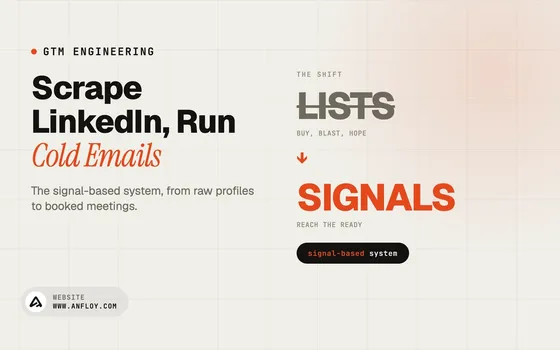
- Signal-based prospecting
- Pipeline workflows
- and RevOps coordination
Modern outbound is no longer about sending thousands of generic emails.
The winning approach is:
- Signal-based targeting
- Contextual outreach
- Timing optimization
- and operational intelligence
A modern AI outbound system can:
- Monitor buying signals
- Identify ICP-fit companies
- Enrich contact data automatically
- generate personalized messaging
- prioritize accounts
- Update CRM systems
- Trigger outbound workflows
- and coordinate sales execution
This creates enormous leverage for lean GTM teams.
At Anfloy GTM AI Agents, the focus is on building custom GTM systems around real sales infrastructure rather than selling another outbound tool.
That distinction matters.
Because the best AI systems are not standalone products.
They are operational layers integrated directly into the company.
If your sales team is buried in manual prospect research, enrichment, or repetitive outbound workflows, explore Anfloy’s GTM AI systems to build a signal-driven outbound engine your company actually owns.
2. Content AI Automation
Content operations are changing rapidly. Most AI-generated content online is becoming indistinguishable.
Generic AI tools create:
- Repetitive language
- Weak positioning
- Shallow insights
- And low-conversion content
That is because the problem is not content generation. The problem is content operations. High-performing AI content systems combine:
- Research
- Semantic SEO
- Internal knowledge
- Topical authority
- Distribution workflows
- Editing systems
- and brand positioning
Modern content AI systems can:
- Analyze SERPs
- Identify semantic entities
- Build outlines
- Generate drafts
- Repurpose content
- Optimize internal linking
- Support SEO workflows
- and coordinate publishing operations
But the real advantage comes from customization.
At Anfloy Content AI Agents, content systems are built specifically around:
- Your ICP
- Your messaging
- Your positioning
- Your semantic SEO strategy
- and your pipeline goals
This matters because content is no longer simply a traffic channel.
For modern SaaS companies, content is part of the GTM system.
If your content team is struggling to scale high-quality SEO and thought leadership content, Anfloy can build AI-powered content systems tailored to your market, positioning, and revenue goals.
3. Internal Operations AI Systems
Most growing SaaS companies suffer from internal operational fragmentation.
Knowledge lives everywhere.
Teams rely on:
- Slack
- Notion
- Google Drive
- CRMs
- Project management tools
- SOP docs
- Scattered spreadsheets
- and disconnected systems
The result is operational inefficiency.
Employees waste time searching for information.
Processes become inconsistent.
Execution slows down.
This is where internal AI systems become extremely powerful.
At Anfloy Internal Ops AI Agents, systems are designed to function like a company AI brain.
These systems can:
- retrieve operational knowledge
- summarize meetings
- execute SOPs
- automate onboarding
- generate reports
- coordinate tasks
- support internal operations
- and streamline company workflows
The goal is not to replace employees. The goal is to reduce operational friction.
If your team constantly loses time searching for information or coordinating repetitive workflows, Anfloy can help you build an internal AI operating layer integrated directly into your company systems.
Why Ownership Is the Biggest Strategic Advantage?
Most AI vendors want companies to be dependent on their platform.
You rent the workflows. You rent the infrastructure. You rent the operational logic.
The problem starts when:
- Pricing changes
- Feature limitations appear
- Workflows become too complex
- Or the platform cannot adapt to your operations
Your business becomes trapped inside someone else’s system.
That is one of the biggest issues with traditional AI SaaS platforms.
Custom AI infrastructure changes that are complete. Instead of renting software, companies build AI systems they fully control.
That means:
- The code lives in your GitHub
- The workflows belong to your team
- The integrations stay inside your infrastructure
- and the operational logic becomes a long-term company asset
This is especially important for:
- B2B SaaS companies
- RevOps teams
- Technical founders
- and scale-ups building long-term operational systems
The real value of AI is not temporary productivity gains.
The real value is owning the operational infrastructure that powers growth.
That is why more companies are moving away from generic AI SaaS tools and investing in custom AI systems designed around their workflows.
Why Forward-Deployed AI Engineering Matters?
Most AI agencies still operate like traditional service businesses.
They sell:
- Hours
- Retainers
- Strategy decks
- Consulting
- And ongoing dependency
Anfloy’s model is fundamentally different. The company operates as a forward-deployed AI engineering firm.
That means:
- Systems get shipped fast
- Infrastructure gets deployed directly into client environments
- Workflows are custom-built around operations
- and the asset compounds internally over time
The goal is not to create long-term service dependency.
The goal is to create operational leverage.
This is a major difference between Anfloy and traditional AI agencies.
AI Automation vs Hiring Internal AI Engineers
Many SaaS founders face the same decision.
Should they:
- Hire internal AI engineers
- or deploy external AI infrastructure faster?
Hiring internal AI talent is expensive.
A strong AI engineer can cost:
- $200K+
- plus recruiting
- onboarding
- infrastructure setup
- management overhead
- and ramp-up time
Even then, companies still need:
- architecture
- workflows
- integrations
- operational planning
- and deployment systems
This is why many growing SaaS companies use external AI engineering partners initially.
At Anfloy vs In-House AI Hiring, the focus is on helping companies bridge the gap between experimentation and production deployment.
Instead of waiting six months to build internal infrastructure, companies can deploy operational AI systems immediately.
AI Automation vs SaaS Tools
Many SaaS tools claim to offer AI-driven automation. But most of these products are still fundamentally software platforms, where the workflow has to adapt to the tool.
Custom AI infrastructure flips that relationship. Here, the system adapts to the company instead.
This is a critical distinction.Platforms like:
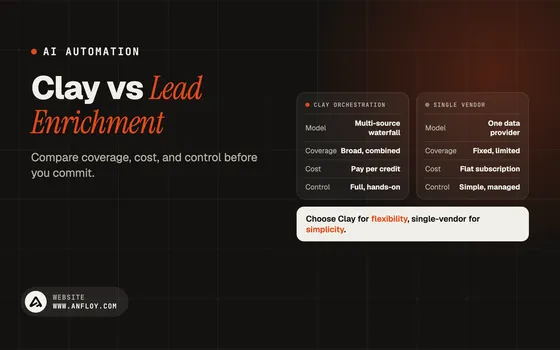
- Clay sales intelligence platform
- Apollo
- HubSpot
- Zapier
- Make
- Notion AIThey
are excellent components, but they are still tools.
High-performing AI systems require orchestration across those tools.
That orchestration layer is where custom AI infrastructure becomes valuable.
What are the common mistakes SaaS companies make with AI automation?
1. Buying Too Many AI Tools
Many companies mistake AI adoption for software accumulation.
The result:
- Disconnected workflows
- Inconsistent outputs
- Fragmented operations
- Overlapping tools
- And poor adoption
AI works best as infrastructure, not isolated products.
2. Focusing on Prompts Instead of Systems
Prompts are not operational infrastructure. The real value comes from:
- Workflows
- Orchestration
- Integrations
- Memory
- Operational logic
- and execution systems
3. Ignoring Operational Design
AI systems fail when workflows are poorly designed.
The best AI infrastructure starts with clear, well-defined workflows:
- Operational bottlenecks
- Execution gaps
- and workflow inefficiencies
Not technology hype.
4. Treating AI Like Magic
AI systems still require:
- Monitoring
- Architecture
- Governance
- Testing
- and iteration
The best systems combine:
- Deterministic automation
- AI reasoning
- and human oversight
What does a modern AI Automation stack look like?
A modern B2B AI infrastructure stack often includes:
- OpenAI
- Anthropic
- Vector databases
- Orchestration frameworks
- APIs
- CRMs
- Slack
- Notion
- Airtable
- Postgres
- Enrichment systems
- Workflow automation tools
- Custom backend infrastructure
But tools alone are not the advantage.
Operational design is.
The most valuable companies are not the ones with the biggest software stacks.
They are the ones with the best operational systems.
How to know if your company is ready for AI automation?
Your company is likely ready if:
- GTM workflows are highly manual
- Your team repeats operational tasks weekly
- Multiple systems require human coordination
- RevOps complexity is growing
- Content production is bottlenecked
- Outbound personalization is difficult to scale
- Knowledge management is fragmented
- Or SaaS tools are creating operational friction
The best-fit companies are usually:
- Seed to Series B SaaS companies
- With active GTM motion
- Technical leadership
- Operational complexity
- and scaling pressure
What is the future of AI automation in SaaS?
The next generation of SaaS companies will not operate like software companies from the previous decade.
AI will become:
- the workflow layer
- the operational coordination layer
- the knowledge layer
- and the execution layer
The future stack will include:
- fewer disconnected SaaS tools
- more orchestration systems
- more AI agents
- and more owned infrastructure
Companies that win will not necessarily use the most AI tools.
They will build the best operational systems.
That is the real shift happening right now.
Conclusion
Custom AI automation is no longer just an experiment for B2B SaaS companies.
It is quickly becoming the operational layer behind modern growth, RevOps, content systems, and internal workflows.
The companies gaining the biggest advantage are not simply adding more AI tools to their stack. They are building AI infrastructure around how their business actually operates.
That includes:
- AI-powered GTM systems
- internal AI knowledge operations
- AI content workflows
- signal-based outbound automation
- and custom operational infrastructure
The biggest shift happening right now is not about software.
It is about operational leverage.
Traditional SaaS tools force companies into predefined workflows. Custom AI systems adapt around your processes, your team, your customers, and your business logic.
That flexibility becomes a major competitive advantage as companies scale.
Most importantly, ownership matters.
The future winners in SaaS will not rely entirely on rented AI platforms. They will build systems they control, improve, and compound internally over time.
Frequently Asked Questions About Custom AI Automation
What is custom AI automation?
Custom AI automation uses AI agents, workflows, APIs, and operational logic to automate business processes around your company’s systems, workflows, and data instead of forcing teams into generic SaaS tools.
How much does custom AI automation cost?
Custom AI automation typically starts around $5K for focused systems and increases based on workflow complexity, integrations, infrastructure requirements, AI orchestration layers, and operational scope across teams and departments.
Are AI agents better than Zapier?
AI agents are better for dynamic workflows requiring reasoning, personalization, and decision-making. The Zapier workflow automation platform works best for deterministic rule-based automations with predictable triggers and structured processes.
Should SaaS companies build internal AI systems?
Yes, growing SaaS companies benefit from internal AI systems because they reduce operational friction, centralize knowledge, automate repetitive workflows, improve GTM efficiency, and create long-term operational leverage across teams.
How long does AI implementation take?
AI implementation timelines vary by complexity. Focused AI systems can launch within days, while full AI infrastructure stacks with integrations, workflows, and orchestration layers typically take one to two weeks.
Can I deploy custom AI for automating internal systems?
Yes. You can deploy custom AI to automate internal systems like workflows, data processing, customer support, reporting, and operations, with secure integration into your existing tools, databases, and business applications.
Let's build
what your
company needs.
Drop your email. We'll send The Custom Agent Blueprint on what we'd build first for a company like yours, before you ever take a meeting.