
AI Automation Agency for Recruiting: Best Partners Compared
Compare AI automation agencies for recruiting and staffing firms. Evaluate ATS integrations, candidate sourcing, AI agents, workflow automation, compliance, and cost.
On this page
- Best AI automation agencies for recruiting: quick comparison
- 1. Effi Flo: Recruitment-specific automation
- 2. Kyloe Partners: Bullhorn-focused staffing technology
- 3. PARQA: Staffing technology and salesforce consulting
- 4. Kinematic Labs: Custom AI engineering
- 5. Velocis: Custom AI agents and workflow automation
- 6. Anfloy: Custom AI agents and connected recruiting workflows
- AI automation agency vs AI recruiting software: Which do you need?
- What should a recruiting agency automate first?
- 1. Job-order intake
- 2. Candidate enrichment
- 3. Candidate matching
- 4. Outreach and follow-up
- 5. ATS and CRM hygiene
- 6. Interview coordination
- 7. Client reporting
- A practical example: Automating a recruitment workflow end to end
- How to choose the right AI automation agency for recruiting?
- 1. Recruiting-specific experience
- 2. ATS and CRM integration
- 3. Human oversight
- 4. Data protection and compliance
- 5. Production reliability
- 6. Ownership and maintenance
- 7. Measurable business outcomes
- How much does recruiting automation cost?
- Final recommendation: Which partner should you choose?
Recruitment agencies do not usually lose time because recruiters lack the ability to find candidates. They lose time because too much of the recruiting process happens between systems, spreadsheets, inboxes, and manual follow-ups.
A recruiter receives a job brief, searches for candidates, checks their experience, enriches contact details, writes outreach, follows up, updates the applicant tracking system (ATS), coordinates interviews, and reports progress to the client.
Repeat that process across 10 or 20 open roles, and a large part of the working day disappears into operational tasks.
AI recruiting tools can reduce some of this work. But adding another tool does not automatically fix a fragmented recruiting operation.
An AI automation agency takes a different approach. It can connect the tools a recruitment business already uses, automate repetitive workflows, and build AI agents for tasks that require research, classification, or contextual decisions.
The challenge is choosing the right partner.
Some providers specialize in recruitment-specific automation. Others build custom AI agents. Some are primarily recruiting platforms, sourcing products, or staffing technology consultants rather than automation agencies.
This guide compares the options by their practical fit, explains what each type of provider can help automate, and shows how to evaluate a partner before committing your recruiting operations to a new system.
Best AI automation agencies for recruiting: quick comparison
The providers below represent different approaches to recruiting automation.
They are not all direct substitutes, so evaluate them against your workflow requirements rather than treating the list as a universal ranking.
| Provider | Best fit | Primary approach | What to evaluate |
|---|---|---|---|
| Effi Flo | Staffing and recruitment agencies | Recruitment-specific automation and agentic workflows | ATS compatibility, workflow scope, ownership and ongoing support |
| Kyloe Partners | Staffing firms using Bullhorn | Staffing technology implementation and optimization | Bullhorn expertise, integration scope and customization |
| PARQA | Staffing firms with complex systems and Salesforce-based workflows | Staffing technology and Salesforce consulting | Salesforce architecture, implementation requirements and recruiting-specific experience |
| Kinematic Labs | Businesses needing custom AI solutions | Custom AI engineering and automation | Relevant recruiting case studies, integration depth and production support |
| Velocis | Businesses exploring custom AI agents and workflow automation | Custom AI agents and business process automation | Recruiting-specific references, data handling and delivery model |
| Anfloy | Recruiting firms that need connected, custom workflows | AI agents, workflow automation and custom systems | ATS integrations, client-owned infrastructure, scope and maintainability |
Important: This is a shortlist of relevant providers and approaches, not a claim that every company has been independently audited or tested against the same recruiting workflow.
Confirm current capabilities, implementation scope, pricing, and customer references directly before choosing a provider.
The shortlist draws on a 2026 recruiting automation comparison that identifies Kyloe Partners, PARQA, Kinematic Labs, and Velocis as options for different staffing technology and custom automation needs.
Effi Flo describes itself as a recruitment automation provider for staffing and recruiting agencies. These providers differ in their delivery models, so they should not be evaluated as interchangeable products.
1. Effi Flo: Recruitment-specific automation
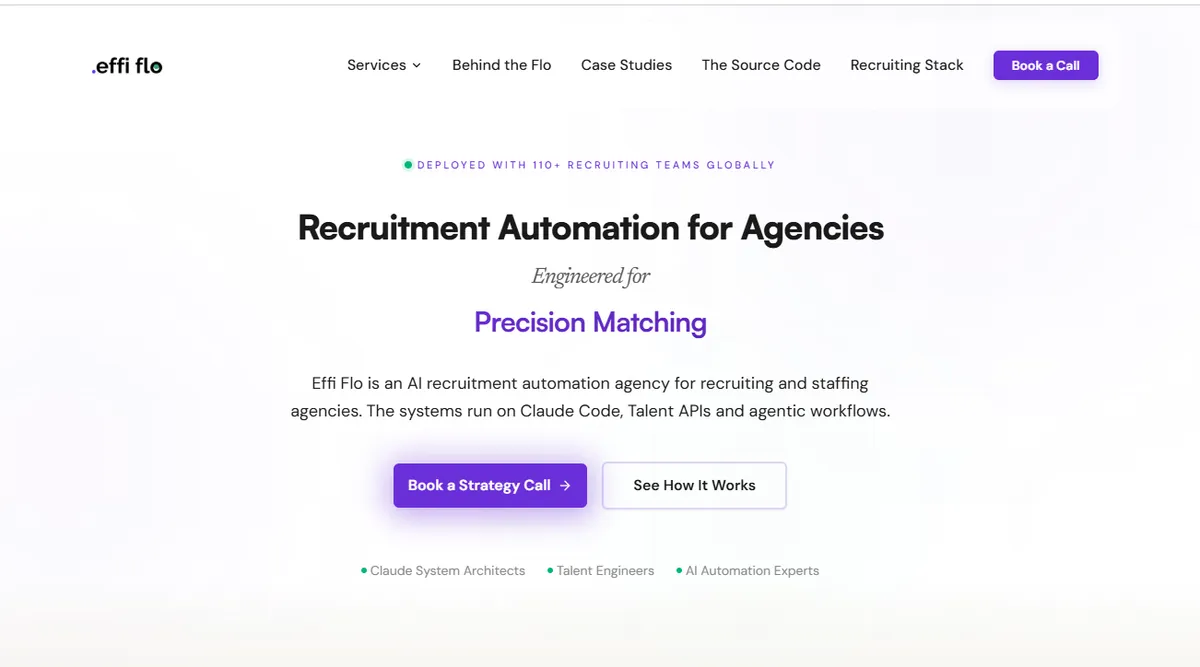
<text size="sm" color="secondary">Best for: Staffing and recruitment agencies seeking recruiting-focused automation</text>Effi Flo positions itself around AI recruitment automation for staffing and recruiting agencies. Its public positioning emphasizes agentic workflows and automation built for recruitment operations rather than generic business processes.
That specialization is relevant because recruiting workflows have their own complexity. One recruiter may manage several clients, each with different job requirements, candidate criteria, communication expectations, and submission processes.
An automation system must account for those differences instead of treating every candidate as an interchangeable contact.
Potential use cases
- Candidate sourcing and enrichment workflows
- Candidate outreach and follow-up
- ATS data updates
- Recruitment workflow orchestration
- Repetitive administrative processes
These are use cases to discuss with the provider, not a guarantee that every workflow is included in its standard engagement.
What to ask before hiring?
Ask Effi Flo to demonstrate a complete workflow using your ATS and an actual recruiting scenario.
For example, show how a new job order becomes a sourced, qualified, contacted, and tracked candidate without losing context between steps.
Also clarify which components are custom-built, which depend on third-party tools, and whether your business retains access to the workflows and code after the engagement.
Consider Effi Flo if: recruitment-specific automation is your primary requirement and you want to evaluate a specialist rather than a general-purpose AI agency.
2. Kyloe Partners: Bullhorn-focused staffing technology
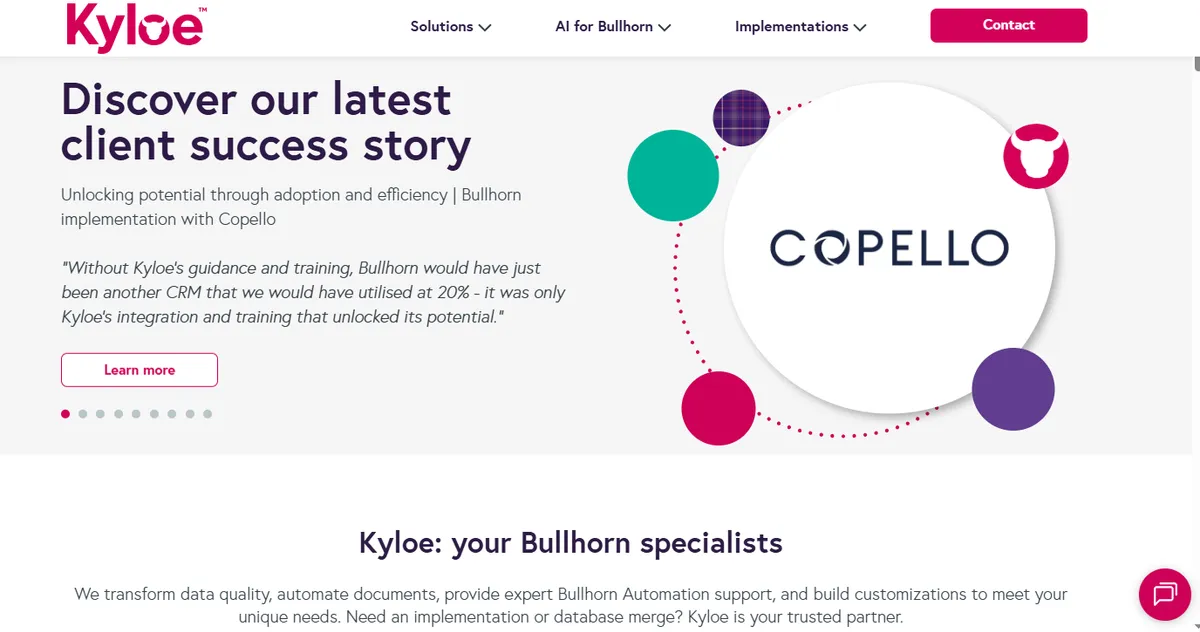
<text size="sm" color="secondary">Best for: Staffing businesses whose recruiting operations depend heavily on Bullhorn</text>For a staffing firm already using Bullhorn, the first question may not be whether to build a custom AI agent. It may be whether the existing ATS is configured, integrated, and automated properly.
Kyloe Partners is identified in the 2026 recruiting automation comparison as a specialist option for Bullhorn-heavy staffing firms.
That distinction matters. An agency with deep experience in your existing staffing platform may be able to address workflow bottlenecks without introducing a separate automation architecture.
Where this approach may fit?
- Bullhorn configuration and optimization
- Recruiting workflow improvements
- Integrations between staffing systems
- Reducing manual administrative work
- Improving consistency across recruiting processes
The exact scope depends on the engagement, so confirm whether your required work involves platform configuration, integration development, custom AI, or a combination.
What to ask before hiring?
- Can you automate the complete workflow rather than just individual steps?
- Which integrations are native, and which require custom development?
- Can the solution support multiple clients, teams, and permission levels?
- What happens when Bullhorn data is missing or inconsistent?
- Does the proposed solution require additional recurring software subscriptions?
Consider Kyloe Partners if: Bullhorn is central to your operation and you want a staffing technology partner with relevant platform expertise.
3. PARQA: Staffing technology and salesforce consulting
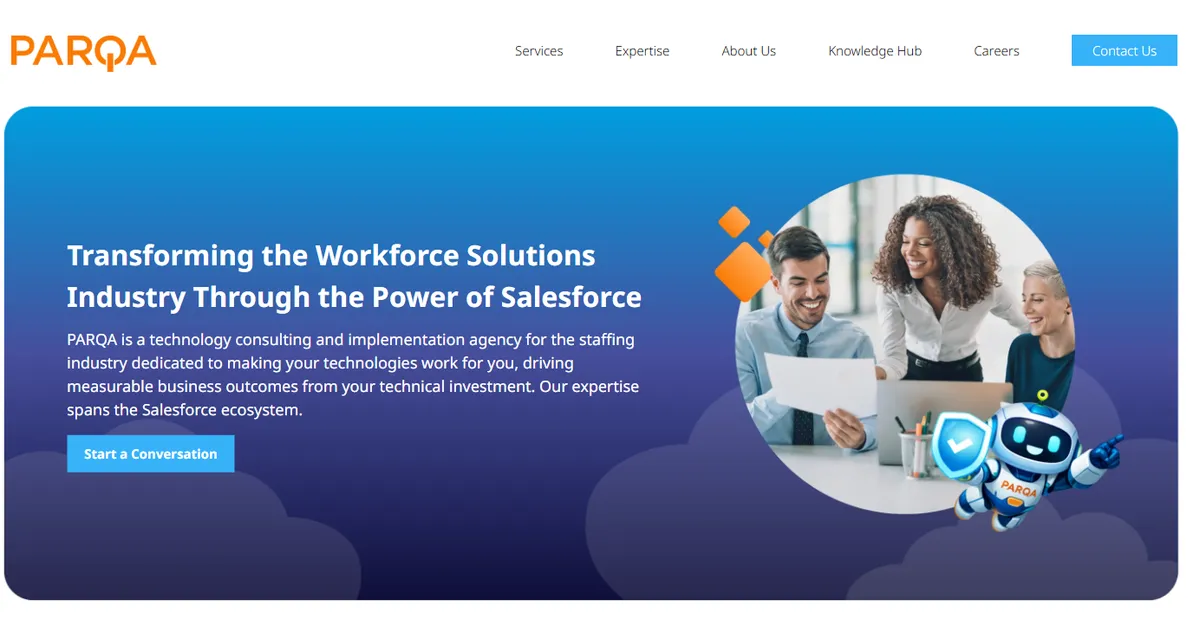
<text size="sm" color="secondary">Best for: Staffing organizations with complex Salesforce-based workflows</text>Large or growing recruitment businesses may have more complicated requirements than candidate sourcing alone. They may need to coordinate client relationships, job orders, candidate records, sales activity, reporting, and delivery operations across a connected technology stack.
PARQA appears in the 2026 recruiting automation comparison as an option for staffing firms with Salesforce-based ATS and workflow requirements.
For these businesses, the core challenge may be system design and implementation rather than simply adding an AI writing assistant.
Where this approach may fit?
- Salesforce-based recruiting workflows
- CRM and recruiting-system integration
- Staffing process configuration
- Data structure and reporting improvements
- Complex business process implementation
What to ask before hiring?
Ask for an architecture proposal showing how your recruiting data will move across Salesforce, the ATS, sourcing systems, communication tools, and reporting.
You should also establish whether AI agents and autonomous workflows are included in the proposed scope or would require another specialist.
Consider PARQA if: your recruiting operation relies on Salesforce and your main challenge involves complex systems, integrations, and process implementation.
4. Kinematic Labs: Custom AI engineering
<text size="sm" color="secondary">Best for: Organizations evaluating custom AI agents and automation beyond standard recruiting software</text>A recruitment company may already have an ATS, sourcing platforms, email tools, and reporting software but still struggle with a workflow that spans all of them.
In that situation, a custom AI engineering partner may be worth evaluating.
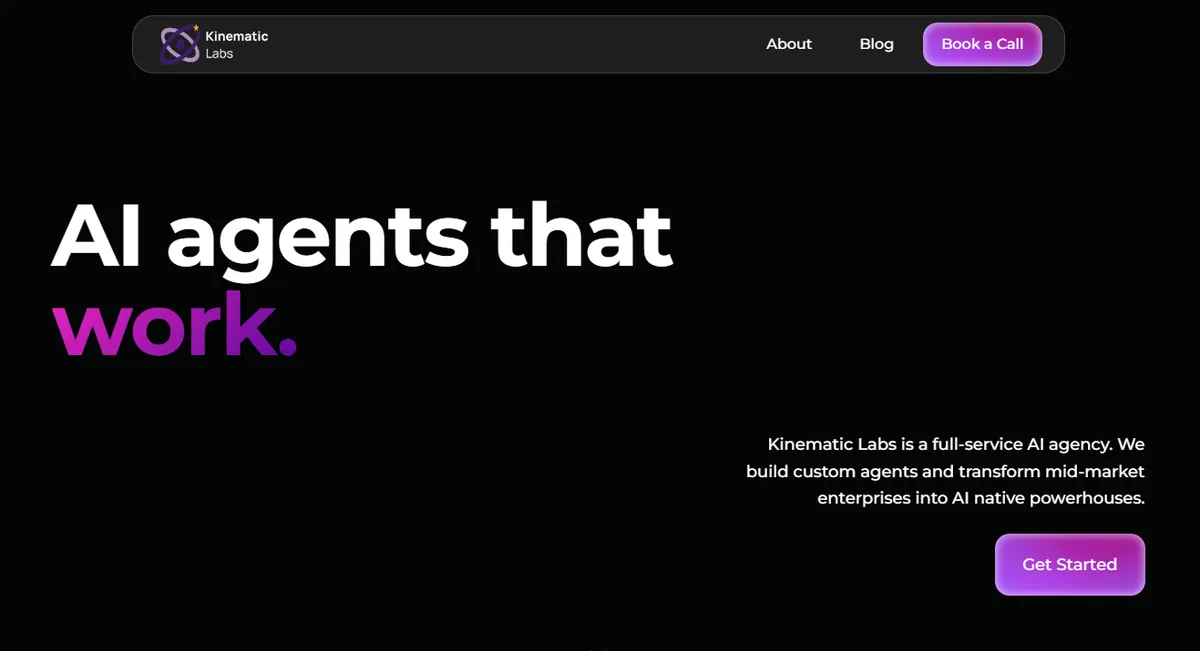
Kinematic Labs is included in the 2026 recruiting automation comparison as a generalist custom-agent option with a recruiting-firm case study referenced by the publisher. That is a useful starting point for due diligence, but it does not establish that the company is exclusively focused on recruiting.
Where custom engineering may help
- Connecting multiple systems through APIs
- Building workflow-specific AI agents
- Processing unstructured job descriptions and candidate information
- Creating internal recruiting assistants
- Automating multi-step operations that standard tools cannot handle cleanly
What to ask before hiring?
Request a demonstration of a production workflow that resembles your use case. Ask how the system handles incomplete candidate data, API failures, changing job requirements, permission boundaries, and human review.
A polished demo is not enough. You need to understand how the system will behave after deployment.
Consider Kinematic Labs if: your workflow requires custom AI engineering and your evaluation confirms that the team can support your recruiting-specific requirements.
5. Velocis: Custom AI agents and workflow automation
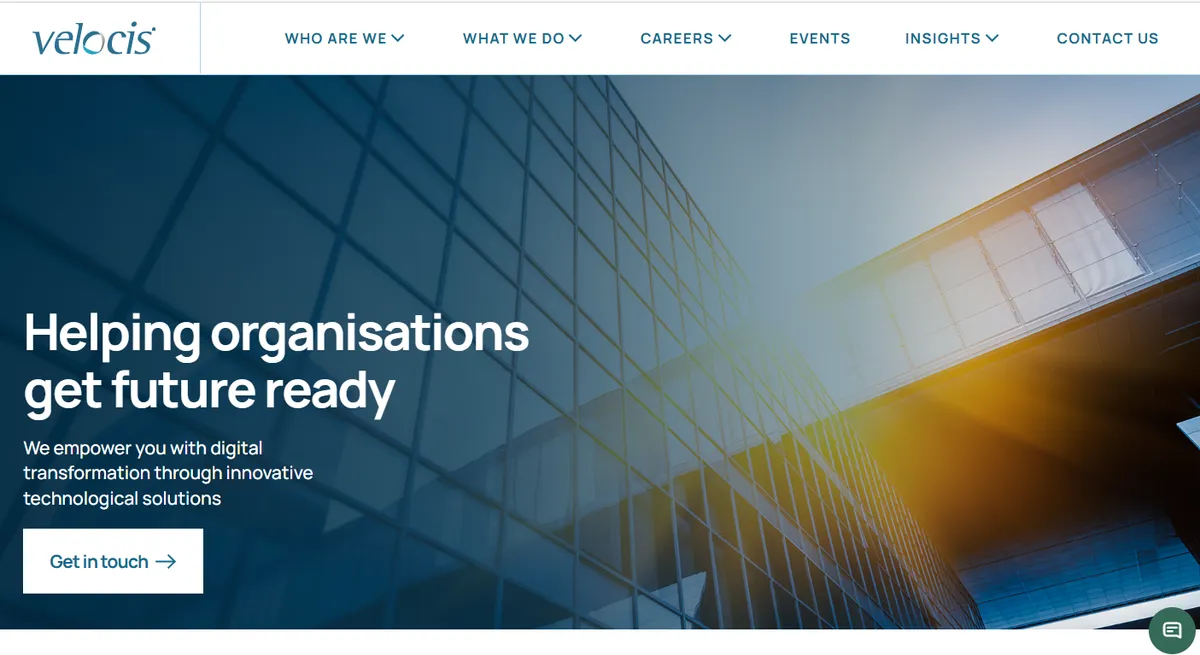
<text size="sm" color="secondary">Best for: Recruiting businesses evaluating custom automation across multiple operational workflows</text>Velocis published a 2026 comparison specifically addressing AI automation agencies for staffing and recruiting firms. Its shortlist distinguishes staffing technology specialists from custom-agent builders, highlighting the importance of choosing a partner based on the underlying system and workflow rather than the agency's AI positioning alone.
For recruitment businesses, custom automation can be useful when administrative work extends beyond sourcing and screening.
Examples include client reporting, candidate communication, job-order intake, interview coordination, CRM hygiene, and internal knowledge retrieval.
Where this approach may fit?
- Custom workflow automation
- AI-assisted business operations
- Connecting existing tools
- Automating repetitive administrative tasks
- Building agents for defined business processes
What to ask before hiring?
Ask for evidence that the proposed team can work with your ATS and handle candidate personal information appropriately.
Establish which parts of the solution are already available, which require custom development, and who will maintain the system after launch.
Consider Velocis if: custom AI automation is the priority and the provider can demonstrate relevant recruiting experience, technical fit, and clear ownership terms.
6. Anfloy: Custom AI agents and connected recruiting workflows
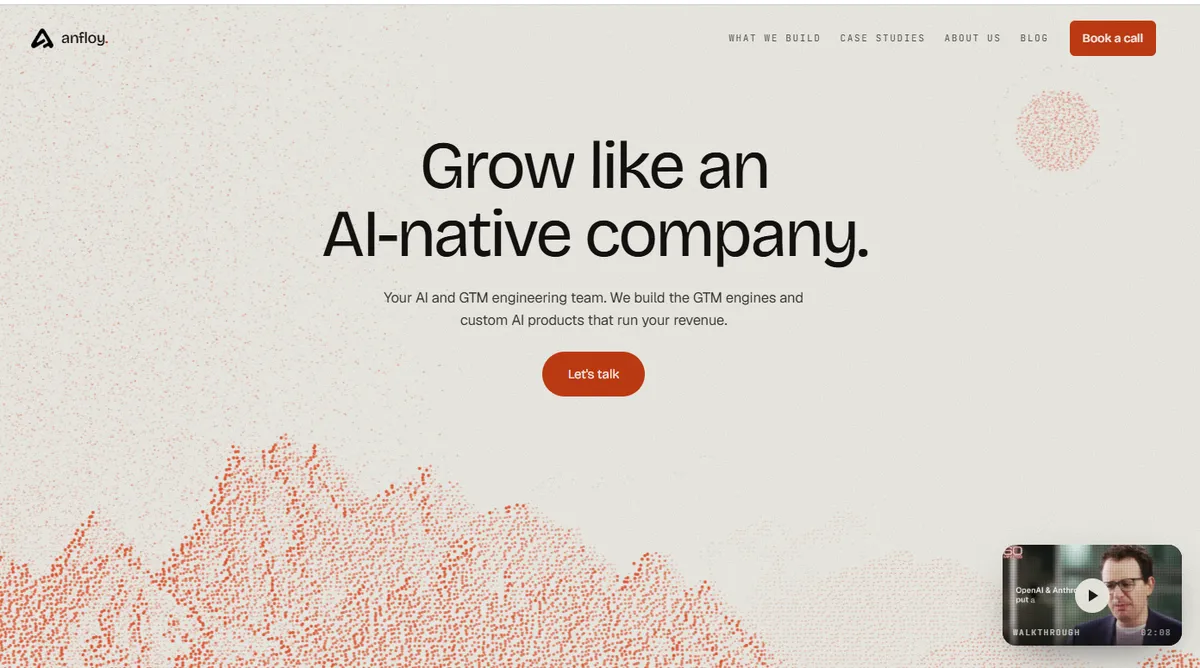
<text size="sm" color="secondary">Best for: Recruitment firms that need custom automation connecting multiple systems</text>Anfloy approaches automation through custom AI agents, workflows, and connected systems. Its services include workflow automation and autonomous agents, which can be relevant when a recruiting company needs more than an isolated sourcing or screening tool. (Anfloy services, AI automation, AI agents).
The important question is whether your recruiting operation has a specific process that cannot be handled efficiently by your existing software.
For example, a staffing firm may receive a new job order in its CRM, source candidates through several providers, qualify them against client requirements, generate outreach, track responses, update the ATS, and prepare a client-facing shortlist.
If each step happens in a separate tool, recruiters become the integration layer.
A custom system can connect those steps while preserving human review where it matters.
Potential recruiting workflows
- Job-order intake and structured requirement extraction
- Candidate enrichment and qualification
- AI-assisted candidate research
- Drafting personalized candidate outreach
- Follow-up scheduling and response classification
- ATS and CRM updates
- Interview coordination
- Client reporting and shortlist preparation
These are possible applications of Anfloy's general automation and agent capabilities, not a claim that each is a prebuilt recruitment product. Confirm the required integrations, scope, and feasibility before committing.
What makes this approach different?
The emphasis is on engineering a workflow around the company's actual process rather than assuming that another recruiting platform will solve every operational gap.
For a recruitment business, that could mean connecting the ATS, sourcing tools, CRM, email, scheduling, and reporting into one controlled process.
The right implementation should also define permissions, human approvals, failure handling, monitoring, and ownership from the beginning.
Consider Anfloy if: your recruiting operation needs custom workflows or agents that connect existing systems, and you want to evaluate a build-oriented engineering partner rather than only buying another standalone recruiting tool.
AI automation agency vs AI recruiting software: Which do you need?
This distinction can save a recruitment company from buying the wrong solution.
An AI recruiting platform is a product your team uses. An automation agency designs, configures, or builds the system that connects your tools and processes.
Some providers combine both approaches, but the buying decision remains different.
| Requirement | Recruiting software | AI automation agency |
|---|---|---|
| Standard candidate sourcing | Often a good fit | May integrate existing sourcing tools |
| Resume screening | Often available as a product feature | Can build a custom workflow where needed |
| ATS configuration | Depends on the platform | Can configure or integrate systems, depending on expertise |
| Connecting several systems | Depends on native integrations | Can build custom integrations |
| Unique recruiting process | Limited by product capabilities | Can design custom workflows |
| Proprietary business logic | May require workarounds | Can be implemented in a custom system |
| Ongoing product maintenance | Usually handled by the vendor | Depends on the delivery and support agreement |
| Ownership of custom code | Usually not applicable | Must be agreed contractually |
If your recruiting process is standard, buying software is often simpler and cheaper.
If your workflow is unique, involves several disconnected systems, or requires custom decision logic, an automation agency may provide more flexibility.
Do not commission custom AI development just because AI is available. First establish whether your ATS or existing recruiting software can solve the problem with configuration or a native integration.
What should a recruiting agency automate first?
The best first project is not necessarily the most impressive AI agent. It is the workflow that consumes significant time, follows repeatable rules, and has a measurable business outcome.
1. Job-order intake
Recruiters often receive job requirements through email, calls, documents, and client systems.
An automation workflow can extract the job title, required skills, location, seniority, compensation range, experience criteria, and mandatory qualifications into a structured format.
A recruiter should review ambiguous or contradictory requirements before the system starts sourcing.
2. Candidate enrichment
Candidate records may lack current contact information, skills, work history, or structured experience data.
An enrichment workflow can retrieve permitted information from approved sources, update the appropriate fields, and flag records that need manual verification.
The system should distinguish verified information from inferred information rather than presenting every field as fact.
3. Candidate matching
A matching system can compare a candidate's documented skills and experience with the job requirements.
A useful result should explain the match:
- Required skills supported by evidence
- Relevant experience
- Missing or uncertain qualifications
- Potential conflicts with mandatory requirements
- Information requiring recruiter verification
Candidate matching should assist recruiters, not make unreviewable hiring decisions. Sensitive attributes and inappropriate proxies should not influence ranking.
4. Outreach and follow-up
An AI workflow can draft candidate-specific messages using approved job details and relevant professional information.
It can also classify replies and prepare suggested next steps.
Sending messages automatically should depend on clear consent and communication rules, applicable law, platform policies, and appropriate human controls.
5. ATS and CRM hygiene
Repeated manual updates are an ideal automation target.
A workflow can synchronize approved changes, flag duplicate records, identify missing fields, and create follow-up tasks.
This often produces value without requiring a fully autonomous recruiting agent.
6. Interview coordination
Scheduling involves finding availability, communicating with candidates, coordinating interviewers, and updating calendars and records.
Automation can reduce administrative work, but unusual conflicts and candidate requests should be escalated rather than handled through brittle rules.
7. Client reporting
Recruitment agencies need to explain progress to clients.
A reporting workflow can compile candidate submissions, interview stages, feedback delays, time-to-shortlist, and open requirements from the underlying systems.
This helps recruiters spend more time interpreting results and less time assembling reports manually.
A practical example: Automating a recruitment workflow end to end
Consider a staffing agency managing 15 open roles across five clients.
Each role has different requirements, and recruiters use an ATS, a CRM, sourcing tools, email, and calendars.
The current process looks like this:
New job order → manual requirement review → candidate search → contact enrichment → recruiter review → outreach → follow-up → ATS update → client report
The agency could build a connected workflow:
<box border radius="xl" padding={4} gap={3}> <box background="surface-secondary" radius="lg" padding={3} align="center" gap={1}> **1. Job-order intake**

<text color="secondary" size="sm" textAlign="center">Extract requirements and identify missing information</text>

</box> <box align="center"> <icon name="arrow-down" size="lg" color="secondary" /> </box> <box background="surface" border radius="lg" padding={3} align="center" gap={1}> **2. Candidate sourcing and enrichment**

<text color="secondary" size="sm" textAlign="center">Find candidates and verify available professional information</text>

</box> <box align="center"> <icon name="arrow-down" size="lg" color="secondary" /> </box> <box background="surface" border radius="lg" padding={3} align="center" gap={1}> **3. Matching and recruiter review**

<text color="secondary" size="sm" textAlign="center">Show evidence, gaps, and uncertain information for human approval</text>

</box> <box align="center"> <icon name="arrow-down" size="lg" color="secondary" /> </box> <box background="surface" border radius="lg" padding={3} align="center" gap={1}> **4. Outreach and coordination**

<text color="secondary" size="sm" textAlign="center">Prepare approved messages, track replies, and coordinate interviews</text>

</box> <box align="center"> <icon name="arrow-down" size="lg" color="secondary" /> </box> <box background="surface-secondary" radius="lg" padding={3} align="center" gap={1}> **5. ATS updates and client reporting**

<text color="secondary" size="sm" textAlign="center">Record outcomes and report progress from a consistent data source</text>

</box> </box>
The benefit is not simply that the agency uses AI at five stages.
The benefit is that information moves between stages without requiring a recruiter to manually coordinate every transition.
The system should still preserve human control over candidate suitability, sensitive decisions, client commitments, and exceptional situations.
Before building the entire workflow, start with one role type or one team. Measure the time spent on administration, data accuracy, recruiter adoption, candidate response, and progression through the hiring funnel.
Expand only after the pilot demonstrates value.
How to choose the right AI automation agency for recruiting?
Use the following criteria when evaluating proposals.
1. Recruiting-specific experience
Ask whether the provider has implemented workflows for staffing agencies, recruitment firms, or in-house talent acquisition teams.
A general AI portfolio is not enough. Recruiting has specific requirements around candidate data, job criteria, ATS records, and communication.
2. ATS and CRM integration
Ask the agency to map the complete data flow between your ATS, CRM, sourcing tools, communication systems, and reporting layer.
Confirm how it will handle duplicates, permissions, API limits, failed updates, and inconsistent records.
3. Human oversight
Candidate matching and screening can influence employment opportunities.
Require clear rules for recruiter review, explainable recommendations, correction of inaccurate data, and escalation when the system is uncertain.
Do not allow a black-box score to become the sole basis for rejecting a candidate.
4. Data protection and compliance
Candidate information may include personal data, employment history, contact information, and other sensitive details.
Ask where data is processed and stored, which third parties receive it, how long it is retained, how access is controlled, and how deletion requests are handled.
Confirm the relevant legal obligations for the countries in which your agency operates. A provider's general claim of being "compliant" is not a substitute for reviewing the actual data flows and contract.
5. Production reliability
Ask what happens when an API is unavailable, an email fails, an ATS update is rejected, or an AI output is incomplete.
The system should have retries, error logging, monitoring, and a manual fallback process.
6. Ownership and maintenance
Establish what you own at the end of the engagement.
This may include custom code, workflow definitions, configuration, documentation, and deployment assets. Also confirm who pays for third-party subscriptions and who maintains the system after launch.
7. Measurable business outcomes
Do not accept "more automation" as the only success metric.
Agree on baseline measurements and target outcomes, such as:
- Recruiter administrative hours per role
- Time from job order to first qualified shortlist
- Candidate data accuracy
- Time to respond to candidates
- Interview scheduling time
- ATS completeness
- Recruiter adoption
- Cost per qualified shortlist
- Placement rate, where the project can reasonably influence it
These measures make it possible to distinguish a working AI demo from an operational improvement.
How much does recruiting automation cost?
There is no reliable universal price for an AI automation agency because a workflow built around an existing ATS is very different from a custom system connecting several data sources, agents, and business processes.
Rather than relying on an unsupported industry-wide price range, ask shortlisted providers to quote the same defined scope.
Your budget should account for:
| Cost component | What affects the cost |
|---|---|
| Discovery and process mapping | Number of workflows, teams, and systems |
| ATS/CRM integration | API access, custom fields, data quality, and system complexity |
| AI development | Reasoning, document processing, matching logic, and evaluation |
| Data providers | Candidate sourcing, enrichment, and usage-based fees |
| Infrastructure | Hosting, databases, queues, monitoring, and security |
| Testing | Accuracy evaluation, edge cases, and user acceptance |
| Maintenance | Monitoring, API changes, model changes, and workflow updates |
A simple workflow that moves approved data between two systems may need little custom engineering. A multi-client sourcing and engagement system with several integrations, permissions, and AI decision points requires more design and testing.
Ask each agency to separate the initial build cost from ongoing operating costs. Include software subscriptions, API usage, model inference, infrastructure, and support in your total-cost comparison.
The best proposal is not necessarily the cheapest. It is the one that solves a clearly defined problem with a maintainable system and measurable results.
Final recommendation: Which partner should you choose?
The right provider depends on what is broken in your recruiting operation.
- Choose Effi Flo if you want to evaluate a recruitment-specific automation provider.
- Choose Kyloe Partners if your primary need is Bullhorn-centered staffing technology.
- Choose PARQA if your operation relies on Salesforce and complex staffing workflows.
- Evaluate Kinematic Labs or Velocis if you need custom AI engineering and can verify the provider's recruiting experience.
- Evaluate Anfloy if you need custom agents or connected workflows across your existing systems, rather than another standalone recruiting product.
These are starting points for a shortlist, not a substitute for a structured procurement process.
My recommendation is to document one workflow that currently consumes too much recruiter time. Map every system involved, identify the manual handoffs, and define the outcome you want to improve.
Give the same brief to two or three providers and compare their proposed architecture, cost, security controls, implementation plan, and ownership terms.
That will tell you more than a generic AI demo.
For recruiting agencies, the strongest automation investment is not the one with the most AI features.
It is the one that removes unnecessary coordination while helping recruiters make better decisions and maintain a better candidate experience.
Frequently Asked Questions
What does an AI automation agency do for a recruitment company?
An AI automation agency designs or builds workflows that reduce repetitive work across sourcing, candidate enrichment, outreach, ATS updates, interview coordination, and reporting. The scope may involve configuring existing tools, integrating systems, or developing custom AI agents.
What is the difference between an AI recruiting platform and an AI automation agency?
A recruiting platform is a software product used to perform specific recruiting tasks. An automation agency helps configure, connect, or build systems around your processes. Some agencies use existing products, while others develop custom workflows and integrations.
Can AI automate the entire recruitment process?
AI can assist with many operational stages, but full automation is not appropriate for every decision. Candidate evaluation, sensitive communications, exceptions, and consequential hiring decisions need appropriate human oversight, transparency, and safeguards.
Which ATS should a recruiting automation agency support?
Choose based on the ATS your organization already uses and intends to keep. Confirm the provider can integrate with your specific configuration, fields, permissions, and workflows rather than relying only on a general claim of ATS compatibility.
How do I measure the ROI of recruiting automation?
Establish a baseline for recruiter administrative time, time to shortlist, candidate response time, data accuracy, scheduling effort, and cost per qualified shortlist. Compare those metrics after launch, and track placement outcomes where the system can reasonably influence them.
Should a small recruitment agency build custom AI agents?
Usually, the best starting point is to review the ATS and recruiting tools already available. Custom agents become more attractive when multiple systems are disconnected, manual work is substantial, or the business needs workflow logic that existing products cannot provide efficiently.
Let's build
what your
company needs.
Drop your email. We'll send The Custom Agent Blueprint on what we'd build first for a company like yours, before you ever take a meeting.