
Why a Forward-Deployed Engineering Team Beats the Traditional Setup
Discover how forward-deployed engineering teams outperform consulting and outsourcing with faster execution, tighter alignment, and better AI results.
On this page
- What is a forward-deployed engineering team?
- How traditional delivery models work?
- Why traditional setups break down?
- Forward-deployed engineering vs traditional consulting
- Forward-deployed engineering vs agencies
- Forward-deployed engineering vs staff augmentation
- What are the benefits of forward-deployed engineering teams?
- Why forward-deployed teams excel in AI projects?
- What are the top enterprise use cases?
- Common mistakes companies make
- How Anfloy uses a forward-deployed model?
- The future of forward-deployed engineering
- Conclusion
Building software has never been easier.
Building software that actually changes how a business operates is still incredibly difficult.
For decades, companies have relied on traditional delivery models to implement technology. A project begins with requirements gathering, moves into development, passes through multiple stakeholders, and eventually reaches production.
Sometimes it works.
Often, it doesn't.
The problem isn't a lack of engineering talent.
It's a lack of proximity.
The people building the technology are frequently disconnected from the people using it.
This challenge becomes even more significant in the age of artificial intelligence.
Modern AI systems aren't simply products.
They're deeply integrated into:
- business workflows
- operational processes
- decision-making
- company knowledge
- revenue operations
- customer experiences
Successfully deploying AI requires engineers to understand how a business actually works.
That's why forward-deployed engineering teams are becoming increasingly popular.
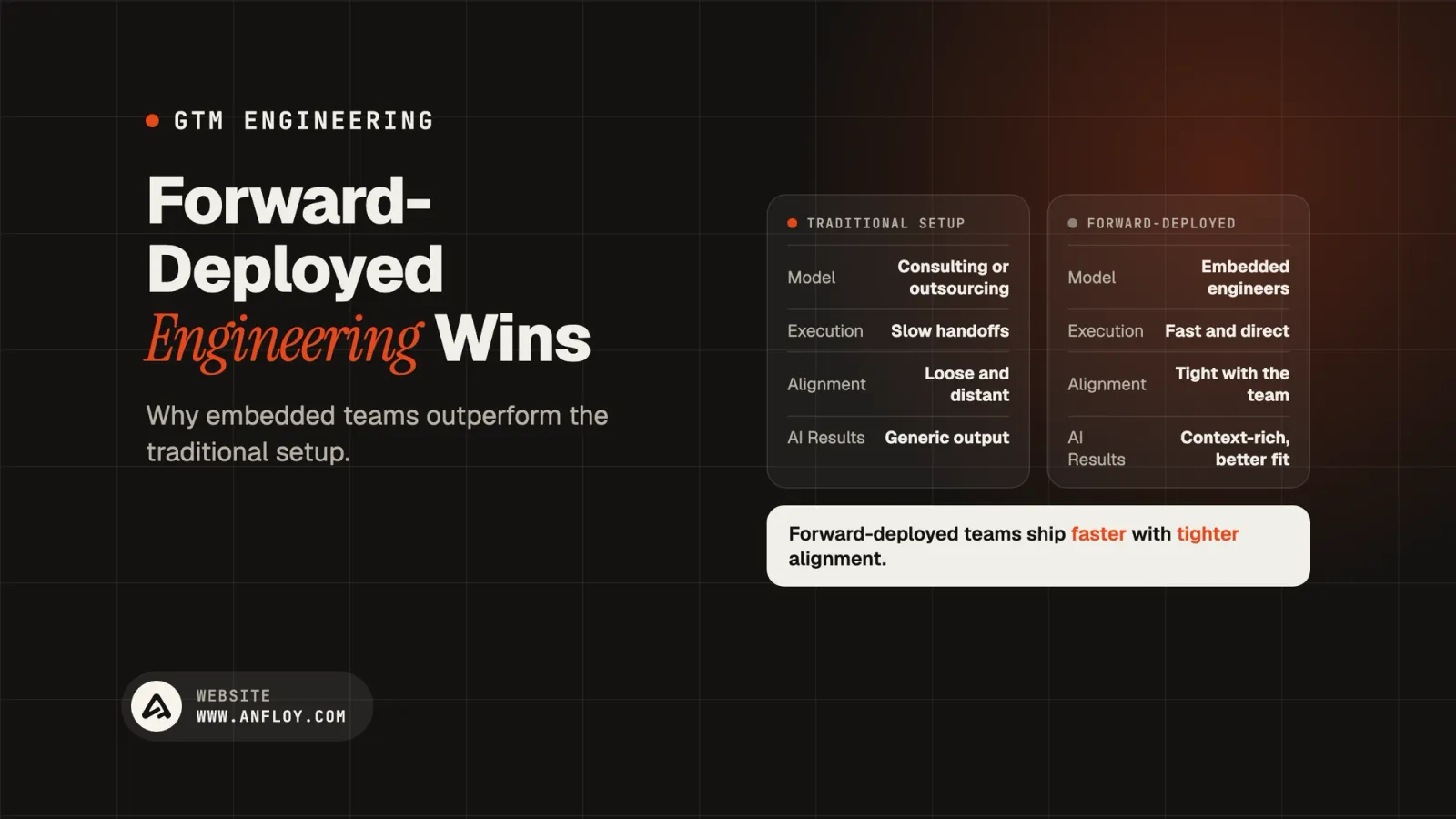
Instead of operating as an external vendor, a forward-deployed team works closely with the client, embedding themselves within the organization to understand objectives, workflows, and operational realities.
The result isn't just faster software delivery.
It's better business outcomes.
Companies building AI infrastructure, Agentic Systems, GTM platforms, and Company AI Brains are increasingly adopting this model because it reduces communication gaps, improves iteration speed, and produces solutions better aligned with business goals.
What is a forward-deployed engineering team?
A forward-deployed engineering team is a group of engineers that works directly alongside a client to design, build, and implement technology solutions.
Unlike traditional development teams that operate at a distance, forward-deployed teams become deeply embedded in the business.
They don't just receive requirements.
They participate in understanding:
- business objectives
- operational challenges
- customer journeys
- internal workflows
- technology constraints
- success metrics
Think of them as an extension of your internal team rather than an external vendor.
A forward-deployed engineer may attend:
- revenue meetings
- product discussions
- operational reviews
- customer calls
- implementation workshops
This proximity enables them to make better decisions because they understand the context behind every technical requirement.
For example, consider an AI-powered GTM implementation.
A traditional team may receive a specification document that says:
"Build an AI lead qualification system."
A forward-deployed team asks:
- How does your sales team qualify leads today?
- Which buying signals matter most?
- What does your ideal customer profile look like?
- How should opportunities be prioritized?
- Which CRM workflows already exist?
- What metrics define success?
The difference is significant.
Traditional teams build features.
Forward-deployed teams build solutions.
How traditional delivery models work?
Traditional delivery models have existed for decades and continue to work well for many organizations.
The process typically looks like this:

Requirements Gathering
        ↓
Project Planning
        ↓
Development
        ↓
Testing
        ↓
Delivery
        ↓
Support
This model offers several advantages:
- predictable timelines
- clear contracts
- defined scopes
- established processes
For straightforward projects, it's often sufficient.
However, AI projects are rarely straightforward.
AI systems evolve as businesses learn:
- which workflows matter
- where data exists
- how employees interact with AI
- what customers actually need
- which automations provide value
By the time a traditional project reaches delivery, the original requirements may already be outdated.
Why traditional setups break down?
Traditional delivery models often struggle because they rely heavily on assumptions.
Engineers assume:
- requirements are complete
- workflows are documented
- stakeholders agree
- data is available
- processes are stable
In reality, businesses are constantly changing.
This creates several problems.
Long feedback loops
Questions that could be answered in five minutes often take days.
The cycle looks like:
- engineer asks a question
- project manager responds
- stakeholder reviews
- feedback is collected
- development resumes
Over time, these delays compound.
Limited business context
Engineers who rarely interact with the business lack important context.
They may not understand:
- customer expectations
- operational constraints
- revenue priorities
- internal dependencies
Without context, teams optimize for requirements rather than outcomes.
Multiple handoffs
Traditional projects involve numerous handoffs between:
- Sales
- project management
- engineering
- QA
- support
Every handoff introduces opportunities for miscommunication.
Slow iteration
AI projects benefit from rapid experimentation.
Traditional delivery models often struggle to support:
- continuous feedback
- workflow changes
- iterative improvements
- evolving requirements
As a result, businesses frequently receive solutions that technically satisfy requirements but fail to create meaningful business impact.
Forward-deployed engineering vs traditional consulting
Traditional consultants typically provide recommendations.
Forward-deployed engineers provide implementation.
| Factor | Traditional Consulting | Forward-Deployed Engineering |
|---|---|---|
| Primary Focus | Strategy | Outcomes |
| Business Proximity | Limited | High |
| Implementation | Often outsourced | Core responsibility |
| Feedback Speed | Moderate | Fast |
| Iteration | Periodic | Continuous |
| Technical Ownership | Shared | Embedded |
Consulting answers:
"What should we do?"
Forward-deployed engineering answers:
"Let's build it together."
This distinction becomes especially important when implementing AI systems that require ongoing iteration and business alignment.
Forward-deployed engineering vs agencies
Agencies are designed for delivery.
Forward-deployed teams are designed for collaboration.
| Factor | Agency | Forward-Deployed Team |
|---|---|---|
| Relationship | Vendor | Embedded partner |
| Context | Project-specific | Business-wide |
| Communication | Scheduled | Continuous |
| Flexibility | Limited by scope | High |
| AI Adoption | Tool-focused | Outcome-focused |
Neither model is inherently better.
However, businesses implementing AI, GTM systems, and operational infrastructure often benefit from deeper collaboration.
Forward-deployed teams don't simply ask:
"What do you want us to build?"
They ask:
"What problem are we trying to solve?"
That difference frequently determines whether a project succeeds or becomes another underutilized technology investment.
Forward-deployed engineering vs staff augmentation
Forward-deployed engineering is also frequently confused with staff augmentation.
Although both models involve external talent, they operate very differently.
Staff augmentation focuses on increasing capacity.
Forward-deployed engineering focuses on delivering outcomes.
| Factor | Staff Augmentation | Forward-Deployed Engineering |
|---|---|---|
| Primary Goal | Additional resources | Business outcomes |
| Team Integration | Moderate | Deep |
| Strategic Input | Limited | High |
| Business Context | Minimal | Extensive |
| Ownership | Client-managed | Shared responsibility |
| Success Metric | Hours delivered | Problems solved |
A staff augmentation partner might provide two engineers for six months.
A forward-deployed team provides:
- technical expertise
- business understanding
- workflow design
- AI implementation
- continuous optimization
One supplies capacity.
The other supplies capability.
What are the benefits of forward-deployed engineering teams?
Organizations adopting forward-deployed models consistently report several advantages.
Faster execution
Proximity improves speed.
Instead of waiting for requirements to move through multiple layers of communication, forward-deployed teams receive immediate feedback.
Questions are answered faster.
Decisions happen sooner.
Projects move more quickly.
This becomes especially important when implementing AI systems that require frequent iteration.
Better business alignment
Forward-deployed teams understand:
- revenue objectives
- customer needs
- operational constraints
- organizational priorities
As a result, they build systems aligned with business outcomes rather than technical specifications.
Stronger feedback loops
AI projects benefit significantly from rapid feedback.
Forward-deployed teams continuously validate:
- workflows
- automations
- user experiences
- AI outputs
- business impact
This allows organizations to improve systems while they're being built rather than after deployment.
Higher implementation success
Many technology projects fail because users never adopt them.
Forward-deployed teams reduce this risk by involving stakeholders throughout the implementation process.
Employees feel ownership.
Leadership gains visibility.
Adoption improves.
Improved AI adoption
AI implementations frequently fail because businesses underestimate organizational change.
Forward-deployed teams help organizations:
- identify use cases
- prioritize workflows
- train employees
- establish governance
- monitor outcomes
AI becomes part of the business rather than another disconnected tool.
Why forward-deployed teams excel in AI projects?
AI projects are fundamentally different from traditional software projects.
Unlike conventional applications, AI systems depend on:
- company knowledge
- operational context
- workflow understanding
- human behavior
- continuous evaluation
Requirements evolve constantly.
Consider a Company AI Brain implementation.
The initial assumption might be:
"We need an AI assistant."
After several workshops, the organization discovers it actually needs:
- knowledge retrieval
- customer intelligence
- workflow automation
- AI orchestration
- approval workflows
Traditional delivery models struggle with this level of ambiguity
Forward-deployed teams thrive because they're embedded within the discovery process.
This allows them to adapt as the business learns.
In many ways, AI implementation is less about building software and more about understanding how organizations operate.
Forward-deployed engineering bridges that gap.
What are the top enterprise use cases?
Forward-deployed teams are increasingly being used across multiple business functions.
GTM systems
Forward-deployed engineers help organizations build:
- Company Intelligence systems
- Revenue Intelligence platforms
- AI SDR workflows
- CRM automation
- outbound engines
Internal operations
Examples include:
- employee onboarding
- knowledge management
- approval workflows
- reporting automation
Customer support
Forward-deployed teams build:
- AI support agents
- ticket routing systems
- knowledge retrieval workflows
- customer intelligence platforms
AI infrastructure
Organizations frequently use forward-deployed teams to implement:
- Company AI Brains
- Agentic Systems
- AI orchestration platforms
- Retrieval-Augmented Generation (RAG)
- multi-agent systems
These initiatives require deep collaboration between technical teams and business stakeholders.
Build AI Systems That Deliver Business Outcomes
Our Free AI Infrastructure Audit helps identify opportunities across GTM, operations, customer support, and enterprise AI.
Get Your Free Audit
Common mistakes companies make
Despite the benefits, organizations often struggle to maximize the value of forward-deployed teams.
Treating them like vendors
Forward-deployed teams should operate as partners rather than external suppliers.
Organizations that maintain traditional vendor relationships frequently limit collaboration and reduce effectiveness.
Limiting access
Forward-deployed engineers need visibility into:
- workflows
- business objectives
- operational challenges
- customer interactions
Restricting access limits context and reduces implementation quality.
Focusing Only on Technology
Successful forward-deployed engagements prioritize outcomes.
The conversation should begin with.
"What business problem are we solving?"
Not:
"Which technology should we use?"
Ignoring change management
Technology alone rarely changes organizations.
Businesses should invest in:
- employee training
- adoption strategies
- governance
- continuous feedback
Forward-deployed engineering works best when paired with organizational support.
How Anfloy uses a forward-deployed model?
At Anfloy, we believe AI projects succeed when engineers work closely with the businesses they're building for.
Our forward-deployed model is designed around business outcomes rather than project milestones.
Every engagement follows several principles.
Embedded collaboration
Our teams work closely with clients to understand:
- business objectives
- operational workflows
- customer journeys
- technology constraints
This ensures every implementation reflects how the business actually operates.
Continuous discovery
AI projects evolve over time.
Rather than treating discovery as a one-time activity, we continuously refine our understanding throughout the engagement.
Company AI brain firs
Most AI systems depend on trusted business knowledge.
We prioritize building centralized Company AI Brains that become the foundation for:
- AI agents
- GTM systems
- knowledge retrieval
- operational automation
Agentic systems
We design specialized AI agents for:
- Company Intelligence
- Revenue Intelligence
- Customer Success
- Internal Operations
These agents are coordinated through AI orchestration while remaining independently scalable.
Infrastructure you own
Every implementation is deployed on infrastructure owned by the client.
You own:
- the code
- the workflows
- the AI systems
- the knowledge architecture
- the operational logic
No lock-in.
No recurring platform dependency.
The future of forward-deployed engineering
Forward-deployed engineering is becoming increasingly important as businesses adopt AI.
Over the next decade, several trends will emerge.
AI-first organizations
Businesses will increasingly rely on forward-deployed teams to implement:
- AI coworkers
- autonomous workflows
- multi-agent systems
- Company AI Brains
Smaller, more effective teams
AI will allow smaller engineering teams to deliver significantly greater impact.
Forward-deployed engineers will become multipliers rather than individual contributors.
Outcome-based delivery
Organizations will increasingly evaluate technology partners based on:
- business impact
- adoption rates
- operational improvements
- revenue outcomes
This aligns naturally with the forward-deployed model.
Enterprise AI infrastructure
Forward-deployed engineering will become a critical capability for businesses building:
- GTM systems
- Revenue Intelligence
- Agentic Systems
- AI orchestration platforms
The organizations that embrace this model will likely adopt AI faster and more effectively than those relying solely on traditional delivery approaches.
Conclusion
Technology projects rarely fail because of engineering capability.
They fail because the people building the systems are disconnected from the people using them.
Forward-deployed engineering solves this problem by embedding technical expertise directly within the business.
The result is faster execution, stronger alignment, and better outcomes.
As organizations increasingly adopt AI, Company AI Brains, Agentic Systems, and GTM infrastructure, the importance of business context will only continue to grow.
Forward-deployed teams don't simply build software.
They help businesses build capabilities.
And in the AI era, that difference matters more than ever.
Ready to Work with a Forward-Deployed AI Team?
From Company AI Brains and Agentic Systems to GTM Infrastructure and AI Orchestration, Anfloy helps businesses build AI systems designed around measurable business outcomes.
Book a Strategy Call
Frequently Asked Questions
What is a forward-deployed engineer?
A forward-deployed engineer works closely with clients to design, build, and implement technology solutions while maintaining deep business context.
How is forward-deployed engineering different from consulting?
Consulting primarily provides recommendations, while forward-deployed engineering focuses on implementation and business outcomes.
Is forward-deployed engineering only for AI companies?
No. However, AI projects benefit significantly from the model because they require continuous feedback and business alignment.
What types of projects are best suited for forward-deployed teams?
AI implementations, GTM systems, internal operations platforms, and enterprise software projects typically benefit the most.
Why are forward-deployed teams effective?
They improve communication, accelerate iteration, strengthen business alignment, and increase implementation success.

Let's build
what your
company needs.
Drop your email. We'll send The Custom Agent Blueprint on what we'd build first for a company like yours, before you ever take a meeting.