
GTM Automation: The Complete Guide to Automating Revenue Operations in 2026
Learn how GTM automation works, the best GTM automation strategies, AI use cases, tools, workflows, and how businesses build scalable revenue systems in 2026.
On this page
- What is GTM automation?
- Why GTM automation matters?
- The GTM automation stack
- What are the top GTM automation use cases?
- What are the pros and cons of GTM automation workflows?
- AI and GTM automation
- What are top GTM automation tools?
- How to build a GTM automation strategy? Step by Step
- What are the common GTM automation mistakes?
- How Anfloy builds GTM automation systems?
- What is the future of GTM automation?
- Conclusion
Go-to-market teams have never had more technology available to them.
The average B2B organization uses dozens of tools across:
- CRM
- marketing automation
- sales engagement
- customer success
- analytics
- customer support
- reporting
Despite these investments, many revenue teams continue to face the same challenges:
- disconnected systems
- manual workflows
- poor CRM hygiene
- weak attribution
- inconsistent customer experiences
- operational inefficiencies
Sales representatives spend hours updating CRM records.
Marketing teams manually build reports.
Operations teams move data between systems.
Leadership struggles to understand where revenue is coming from.
The problem isn't a lack of software.
It's a lack of automation.
Modern GTM organizations require systems capable of operating across multiple departments while maintaining visibility, consistency, and efficiency.
This is where GTM automation comes in.
GTM automation enables businesses to automate sales, marketing, and revenue operations activities using workflows, integrations, AI, and intelligent systems.
Examples include:
- lead routing
- CRM updates
- account enrichment
- personalized outreach
- reporting
- pipeline monitoring
Increasingly, organizations are combining GTM automation with:
- AI Agents
- Company AI Brains
- Revenue Intelligence
- AI Orchestration
- GTM Engineering
The result is a revenue organization that spends less time managing systems and more time creating value.
By the end, you'll understand how leading organizations are using GTM automation to create scalable and predictable revenue operations.
What is GTM automation?
GTM (Go-to-Market) automation is the process of using software, workflows, AI, and integrations to automate activities across sales, marketing, and revenue operations.
Rather than relying on manual processes, organizations create systems capable of executing repetitive tasks automatically.
Examples include:
- assigning leads
- enriching CRM records
- triggering email sequences
- updating pipeline reports
- routing customer requests
- generating forecasts
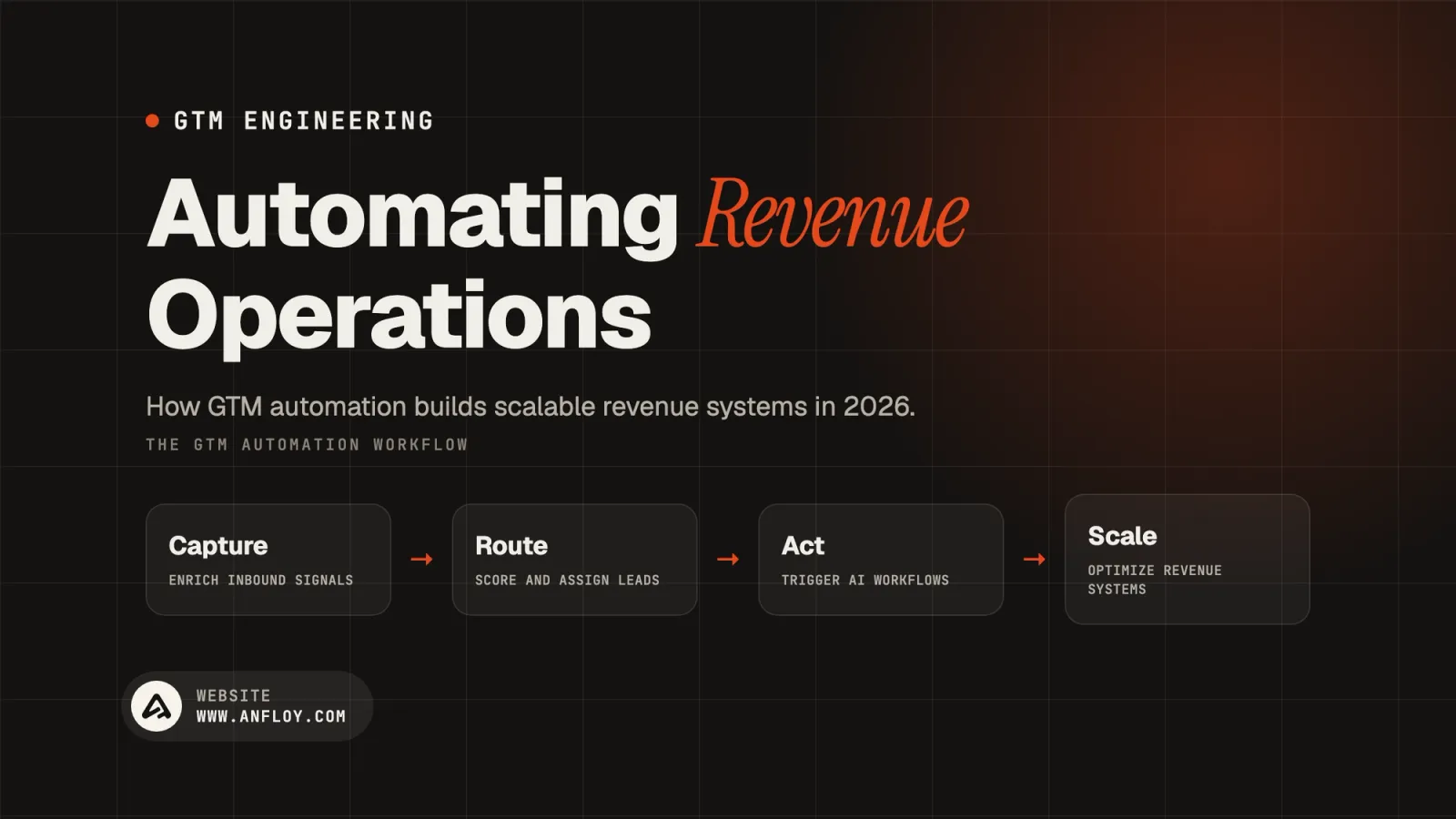
A simplified GTM automation workflow looks like this:
Lead Form Submission
        ↓
CRM Update
        ↓
Enrichment
        ↓
Lead Scoring
        ↓
Sales Assignment
        ↓
Outreach Sequence
        ↓
Pipeline Reporting
The goal isn't simply to reduce manual work.
It's to create a revenue engine capable of scaling efficiently.
Why GTM automation matters?
Revenue organizations are becoming increasingly complex.
Modern GTM teams must coordinate activities across:
- sales
- marketing
- customer success
- operations
- leadership
Without automation, organizations frequently experience:
- delayed responses
- poor customer experiences
- inaccurate reporting
- operational bottlenecks
GTM automation provides several advantages.
Faster execution
Automated workflows reduce delays and improve responsiveness.
Improved efficiency
Teams spend less time on administrative work and more time on strategic activities.
Better attribution
Automation creates clearer visibility into:
- pipeline
- conversions
- revenue
Reduced operational costs
Organizations can support growth without increasing headcount proportionally.
Scalable revenue systems
Automation enables businesses to scale operations without significantly increasing complexity.
The GTM automation stack
Most GTM automation systems consist of several layers.
Company AI Brain
       ↓
Company Intelligence
       ↓
CRM
       ↓
AI Agents
       ↓
Sales Automation
       ↓
Marketing Automation
       ↓
Revenue Intelligence
       ↓
AI Orchestration
Each layer contributes to a more intelligent revenue organization.
Company AI brain
Centralizes:
- customer history
- documentation
- sales playbooks
- operational knowledge
Company intelligence
Provides visibility into:
- buying signals
- market activity
- account changes
CRM
Maintains:
- accounts
- contacts
- opportunities
AI agents
Examples include:
- Revenue Intelligence Agents
- CRM Agents
- Company Intelligence Agents
AI orchestration
Coordinates workflows, approvals, and reporting across systems.
What are the top GTM automation use cases?
Sales automation
Examples include:
- lead qualification
- meeting scheduling
- outreach personalization
- account research
Marketing automation
Examples include:
- email campaigns
- audience segmentation
- lead nurturing
- campaign reporting
RevOps automation
Examples include:
- forecasting
- pipeline analysis
- attribution
- dashboard creation
Customer success automation
Examples include:
- onboarding
- renewal reminders
- customer health monitoring
- expansion opportunities
What are the pros and cons of GTM automation workflows?
Like any business initiative, GTM automation has both advantages and limitations.
Pros
Improved efficiency
Automation significantly reduces repetitive work across revenue teams.
Better consistency
Every lead, customer, and workflow follows the same process.
Faster decision making
Leaders gain access to real-time reporting and Revenue Intelligence.
Scalability
Businesses can support additional growth without increasing operational complexity.
Stronger customer experiences
Automation helps ensure prospects and customers receive timely communication.
Cons
Automating bad processes
Poor workflows become poor automated workflows.
Organizations should optimize processes before automating them.
Over-automation
Too much automation can reduce personalization and negatively impact customer experiences.
Data dependencies
Automation depends heavily on:
- CRM quality
- integrations
- operational discipline
Implementation complexity
Large organizations often require significant planning before implementing GTM automation successfully.
Ongoing maintenance
Automation isn't a one-time activity.
Workflows should be reviewed and optimized continuously.
The best GTM organizations understand that automation should enhance human capabilities rather than replace them.
AI and GTM automation
AI is rapidly becoming the intelligence layer behind GTM automation.
Modern organizations increasingly use:
AI SDRs
Responsible for:
- prospecting
- personalization
- follow-ups
AI agents
Responsible for:
- research
- reporting
- CRM management
- account intelligence
Company AI brains
Provide trusted context across all workflows.
AI orchestration
Coordinates:
- workflows
- approvals
- monitoring
- reporting
AI doesn't replace GTM automation.
It makes it significantly more intelligent.
What are top GTM automation tools?
Organizations typically use multiple tools across their GTM stack.
Examples include:
CRM platforms
- Salesforce
- HubSpot
- Pipedrive
Workflow automation platforms
- Zapier
- Make
- n8n
Revenue intelligence platforms
- Gong
- Clari
- People.ai
Enrichment platforms
- Clay
- Apollo
- Clearbit
AI platforms
- OpenAI
- Anthropic
- Google Gemini
The best GTM stacks are designed around workflows rather than individual products.
How to build a GTM automation strategy? Step by Step
The most successful GTM automation initiatives begin with strategy rather than software.
Many organizations make the mistake of purchasing tools before understanding:
- what should be automated
- where bottlenecks exist
- which teams are affected
- how success will be measured
A practical GTM automation framework looks like this:
Audit
  ↓
Map Workflows
  ↓
Identify Bottlenecks
  ↓
Prioritize Automation
  ↓
Implement AI
  ↓
Measure Outcomes
  ↓
Optimize
Step 1: Audit existing processes
Document:
- sales workflows
- marketing workflows
- RevOps processes
- customer success activities
The goal is to understand where time is currently being spent.
Step 2: Map your workflows
Examples include:
- lead capture
- lead assignment
- meeting scheduling
- onboarding
- reporting
Mapping workflows helps identify dependencies across teams.
Step 3: Identify bottlenecks
Common bottlenecks include:
- manual CRM updates
- delayed lead routing
- inconsistent reporting
- poor attribution
These areas typically provide the highest ROI when automated.
Step 4: Prioritize high-impact automations
Not every workflow should be automated immediately.
Start with activities that are:
- repetitive
- time-consuming
- high volume
- low risk
Examples include:
- CRM enrichment
- lead routing
- email notifications
- reporting
Step 5: Introduce AI
AI can improve:
- personalization
- forecasting
- account research
- workflow recommendations
Step 6: Measure outcomes
Track:
- time saved
- operational efficiency
- conversion rates
- pipeline generated
Step 7: Optimize continuously
Automation should evolve alongside the business.
The organizations that benefit most from GTM automation treat it as an ongoing capability rather than a one-time project.
What are the common GTM automation mistakes?
Even well-intentioned GTM initiatives can fail.
Automating broken processes
One of the most common mistakes is automating workflows that were already inefficient.
Automation amplifies existing processes.
If the process is broken, automation will simply make it fail faster.
Poor CRM hygiene
Automation depends on data quality.
Examples of common issues include:
- duplicate records
- missing fields
- outdated information
No ownership
Every GTM automation initiative should have a clear owner responsible for:
- implementation
- maintenance
- reporting
- optimization
Increasingly, this role belongs to GTM engineering teams.
Over-automation
Automation should improve customer experiences.
Organizations that automate every interaction risk creating experiences that feel impersonal.
Disconnected systems
Examples include:
- CRM operating independently from marketing
- sales tools lacking customer context
- disconnected reporting systems
The best GTM systems operate as a single ecosystem.
No measurement
Organizations should continuously evaluate:
- adoption
- workflow performance
- business impact
Without measurement, optimization becomes impossible.
How Anfloy builds GTM automation systems?
At Anfloy, we help businesses build AI-powered GTM infrastructure designed to scale.
Our methodology includes:
Discovery
We identify:
- GTM challenges
- revenue goals
- workflow bottlenecks
- operational inefficiencies
Company AI brain
We centralize:
- CRM records
- customer history
- internal knowledge
- sales playbooks
This becomes the intelligence layer across all GTM systems.
GTM engineering
We implement:
- workflow automation
- integrations
- reporting systems
- operational infrastructure
AI agents
We deploy specialized agents responsible for:
- Company Intelligence
- Revenue Intelligence
- CRM management
- customer success
Revenue intelligence
Every GTM activity is connected to:
- pipeline
- forecasting
- business outcomes
AI orchestration
AI orchestration ensures every workflow operates cohesively across the organization.
Continuous optimization
Automation improves through:
- testing
- reporting
- customer feedback
- AI insights
The objective isn't simply to automate work.
It's to create intelligent revenue systems.
What is the future of GTM automation?
GTM automation is evolving rapidly.
Over the next decade, organizations will increasingly deploy:
- AI coworkers
- AI SDRs
- Revenue Intelligence Agents
- Company Intelligence Agents
- autonomous workflows
Future GTM systems will automatically:
- identify opportunities
- enrich customer records
- personalize communications
- forecast revenue
- optimize performance
In many ways, GTM automation is becoming the operating system for modern revenue organizations.
Businesses that invest in these capabilities today will be better positioned for tomorrow.
Conclusion
Revenue teams weren't designed to spend their time moving information between systems.
They were designed to build relationships, create value, and drive growth.
GTM automation makes that possible.
By combining workflow automation, AI, Revenue Intelligence, and GTM engineering, organizations can create scalable systems capable of continuously improving over time.
At Anfloy, we believe the future of go-to-market isn't defined by how many tools a business owns.
It's defined by how intelligently those tools work together.
Because the companies that win over the next decade won't simply automate tasks.
They'll build intelligent GTM systems.
Ready to Build Intelligent GTM Systems?
From Company AI Brains and AI Agents to Revenue Intelligence and AI Orchestration, Anfloy helps businesses build GTM automation systems designed for the AI era.
Book your call
Frequently Asked Questions
Why is GTM automation important?
GTM automation improves efficiency, scalability, attribution, and customer experiences while reducing operational overhead.
Which GTM processes should be automated?
Examples include: lead routing CRM updates reporting outreach onboarding
What tools are used for GTM automation?
Common categories include: CRM platforms workflow automation tools AI platforms Revenue Intelligence tools
How does AI improve GTM automation?
AI improves personalization, forecasting, account research, and workflow optimization.
Can small businesses implement GTM automation?
Yes. Modern tools have significantly reduced the cost and complexity of GTM automation.
How much does GTM automation cost?
Costs vary depending on workflow complexity, integrations, and AI requirements.
Should GTM automation be built in-house?
Many organizations use agencies for implementation and internal teams for ongoing management.

Let's build
what your
company needs.
Drop your email. We'll send The Custom Agent Blueprint on what we'd build first for a company like yours, before you ever take a meeting.