
GTM Engineer Roadmap: A Complete Learning Path for 2026
Follow this GTM Engineer roadmap to learn CRM architecture, Revenue Operations, AI, workflow automation, APIs, and GTM Engineering step by step.
On this page
- Why GTM engineering is becoming a core career path?
- What does the GTM engineer roadmap cover?
- Phase 1: Learn go-to-market fundamentals
- Phase 2: Master revenue operations
- Phase 3: learn CRM architecture
- Phase 4: build workflow automation skills
- Phase 5: learn APIs and integrations
- Phase 6: understand customer data
- Phase 7: learn AI for GTM engineering
- Phase 8: learn revenue intelligence
- Phase 9: develop systems thinking
- Recommended GTM engineer learning timeline
- Hands-on projects every future GTM engineer should build
- Certifications that complement the roadmap
- Common mistakes when following the GTM engineer roadmap
- Career progression
- 90-day GTM engineer learning plan
- Recommended resources for learning GTM engineering
- Build a GTM engineering portfolio
- How to stay current as a GTM engineer?
- Why businesses choose Anfloy?
- Conclusion
The GTM Engineer has quickly become one of the most valuable roles inside modern B2B organizations.
As AI, automation, Revenue Operations, and CRM platforms reshape go-to-market execution, companies need professionals who can connect business strategy with technical implementation.
Unlike traditional Sales Operations or CRM Administrator roles, GTM Engineers design the systems that enable marketing, sales, customer success, and leadership to work from one connected revenue engine.
However, becoming a GTM Engineer isn't about mastering one platform.
It requires learning business strategy, customer journeys, CRM architecture, workflow automation, APIs, data infrastructure, AI implementation, and systems thinking.
This roadmap provides a structured learning path for aspiring GTM Engineers, career switchers, RevOps professionals, and operations teams looking to build modern GTM capabilities.
Why GTM engineering is becoming a core career path?
Go-to-market organizations have become increasingly technical.
Modern revenue teams depend on:
- CRM platforms
- Revenue Operations
- Workflow automation
- AI agents
- Data enrichment
- Sales engagement platforms
- API integrations
- Revenue Intelligence
- Customer lifecycle automation
These systems must work together.
Organizations therefore need professionals capable of designing operational infrastructure instead of simply managing individual tools.
This demand has created the GTM Engineer career path.
What does the GTM engineer roadmap cover?
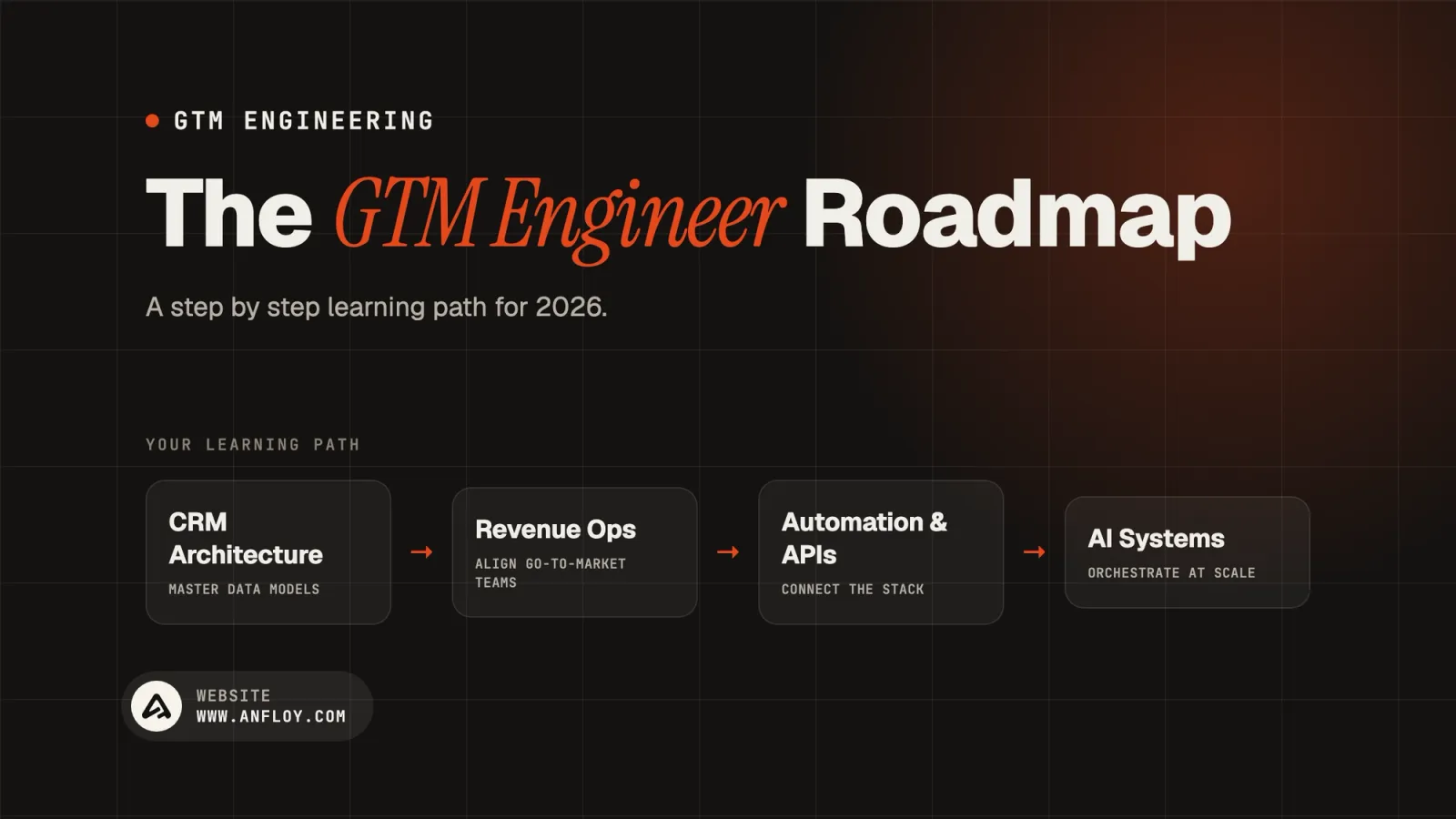
The roadmap develops expertise across four major disciplines.
Business Strategy
        │
        ▼
Revenue Operations
        │
        ▼
CRM Architecture
        │
        ▼
Workflow Automation
        │
        ▼
API Integrations
        │
        ▼
Customer Data
        │
        ▼
Artificial Intelligence
        │
        ▼
Revenue Intelligence
        │
        ▼
GTM Engineering
Each layer builds on the previous one.
Skipping foundational knowledge usually creates operational gaps later.
Phase 1: Learn go-to-market fundamentals
Every GTM Engineer should first understand how businesses generate revenue.
Begin by learning:
GTM strategy
Understand:
- Target market
- Ideal Customer Profile (ICP)
- Buyer personas
- Positioning
- Sales motion
- Product launches
- Customer lifecycle
Without understanding business strategy, technical implementation becomes disconnected from business outcomes.
Sales fundamentals
Study:
- Sales pipeline
- Lead qualification
- Opportunity stages
- Buying committees
- Sales forecasting
- Revenue metrics
Knowing how revenue is generated helps prioritize operational improvements.
Marketing fundamentals
Learn:
- Demand generation
- Content marketing
- Paid acquisition
- Attribution
- Lead generation
- Conversion optimization
Marketing creates many of the workflows GTM Engineers later automate.
Customer success
Understand:
- Customer onboarding
- Product adoption
- Expansion
- Renewals
- Churn prevention
- Customer health scoring
The customer lifecycle extends beyond closing deals.
Strong GTM systems support every stage.
Phase 2: Master revenue operations
Revenue Operations forms the operational backbone of GTM Engineering.
Study:
- Pipeline management
- Forecasting
- KPI reporting
- Revenue analytics
- Territory management
- Lifecycle stages
- Operational governance
- Revenue attribution
Understanding RevOps makes workflow design significantly easier.
Phase 3: learn CRM architecture
CRM is the operational source of truth.
Focus on:
- Data modeling
- Objects
- Relationships
- Pipelines
- Permissions
- Reporting
- Lifecycle stages
- Customer hierarchy
Popular platforms include:
- HubSpot
- Salesforce
The objective is to understand architecture not just administration.
Phase 4: build workflow automation skills
Automation removes repetitive work across the revenue organization.
Learn platforms such as:
- n8n
- Zapier
- Make
Practice building workflows for:
- Lead routing
- CRM updates
- Meeting scheduling
- Customer onboarding
- Renewal reminders
- Executive notifications
Always automate business processes not software features.
Phase 5: learn APIs and integrations
Modern GTM stacks depend on connected systems.
Study:
- REST APIs
- Webhooks
- Authentication
- JSON
- Data synchronization
- Integration architecture
You don't need to become a software engineer.
However, understanding how platforms exchange information is essential for designing scalable GTM infrastructure.
Phase 6: understand customer data
Customer data powers every GTM system.
Learn:
- Data governance
- Data enrichment
- Deduplication
- Customer segmentation
- Data quality
- Company enrichment
- Buying intent
- Identity resolution
High-quality customer data improves CRM performance, automation, reporting, and AI accuracy.
Phase 7: learn AI for GTM engineering
Artificial intelligence has become a core competency for GTM Engineers.
In 2026, AI is no longer a separate tool. It is integrated into CRM systems, Revenue Operations, workflow automation, customer research, and sales execution.
Rather than learning every AI platform, focus on understanding how AI improves business processes.
Study:
- AI lead scoring
- AI-powered prospect research
- AI SDR workflows
- Prompt engineering
- AI agents
- Revenue Intelligence
- Predictive forecasting
- AI workflow orchestration
The goal is to understand where AI creates measurable operational value rather than simply automating existing tasks.
Phase 8: learn revenue intelligence
Modern GTM Engineering extends beyond implementation.
Organizations increasingly expect GTM Engineers to generate operational insights that improve business performance.
Important topics include:
- Pipeline analysis
- Forecast accuracy
- Executive dashboards
- Revenue reporting
- Customer health metrics
- Opportunity scoring
- Performance analytics
Revenue Intelligence transforms operational data into business decisions.
Phase 9: develop systems thinking
This is the skill that separates experienced GTM Engineers from platform specialists.
Instead of optimizing one tool, learn to optimize entire systems.
Ask questions like:
- How does customer data move across departments?
- Which workflow creates the greatest operational bottleneck?
- Where should automation replace manual work?
- Which KPIs actually predict revenue growth?
- How does AI improve decision-making?
The best GTM Engineers solve business problems by improving the relationships between systems.
Recommended GTM engineer learning timeline
Learning GTM Engineering is a gradual process.
A structured roadmap helps build skills in the correct order.
| Timeline | Focus Area |
|---|---|
| Month 1 | GTM strategy, sales, marketing fundamentals |
| Month 2 | Revenue Operations and customer lifecycle |
| Month 3 | CRM architecture (HubSpot or Salesforce) |
| Month 4 | Workflow automation (n8n, Zapier, Make) |
| Month 5 | APIs, webhooks, integrations, customer data |
| Month 6 | AI implementation and Revenue Intelligence |
| Month 7+ | Build projects, document workflows, optimize real GTM systems |
The timeline varies depending on previous experience, but learning foundational business concepts before advanced automation usually produces better long-term results.
Hands-on projects every future GTM engineer should build
Practical experience is more valuable than certifications alone.
Build projects that demonstrate your ability to connect business strategy with technical execution.
Examples include:
CRM project
Design a CRM for a fictional SaaS company.
Include:
- Customer lifecycle stages
- Sales pipeline
- Lead qualification
- Dashboard reporting
Automation project
Build workflows that automate:
- Lead routing
- Customer onboarding
- Meeting reminders
- Renewal notifications
AI project
Implement:
- AI lead scoring
- Prospect research
- Sales email generation
- Executive summaries
Revenue dashboard
Create dashboards showing:
- Pipeline performance
- Conversion rates
- Forecast accuracy
- Customer health
- Revenue growth
These projects demonstrate systems thinking and problem-solving ability during interviews.
Certifications that complement the roadmap
While certifications are not mandatory, they can strengthen foundational knowledge.
Useful certifications include:
CRM
- HubSpot Academy
- Salesforce Trailhead
Automation
- n8n Academy
- Zapier Learning Center
- Make Academy
AI
- OpenAI documentation
- Anthropic documentation
- Microsoft AI learning resources
Revenue operations
- HubSpot RevOps courses
- Pavilion resources
- RevOps-focused communities
Treat certifications as supplements to practical implementation experience.
Common mistakes when following the GTM engineer roadmap
Many aspiring GTM Engineers slow their progress by focusing on the wrong priorities.
Avoid these common mistakes.
Learning tools before business strategy
Software changes constantly.
Business fundamentals remain valuable regardless of technology.
Always understand customer acquisition, sales, and Revenue Operations before mastering platforms.
Becoming platform-specific
Don't build your career around one CRM or automation platform.
Learn transferable concepts such as:
- CRM architecture
- Workflow design
- API integrations
- Data governance
- Systems thinking
These skills remain valuable regardless of the software stack.
Ignoring customer data
Automation and AI depend on accurate customer data.
Learning data governance early improves every downstream capability.
Treating AI as a standalone skill
AI creates the most value when integrated into:
- CRM
- Workflow automation
- Revenue Operations
- Forecasting
- Customer segmentation
Avoid learning AI in isolation.
Not building real projects
Theory alone is insufficient.
The fastest way to become a GTM Engineer is by designing, implementing, documenting, and improving operational systems.
A portfolio of projects often demonstrates capability better than multiple certifications.
Career progression
The GTM Engineer role creates several long-term career opportunities.
A typical progression may look like:
Sales Operations
Marketing Operations
CRM Administrator
Automation Engineer
        │
        ▼
Junior GTM Engineer
        │
        ▼
GTM Engineer
        │
        ▼
Senior GTM Engineer
        │
        ▼
Lead GTM Engineer
        │
        ▼
Head of GTM Engineering
        │
        ▼
VP of Revenue Systems
Some professionals also transition into:
- Revenue Operations Leadership
- Solutions Architecture
- AI Operations
- GTM Consulting
- Fractional GTM Engineering
- Founder of GTM agencies
Because GTM Engineering combines business strategy with technical implementation, the career path offers significant flexibility.
90-day GTM engineer learning plan
A roadmap becomes much more effective when it is paired with a practical execution plan.
Instead of trying to master every GTM platform simultaneously, focus on building one competency at a time while applying it through hands-on projects.
Days 1–30: Build business foundations
During the first month, concentrate on understanding how B2B companies generate revenue.
Study:
- GTM strategy
- Revenue funnel
- Customer lifecycle
- Sales process
- Marketing fundamentals
- Customer Success
- Revenue Operations
Deliverables:
- Map a complete customer journey.
- Document an Ideal Customer Profile (ICP).
- Create a simple sales pipeline.
- Understand key GTM metrics such as CAC, LTV, ARR, MRR, and pipeline velocity.
The objective is to understand the business before learning the technology.
Days 31–60: Build technical skills
The second month focuses on implementation.
Learn how modern GTM systems are built.
Topics include:
- CRM architecture
- Workflow automation
- APIs
- Webhooks
- Customer data management
- Dashboard creation
Practical projects:
- Build a CRM pipeline.
- Create automated lead routing.
- Connect two applications through APIs.
- Design a customer onboarding workflow.
This phase transforms theoretical knowledge into operational capability.
Days 61–90: Build AI-powered revenue systems
The final month introduces AI into the revenue engine.
Practice implementing:
- AI lead scoring
- AI SDR workflows
- Customer research automation
- Pipeline analysis
- Forecast summaries
- Executive dashboards
Rather than experimenting with AI in isolation, integrate it into CRM, Revenue Operations, and workflow automation.
By the end of the first 90 days, you should have several practical GTM Engineering projects that demonstrate systems thinking rather than platform familiarity.
Recommended resources for learning GTM engineering
Because GTM Engineering combines several disciplines, learning should come from multiple sources.
CRM
- HubSpot Academy
- Salesforce Trailhead
Learn CRM architecture, object relationships, lifecycle stages, and reporting.
Revenue operations
Study:
- Revenue forecasting
- Pipeline management
- Revenue analytics
- Operational governance
- Customer lifecycle
Understanding RevOps makes GTM implementation significantly more effective.
Workflow automation
Build projects using:
- n8n
- Zapier
- Make
Automation experience is often one of the strongest differentiators during interviews.
Artificial intelligence
Focus on learning:
- Prompt engineering
- AI agents
- Workflow orchestration
- LLM fundamentals
- AI-assisted Revenue Operations
- AI lead scoring
The objective is to understand how AI supports business processes rather than simply generating content.
APIs
Study:
- REST APIs
- Authentication
- JSON
- Webhooks
- Data synchronization
Nearly every modern GTM platform depends on APIs.
Build a GTM engineering portfolio
One of the fastest ways to stand out is by creating a portfolio that demonstrates practical implementation skills.
Projects may include:
- CRM architecture designs
- Workflow automation diagrams
- Customer lifecycle maps
- Revenue dashboards
- AI-powered workflows
- API integration projects
- GTM system documentation
Employers increasingly value evidence of systems thinking over platform certifications alone.
How to stay current as a GTM engineer?
The GTM ecosystem evolves rapidly.
Successful GTM Engineers build continuous learning into their workflow.
Stay informed by:
- Following Revenue Operations trends.
- Testing emerging AI tools.
- Learning new automation platforms.
- Reviewing CRM product updates.
- Building experimental workflows.
- Participating in GTM communities.
- Studying successful revenue systems.
Continuous learning is one of the defining characteristics of experienced GTM Engineers.
Why businesses choose Anfloy?
At Anfloy, we believe GTM Engineering is more than a technical discipline.
It is the operational capability that connects strategy, technology, customer data, automation, AI, and Revenue Operations into one scalable revenue engine.
Our GTM Engineering expertise includes:
- GTM strategy
- CRM architecture
- Revenue Operations
- Workflow automation
- AI implementation
- API integrations
- Data enrichment
- Revenue Intelligence
- Customer lifecycle automation
- GTM infrastructure design
Whether you're building your first GTM Engineering team or developing your own GTM Engineering career, our frameworks focus on creating systems that remain scalable as businesses grow.
Conclusion
Becoming a GTM Engineer in 2026 is not about mastering one platform or collecting certifications. It is about learning how modern revenue organizations operate and developing the ability to design systems that connect strategy, customer data, AI, automation, and Revenue Operations into one scalable operating model.
Following a structured roadmap helps you build these skills progressively from business fundamentals to CRM architecture, workflow automation, APIs, AI, and Revenue Intelligence.
As go-to-market organizations continue evolving, professionals who combine systems thinking with practical implementation will be well positioned to lead the next generation of revenue operations.
Start your GTM engineering journey with Anfloy
Whether you're transitioning into GTM Engineering, upskilling an existing RevOps team, or building an AI-native revenue organization, Anfloy provides the expertise, frameworks, and implementation experience to accelerate your journey.
We help professionals and businesses design scalable GTM systems through GTM strategy, GTM Engineering, CRM architecture, Revenue Operations, workflow automation, AI implementation, customer data infrastructure, and Revenue Intelligence.
Book your call!
Frequently Asked Questions
How long does it take to become a GTM Engineer?
The timeline depends on prior experience. Professionals with backgrounds in Sales Operations, Marketing Operations, CRM administration, or software engineering often transition more quickly. Most learners can build a solid foundation within six to twelve months through consistent study and hands-on projects.
Do I need to know programming?
Not necessarily. Most GTM Engineers benefit from understanding APIs, webhooks, JSON, and workflow automation. Basic scripting knowledge is helpful, but systems thinking, business understanding, and operational design are often more important than advanced software development skills.
Which CRM should I learn first?
HubSpot and Salesforce are the most widely used platforms. Rather than focusing exclusively on one tool, learn CRM architecture, customer lifecycle management, data modeling, and reporting principles that transfer across platforms.
Is GTM Engineering a good career in 2026?
Yes. As businesses invest more heavily in AI, automation, Revenue Operations, and connected revenue systems, demand for professionals who can integrate these capabilities continues to grow. GTM Engineering combines technical expertise with strategic business impact, making it one of the fastest-growing roles in modern B2B organizations.
Let's build
what your
company needs.
Drop your email. We'll send The Custom Agent Blueprint on what we'd build first for a company like yours, before you ever take a meeting.