
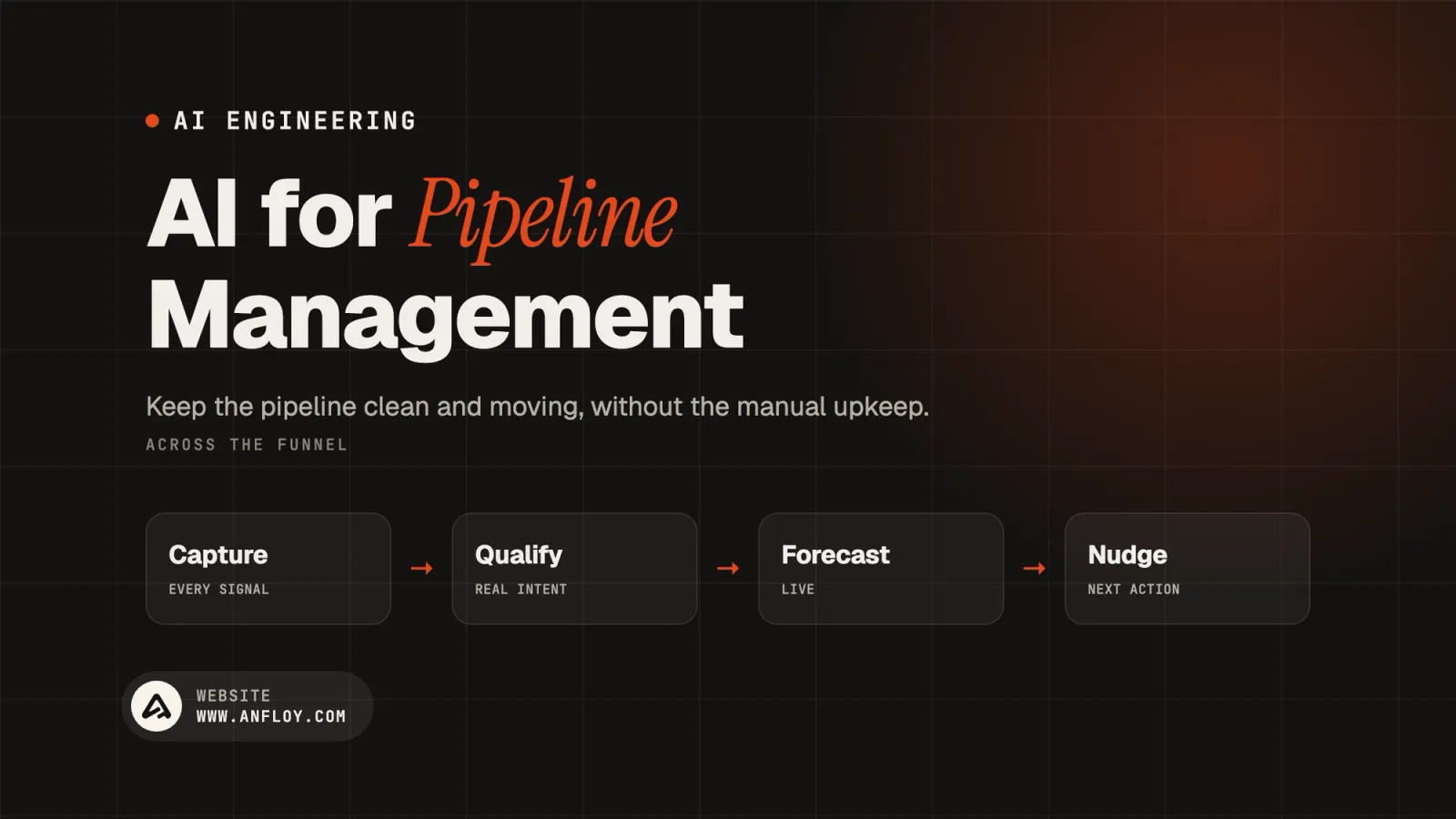
AI for Pipeline Management: The Complete Guide
Learn how AI for pipeline management improves deal tracking, forecasting, lead prioritization, and revenue growth with AI agents and intelligent automation.
On this page
- What is AI pipeline management?
- Why traditional pipeline management breaks?
- How does AI improve pipeline management?
- What are the key features of AI pipeline management?
- What are the benefits of AI for pipeline management?
- AI pipeline management vs traditional pipeline management
- What are the top AI pipeline management use cases?
- What are the common pipeline management mistakes?
- How AI agents improve pipeline management?
- How Anfloy builds AI pipeline management systems?
- Conclusion
A healthy sales pipeline is the foundation of predictable revenue.
Yet many businesses struggle to answer questions like:
- Which deals are most likely to close?
- Which opportunities need immediate attention?
- Where is the pipeline slowing down?
- Which accounts should sales prioritize this week?
- How accurate is our revenue forecast?
Most of the information already exists.
It's spread across CRM records, sales calls, emails, marketing platforms, and customer interactions.
The challenge is turning that data into meaningful action before opportunities are lost.
This is where AI for pipeline management is changing the way revenue teams operate.
Instead of relying on manual CRM updates and weekly pipeline reviews, AI continuously monitors deals, identifies risks, prioritizes opportunities, and recommends the next best action.
Rather than simply tracking your pipeline, AI helps improve it.
This guide explains how AI-powered pipeline management works, its benefits, and how businesses are using AI agents to build healthier, more predictable sales pipelines.
What is AI pipeline management?
AI pipeline management is the use of artificial intelligence to monitor, analyze, and optimize every stage of the sales pipeline.
Instead of relying on static reports or manual updates, AI continuously evaluates opportunities using customer data, buying signals, engagement history, and CRM activity.
AI can help teams:
- qualify opportunities
- prioritize deals
- detect pipeline risks
- improve forecasting
- automate CRM updates
- recommend next actions
- coordinate sales workflows
The goal is to help revenue teams close more deals with greater consistency.
Why traditional pipeline management breaks?
As businesses grow, pipeline management becomes increasingly difficult.
Sales managers often rely on:
- CRM dashboards
- spreadsheets
- manual forecasting
- pipeline review meetings
- individual sales updates
This creates several challenges.
Common problems include:
- outdated CRM records
- inconsistent deal stages
- poor forecast accuracy
- stalled opportunities
- delayed follow-ups
- limited pipeline visibility
By the time issues are discovered, valuable opportunities may already be at risk.
How does AI improve pipeline management?
AI transforms pipeline management from reactive reporting into proactive decision-making.
Instead of waiting for sales managers to identify issues, AI continuously monitors the pipeline and highlights opportunities that need attention.
A typical workflow includes:
Step 1: Collect sales data
AI gathers information from:
- CRM platforms
- emails
- meetings
- outbound campaigns
- customer interactions
- internal systems
Step 2: Analyze pipeline health
The system evaluates:
- deal progression
- engagement activity
- buying signals
- sales velocity
- historical conversion patterns
This provides a real-time view of pipeline health.
Step 3: Detect risks and opportunities
AI identifies:
- stalled deals
- inactive accounts
- high-intent prospects
- expansion opportunities
- forecast risks
before they impact AI revenue intelligence.
Step 4: Recommend next actions
Instead of simply generating reports, AI recommends actions such as:
- prioritizing an opportunity
- scheduling follow-ups
- updating deal stages
- routing leads
- notifying sales managers
This helps teams act faster.
What are the key features of AI pipeline management?
Modern AI pipeline management platforms combine several capabilities.
Opportunity prioritization
AI ranks opportunities based on buying intent, engagement, account quality, and revenue potential.
Pipeline health monitoring
Monitor deal progression and identify bottlenecks before they slow revenue growth.
AI forecasting
Improve forecast accuracy using real-time sales activity instead of manual estimates.
CRM intelligence
Automatically update customer records and maintain accurate pipeline data.
Buying signal detection
Identify companies showing signs of active purchasing behavior.
Workflow automation
Workflow automation reduce repetitive operational work across the sales organization.
What are the benefits of AI for pipeline management?
Organizations using AI often experience measurable improvements across their revenue operations.
Better pipeline visibility
Leadership gains a complete, real-time view of sales performance.
More accurate forecasts
AI continuously updates predictions as opportunities change.
Faster sales execution
Representatives know which accounts deserve immediate attention.
Higher CRM accuracy
Customer records remain current without manual updates.
Improved win rates
Better prioritization helps sales teams focus on the opportunities most likely to convert.
AI pipeline management vs traditional pipeline management
| Traditional Pipeline Management | AI Pipeline Management |
|---|---|
| Manual pipeline reviews | Continuous monitoring |
| Static CRM reports | Real-time intelligence |
| Manual forecasting | AI-assisted forecasting |
| Rule-based prioritization | Dynamic opportunity scoring |
| Delayed issue detection | Early risk identification |
| Reactive management | Proactive recommendations |
The biggest difference is visibility.
Traditional systems report what happened.
AI helps teams decide what to do next.
What are the top AI pipeline management use cases?
Sales leadership
Monitor pipeline health and improve forecasting.
Revenue operations
Automate CRM management and pipeline reporting.
Account executives
Prioritize deals with the highest probability of closing.
Customer success
Identify renewal and expansion opportunities.
Executive teams
Track revenue performance with greater confidence.
What are the common pipeline management mistakes?
Managing the pipeline once a week
Revenue conditions change every day.
Pipeline visibility should be continuous.
Treating every opportunity equally
Not every deal deserves the same attention.
AI helps identify the highest-value opportunities.
Ignoring buying signals
External business events often explain why deals accelerate or stall.
Depending on manual CRM updates
Poor CRM hygiene leads to unreliable forecasts.
Measuring activity instead of progress
Pipeline health depends on deal movement, not just sales activity.
How AI agents improve pipeline management?
AI agents extend pipeline management beyond dashboards.
Instead of simply displaying pipeline data, they actively improve it.
AI agents can:
- monitor deal progression
- enrich account information
- detect buying signals
- identify stalled opportunities
- update CRM records
- notify sales managers
- trigger follow-up workflows
This transforms pipeline management into an intelligent operational system that continuously supports the sales team.
How Anfloy builds AI pipeline management systems?
Most businesses manage their pipeline using CRM reports.
At Anfloy, we build AI systems that actively manage pipeline health.
Every implementation starts by understanding:
- your sales process
- pipeline stages
- qualification criteria
- CRM architecture
- revenue goals
- operational workflows
From there, we build a custom AI infrastructure that improves every stage of your pipeline.
AI-powered GTM engines
Our GTM engines continuously monitor buying signals, enrich opportunities, qualify leads, prioritize accounts, and keep your pipeline moving without relying on manual intervention.
Company AI brain
Every AI agent has access to a centralized Company AI Brain containing CRM history, customer interactions, sales playbooks, internal documentation, and operational knowledge. This allows the system to make decisions using real business context instead of isolated data.
Multi-agent pipeline management
Rather than using one AI assistant, specialized AI agents collaborate across:
- opportunity qualification
- pipeline monitoring
- CRM management
- forecasting
- follow-up automation
- sales reporting
Each agent performs a dedicated role, creating a more reliable and scalable pipeline management system.
Workflow automation
AI agents automatically:
- update CRM records
- identify pipeline risks
- trigger follow-up tasks
- assign opportunities
- notify sales teams
- coordinate revenue workflows
This reduces administrative work while improving pipeline visibility.
Infrastructure you own
Every AI pipeline management system is deployed on infrastructure owned by the client.
You own:
- the code
- the workflows
- the AI logic
- the integrations
- the operational infrastructure
No platform lock-in.
No recurring software dependency.
The result is a pipeline management system that continuously improves forecasting, prioritization, and revenue execution as your business grows.
Conclusion
Managing a sales pipeline is no longer just about tracking deals in a CRM.
Modern revenue teams need systems that can identify risks, prioritize opportunities, automate repetitive work, and support better decisions in real time.
By combining:
- AI agents
- buying signal intelligence
- CRM automation
- forecasting
- workflow orchestration
- pipeline analytics
businesses can create a healthier, more predictable revenue engine.
At Anfloy, we build pipeline management as part of a broader AI infrastructure through:
- GTM engines
- Company AI Brains
- agentic systems
- internal operations systems
- and full-stack AI products
Because the future of pipeline management is not spending more time reviewing dashboards.
It is building intelligent systems that continuously monitor your pipeline, surface the right opportunities, and help your team close more revenue with less manual effort.
Frequently Asked Questions
How does AI improve pipeline management?
AI continuously analyzes pipeline data, detects risks, recommends next actions, and automates repetitive sales operations.
Can AI improve sales forecasting?
Yes. AI evaluates real-time pipeline activity, customer engagement, and historical performance to produce more accurate revenue forecasts.
Does AI replace sales managers?
No. AI supports sales managers by providing better visibility, recommendations, and automation while leaving strategic decisions to humans.
Which businesses benefit most from AI pipeline management?
SaaS companies, agencies, consulting firms, recruiting businesses, and B2B organizations with growing sales teams typically benefit the most.
Let's build
what your
company needs.
Drop your email. We'll send The Custom Agent Blueprint on what we'd build first for a company like yours, before you ever take a meeting.