
AI-Powered Sales Forecasting: The Methodology Behind the Number
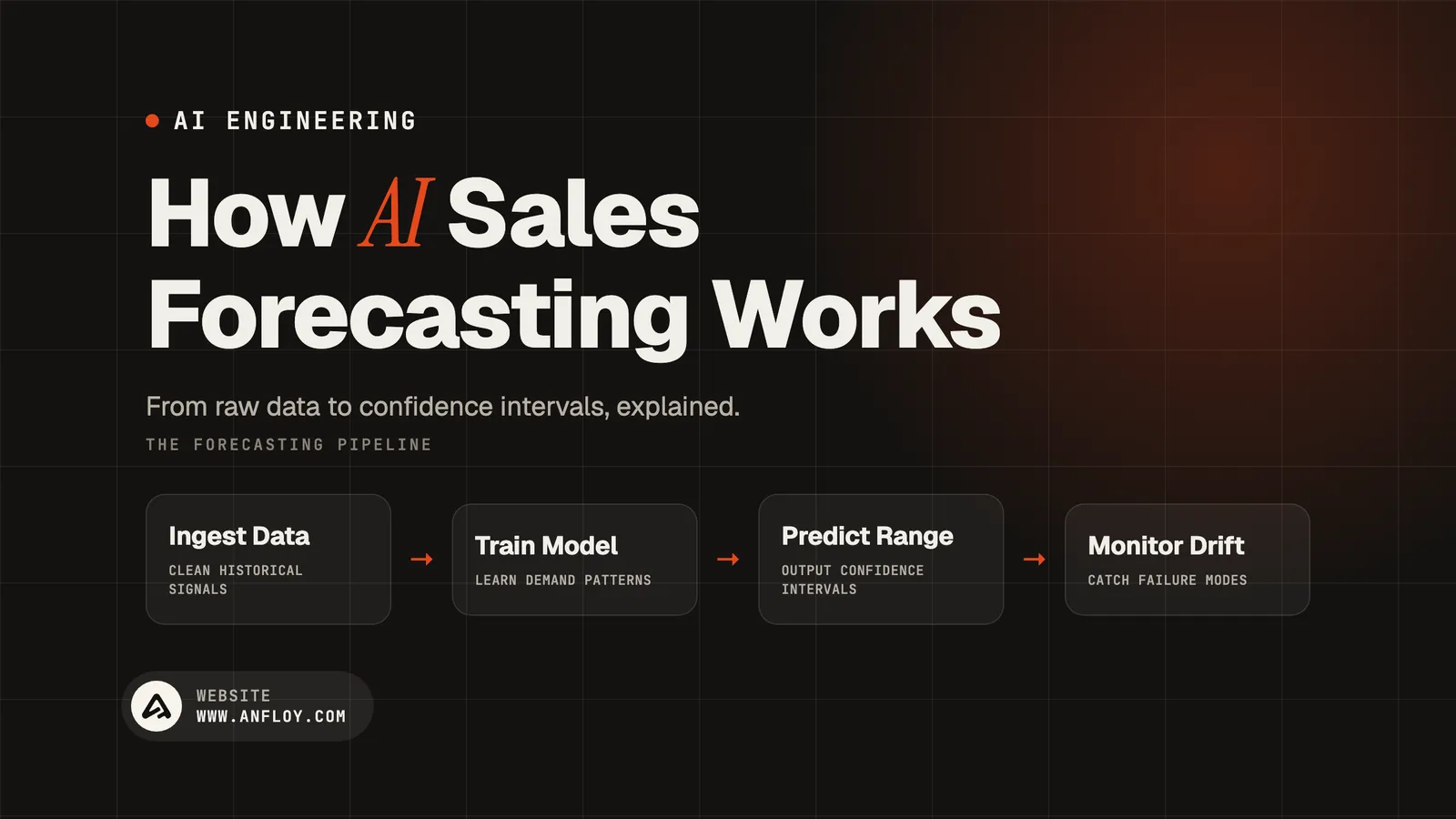
How AI sales forecasting models actually work, why confidence intervals matter more than a single predicted number, and the specific reasons AI forecasts fail in practice.
On this page
- What an AI Forecast Actually Does, Mechanically
- The Core Model Types Behind AI Forecasting
- Why a Single Number Is the Wrong Way to Communicate a Forecast?
- Why AI Forecasts Fail in Practice?
- Building a Forecasting System That Earns Trust
- Common Mistakes in AI Sales Forecasting
- A Worked Example
- How I Approach AI Sales Forecasting
- Conclusion
A forecasting dashboard that shows one confident number, this quarter will close at $2.3 million, is answering a question nobody should be asking with that much false precision.
I've written about revenue intelligence and AI for pipeline management elsewhere, both adjacent to forecasting but not actually about the methodology itself, how a model arrives at a number.
Why that number should come with a range rather than a false sense of certainty, and the specific, predictable reasons AI forecasting models fail in practice even when they're technically well-built.
This guide is specifically about that methodology: what's actually happening underneath an AI sales forecast, why a single point estimate without a confidence interval is close to useless for real planning.
The failure modes worth understanding before you trust a forecasting system with real business decisions.
What an AI Forecast Actually Does, Mechanically
At its core, an AI sales forecasting model learns patterns from historical deal data, how deals of a certain size, in a certain segment, at a certain stage, with certain engagement characteristics, have historically progressed, and applies those learned patterns to current open pipeline to estimate a likely outcome.
This is a meaningfully different approach from a traditional, rep-driven forecast, where each rep manually assigns a probability or a category to their own deals based on individual judgment, rolled up into a team total.
The AI approach trades individual judgment for pattern recognition at scale, which has real strengths and real limitations.
It can surface patterns a human forecaster wouldn't consciously notice, a specific combination of stage duration and engagement drop-off that's historically correlated with a deal slipping, for instance, and it doesn't carry the optimism bias that affects a lot of rep-driven forecasting, where reps systematically overestimate their own likely close rate.
It also has a real, structural weakness: it's only as good as the historical pattern it learned from, and a genuinely novel situation, a new product line with no deal history, a sudden market shift, a new competitor changing the sales cycle, is exactly the kind of thing a pattern-based model is poorly equipped to anticipate.
The Core Model Types Behind AI Forecasting
Regression-based models
The more traditional, interpretable approach: a model that learns the statistical relationship between specific deal characteristics, size, stage, days in stage, engagement level, and historical outcome, producing a probability of closing based on how similar deals have performed.
These models tend to be more explainable, you can often point to which specific factors drove a given deal's score up or down, which matters considerably for a sales team's willingness to actually trust and act on the output.
Machine learning classification models
More sophisticated models, commonly gradient-boosted trees or similar ensemble methods, that can capture more complex, non-linear relationships between deal characteristics and outcome than a simpler regression model can.
These often produce more accurate predictions in aggregate, at the cost of being considerably harder to explain, a deal's score moving from sixty to forty percent likely to close isn't always traceable to one clear, specific reason the way a simpler model's output tends to be.
Time-series models for aggregate pipeline forecasting
Distinct from individual deal-level scoring, these models forecast aggregate metrics, total pipeline value, expected close count, over time, learning from historical patterns in how pipeline has moved through the funnel in aggregate rather than scoring each deal individually.
These are often used alongside deal-level scoring rather than instead of it, providing a cross-check between a bottom-up sum of individual deal probabilities and a top-down, pattern-based aggregate estimate.
Large language model-based approaches for qualitative signal
A newer category, using an LLM to extract and weight qualitative signal from unstructured data, call transcripts, email sentiment, CRM notes, that a purely structured, numeric model can't directly use.
This can meaningfully improve a forecast by incorporating genuinely predictive signal that was previously invisible to the model, a champion's language shifting from enthusiastic to notably cautious across recent calls, for instance, but it introduces its own reliability questions worth taking seriously rather than assuming the qualitative signal extraction is automatically trustworthy.
Why a Single Number Is the Wrong Way to Communicate a Forecast?
Confidence intervals matter more than the point estimate
A forecast that says "we expect $2.3 million to close this quarter" communicates false precision.
A forecast that says "we expect between $1.9 million and $2.7 million to close, with $2.3 million as the most likely single value" communicates something genuinely more honest and more useful, the actual range of uncertainty the underlying model carries.
Any forecasting system worth trusting should produce this range, not just a single number, and any forecasting output that doesn't show its uncertainty should be treated with real skepticism about how that single number was actually calculated.
Uncertainty should widen appropriately with the forecast horizon
A forecast for the current week should carry a tighter, more confident range than a forecast for two quarters out, since considerably more could genuinely change over a longer horizon, new deals entering pipeline, existing deals shifting meaningfully, market conditions changing.
A forecasting system that shows the same confidence level regardless of how far out it's predicting is very likely not actually modeling uncertainty correctly, it's just presenting a number with a fixed, arbitrary-looking range attached regardless of the horizon.
Different stakeholders need different precision levels
A board-level forecast conversation can reasonably work with a wider range and a focus on trend direction.
A weekly pipeline review with a sales team benefits from more granular, deal-level detail.
Presenting the same level of precision to every audience regardless of what decision they're actually trying to make is a common design mistake, one worth avoiding by matching the forecast's granularity to the actual decision it's meant to inform.
Want a read on whether your current forecasting setup is actually producing honest uncertainty or false precision? Get a free AI infrastructure audit and I'll help you evaluate it.
Why AI Forecasts Fail in Practice?
Insufficient or low-quality historical training data
A model trained on a small number of historical deals, or on deals with inconsistent, poorly-maintained CRM data, firmographic data, data quality issues this content has covered extensively elsewhere, will produce an unreliable forecast regardless of how sophisticated the underlying modeling technique is.
This is the single most common reason a forecasting initiative disappoints: the modeling approach gets the attention, while the underlying data quality, the actual limiting factor, goes unaddressed.
Regime change, when the future genuinely doesn't resemble the past
Any model trained on historical patterns assumes, implicitly, that the future will behave similarly to the past.
A genuine regime change, a new competitor entering the market, a significant pricing change, a shift in buyer behavior following a broader economic shift, breaks that assumption, and a model trained on pre-change data will confidently produce forecasts based on patterns that no longer actually hold, often without any obvious signal that something has fundamentally shifted.
Sparse data in new segments or product lines
A forecasting model performs considerably worse, and should be trusted considerably less, for a new product line, a newly entered market segment, or any area where historical deal volume is genuinely thin.
A model will often still produce a confident-looking number for these cases, since most modeling approaches don't automatically widen their uncertainty range proportionally to how little relevant historical data actually exists, which is a real, specific failure mode worth checking for directly rather than assuming the model handles gracefully on its own.
Feedback loops from the forecast itself changing behavior
A forecast that flags a deal as low-probability can change how a rep actually treats that deal, sometimes becoming a self-fulfilling prediction as the rep deprioritizes it based on the forecast's own output.
This is a genuinely subtle failure mode worth being aware of: the forecast isn't just observing pipeline behavior, in some cases it's actively influencing it, which can distort the relationship between the model's predictions and what would have actually happened absent the forecast's own existence.
Overfitting to historical patterns that don't generalize
A model tuned too closely to the specific quirks of its historical training data can perform impressively well on that historical data while generalizing poorly to new, current deals, a classic overfitting problem that's worth actively testing for rather than assuming a model that performed well in backtesting will perform equally well going forward.
Building a Forecasting System That Earns Trust
Validate against genuinely held-out historical data, not just a retrospective fit to data the model already saw.
A model that's evaluated only on the same historical data it was trained on will almost always look impressively accurate, since it's essentially being graded on data it already memorized.
A genuine validation needs to test the model's predictions against historical periods it never saw during training, simulating how it would have actually performed in real time.
Build in explicit, visible confidence intervals from the start, not as an afterthought. This is the single highest-leverage design decision covered in this guide, and it should be a core requirement for any forecasting system, not a feature to add later once the point-estimate version is already in use and the team has already become accustomed to trusting a number that was never actually that precise.
Track forecast accuracy over time as an ongoing, measured metric, not a one-time validation exercise.
A forecasting model's real-world accuracy should be measured continuously against actual outcomes, and that tracked accuracy is what tells you whether the model is still performing well or has started to drift.
The same ongoing evaluation discipline covered in more depth in AI agent cost optimization, applied here to forecast quality rather than cost efficiency.
Flag low-confidence segments explicitly rather than presenting uniform precision everywhere.
A new product line or a sparse segment with genuinely limited historical data should visibly carry a wider confidence interval and, ideally, an explicit flag noting the forecast here is based on limited data, rather than presenting the same apparent precision across every segment regardless of how much reliable history actually backs it.
Combine the model's quantitative output with genuine human judgment, not as a replacement for it.
The strongest forecasting approaches I've seen use the AI model's output as a rigorous, pattern-based input to a broader forecasting process that still includes human review, particularly for the largest, most consequential deals where a rep or a sales leader's direct, qualitative knowledge of the specific situation adds real value a purely pattern-based model can't capture on its own.
Common Mistakes in AI Sales Forecasting
Presenting a single point estimate with no visible confidence interval.
This is the most common and most consequential mistake covered in this guide, and it misleads every downstream decision made on the strength of that falsely precise number, from hiring plans to board commitments.
Trusting a model's output uniformly regardless of how much historical data actually backs a given segment.
A forecast for an established, high-volume segment and a forecast for a brand-new product line with a handful of historical deals shouldn't be presented with the same apparent confidence, and treating them identically is a genuine, correctable failure most forecasting dashboards don't actually address.
Never testing for regime change or model drift.
A model that performed well a year ago isn't guaranteed to still be performing well today if the underlying market or business has shifted meaningfully since then, and without ongoing accuracy tracking against real, current outcomes, a genuinely drifted model can keep producing confident, plausible-looking, and quietly wrong forecasts for a long time before anyone notices.
Ignoring the feedback loop risk between a forecast and rep behavior.
A forecast that visibly deprioritizes a specific deal can change how that deal actually gets worked, which complicates any clean read on whether the forecast was accurate or whether it partly caused the outcome it predicted.
This is worth being aware of specifically when evaluating a model's historical accuracy, since some of that apparent accuracy may reflect the forecast's own influence rather than pure predictive skill.
Building the forecasting model before the underlying CRM data is actually reliable.
The same sequencing mistake covered in what is a revenue operations system: layering sophisticated forecasting on top of fragmented, inconsistent underlying pipeline data produces a confidently wrong forecast rather than a genuinely useful one, regardless of how well-built the modeling approach itself is.
A Worked Example
A mid-market SaaS company builds an AI forecasting model trained on roughly three years of historical deal data, and initial testing shows the model performing impressively, closely matching actual outcomes when evaluated against the same historical data it was trained on.
Before deploying it for real planning decisions, the team runs a more rigorous validation, testing the model against a genuinely held-out quarter it never saw during training, and finds its accuracy is meaningfully weaker on that held-out data than the initial, overly optimistic evaluation had suggested, a classic sign of mild overfitting to the specific patterns in the original training set.
Rather than discarding the model, they retune it with stronger regularization to reduce the overfitting, and critically, add explicit confidence intervals to its output rather than presenting a single number, with those intervals visibly widening for their newest product line, which has less than six months of real deal history behind it.
They also add ongoing accuracy tracking, comparing the model's forecasts against actual quarterly outcomes continuously rather than treating the initial validation as a one-time check, which lets them catch a genuine, meaningful drift in accuracy within two quarters when a new competitor entering their market measurably changed typical sales cycle length in a way the model, trained on pre-competitor data, hadn't yet adapted to.
The resulting forecasting process isn't a single dashboard number the team blindly trusts, it's a model whose output feeds into a broader forecasting conversation that explicitly accounts for its own known limitations, flags the specific segments.
Where its confidence is genuinely lower, and gets actively monitored for the exact kind of drift that silently degrades a model's real-world usefulness over time.
How I Approach AI Sales Forecasting
I build forecasting systems that surface genuine uncertainty rather than false precision, explicit confidence intervals, visibly lower confidence flagged for sparse or newly-launched segments, and ongoing accuracy tracking against real outcomes rather than a one-time validation exercise.
This connects directly to my broader work on AI revenue intelligence and the underlying revenue operations systems that need to be reliable before any forecasting layered on top of them can be trusted.
Every forecasting system I build is validated against genuinely held-out historical data before deployment, not just a retrospective fit, and ships with the monitoring in place to catch drift before it quietly erodes trust in the forecast.
Not sure whether your current forecast is actually reliable or just confidently precise? See how my process works before your next planning cycle.
Conclusion
AI sales forecasting is a genuinely powerful methodology for surfacing patterns a purely rep-driven process would miss, but its real value depends entirely on being honest about uncertainty rather than presenting a single, falsely precise number.
The specific failure modes, insufficient training data, regime change, sparse new segments, feedback loops between the forecast and rep behavior, are predictable and addressable, provided the system is built to surface confidence intervals explicitly, validated against genuinely held-out data, and monitored continuously for drift rather than trusted as a one-time-built, permanently accurate tool.
Ready to build a forecasting system that tells you how confident it actually is? Book a call, no decks, no demos, just a working session on your pipeline data.
Frequently Asked Questions
Is an AI-generated forecast more accurate than a traditional, rep-driven one?
It depends on data quality and the specific situation. AI forecasting tends to outperform rep-driven forecasting on removing individual optimism bias and surfacing non-obvious patterns across large pipeline volumes, but it depends heavily on sufficient, clean historical data, and it genuinely struggles with novel situations a human forecaster with direct, current context might reasonably account for. The strongest approaches tend to combine both rather than fully replacing one with the other.
Why does my forecasting dashboard show one number instead of a range?
Many forecasting tools present a single point estimate for simplicity, but this omits genuinely important information about how confident that estimate actually is. A forecast without a visible confidence interval should be treated with real skepticism about how reliable the underlying number actually is, regardless of how precise it looks.
How do I know if my forecasting model has started to drift?
Track its accuracy against real, actual outcomes continuously, not just during an initial validation. A model whose accuracy is meaningfully declining over time, particularly following a known market or business shift, is a sign of drift worth investigating, and ongoing tracking is the only reliable way to catch this before it's been quietly producing wrong forecasts for an extended period.
Should a new product line with limited historical data use the same forecasting model as an established one?
Generally not with the same confidence level. A model's predictions for a segment with genuinely thin historical data should carry a visibly wider confidence interval, reflecting the real uncertainty, rather than the same apparent precision applied to an established segment with years of reliable deal history behind it.
Can a forecast actually influence the outcome it's trying to predict?
Yes, and this is a genuinely underappreciated risk. A forecast that flags a deal as low-probability can change how a rep actually prioritizes and works that deal, which can make the prediction partly self-fulfilling. This is worth factoring into how you interpret a model's historical accuracy, since some of that apparent accuracy may reflect the forecast's own influence on behavior rather than pure predictive skill.
Let's build
what your
company needs.
Drop your email. We'll send The Custom Agent Blueprint on what we'd build first for a company like yours, before you ever take a meeting.