
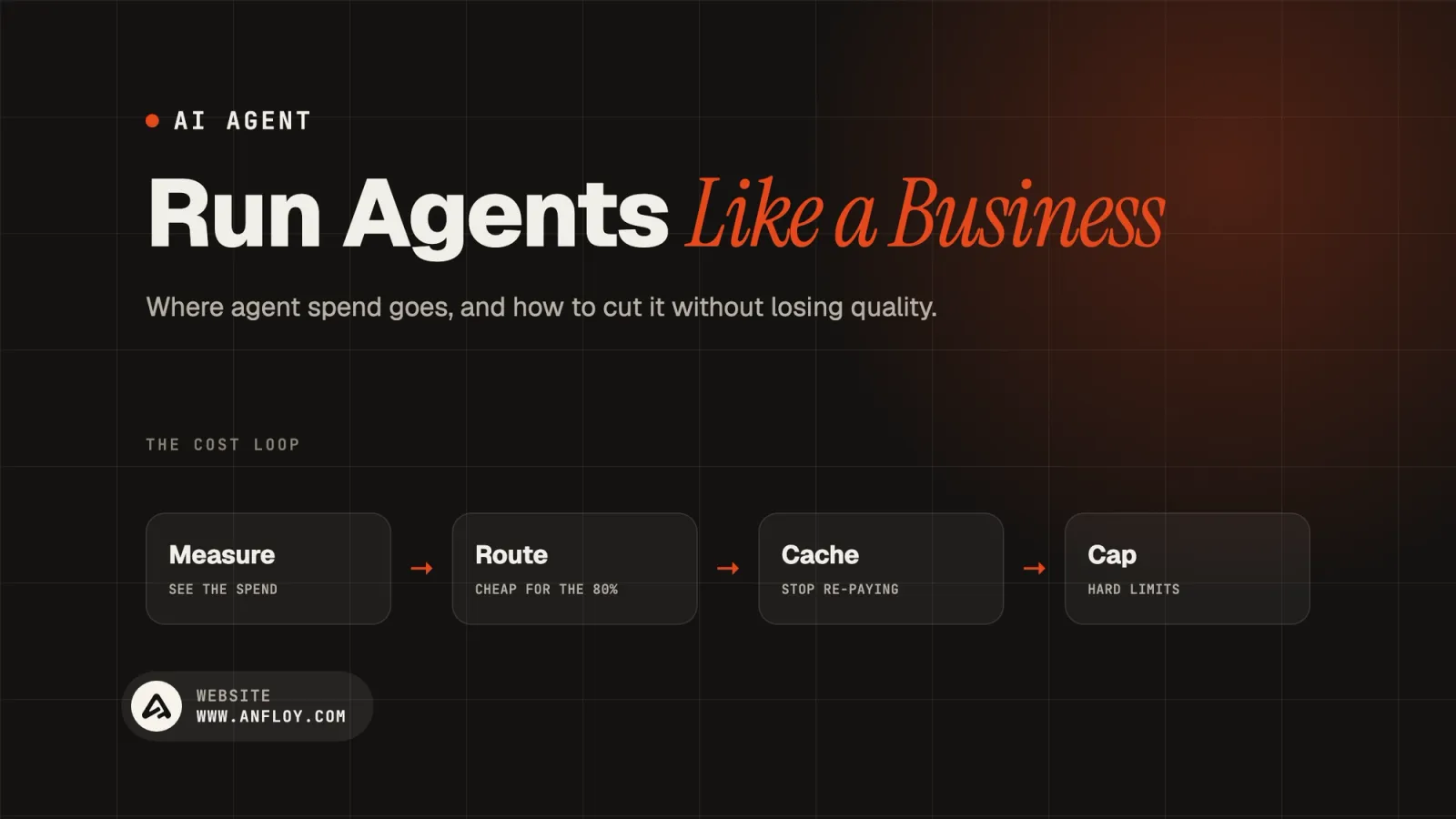
AI Agent Cost Optimization: How to Run Agents Like a Business in 2026
Learn how to optimize AI agent costs by improving architecture, workflows, model selection, and infrastructure instead of simply reducing API usage.
On this page
- What is AI agent cost optimization?
- Why AI costs increase as businesses scale?
- What are the biggest cost drivers for AI agents?
- Why looking only at API costs is a mistake?
- How do you measure AI ROI?
- How to optimize AI agent costs?
- How to choose the right model for each task?
- What does a cost-optimized AI architecture look like?
- What are the common mistakes that increase AI costs?
- How Anfloy builds cost-efficient AI infrastructure?
- What is the future of AI cost optimization?
- Conclusion
AI agents are rapidly becoming part of everyday business operations.
Organizations are deploying AI agents to qualify leads, automate customer support, retrieve company knowledge, manage CRM data, and streamline internal workflows.
As adoption grows, one question becomes increasingly important:
How do you scale AI without letting costs spiral out of control?
Many businesses assume AI costs are limited to API pricing.
In reality, the total cost of running AI agents includes far more than the language model itself.
Poor workflows, unnecessary model calls, duplicated processes, disconnected systems, and inefficient architecture can all increase operational costs while reducing business value.
The goal shouldn't be to build the cheapest AI agent.
The goal should be to build AI systems that generate significantly more value than they cost to operate.
This is where AI agent cost optimization becomes essential.
Rather than reducing capabilities, cost optimization focuses on designing AI infrastructure that delivers the highest return on investment.
In this guide, you'll learn what AI agent cost optimization means, the biggest cost drivers, practical optimization strategies, and how businesses can build AI systems that scale efficiently.
What is AI agent cost optimization?
AI agent cost optimization is the process of reducing the total operational cost of AI systems while maintaining or improving business performance.
Instead of focusing only on token usage or API pricing, cost optimization looks at the complete AI architecture.
This includes:
- model selection
- workflow design
- knowledge retrieval
- infrastructure
- automation
- system integrations
- operational efficiency
The objective is simple:
Deliver more business value with fewer resources.
A well-designed AI system should improve productivity, reduce manual work, and generate measurable business outcomes that outweigh its operating costs.
Why AI costs increase as businesses scale?
Many organizations begin with one AI assistant.
Over time, they add:
- customer support bots
- sales assistants
- internal knowledge tools
- CRM automation
- reporting agents
- workflow automations
Without a clear architecture, these systems often become disconnected.
As a result:
- multiple AI agents perform the same work
- duplicate API requests increase costs
- employees use different AI tools
- knowledge becomes fragmented
- workflows become difficult to manage
Instead of creating operational efficiency, businesses end up paying for unnecessary complexity.
Scaling AI successfully requires designing systems that work together rather than independently.
What are the biggest cost drivers for AI agents?
Understanding where costs come from is the first step toward optimization.
Language model usage
Every interaction with a language model consumes computational resources.
Long prompts, unnecessary requests, and inefficient workflows all increase operating costs.
Choosing the right model for the right task is often more important than always using the most advanced model available.
Poor workflow design
Many AI agents perform unnecessary steps before completing a task.
Examples include:
- retrieving duplicate information
- calling multiple models unnecessarily
- repeating the same reasoning process
- executing redundant workflows
Better workflow orchestration reduces both latency and cost.
Disconnected business systems
When AI cannot access the information it needs, employees often compensate by manually copying data between systems.
Disconnected software also causes AI agents to repeat work that has already been completed elsewhere.
Connected infrastructure reduces duplication while improving efficiency.
Weak knowledge architecture
Without centralized business knowledge, AI agents repeatedly search multiple systems or generate generic responses.
A well-designed knowledge layer reduces unnecessary computation while improving answer quality.
Human rework
One of the most overlooked AI costs is employee time.
If people must constantly correct AI outputs, rewrite responses, or manually complete unfinished workflows, the true operational cost becomes much higher than API usage alone.
Successful AI systems reduce manual work instead of creating more of it.
Why looking only at API costs is a mistake?
Many businesses evaluate AI based solely on monthly API spending.
While API usage is important, it represents only one part of the overall cost.
Businesses should also consider:
- implementation time
- employee productivity
- operational efficiency
- workflow automation
- maintenance
- software licensing
- opportunity cost
- revenue generated
For example, an AI system that costs $2,000 per month but eliminates dozens of hours of repetitive work and increases qualified pipeline may deliver a much higher return than a cheaper system that creates inconsistent results.
The goal is not to minimize spending.
The goal is to maximize business value.
How do you measure AI ROI?
Before optimizing costs, businesses need to understand what success looks like.
Useful KPIs include:
Operational metrics
- hours saved
- workflow completion time
- response time
- automation rate
Revenue metrics
- qualified pipeline generated
- meetings booked
- customer retention
- revenue influenced
Efficiency metrics
- cost per workflow
- cost per qualified lead
- cost per customer interaction
- support resolution time
These metrics provide a more complete picture than API costs alone and help businesses optimize AI investments around measurable business outcomes rather than technical expenses.
How to optimize AI agent costs?
Cost optimization isn't about making AI agents cheaper.
It's about designing AI systems that deliver the highest business value while using resources efficiently.
The most successful businesses optimize architecture before they optimize API usage.
Here are the strategies that have the biggest impact.
Start with the right business problem
One of the fastest ways to waste money is building AI for tasks that don't create measurable business value.
Instead of asking:
"Where can we use AI?"
Ask:
"Which repetitive business process costs us the most time or money?"
High-impact opportunities often include:
- lead qualification
- CRM management
- customer support
- onboarding
- knowledge retrieval
- reporting
- outbound prospecting
When AI solves expensive operational problems, the return on investment becomes much easier to justify.
How to choose the right model for each task?
Not every workflow requires the largest or most advanced language model.
For example:
- simple document classification may use a lightweight model
- CRM updates may require little reasoning
- customer support may use a balanced model
- complex planning or technical analysis may benefit from Claude or another advanced model
Matching the model to the task reduces unnecessary compute costs without sacrificing quality.
Build a centralized company AI brain
Many businesses unknowingly pay multiple times for the same information.
Different AI assistants search different document repositories, employees upload the same files repeatedly, and knowledge becomes fragmented.
A centralized Company AI Brain solves this problem.
Instead of every AI agent maintaining its own knowledge, all agents retrieve information from the same trusted source.
Benefits include:
- fewer duplicate requests
- more accurate answers
- consistent business knowledge
- lower operational complexity
- easier maintenance
A shared knowledge layer improves both quality and cost efficiency.
Use retrieval before generation
One of the most effective optimization strategies is reducing unnecessary reasoning.
Instead of asking the model to generate answers from scratch, use Retrieval-Augmented Generation (RAG) to retrieve relevant business information first.
This approach often provides:
- faster responses
- lower token usage
- improved accuracy
- fewer hallucinations
For many enterprise AI systems, RAG reduces operational costs while improving reliability.
Design end-to-end workflows
Many organizations optimize individual AI prompts.
The bigger opportunity is optimizing complete workflows.
For example, instead of creating separate automations for:
- prospect research
- CRM enrichment
- lead qualification
- outreach preparation
combine them into one connected workflow.
Reducing duplicate processing often has a greater impact than optimizing prompts alone.
Continuously measure performance
Optimization isn't a one-time project.
Businesses should regularly monitor:
- workflow completion rates
- failed automations
- response quality
- operational costs
- employee feedback
- business outcomes
Continuous improvement helps AI systems become more efficient over time.
Ready to Build AI That Delivers Better ROI?
Many businesses focus on reducing AI costs.
We help businesses increase the value their AI creates.
Our Free AI Infrastructure Audit identifies:
high-impact automation opportunities
workflow inefficiencies
AI architecture improvements
operational bottlenecks
opportunities to maximize AI ROI
Get Your Free AI Audit
What does a cost-optimized AI architecture look like?
The most efficient AI systems share a common architectural pattern.
Instead of deploying isolated AI tools, they build connected infrastructure.
A modern cost-optimized AI stack typically includes:
Foundation models
Choose the most appropriate model for each workflow instead of relying on one model for everything.
Company AI brain
A centralized knowledge layer prevents duplication and improves retrieval accuracy.
Retrieval-augmented generation (RAG)
Retrieve trusted company information before generating responses to reduce unnecessary computation.
Multi-agent architecture
Deploy specialized AI agents with clear responsibilities rather than one general-purpose assistant.
Examples include:
- sales agent
- support agent
- CRM agent
- onboarding agent
- reporting agent
Specialization improves efficiency while making systems easier to manage.
Workflow orchestration
Connect business processes across departments instead of automating isolated tasks.
This reduces duplicated work while improving operational consistency.
Monitoring and optimization
Track both technical performance and business outcomes to identify opportunities for continuous improvement.
What are the common mistakes that increase AI costs?
Many organizations spend more on AI than necessary because of architectural decisions rather than model pricing.
Avoid these common mistakes.
Using multiple AI tools for the same work
Different teams often purchase separate AI solutions.
Over time, businesses end up paying for duplicate functionality while creating fragmented workflows.
A unified AI infrastructure is usually more efficient.
Building one agent that does everything
Large, general-purpose agents become expensive and difficult to maintain.
Specialized AI agents typically perform better while using resources more efficiently.
Ignoring business knowledge
Without access to company-specific information, AI agents often repeat unnecessary reasoning or produce inaccurate responses that require human correction.
A strong knowledge layer reduces both errors and operating costs.
Measuring token costs instead of business value
Lower API usage doesn't always mean better ROI.
An AI system should ultimately be evaluated by outcomes such as:
- revenue generated
- hours saved
- customer satisfaction
- workflow efficiency
Business impact matters more than individual model calls.
Treating AI as a software subscription
Many businesses continue adding standalone AI tools whenever a new problem appears.
This creates a growing collection of disconnected applications that are expensive to maintain.
Building AI infrastructure creates a stronger long-term foundation.
How Anfloy builds cost-efficient AI infrastructure?
At Anfloy, we believe cost optimization starts with architecture, not pricing.
Rather than helping businesses reduce token usage, we design AI systems that maximize business value while minimizing operational complexity.
Every project begins by understanding:
- your business goals
- operational workflows
- technology stack
- customer journey
- internal knowledge
- AI automation cost opportunities
From there, we build AI infrastructure that scales efficiently as your business grows.
Agentic systems
Instead of one large AI assistant, we design multi-agent systems where each agent is responsible for a specific business function.
For example:
- lead qualification
- CRM automation
- customer support
- reporting
- onboarding
- knowledge retrieval
This specialization improves reliability while reducing unnecessary processing.
Company AI brain
Every AI system connects to a centralized Company AI Brain built using:
- Retrieval-Augmented Generation (RAG)
- embeddings
- hybrid search
- reranking
- persistent memory
Rather than duplicating knowledge across multiple tools, every AI agent retrieves trusted information from one shared intelligence layer.
This improves consistency while reducing operational overhead.
AI-powered GTM engines
Our GTM Engines automate the complete revenue workflow, including:
- buying signal monitoring
- lead enrichment
- qualification
- CRM synchronization
- personalized outreach
- pipeline management
Instead of paying for multiple disconnected sales tools, businesses operate from one intelligent system.
Internal operations systems
Beyond revenue generation, we automate internal workflows such as:
- onboarding
- approvals
- reporting
- documentation retrieval
- knowledge management
This reduces repetitive manual work while improving operational efficiency across departments.
Infrastructure you own
Unlike subscription-based AI platforms, every solution is deployed directly on infrastructure owned by your business.
You own:
- the code
- the AI workflows
- the knowledge architecture
- the integrations
- the operational logic
No vendor lock-in.
No recurring software dependency.
The result is AI infrastructure that becomes more valuable as your organization grows.
What is the future of AI cost optimization?
As AI adoption accelerates, businesses will shift their focus from reducing model costs to optimizing entire AI ecosystems.
Future organizations will prioritize:
- intelligent workflow orchestration
- shared Company AI Brains
- multi-agent collaboration
- dynamic model selection
- continuous performance optimization
- business-level ROI measurement
Competitive advantage will no longer come from simply having access to AI.
It will come from operating AI infrastructure that delivers measurable outcomes efficiently and at scale.
Ready to Build Cost-Efficient AI Infrastructure?
Whether you're building AI agents, a Company AI Brain, GTM automation, or a custom AI product, we'll help you design AI systems that scale efficiently and create measurable business value.
Book a Strategy Call
Conclusion
Successful AI cost optimization isn't about spending less on AI.
It's about designing systems that generate more value than they cost to operate.
By combining:
- specialized AI agents
- Company AI Brains
- Retrieval-Augmented Generation (RAG)
- workflow orchestration
- intelligent integrations
- continuous optimization
businesses can reduce operational complexity while improving productivity, customer experience, and revenue growth.
At Anfloy, we build cost-efficient AI infrastructure through Agentic Systems, Company AI Brains, GTM Engines, Internal Operations Systems, and Full-Stack AI Products that are tailored to your business and deployed on infrastructure you own.
Because the companies that achieve the greatest return from AI won't necessarily have the lowest API bill.
They'll have the most efficient AI systems, the strongest operational workflows, and the highest business impact.
Frequently Asked Questions
How can businesses reduce AI agent costs?
Businesses can reduce costs by choosing the right model for each task, building a centralized knowledge layer, using Retrieval-Augmented Generation (RAG), automating complete workflows, and continuously monitoring performance.
Is API pricing the biggest AI cost?
Not always. Implementation, maintenance, employee time, workflow inefficiencies, disconnected systems, and poor architecture often have a greater impact on total AI costs than API usage alone.
Why is a Company AI Brain important for cost optimization?
A centralized Company AI Brain eliminates duplicate knowledge, improves retrieval accuracy, reduces unnecessary model calls, and allows multiple AI agents to share the same trusted information.
What is the best way to measure AI ROI?
The most useful metrics include hours saved, qualified pipeline generated, workflow completion rates, customer satisfaction, operational efficiency, and revenue influenced rather than focusing only on token usage.
How do I estimate AI agent costs before launch?
Estimate AI agent costs by evaluating model usage, workflow complexity, integrations, infrastructure, maintenance, and expected business outcomes like time saved, automation gains, and revenue impact, not just API pricing.
When should I use batch inference vs. on-demand AI?
Use batch inference for scheduled, high-volume tasks like CRM enrichment and reporting. Use on-demand AI for real-time interactions such as customer support, sales conversations, and knowledge retrieval.
How does multi-agent orchestration affect total cost?
Multi-agent orchestration lowers costs by assigning specialized tasks to different agents, reducing duplicate processing, improving efficiency, and enabling shared access to centralized business knowledge and workflows.
Let's build
what your
company needs.
Drop your email. We'll send The Custom Agent Blueprint on what we'd build first for a company like yours, before you ever take a meeting.