
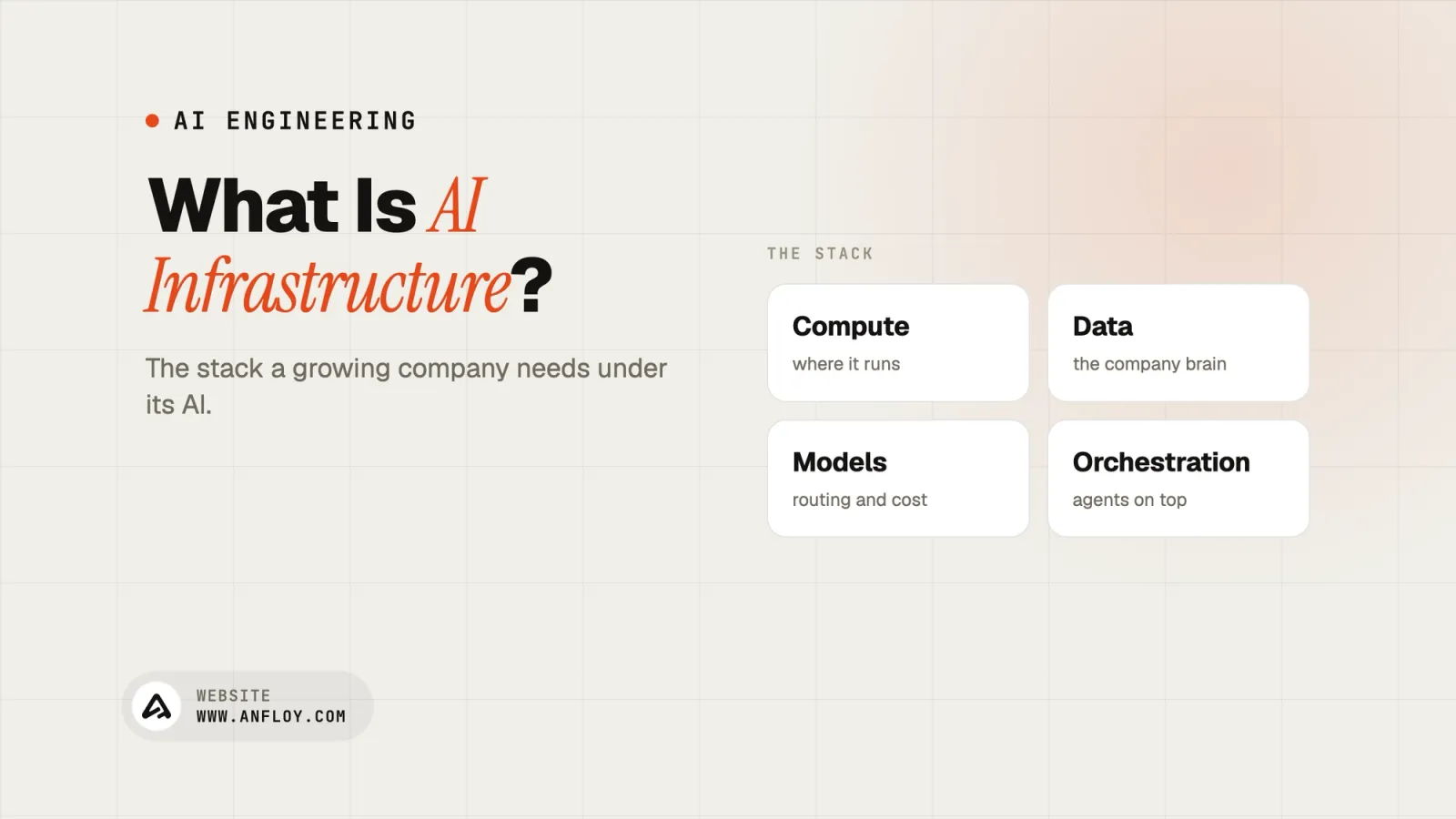
What Is AI Infrastructure? A Practical Guide for Growing Companies
Learn what AI infrastructure is, why it matters, and how growing companies build scalable AI systems with agents, RAG, and workflow automation.
On this page
- What is AI infrastructure?
- Why does AI infrastructure matter?
- What are the core components of AI infrastructure?
- How does AI infrastructure work?
- What problems does AI infrastructure solve?
- What are the benefits of AI infrastructure?
- AI infrastructure vs AI tools
- When should a business invest in AI infrastructure?
- Common mistakes businesses make
- How Anfloy builds AI infrastructure?
- What is the future of AI infrastructure?
- Conclusion
Most businesses start their AI journey with a chatbot.
They subscribe to an AI tool, experiment with prompts, and automate a few repetitive tasks.
At first, the results are impressive.
Teams save time writing emails.
Marketing creates content faster.
Customer support gets instant answers.
But as AI adoption grows, new challenges begin to appear.
Teams use different AI tools that don't communicate with each other.
Company knowledge lives across CRMs, Google Drive, Notion, Slack, and internal databases.
Automations become difficult to maintain.
AI generates inconsistent answers because it lacks business context.
Instead of improving operations, businesses end up managing disconnected AI tools.
This is where AI infrastructure becomes essential.
Rather than thinking of AI as another application, growing companies are treating it as business infrastructure that connects knowledge, workflows, data, and AI agents into one intelligent system.
This guide explains what AI infrastructure is, why it matters, and how companies can build AI systems that scale with their business.
What is AI infrastructure?
AI infrastructure is the collection of technologies, data, workflows, and AI systems that enable artificial intelligence to operate across a business.
Instead of relying on a single AI application, AI infrastructure connects your business systems so AI can retrieve information, make decisions, and execute work.
A modern AI infrastructure typically includes:
- AI agents
- company knowledge
- Retrieval-Augmented Generation (RAG)
- vector databases
- workflow automation
- CRM integrations
- APIs
- business applications
- monitoring and security
Together, these components allow AI to support real business operations rather than isolated tasks.
Why does AI infrastructure matter?
Many businesses adopt AI one tool at a time.
Over time, this creates disconnected workflows.
Sales uses one AI platform.
Marketing uses another.
Customer support has its own chatbot.
Operations rely on manual processes.
The result is fragmented automation.
A connected AI infrastructure solves this problem by creating a shared foundation that every department can use.
Benefits include:
- consistent business knowledge
- connected workflows
- improved automation
- better decision-making
- scalable AI deployment
Instead of adding more tools, businesses build one intelligent system.
What are the core components of AI infrastructure?
A scalable AI infrastructure consists of several connected layers.
AI agents
AI agents perform business tasks such as:
- lead qualification
- CRM management
- customer support
- workflow execution
- knowledge retrieval
Each agent is responsible for a specific function.
Company AI brain
Every AI system needs access to accurate business knowledge.
A Company AI Brain stores and retrieves:
- SOPs
- product documentation
- pricing
- customer history
- internal policies
- sales playbooks
This ensures every AI agent works from the same trusted information.
Retrieval-augmented generation (RAG)
RAG allows AI to retrieve current business information before generating responses.
Instead of relying only on model training, AI uses your company's knowledge in real time.
This improves accuracy while reducing hallucinations.
Workflow automation
AI infrastructure connects business processes across departments.
Examples include:
- CRM updates
- onboarding
- lead routing
- reporting
- approvals
- customer support
Automation becomes intelligent rather than rule-based.
Business integrations
AI should connect with the systems your business already uses.
These often include:
- CRM platforms
- communication tools
- databases
- cloud storage
- ERP systems
- project management software
The more connected your systems become, the more valuable AI becomes.
How does AI infrastructure work?
Although every business has different requirements, most AI infrastructures follow a similar process.
Step 1: Connect business systems
AI connects to your CRM, documentation, databases, communication tools, and operational software.
Step 2: Build a central knowledge layer
Business information is organized into a centralized Company AI Brain.
This gives every AI agent access to trusted company knowledge.
Step 3: Deploy AI agents
Specialized AI agents are assigned specific responsibilities such as prospecting, CRM automation, onboarding, or customer support.
Step 4: Automate workflows
AI agents coordinate tasks across departments while keeping systems synchronized.
Step 5: Monitor and improve
As AI collects more business context, workflows continue improving through ongoing optimization and refinement.
What problems does AI infrastructure solve?
Growing businesses often face similar operational challenges.
Knowledge silos
Information exists across multiple tools with no central source of truth.
Manual processes
Employees spend valuable time completing repetitive administrative work.
Disconnected software
Business systems fail to communicate with one another.
Inconsistent AI responses
Generic AI lacks company-specific context.
Scaling challenges
Operations become more complex as businesses grow.
AI infrastructure addresses these issues by creating one connected operational system.
What are the benefits of AI infrastructure?
Organizations investing in AI infrastructure often experience improvements across the business.
Faster operations
AI automates repetitive workflows and reduces manual effort.
Better decision-making
Employees and AI agents access the same business knowledge.
Higher productivity
Teams focus on strategic work instead of administrative tasks.
Scalable growth
Businesses expand operations without increasing headcount at the same pace.
Long-term flexibility
AI infrastructure evolves with the business instead of requiring constant tool replacements.
AI infrastructure vs AI tools
| AI Tools | AI Infrastructure |
|---|---|
| Solve individual tasks | Connect entire business operations |
| Standalone applications | Integrated systems |
| Limited context | Company-wide intelligence |
| Short-term productivity | Long-term operational efficiency |
| Separate data sources | Centralized knowledge |
| Individual automation | End-to-end workflows |
The biggest difference is ownership.
AI tools help employees work faster.
AI infrastructure helps the entire business operate smarter.
When should a business invest in AI infrastructure?
AI infrastructure becomes valuable when:
- teams use multiple AI tools
- CRM data is difficult to maintain
- knowledge exists across different platforms
- workflows involve multiple departments
- manual processes slow growth
- AI needs company-specific knowledge
Growing companies often reach this point sooner than expected.
Common mistakes businesses make
Buying more AI tools
More software rarely solves operational problems.
Connected systems create more value than disconnected applications.
Ignoring business workflows
Technology should support business processes, not replace them.
Building without company knowledge
AI performs significantly better when connected to internal documentation and operational context.
Automating individual tasks instead of entire processes
The greatest value comes from automating complete business workflows.
Renting instead of owning AI infrastructure
Owning your AI systems provides greater flexibility, customization, and long-term scalability.
How Anfloy builds AI infrastructure?
At Anfloy, we believe AI infrastructure should become part of how your business operates, not another disconnected software subscription.
Every implementation starts with understanding:
- your business goals
- operational workflows
- customer journey
- technology stack
- internal knowledge
- automation opportunities
From there, we build custom AI infrastructure designed specifically for your organization.
Agentic systems
We design multi-agent systems where specialized AI agents collaborate across sales, operations, customer support, and internal workflows. Each agent owns a specific responsibility, making automation more reliable and scalable.
Company AI brain
We build centralized knowledge systems powered by Retrieval-Augmented Generation (RAG), embeddings, hybrid search, reranking, and persistent memory. This enables every AI agent to retrieve accurate business information before making decisions or executing tasks.
GTM engines
Our GTM engines connect buying signals, lead enrichment, qualification, CRM automation, outbound workflows, and revenue intelligence into one AI-powered growth system.
Internal operations systems
We automate repetitive operational processes including onboarding, documentation retrieval, reporting, approvals, knowledge management, and cross-functional workflows.
Full-stack AI products
For businesses that require more than workflow automation, we develop custom AI platforms, internal SaaS applications, and customer-facing AI products deployed on your own cloud infrastructure.
Infrastructure you own
Every AI infrastructure project is built around your business.
You own:
- the code
- the workflows
- the AI logic
- the knowledge architecture
- the integrations
- the infrastructure
No vendor lock-in.
No recurring software dependency.
The result is a scalable AI infrastructure that becomes smarter, more valuable, and more deeply integrated into your business over time.
What is the future of AI infrastructure?
The future of AI is moving beyond individual applications.
Businesses will increasingly operate with interconnected AI systems that:
- collaborate through multiple AI agents
- retrieve company knowledge instantly
- automate operational workflows
- support employee decision-making
- coordinate business processes across departments
Companies that invest in AI infrastructure today will be better positioned to adapt as AI capabilities continue to evolve.
Conclusion
AI adoption is no longer about adding another chatbot or automation tool.
It's about building the infrastructure that allows AI to become part of your everyday operations.
By combining:
- AI agents
- Company AI Brains
- Retrieval-Augmented Generation
- workflow automation
- GTM engines
- internal operations systems
businesses can create intelligent foundations that improve productivity, reduce operational complexity, and support long-term growth.
At Anfloy, we help growing companies design and build AI infrastructure they fully own through:
- Agentic Systems
- Company AI Brains
- GTM Engines
- Internal Operations Systems
- Full-Stack AI Products
Because the companies that gain the greatest advantage from AI won't simply use more AI tools.
They'll build AI infrastructure that helps every team work smarter, every workflow run faster, and every decision become more informed.
Frequently Asked Questions
Why is AI infrastructure important?
It connects business knowledge, software, and workflows, allowing AI to automate operations, improve decision-making, and scale efficiently.
What is included in AI infrastructure?
AI infrastructure typically includes AI agents, RAG systems, vector databases, workflow automation, business integrations, APIs, monitoring, and centralized company knowledge.
What's the difference between AI tools and AI infrastructure?
AI tools solve individual tasks, while AI infrastructure connects multiple systems into a unified AI-powered operational platform.
Do small and growing businesses need AI infrastructure?
Yes. As businesses adopt more AI tools and automate more workflows, AI infrastructure helps ensure those systems remain connected, scalable, and aligned with business goals.
Let's build
what your
company needs.
Drop your email. We'll send The Custom Agent Blueprint on what we'd build first for a company like yours, before you ever take a meeting.