
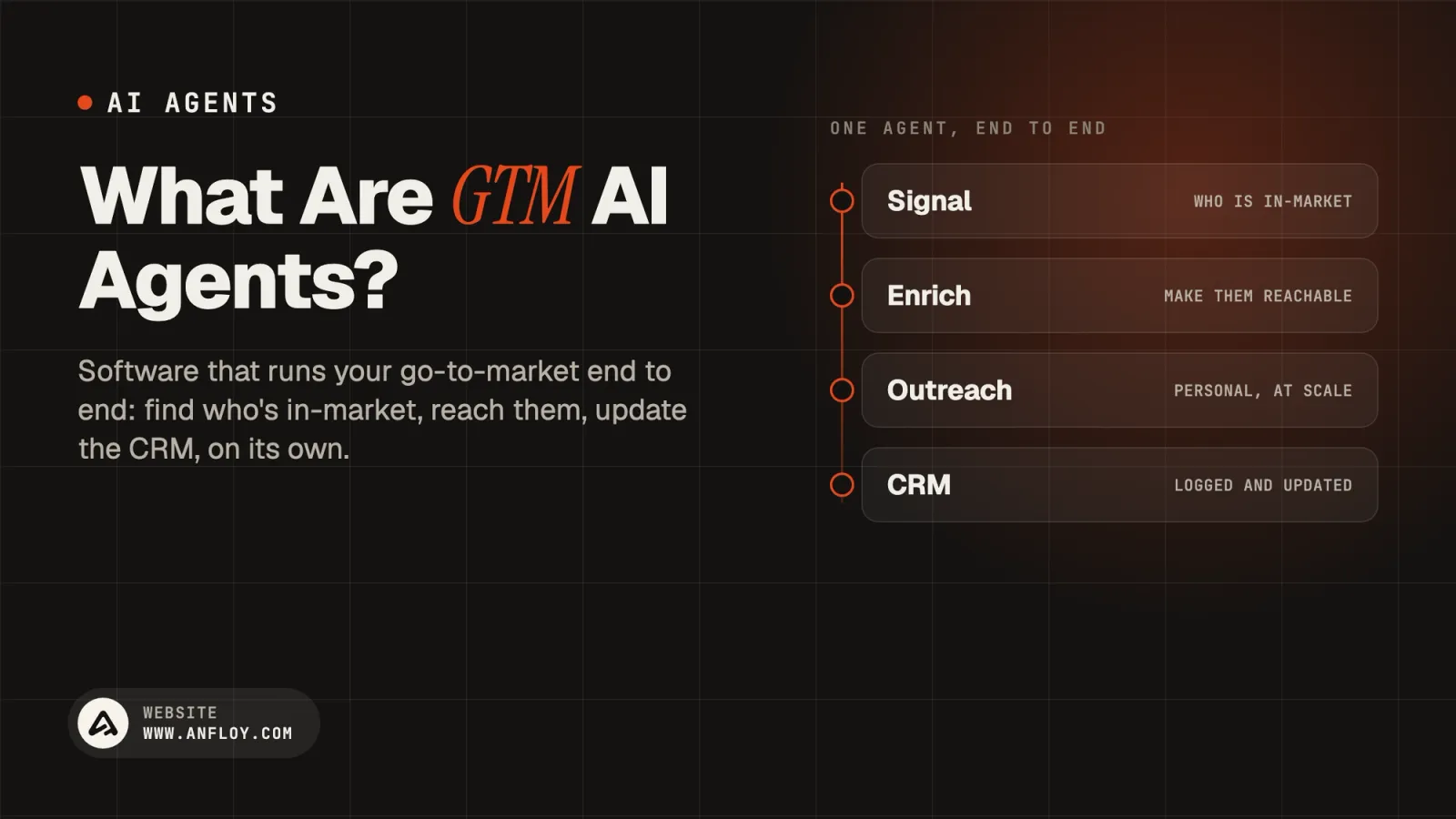
What Are GTM AI Agents?
Learn what GTM AI agents are, how they work, and how B2B SaaS companies use AI agents for lead generation, RevOps, outbound sales, pipeline growth.
On this page
- What are GTM AI agents?
- Why do traditional GTM workflows break?
- How do GTM AI agents work?
- What are the different types of GTM AI agents?
- What GTM AI agents can automate?
- GTM AI Agents vs Traditional Automation
- What are the differences between GTM AI agents vs AI SDR tools?
- What are the benefits of GTM AI agents?
- What are real examples of GTM AI agents?
- Why Ownership Matters?
- What are the common mistakes companies make?
- What is the future of GTM AI agents?
- Conclusion
Go-to-market teams are under more pressure than ever.
Pipeline targets keep increasing. Buyers expect personalized experiences. Sales cycles are becoming more complex. At the same time, companies are expected to grow revenue without significantly increasing headcount.
For years, the solution was adding more software.
Teams adopted:
- CRM platforms
- outbound tools
- enrichment software
- automation platforms
- sales engagement tools
- intent data providers
- and analytics dashboards
The goal was efficiency.
Instead, many GTM teams created operational fragmentation.
Sales reps spend hours researching prospects. RevOps teams maintain broken workflows. Marketing teams struggle to coordinate data across systems. Founders end up paying for dozens of tools while still relying on manual execution.
This is why GTM AI agents are becoming one of the most important developments in modern revenue operations.
Instead of acting as standalone tools, GTM AI agents function as intelligent systems that can analyze data, make decisions, coordinate workflows, and execute tasks across the go-to-market organization.
A GTM AI agent can:
- identify buying signals
- enrich prospect data
- qualify leads
- personalize outreach
- update CRM records
- route opportunities
- and support revenue teams automatically
The result is faster execution, improved operational efficiency, and scalable pipeline generation.
What are GTM AI agents?
GTM AI agents are AI-powered systems designed to automate and optimize go-to-market operations.
Unlike traditional automation tools that follow fixed rules, GTM AI agents can analyze context, make decisions, and coordinate workflows across multiple systems.
They operate across functions such as:
- lead generation
- prospect research
- outbound sales
- CRM management
- RevOps
- pipeline management
- and customer operations
Think of them as digital team members that support your revenue organization.
Instead of manually researching accounts or routing leads, GTM AI agents can perform those tasks automatically while continuously improving execution.
The distinction becomes even clearer when comparing AI agents to traditional no-code automations that rely entirely on predefined rules.
Why do traditional GTM workflows break?
Most GTM teams eventually hit an operational ceiling.
As companies grow:
- more leads enter the funnel
- more tools get added
- more workflows are created
- and more coordination is required
The result is operational drag.
What are the common GTM bottlenecks?
Many SaaS companies struggle with:
- manual prospect research
- inconsistent lead qualification
- poor CRM hygiene
- fragmented customer data
- slow outbound execution
- disconnected RevOps workflows
- duplicate operational tasks
- reporting inefficiencies
- and pipeline visibility issues
Most organizations try solving these problems by purchasing more software.
The problem is rarely a lack of tools.
The problem is coordination.
Many companies discover that disconnected tools create more complexity than they eliminate, particularly when scaling revenue operations.
This is exactly where GTM AI agents create value.
How do GTM AI agents work?
Most GTM AI systems operate through three layers.
Advanced GTM systems often rely on multiple specialized agents working together rather than a single AI model handling every task.
1. Signal Layer
This layer gathers data from multiple sources.
That includes:
- CRM systems
- website activity
- LinkedIn engagement
- email interactions
- intent data
- enrichment tools
- product usage signals
- and sales conversations
The purpose is to understand what is happening across the revenue ecosystem.
2. Intelligence Layer
This is where AI models evaluate information and make decisions.
The AI analyzes:
- ICP fit
- buying intent
- lead quality
- engagement signals
- account activity
- and pipeline opportunities
Unlike traditional automation, this layer introduces reasoning into workflows.
3. Execution Layer
The execution layer performs actions automatically.
This may include:
- updating CRM records
- generating outbound messages
- assigning leads
- enriching accounts
- triggering workflows
- creating reports
- and notifying sales teams
Together, these layers create an intelligent operational system.
What are the different types of GTM AI agents?
Different agents specialize in different functions.
Lead Research Agents
Lead research agents collect and analyze prospect information.
They can:
- identify target accounts
- gather firmographic data
- enrich contact information
- and evaluate ICP alignment
This dramatically reduces manual research time.
Prospecting Agents
Prospecting agents monitor signals that indicate buying intent.
Examples include:
- funding announcements
- hiring activity
- technology adoption
- website visits
- and engagement signals
This enables signal-based prospecting rather than generic lead lists.
Outbound AI Agents
Outbound agents generate personalized outreach automatically.
They can:
- create cold emails
- write LinkedIn messages
- generate follow-ups
- and personalize messaging based on account context
This improves both efficiency and relevance. The highest-performing outbound programs combine personalization, intent signals, and automated workflow orchestration across the entire pipeline.
RevOps Agents
RevOps AI agents support operational workflows.
They can:
- maintain CRM hygiene
- route leads
- manage lifecycle stages
- automate reporting
- and improve pipeline visibility
This helps revenue teams scale more effectively. Revenue operations is one of the areas seeing the fastest adoption of AI RevOps due to the amount of manual coordination involved.
What GTM AI agents can automate?
Modern GTM AI systems can automate far more than outbound messaging.
Prospect Research
Agents continuously collect and organize account information.
Lead Enrichment
AI systems can enrich company and contact data automatically.
Lead Qualification
Agents evaluate lead quality using multiple data points.
CRM Updates
AI agents can maintain records without manual input.
Personalized Outreach
Messaging can be generated dynamically based on context.
Pipeline Management
AI systems help prioritize opportunities and surface risks.
Revenue Reporting
Agents can generate operational insights automatically.
GTM AI Agents vs Traditional Automation
| Traditional Automation | GTM AI Agents |
|---|---|
| Rule-based workflows | Context-aware execution |
| Static automation | Dynamic decision-making |
| Trigger → action | Multi-step reasoning |
| Limited flexibility | Adaptive workflows |
| Workflow automation | Operational intelligence |
| App connectivity | Revenue orchestration |
Traditional automation is valuable.
But it struggles when workflows require judgment, context, and adaptability.
What are the differences between GTM AI agents vs AI SDR tools?
Many companies confuse GTM AI agents with AI SDR tools.
The two are not the same.
AI SDR tools focus primarily on outreach.
GTM AI agents support the entire revenue operation.
They can:
- enrich leads
- analyze intent
- coordinate workflows
- manage CRM systems
- support forecasting
- and improve pipeline execution
AI SDR tools solve one workflow.
GTM AI agents orchestrate many workflows together.
What are the benefits of GTM AI agents?
Faster Pipeline Generation
AI systems identify opportunities and execute workflows faster than manual processes.
Better Personalization
Agents can personalize outreach at a scale impossible for most teams.
Reduced Operational Costs
Teams spend less time on repetitive tasks.
Improved Data Quality
CRM systems remain cleaner and more reliable.
Better Revenue Efficiency
Sales, marketing, and RevOps teams operate from the same intelligence layer.
What are real examples of GTM AI agents?
AI Lead Enrichment Agent
Automatically enriches:
- companies
- contacts
- technologies
- and account data
AI Outbound Agent
Creates personalized outreach based on:
- account context
- ICP fit
- and buying signals
AI RevOps Agent
Supports:
- lead routing
- CRM workflows
- forecasting
- and pipeline visibility
AI Pipeline Agent
Monitors:
- opportunity progression
- engagement signals
- and revenue risks
This allows GTM teams to focus on execution instead of administration.
Why Ownership Matters?
One of the biggest challenges with traditional SaaS tools is dependency.
Most platforms lock critical workflows inside their systems.
That creates:
- platform dependency
- workflow limitations
- and rising software costs
Custom GTM AI systems work differently.
The infrastructure belongs to the company.
The workflows belong to the team.
The operational logic becomes a business asset.
This is why many B2B SaaS companies are moving away from renting operational systems and toward building AI infrastructure they control.
At Anfloy vs Zapier and Anfloy vs Clay, this difference becomes especially clear.
The goal is not replacing every SaaS tool.
The goal is creating an operational layer that coordinates them intelligently.
What are the common mistakes companies make?
Buying More Tools Instead of Fixing Workflows
More software rarely solves workflow problems.
Treating AI Like a Shortcut
Strong GTM systems still require:
- workflow design
- operational logic
- and strategic execution
Ignoring Data Quality
AI systems depend on reliable operational data.
Poor CRM hygiene weakens outcomes.
Building Disconnected AI Systems
Many organizations deploy AI tools without coordination.
This creates fragmentation rather than efficiency.
What is the future of GTM AI agents?
The future of go-to-market operations is moving toward AI-native infrastructure.
Instead of managing dozens of disconnected tools, companies will increasingly rely on AI systems that:
- coordinate workflows
- analyze signals
- automate execution
- support decision-making
- and improve operational efficiency continuously
This shift is especially important for:
- B2B SaaS companies
- RevOps teams
- growth leaders
- founders
- and revenue organizations scaling rapidly
The future advantage is not simply having access to AI.
It is building AI systems that operate as part of the business.
Conclusion
Modern GTM teams are facing increasing complexity.
More tools, more data, and more workflows do not automatically create better execution.
In many cases, they create operational friction.
This is why GTM AI agents are becoming a critical part of modern revenue infrastructure.
Instead of relying on manual coordination, AI agents can:
- identify opportunities
- automate workflows
- improve CRM operations
- personalize outreach
- and support pipeline growth automatically
The biggest advantage is not simply automation.
It is operational leverage.
At Anfloy, GTM AI systems are designed specifically for B2B SaaS companies looking to build scalable revenue operations.
From:
- AI Agents
- AI Lead Generation
- CRM Automation
- and custom GTM infrastructure
the goal is simple:
Build AI-powered systems that generate pipeline, coordinate execution, and create long-term operational leverage for your business.
Frequently Asked Questions
Are GTM AI agents better than automation tools?
They serve different purposes. Automation tools follow predefined rules, while GTM AI agents can reason, adapt, and coordinate workflows dynamically.
Can GTM AI agents replace SDRs?
Not entirely. They reduce repetitive work and improve efficiency, allowing SDRs to focus on relationship-building and high-value conversations.
How much does it cost to build GTM AI agents?
Costs vary depending on workflow complexity, integrations, and operational requirements. Custom systems typically provide greater long-term value than relying entirely on SaaS subscriptions.
What is GTM AI?
GTM AI (Go-To-Market AI) uses artificial intelligence to automate and optimize sales, marketing, customer outreach, and revenue operations. It helps teams identify opportunities, personalize engagement, improve efficiency, and accelerate business growth.
Let's build
what your
company needs.
Drop your email. We'll send The Custom Agent Blueprint on what we'd build first for a company like yours, before you ever take a meeting.