
AI Lead Scoring: How to Automate Scoring for B2B
Discover how AI lead scoring outperforms traditional methods by automating lead qualification with CRM data and GTM engineering.
On this page
- What is AI lead scoring?
- Why traditional lead scoring falls short?
- How AI lead scoring works?
- AI lead scoring methodology for B2B sales
- What are the data sources used by AI lead scoring?
- What are the benefits of AI lead scoring?
- What is the difference between AI lead scoring vs traditional lead scoring?
- How AI automates lead scoring?
- What is the key signals AI uses to score B2B leads?
- Step-by-step guide to AI lead scoring system implementation
- What are the best AI lead scoring tools?
- AI Lead Scoring in GTM Engineering
- What are the best practices for AI lead scoring?
- Common AI lead scoring mistakes
- What is the future of AI lead scoring?
- How Anfloy helps in Al lead scoring?
- Conclusion
AI Lead Scoring: How to Automate Scoring for B2B
Not every lead deserves the same level of attention.
Some prospects are ready to buy today, while others are simply researching solutions. Without an effective scoring system, sales teams waste valuable time chasing low-quality leads and miss opportunities with high-intent buyers.
Traditional lead scoring attempted to solve this problem by assigning points based on predefined rules. For example, a lead might receive points for downloading an ebook, visiting a pricing page, or working at a company above a certain size.
While this approach helped prioritize leads, it often failed to keep pace with modern buyer behavior.
Today's B2B buying journey is more complex, involving multiple stakeholders, dozens of touchpoints, and constantly changing buying signals. Static scoring models can no longer capture this level of complexity.
Artificial Intelligence (AI) changes the equation.
AI lead scoring analyzes thousands of customer signals in real time, identifying which prospects are most likely to convert based on historical outcomes, behavioral patterns, firmographic data, and predictive insights.
Instead of relying on fixed rules, AI continuously learns and adapts as new data becomes available.
What is AI lead scoring?
AI lead scoring is the process of using machine learning and artificial intelligence to predict how likely a prospect is to become a customer.
Rather than assigning manual point values, AI evaluates multiple factors simultaneously, including:
- Company size
- Industry
- Job title
- Revenue
- Website activity
- Email engagement
- Product usage
- CRM history
- Intent signals
- Previous buying behavior
The AI model compares current prospects against historical customer data to estimate the probability of conversion.
Instead of asking:
"Did this lead download a whitepaper?"
AI asks:
"How similar is this lead to customers who successfully converted in the past?"
This shift makes lead qualification significantly more accurate.
Why traditional lead scoring falls short?
Traditional lead scoring relies on manually defined rules.
For example:
| Action | Score |
|---|---|
| Downloaded ebook | +10 |
| Visited pricing page | +20 |
| Requested demo | +40 |
| Student email | -30 |
| Company size >100 employees | +25 |
Although these rules are simple to implement, they have several limitations.
They are:
- Static
- Difficult to maintain
- Subjective
- Unable to learn
- Poor at identifying hidden buying patterns
As buyer behavior changes, manual scoring models quickly become outdated.
How AI lead scoring works?
AI evaluates large volumes of customer data simultaneously.
Instead of looking at a few isolated actions, it combines hundreds or even thousands of signals.
Website Activity
CRM Data
Email Engagement
Intent Signals
Product Usage
Company Data
Sales History
Marketing Automation
          │
          ▼
Machine Learning Model
          │
          ▼
Lead Score Prediction
          │
          ▼
Sales Prioritization
Automation
CRM Routing
The model continuously improves as additional customer interactions occur.
Every new closed deal helps the system become more accurate.
AI lead scoring methodology for B2B sales
An effective AI lead scoring methodology goes beyond assigning points to individual actions. Instead, it combines multiple data sources, predictive analytics, and continuous learning to determine which prospects are most likely to become customers.
A modern B2B lead scoring methodology typically follows six stages.
1. Define your ideal customer profile (ICP)
The process begins by identifying the characteristics of your best customers.
Common ICP attributes include:
- Industry
- Company size
- Annual revenue
- Employee count
- Geographic region
- Technology stack
- Buying committee roles
AI uses this profile as a benchmark when evaluating new leads.
2. Collect multi-source customer data
AI gathers information from across the GTM ecosystem rather than relying on CRM data alone.
Typical sources include:
- CRM records
- Marketing automation platforms
- Website analytics
- Product usage data
- Email engagement
- Third-party intent data
- Data enrichment platforms
Combining these sources provides a complete view of every prospect.
3. Analyze buying signals
Machine learning models evaluate hundreds of buying signals simultaneously.
These signals may include:
- Pricing page visits
- Demo requests
- Webinar attendance
- Product trial activity
- Repeat website sessions
- Email interactions
- Company growth events
- Technology adoption
Instead of weighting each action manually, AI determines which combinations of signals are most likely to result in a successful sale.
4. Generate predictive lead scores
Using historical sales outcomes, AI predicts the likelihood that each lead will convert.
Rather than assigning arbitrary point values, predictive models estimate conversion probability based on patterns observed in previous customers.
Lead scores are updated automatically as new customer interactions occur.
5. Automate sales actions
Once a lead reaches a predefined confidence threshold, GTM workflows automatically trigger the next steps.
Examples include:
- Assigning leads to sales representatives
- Sending Slack or Teams notifications
- Launching personalized email sequences
- Scheduling follow-up tasks
- Updating CRM records
- Routing enterprise accounts to senior sales teams
This automation ensures high-intent prospects receive immediate attention.
6. Measure, learn, and optimize
AI lead scoring is an ongoing process rather than a one-time implementation.
Successful B2B organizations continuously evaluate:
- Lead-to-opportunity conversion rate
- Opportunity win rate
- Sales cycle length
- Pipeline velocity
- Model accuracy
- Revenue influenced by AI scoring
As new deals are won and lost, the AI model retrains itself to improve future predictions, making lead scoring more accurate over time.
What are the data sources used by AI lead scoring?
Modern AI scoring models combine information from multiple business systems.
Common data sources include:
CRM data
- Company size
- Revenue
- Industry
- Job title
- Deal history
- Pipeline stage
Marketing automation
- Email opens
- Click-through rates
- Campaign engagement
- Form submissions
- Webinar attendance
Website behavior
- Pricing page visits
- Product page views
- Time on site
- Returning visitors
- Resource downloads
Product usage
For SaaS companies, product engagement is one of the strongest buying signals.
Examples include:
- Login frequency
- Feature adoption
- Trial usage
- Team invitations
- Active users
Third-party intent data
External buying signals often include:
- Topic research
- Competitor comparisons
- Review site activity
- Technology adoption
- Hiring activity
These signals help identify companies actively researching solutions.
What are the benefits of AI lead scoring?
Organizations adopting AI scoring typically experience improvements across multiple revenue functions.
Better sales prioritization
Sales representatives spend more time speaking with qualified prospects instead of manually reviewing CRM records.
Improved conversion rates
AI identifies buying patterns that manual scoring often misses, helping teams focus on leads with the highest likelihood of converting.
Faster lead response
AI can automatically trigger routing, notifications, and follow-up workflows as soon as a high-value lead enters the CRM.
This reduces response times and increases the chances of engaging prospects while buying intent is high.
Higher marketing ROI
Marketing teams can optimize campaigns by focusing on channels and audiences that consistently generate high-scoring leads.
This improves budget allocation and campaign performance.
Continuous learning
Unlike rule-based models, AI continuously improves as new customer data becomes available.
Over time, predictions become increasingly accurate without requiring constant manual adjustments.
What is the difference between AI lead scoring vs traditional lead scoring?
Although both approaches aim to prioritize prospects, they differ significantly in how they evaluate lead quality.
| Feature | Traditional Lead Scoring | AI Lead Scoring |
|---|---|---|
| Scoring Method | Manual rules | Machine learning models |
| Learning Ability | None | Continuously improves |
| Accuracy | Moderate | High |
| Behavioral Analysis | Limited | Advanced |
| Intent Recognition | Basic | Predictive |
| CRM Automation | Partial | Extensive |
| Real-Time Updates | Limited | Yes |
| Personalization | Low | High |
| Scalability | Moderate | Excellent |
Traditional scoring works well for simple sales processes, while AI scoring is better suited for organizations with large datasets, multiple buying signals, and complex B2B sales cycles.
How AI automates lead scoring?
One of the biggest advantages of AI is automation.
Instead of manually reviewing leads every day, AI evaluates new information as it enters your GTM systems.
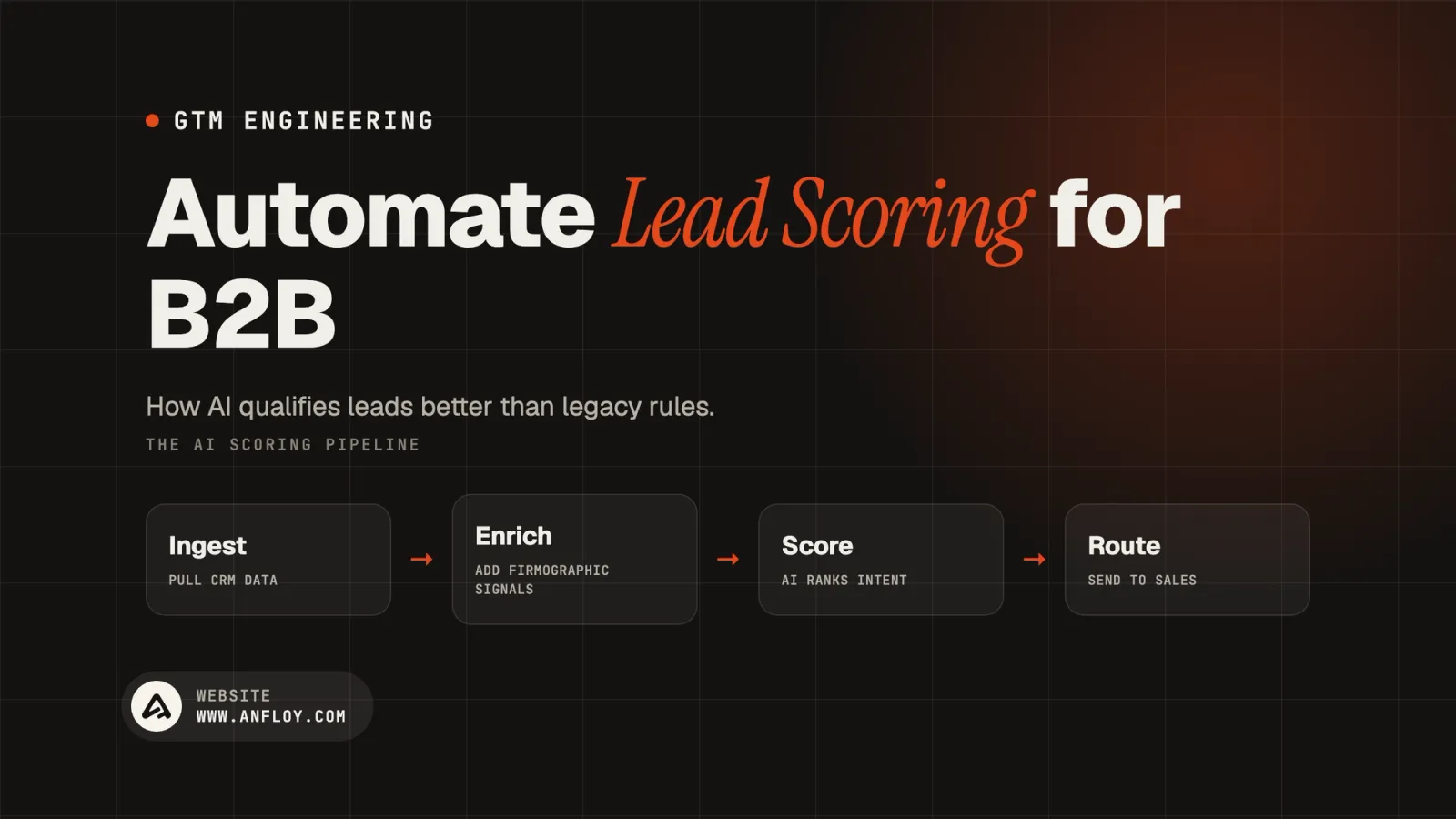
A typical workflow looks like this:

New Lead Enters CRM
        │
        ▼
Data Enrichment
        │
        ▼
Behavior Analysis
        │
        ▼
AI Prediction Model
        │
        ▼
Lead Score Generated
        │
        ▼
CRM Updated
        │
        ▼
Lead Routing
Sales Alerts
Marketing Automation
The entire process can happen within seconds, allowing sales teams to respond while buyer intent is still high.
What is the key signals AI uses to score B2B leads?
Modern AI models don't rely on a single factor. Instead, they evaluate dozens or even hundreds of variables simultaneously.
Some of the most influential signals include:
Firmographic signals
These describe the company behind the lead.
Examples include:
- Industry
- Company size
- Revenue
- Employee count
- Funding stage
- Geographic location
- Growth rate
Firmographic data helps determine whether an organization matches your AI-powered fit scoring for icp lead list.
Demographic signals
AI also evaluates the individual contacting your business.
Important attributes include:
- Job title
- Department
- Seniority level
- Decision-making authority
- Years of experience
For example, a Director of Revenue Operations may receive a higher score than an intern because they are more likely to influence purchasing decisions.
Behavioral signals
Behavior often reveals buying intent better than static profile information.
AI monitors activities such as:
- Pricing page visits
- Demo requests
- Webinar attendance
- Whitepaper downloads
- Repeat website visits
- Product comparisons
- Email engagement
These interactions help AI estimate how close a prospect is to making a purchase.
Product usage signals
For SaaS businesses, product engagement is one of the strongest indicators of future revenue.
Common metrics include:
- Trial activation
- Daily active users
- Feature adoption
- Workspace creation
- Team invitations
- Session frequency
- Time spent inside the product
AI identifies usage patterns that correlate with successful customer conversions.
Intent signals
Third-party intent platforms reveal when companies are actively researching specific solutions.
Examples include:
- Industry keyword research
- Technology comparisons
- Competitor evaluations
- Review website activity
- Content consumption
- Lead scoring software adoption trends
Intent data allows AI to identify prospects before they even contact your sales team.
Step-by-step guide to AI lead scoring system implementation
Implementing AI scoring doesn't require rebuilding your entire GTM stack.
Follow these steps for a successful rollout.
Step 1: Define your ideal customer profile (ICP)
Start by identifying the characteristics of your best customers.
Consider factors such as:
- Industry
- Company size
- Revenue
- Geography
- Technology stack
- Buying committee
- Average deal size
A well-defined ICP provides the foundation for more accurate AI predictions.
Step 2: Improve CRM data quality
AI performs only as well as the data it receives.
Before training a model:
- Remove duplicates
- Standardize lifecycle stages
- Verify contact information
- Fill missing fields
- Enrich company data
High-quality CRM data leads to more reliable lead scores.
Step 3: Connect your GTM systems
AI needs access to information from across your revenue organization.
Typical integrations include:
- CRM
- Marketing automation
- Product analytics
- Customer success platform
- Billing system
- Website analytics
- Intent data providers
Connecting these systems creates a more complete view of each prospect.
Step 4: Train the AI model
Most AI platforms analyze historical opportunities to identify common characteristics among successful customers.
The model then learns patterns such as:
- Which industries convert most often
- Which behaviors predict purchases
- Which marketing channels produce high-value leads
- Which product usage patterns lead to expansion
Training improves over time as additional deals are won or lost.
Step 5: Automate lead routing
Once scores are generated, automation should immediately trigger the next action.
Examples include:
- Assign high-value leads to senior sales representatives
- Notify account executives
- Launch personalized email sequences
- Schedule follow-up tasks
- Update CRM records
- Trigger Slack or Teams notifications
Automation ensures no qualified opportunity is overlooked.
What are the best AI lead scoring tools?
Several platforms now offer AI-powered lead scoring tools capabilities.
| Tool | Best For | AI Scoring | CRM Integration |
|---|---|---|---|
| HubSpot | Marketing automation | ✅ | Excellent |
| Salesforce Einstein | Enterprise CRM | ✅ | Native |
| 6sense | Intent-based selling | ✅ | Excellent |
| MadKudu | Predictive lead scoring | ✅ | Strong |
| Apollo.io | Sales prospecting | Partial | Strong |
| Clay | AI workflows & enrichment | Custom | Excellent |
| ZoomInfo | Revenue intelligence | ✅ | Strong |
The best AI tools lead scoring depends on your CRM, GTM maturity, and existing technology stack.
AI Lead Scoring in GTM Engineering
AI lead scoring has become a core capability within modern GTM Engineering.
Rather than functioning as an isolated marketing feature, lead scoring now integrates directly with:
- CRM systems
- Workflow automation
- Revenue Operations
- Data enrichment
- Customer lifecycle automation
- AI agents
- Revenue Intelligence platforms
GTM Engineers design the workflows that connect these systems, ensuring lead scores automatically influence routing, personalization, reporting, and customer engagement.
This integration transforms lead scoring from a static ranking system into an intelligent decision-making engine across the entire go-to-market organization.
What are the best practices for AI lead scoring?
Implementing AI lead scoring solutions is not simply about enabling a new feature in your CRM. The quality of your results depends on the data you collect, the workflows you automate, and how frequently you evaluate your scoring model.
Follow these best practices to maximize the value of AI-powered lead scoring.
Start with high-quality data
Artificial intelligence depends on clean, complete, and reliable data.
If your CRM contains duplicate records, outdated contact information, or inconsistent lifecycle stages, AI predictions become less accurate.
Before implementing AI lead scoring:
- Remove duplicate contacts and companies
- Standardize CRM fields
- Verify email addresses and phone numbers
- Enrich missing company information
- Define consistent lifecycle stages
- Audit historical opportunity data
Better data produces better predictions.
Combine multiple data sources
The strongest AI models analyze information from multiple systems rather than relying on CRM data alone.
Consider integrating:
- CRM platforms
- Marketing automation tools
- Website analytics
- Product usage data
- Customer success platforms
- Billing systems
- Intent data providers
- Data enrichment platforms
A unified data foundation gives AI a more complete picture of buyer intent.
Continuously train the model
Buying behavior changes over time.
New industries emerge, customer priorities shift, and successful sales motions evolve.
Retraining AI models with recent customer data helps maintain scoring accuracy.
Organizations should regularly review:
- Won opportunities
- Lost opportunities
- Expansion deals
- Churned customers
- Marketing campaign performance
Continuous learning keeps HubSpot lead scoring aligned with current market conditions.
Automate sales workflows
Lead scoring delivers the most value when paired with workflow automation.
For example:
- Assign high-scoring leads to senior account executives
- Notify sales managers of enterprise opportunities
- Trigger personalized email sequences
- Schedule follow-up tasks automatically
- Create CRM activities
- Update opportunity stages
Automation reduces response times and ensures qualified leads receive immediate attention.
Measure business outcomes
Lead scores themselves are not the ultimate goal.
Instead, evaluate how AI scoring influences business performance.
Track metrics such as:
- Lead-to-opportunity conversion rate
- Opportunity win rate
- Sales cycle length
- Pipeline velocity
- Revenue generated
- Customer acquisition cost (CAC)
- Marketing qualified lead (MQL) quality
These KPIs demonstrate whether AI scoring is improving revenue outcomes.
Common AI lead scoring mistakes
Even sophisticated AI models can produce disappointing results if implemented incorrectly.
Avoid these common mistakes.
Relying on poor CRM data
Incomplete or inaccurate CRM data reduces prediction quality.
Regular data hygiene is essential for maintaining trustworthy lead scores.
Ignoring human feedback
AI should support not replace sales expertise.
Encourage sales representatives to provide feedback when lead scores don't reflect real buying intent.
This feedback can improve future model performance.
Treating AI as a "Set It and forget it" system
AI models require ongoing monitoring.
Regularly review scoring accuracy, conversion rates, and business outcomes to ensure the model continues delivering value.
Using too few signals
Evaluating only website visits or email opens limits AI performance.
The best models combine:
- Firmographic data
- Behavioral signals
- Product usage
- Intent data
- CRM history
- Customer engagement
The broader the data foundation, the stronger the predictions.
Failing to explain scores
Sales teams are more likely to trust AI when they understand why a lead received a high or low score.
Whenever possible, choose tools that provide score explanations or key contributing factors.
Transparency increases adoption and improves decision-making.
What is the future of AI lead scoring?
Conversational ai lead scoring is rapidly evolving from predictive analytics into autonomous decision-making.
Over the next few years, organizations can expect several major advancements.
Agentic AI
Instead of simply assigning scores, AI agents will:
- Qualify leads
- Schedule meetings
- Recommend outreach strategies
- Update CRM records
- Trigger workflows
- Coordinate follow-up actions
Lead scoring will become one component of a broader autonomous revenue process.
Real-Time scoring
Traditional scoring models often update periodically.
Future AI systems will recalculate scores instantly whenever a prospect:
- Visits your website
- Opens an email
- Uses your product
- Researches competitors
- Changes job roles
- Raises funding
Real-time scoring enables sales teams to act on buying intent immediately.
Revenue intelligence integration
Lead scores will increasingly combine with Revenue Intelligence platforms to provide:
- Pipeline risk predictions
- Deal health insights
- Expansion opportunities
- Churn probability
- Next-best-action recommendations
Rather than evaluating leads in isolation, AI will analyze the entire customer lifecycle.
Company AI brains
Many organizations are developing centralized AI knowledge systems that connect CRM data, documentation, customer conversations, product usage, and operational metrics.
AI lead scoring marketing tool will become a core capability within these Company AI Brains, allowing every customer interaction to improve future predictions.
How Anfloy helps in Al lead scoring?
At Anfloy, we help B2B companies build AI-powered GTM systems that improve lead qualification, automate revenue workflows, and accelerate pipeline growth.
Our GTM Engineering services include:
- AI lead scoring implementation
- CRM architecture and optimization
- Workflow automation
- Revenue Operations
- Data enrichment
- API integrations
- AI-powered lead routing
- Revenue Intelligence
- Customer lifecycle automation
Whether you're replacing manual scoring models or building an AI-first go-to-market strategy, we help create scalable systems that prioritize the right prospects at the right time.
Conclusion
AI lead scoring has transformed how B2B organizations identify, prioritize, and engage potential customers. Instead of relying on static rules and manual assumptions, modern AI models analyze hundreds of signals to predict which prospects are most likely to convert.
By combining CRM data, behavioral insights, firmographic information, product usage, and intent signals, businesses can improve sales productivity, increase conversion rates, and automate lead qualification at scale.
As AI, Revenue Intelligence, and GTM Engineering continue to evolve, lead scoring will become even more intelligent, real-time, and deeply integrated into every stage of the customer journey.
Organizations that invest in AI-powered lead scoring today will be better positioned to build efficient, data-driven go-to-market strategies tomorrow.
Transform Lead Qualification with Anfloy
The best sales teams don't chase every lead they focus on the right ones.
Anfloy helps businesses implement AI-powered lead scoring through GTM Engineering, CRM optimization, workflow automation, Revenue Operations, data enrichment, and intelligent routing. We build scalable systems that turn customer data into actionable insights, helping your team engage high-intent prospects faster and grow revenue more efficiently.
Book you call!
Frequently Asked Questions
How is AI lead scoring different from traditional lead scoring?
Traditional lead scoring relies on manually assigned rules and point values. AI lead scoring continuously learns from historical data and automatically identifies complex buying patterns that manual models often miss.
How can AI improve lead scoring and targeting?
AI analyzes customer behavior, engagement, demographics, and historical data to prioritize high-potential leads, improve targeting accuracy, personalize outreach, and help sales teams focus on prospects most likely to convert.
How does AI improve lead scoring in sales?
AI evaluates buying signals, past interactions, and behavioral patterns to automatically rank leads, reducing manual effort while helping sales teams engage qualified prospects at the right time.
How AI improves lead scoring in sales?
AI improves lead scoring by using predictive analytics and machine learning to identify high-intent prospects, assign accurate scores, and continuously refine rankings based on new customer data.
Which CRM offers built-in AI for lead scoring?
Popular CRMs with built-in AI lead scoring include Salesforce Einstein, HubSpot, Microsoft Dynamics 365, Zoho CRM, Freshsales, and Pipedrive, offering predictive lead prioritization features.
How AI sales agents handle lead scoring?
AI sales agents automatically assess prospect intent, engagement, and behavior, assign dynamic lead scores, prioritize follow-ups, and update rankings continuously as new interactions occur.
What are the best AI lead scoring tools?
Top AI lead scoring tools include Salesforce Einstein, HubSpot AI, Zoho CRM, Freshsales, Microsoft Dynamics 365, 6sense, MadKudu, and Leadspace for predictive lead qualification.
How to track leads influenced by AI lead scoring?
Track AI-influenced leads by monitoring CRM attribution reports, conversion rates, pipeline progression, engagement metrics, and comparing AI-prioritized leads against manually scored opportunities for performance improvements.
Let's build
what your
company needs.
Drop your email. We'll send The Custom Agent Blueprint on what we'd build first for a company like yours, before you ever take a meeting.