
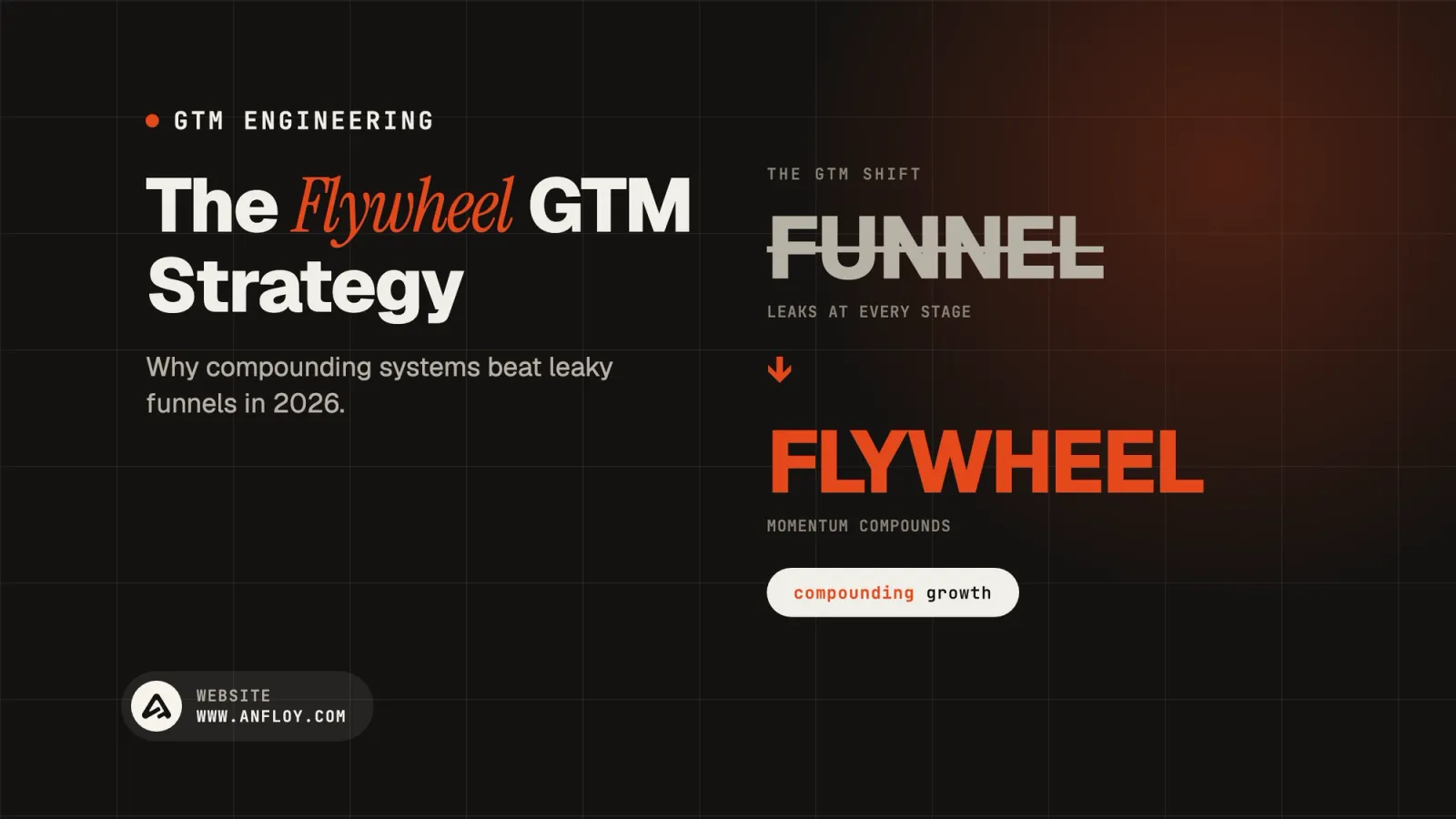
What Is the Flywheel GTM Strategy? Build Compounding Revenue Systems in 2026
Discover the flywheel GTM strategy, why it beats funnels, and how AI, GTM engineering, and Revenue Intelligence fuel growth.
On this page
- What is the flywheel GTM strategy?
- Flywheel GTM strategy vs traditional funnel
- Why the flywheel GTM strategy matters in 2026
- What are the five components of a flywheel GTM strategy?
- What are the top real-world example of a flywheel GTM strategy?
- What are the three types of GTM flywheels?
- Why flywheel GTM strategies perform better in the AI era?
- How to build a flywheel GTM strategy?
- The role of GTM engineering
- What are the top common flywheel GTM strategy mistakes?
- What are the best KPIs for flywheel GTM strategies?
- How Anfloy builds flywheel GTM strategies?
- What is the future of flywheel GTM strategies?
- Conclusion
For decades, businesses have relied on funnels to understand growth.
The framework was simple:
- Generate awareness.
- Capture leads.
- Create opportunities.
- Close customers.
Funnels helped organizations visualize the customer journey, measure conversion rates, and forecast revenue.
But modern businesses no longer grow in straight lines.
Today's buyers:
- conduct independent research
- consume content across multiple channels
- expect personalized experiences
- trust peer recommendations
- engage with brands long before speaking with sales
Growth has changed.
It's no longer linear.
It's compounding.
This shift has given rise to a new go-to-market model: the Flywheel GTM Strategy.
Unlike a traditional funnel, a flywheel doesn't stop once a prospect becomes a customer. Instead, every customer interaction contributes to future growth.
Content drives traffic.
Traffic generates leads.
Leads become customers.
Customers create advocacy.
Advocacy improves future content and sales efforts.
The cycle repeats.
The result is a self-reinforcing growth engine that becomes more effective over time.
Modern Flywheel GTM strategies increasingly incorporate:
- GTM Engineering
- Company AI Brains
- AI Agents
- Revenue Intelligence
- AI Orchestration
- Company Intelligence
- Personalized Outbound Systems
Together, these capabilities transform go-to-market activities into intelligent systems capable of continuously generating momentum.
What is the flywheel GTM strategy?
The Flywheel GTM Strategy is a go-to-market framework that uses interconnected systems to create continuous momentum across marketing, sales, customer success, and revenue operations.
Instead of treating growth as a sequence of isolated activities, the flywheel approach treats every customer interaction as an opportunity to improve future outcomes.
A simplified Flywheel GTM Strategy looks like this:

Content
   ↓
Traffic
   ↓
Leads
   ↓
Pipeline
   ↓
Customers
   ↓
Advocacy
   ↓
Intelligence
   ↓
Optimization
   ↓
Better Content
Every output becomes an input for future growth.
For example:
- Great content attracts prospects.
- Prospects generate customer data.
- Customer data improves personalization.
- Personalization improves conversions.
- More customers create more advocacy.
- Advocacy improves future content performance.
Unlike funnels, which require constant replenishment, flywheels generate momentum.
And momentum compounds.
This is why many of today's highest-performing B2B organizations are adopting Flywheel GTM strategies.
Flywheel GTM strategy vs traditional funnel
Although both frameworks help businesses grow, they operate very differently.
| Traditional Funnel | Flywheel GTM Strategy |
|---|---|
| Linear | Continuous |
| Ends at conversion | Never stops |
| Campaign-focused | System-focused |
| Manual optimization | Continuous optimization |
| Department ownership | Cross-functional ownership |
| Limited feedback loops | Compounding feedback loops |
Funnels are excellent for reporting.
Flywheels are excellent for building sustainable growth.
A funnel asks:
"How many leads did we generate?"
A flywheel asks:
"How much momentum did we create?"
That difference changes how organizations think about:
- customer acquisition
- retention
- content
- revenue operations
- AI implementation
- long-term growth
Why the flywheel GTM strategy matters in 2026
Several trends are accelerating the adoption of flywheel-based GTM models.
Rising customer acquisition costs
Paid acquisition costs continue to increase across nearly every industry.
Businesses need systems that continue generating value long after an initial investment.
Flywheels provide that advantage.
AI has changed go-to-market
Artificial intelligence has dramatically improved:
- personalization
- forecasting
- workflow automation
- account research
- reporting
These capabilities make Flywheel GTM strategies more powerful than ever.
Buyers expect better experiences
Modern buyers expect:
- relevant content
- faster responses
- personalized interactions
- consistent experiences
Flywheels encourage organizations to optimize every touchpoint across the customer journey.
Revenue teams need better systems
Many organizations still struggle with:
- disconnected tools
- poor CRM hygiene
- weak attribution
- inconsistent reporting
Flywheel GTM strategies help unify these activities into one coordinated system.
The companies that win in the next decade won't necessarily spend the most on marketing.
They'll build the best growth systems.
What are the five components of a flywheel GTM strategy?
Every successful GTM flywheel includes five core components:
- Content Engine
- Inbound Engine
- Outbound Engine
- Customer Success Engine
- Intelligence Layer
Let's explore each one in detail.
1. Content engine
Content is often the starting point of the flywheel.
Examples include:
- SEO articles
- comparison pages
- case studies
- newsletters
- webinars
- LinkedIn content
The objective of content isn't simply to generate traffic.
It's to establish trust and create momentum.
Modern content engines should incorporate:
- Semantic SEO
- AI Overview optimization
- topical authority
- internal linking
- content refresh workflows
High-performing content compounds over time, making it one of the most valuable components of a GTM flywheel.
2. Inbound engine
Inbound converts attention into opportunities.
A typical inbound flywheel looks like this:

Traffic
   ↓
Lead Capture
   ↓
Qualification
   ↓
CRM
   ↓
Nurturing
   ↓
Pipeline
Most inbound systems include:
- contact forms
- demo requests
- newsletters
- webinars
- lead magnets
- nurturing sequences
The objective isn't simply to capture leads.
It's to create a predictable pipeline.
Modern inbound systems should support:
- automated lead routing
- CRM enrichment
- lead scoring
- AI-assisted qualification
- attribution reporting
The most successful organizations continuously optimize their inbound engine using customer data and Revenue Intelligence.
3. Outbound engine
Outbound remains one of the fastest ways to generate pipeline.
However, outbound has changed significantly.
Traditional outbound relied on:
- cold email volume
- generic messaging
- manual research
Modern outbound focuses on:
- Company Intelligence
- buying signals
- AI personalization
- multi-channel engagement
A simplified outbound flywheel looks like this:
Buying Signals
   ↓
Research
   ↓
Personalization
   ↓
Outreach
   ↓
Meetings
   ↓
Pipeline
   ↓
Revenue Intelligence
Examples of buying signals include:
- funding announcements
- hiring activity
- leadership changes
- technology adoption
AI increasingly supports outbound through:
- AI SDRs
- account research agents
- personalization engines
- meeting preparation
Outbound becomes significantly more effective when connected to the broader GTM flywheel.
4. Customer success engine
One of the biggest limitations of funnels is that they stop at conversion.
Flywheels don't.
Customers become one of the most important inputs into future growth.
Examples include:
- testimonials
- reviews
- referrals
- product feedback
- expansion opportunities
Customer success teams should continuously ask:
"How can we turn today's customers into tomorrow's growth channel?"
Examples of customer success activities include:
- onboarding
- renewal management
- customer education
- advocacy programs
Organizations with strong customer success functions frequently experience:
- higher retention
- increased referrals
- improved expansion revenue
Customer success isn't the end of the flywheel.
It's the beginning of the next cycle.
5. The intelligence layer
The Intelligence Layer is what separates modern GTM flywheels from traditional growth systems.
This layer typically includes:
- Revenue Intelligence
- Company AI Brains
- AI Agents
- AI Orchestration
- Company Intelligence
Without intelligence, businesses struggle to answer questions like:
- Which content drives revenue?
- Which accounts are most likely to convert?
- Where is pipeline leaking?
- Which channels perform best?
Revenue Intelligence provides visibility into:
- forecasting
- attribution
- pipeline health
- conversion rates
Company AI Brains provide:
- centralized knowledge
- customer history
- sales context
- operational insights
AI Agents support:
- research
- reporting
- enrichment
- optimization
AI Orchestration coordinates:
- workflows
- approvals
- monitoring
- reporting
Together, these systems transform GTM flywheels into intelligent revenue engines.
What are the top real-world example of a flywheel GTM strategy?
Consider a B2B SaaS company selling workflow automation software.
Step 1: Content generates awareness
The company publishes:
- SEO articles
- comparison pages
- webinars
- customer stories
This generates:
- traffic
- newsletter subscribers
- demo requests
Step 2: Inbound creates opportunities
Visitors enter the GTM system through:
- forms
- product demos
- newsletters
The CRM automatically:
- enriches records
- scores leads
- routes opportunities
Step 3: Outbound accelerates growth
Sales teams use:
- buying signals
- account intelligence
- AI personalization
This improves:
- response rates
- meeting volume
- pipeline generation
Step 4: Customer success creates advocacy
Customer success teams collect:
- testimonials
- referrals
- case studies
These assets feed future marketing and sales activities.
Step 5: Revenue intelligence optimizes performance
Revenue Intelligence identifies:
- highest-converting channels
- strongest customer segments
- top-performing content
These insights improve future GTM activities.
This illustrates the defining characteristic of a flywheel:
Every output becomes an input for future growth.
What are the three types of GTM flywheels?
Most organizations operate multiple flywheels simultaneously.
Content flywheel
Research
   ↓
Create
   ↓
Publish
   ↓
Distribute
   ↓
Rank
   ↓
Optimize
Examples include:
- SEO
- Semantic SEO
- AI Overview optimization
Inbound flywheel
Traffic
   ↓
Lead Capture
   ↓
Qualification
   ↓
CRM
   ↓
Customer
Benefits include:
- better attribution
- improved conversion rates
- stronger customer experiences
Outbound flywheel
Signals
   ↓
Research
   ↓
Personalization
   ↓
Outreach
   ↓
Pipeline
Modern outbound increasingly relies on:
- AI SDRs
- Revenue Intelligence
- Company Intelligence
Together, these flywheels create a comprehensive GTM strategy.
Why flywheel GTM strategies perform better in the AI era?
Artificial intelligence has fundamentally changed go-to-market execution.
AI enables organizations to:
- personalize communications
- automate workflows
- improve forecasting
- identify opportunities
- optimize continuously
This makes flywheel strategies significantly more effective.
| Capability | Traditional GTM | Flywheel GTM + AI |
|---|---|---|
| Personalization | Manual | Automated |
| Reporting | Weekly | Real-Time |
| Forecasting | Reactive | Predictive |
| Optimization | Periodic | Continuous |
| Scalability | Limited | High |
AI doesn't replace GTM strategies.
It makes them smarter.
And smarter systems create more momentum.
How to build a flywheel GTM strategy?
Building a GTM flywheel doesn't happen overnight.
The most successful organizations treat it as a long-term investment in infrastructure rather than a short-term marketing initiative.
A practical Flywheel GTM framework looks like this:

ICP
 ↓
Content Engine
 ↓
Inbound Engine
 ↓
Outbound Engine
 ↓
Customer Success
 ↓
Revenue Intelligence
 ↓
AI Orchestration
 ↓
Optimization
Step 1: Define your ideal customer profile (ICP)
Every flywheel begins with understanding:
- industry
- company size
- geography
- buying behavior
- operational challenges
The better your ICP, the more effective every downstream activity becomes.
Step 2: Build a content engine
Your content engine should continuously produce:
- SEO content
- comparison pages
- thought leadership
- newsletters
- customer stories
Modern content engines should also support:
- Semantic SEO
- entity optimization
- AI Overview visibility
- topical authority
Step 3: Implement inbound systems
Examples include:
- lead capture forms
- CRM automation
- lead scoring
- nurturing workflows
The objective is to convert attention into opportunities.
Step 4: Create an outbound engine
Modern outbound should leverage:
- buying signals
- Company Intelligence
- AI personalization
- account enrichment
Outbound is no longer a volume game.
It's an intelligence game.
Step 5: Invest in customer success
Customer success should focus on:
- retention
- referrals
- expansion
- advocacy
Remember:
Customers are not the end of the flywheel. They are fuel for the next rotation.
Step 6: Deploy revenue intelligence
Track:
- pipeline generated
- customer acquisition cost
- conversion rates
- customer lifetime value
Without Revenue Intelligence, optimization becomes difficult.
Step 7: Add AI orchestration
AI orchestration coordinates:
- AI agents
- workflows
- reporting
- approvals
This transforms disconnected systems into one intelligent GTM platform.
Step 8: Optimize continuously
Flywheels are never complete.
The best GTM organizations continuously improve:
- content
- workflows
- messaging
- customer experiences
Momentum compounds over time.
The role of GTM engineering
Modern GTM flywheels require technical ownership.
This responsibility increasingly belongs to GTM engineering teams.
GTM engineering typically includes:
- CRM implementation
- workflow automation
- integrations
- AI orchestration
- Revenue Intelligence
- reporting systems
Without GTM engineering, businesses often experience:
- disconnected tools
- weak attribution
- inconsistent workflows
- poor visibility
In many ways, GTM engineering acts as the infrastructure behind the flywheel.
You can't build momentum on a weak foundation.
What are the top common flywheel GTM strategy mistakes?
Many organizations attempt to build GTM flywheels but fail to achieve meaningful results.
Treating flywheels like campaigns
Campaigns have:
- start dates
- end dates
Flywheels are continuous systems.
Ignoring customer success
Businesses frequently invest heavily in acquisition while neglecting retention and advocacy.
This limits the compounding effect of the flywheel.
No intelligence layer
Organizations without Revenue Intelligence and AI struggle to optimize effectively.
Poor CRM hygiene
Examples include:
- duplicate records
- incomplete profiles
- outdated information
Poor data creates poor decisions.
Overlooking GTM engineering
Flywheels require:
- integrations
- automation
- orchestration
Without GTM engineering, scaling becomes difficult.
What are the best KPIs for flywheel GTM strategies?
Recommended KPIs include:
Growth metrics
- organic traffic
- pipeline generated
- meetings booked
- customer acquisition cost
Revenue metrics
- customer lifetime value
- expansion revenue
- forecast accuracy
- revenue influenced
Content metrics
- keyword rankings
- AI Overview visibility
- backlinks
- conversions
Customer metrics
- retention rate
- referral rate
- NPS
- renewal rate
AI metrics
- workflow completion rates
- AI adoption
- automation savings
Ultimately, every metric should support one question:
Is the flywheel creating more momentum?
How Anfloy builds flywheel GTM strategies?
At Anfloy, we help organizations build AI-powered GTM flywheels designed for long-term growth.
Our methodology includes:
Discovery
We identify:
- business objectives
- GTM challenges
- revenue goals
- operational bottlenecks
Company AI brain
We centralize:
- CRM records
- customer history
- internal knowledge
- sales playbooks
GTM engineering
We implement:
- automations
- integrations
- reporting systems
- workflow infrastructure
Revenue intelligence
Every GTM activity is connected to:
- pipeline
- forecasting
- business outcomes
AI agents
We deploy:
- Company Intelligence Agents
- Revenue Intelligence Agents
- CRM Agents
- Content Agents
AI orchestration
AI orchestration ensures every component of the flywheel works together effectively.
Continuous optimization
Flywheels improve through:
- testing
- reporting
- AI insights
- customer feedback
Our goal isn't simply to generate leads.
It's to build systems that generate momentum.
Ready to Build an AI-Powered GTM Engine?
From Company AI Brains and AI Agents to GTM Flywheels and AI Orchestration, Anfloy helps businesses build revenue systems designed for the AI era.
👉 Book a Strategy Call
What is the future of flywheel GTM strategies?
The next generation of GTM flywheels will become increasingly autonomous.
Organizations will deploy:
- AI coworkers
- AI SDRs
- Revenue Intelligence Agents
- multi-agent systems
- autonomous workflows
Future GTM flywheels will:
- identify opportunities automatically
- personalize communications
- forecast revenue
- optimize continuously
In many ways, GTM flywheels are becoming AI operating systems for revenue teams.
Businesses that invest in these capabilities today will be better positioned for tomorrow.
Conclusion
The future of go-to-market isn't linear.
It's compounding.
The organizations that win over the next decade won't simply run more campaigns.
They'll build better systems.
By combining content, inbound, outbound, customer success, GTM engineering, Revenue Intelligence, and AI, businesses can create GTM flywheels that become stronger with every interaction.
At Anfloy, we believe momentum is one of the most valuable assets a company can build.
Because campaigns end.
Flywheels don't.
Frequently Asked Questions
How is a GTM flywheel different from a sales funnel?
Funnels are linear and end at conversion. GTM flywheels are continuous systems designed to improve over time.
Why are GTM flywheels important?
They improve: scalability attribution customer experience revenue predictability
How does AI improve Flywheel GTM Strategies?
AI improves: personalization forecasting workflow automation reporting
Can startups use GTM flywheels?
Yes. Startups often benefit significantly because flywheels create scalable growth systems early in their lifecycle.


Let's build
what your
company needs.
Drop your email. We'll send The Custom Agent Blueprint on what we'd build first for a company like yours, before you ever take a meeting.