
What Is a GTM Flywheel? Guide to Building Compounding Growth Systems in 2026
Learn what a GTM flywheel is, how it differs from a traditional funnel, and how businesses use content, inbound, outbound, and AI to create compounding revenue growth.
On this page
- What is a GTM flywheel?
- What is the difference between GTM flywheel vs traditional funnel?
- What is the benefit of GTM flywheels?
- Why GTM flywheels matter in 2026?
- What is the anatomy of a GTM flywheel?
- What are the three types of GTM flywheels?
- The AI layer
- How to build a GTM flywheel step by step?
- What is the important KPIs for GTM flywheels?
- What are the common GTM flywheel mistakes?
- How do Anfloy builds GTM flywheels?
- What is the future of GTM flywheels?
- Conclusion
For decades, businesses have measured growth using funnels.
The concept is straightforward:
- attract prospects
- generate leads
- create opportunities
- close customers
Funnels helped organizations understand how people move through the buying process.
They also created a limitation.
Funnels assume that growth is linear.
A prospect enters the top of the funnel, moves through several stages, and eventually exits as either a customer or a lost opportunity. Once that process ends, the funnel starts again.
Modern go-to-market teams operate differently.
Today's buyers:
- conduct independent research
- engage across multiple channels
- consume educational content
- trust peer recommendations
- interact with brands long before speaking with sales
Growth is no longer linear.
It's cumulative.
This is why GTM flywheels are becoming one of the most important concepts in modern revenue operations.
Unlike funnels, GTM flywheels are designed to create momentum. Every interaction contributes to future growth.
Content drives traffic.
Traffic generates leads.
Leads become customers.
Customers create advocacy.
Advocacy improves future content.
The cycle repeats.
Artificial intelligence has accelerated this transition.
Modern GTM flywheels increasingly include:
- Company AI Brains
- AI Agents
- GTM Engineering
- Revenue Intelligence
- AI Orchestration
- Company Intelligence
- Personalized Outbound Systems
Together, these capabilities create intelligent systems that continuously improve over time.
By the end, you'll understand why leading organizations are replacing campaign-based growth with compounding systems.
What is a GTM flywheel?
A GTM (Go-to-Market) flywheel is a self-reinforcing growth system where marketing, sales, customer success, and intelligence continuously generate momentum and revenue.
Unlike traditional funnels, GTM flywheels don't stop at conversion.
Instead, customers contribute to future growth through:
- referrals
- testimonials
- reviews
- product feedback
- community participation
- customer data
This creates a compounding effect.
A simplified GTM flywheel looks like this:

Content
   ↓
Traffic
   ↓
Leads
   ↓
Pipeline
   ↓
Customers
   ↓
Advocacy
   ↓
Intelligence
   ↓
Optimization
   ↓
Better Content
Every stage contributes to future performance.
For example:
- Better content generates more traffic.
- More traffic creates additional leads.
- More leads improve pipeline.
- More customers generate additional data.
- Better data improves personalization.
- Improved personalization increases conversions.
The system becomes more effective over time.
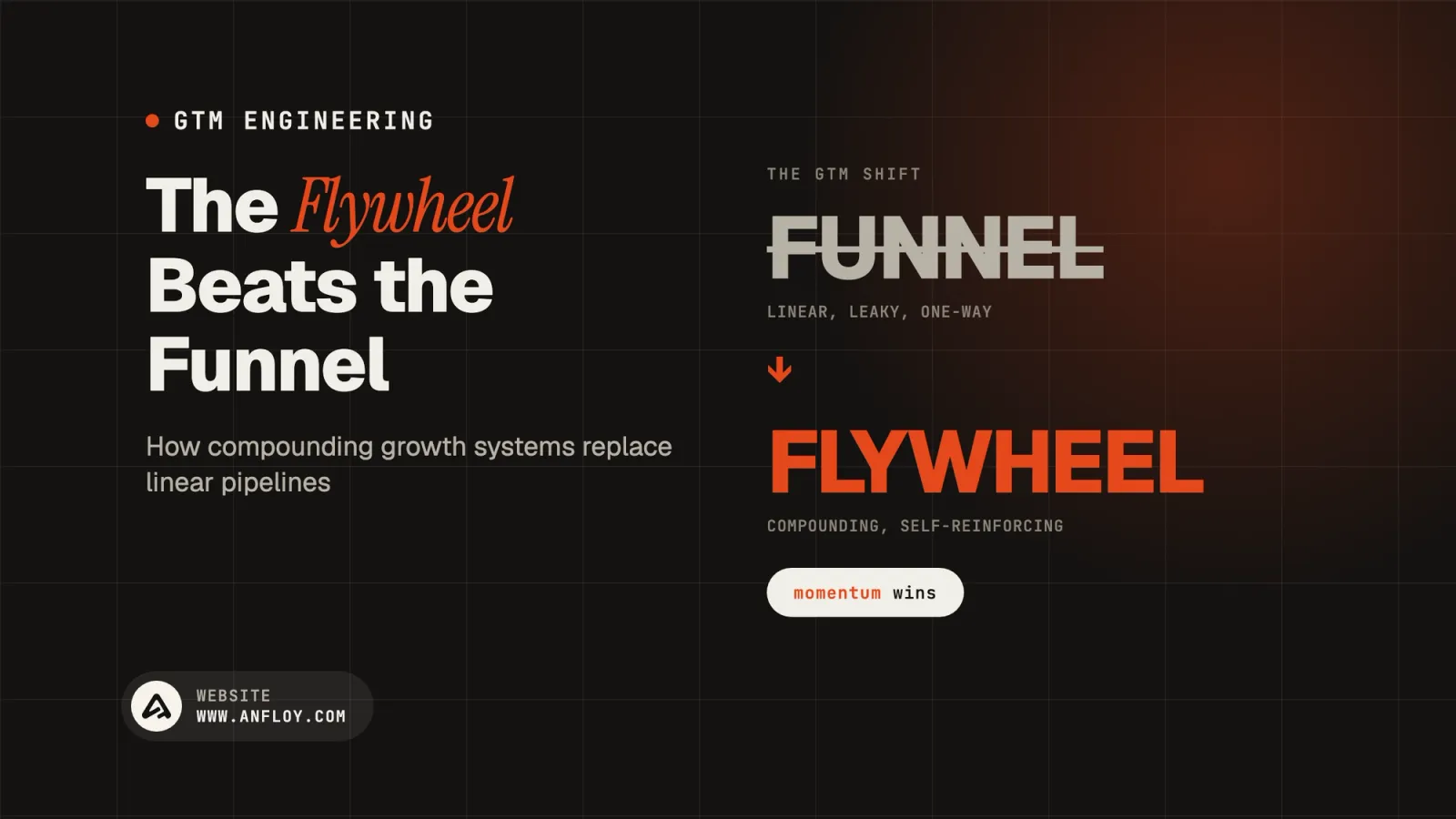
What is the difference between GTM flywheel vs traditional funnel?
Although both frameworks support growth, they operate differently.
| Traditional Funnel | GTM Flywheel |
|---|---|
| Linear | Continuous |
| Ends at conversion | Compounds indefinitely |
| Campaign-focused | System-focused |
| Limited feedback loops | Continuous optimization |
| Departmental ownership | Cross-functional ownership |
| Manual improvements | AI-assisted optimization |
Funnels remain useful for reporting.
Flywheels are better suited for understanding how modern businesses grow.
The key difference is momentum.
Funnels require constant replenishment.
Flywheels generate compounding returns.
What is the benefit of GTM flywheels?
GTM flywheels help businesses create a continuous growth cycle by aligning marketing, sales, customer success, and product teams around the customer journey. Unlike traditional funnels that end after a sale, GTM flywheels keep generating momentum through customer satisfaction, retention, referrals, and expansion.
Key benefits of GTM flywheels include:
- Lower customer acquisition costs (CAC): Happy customers drive referrals and word-of-mouth, reducing reliance on paid acquisition.
- Higher customer retention: Continuous engagement and support improve loyalty and reduce churn.
- Increased revenue growth: Existing customers are more likely to renew, upgrade, and purchase additional products or services.
- Better team alignment: Marketing, sales, customer success, and product teams work toward shared growth objectives.
- Improved customer experience: Consistent interactions across every touchpoint create stronger relationships and trust.
- Faster business growth: Each satisfied customer contributes to attracting new prospects, creating a self-reinforcing growth cycle.
- Higher customer lifetime value (CLV): Long-term customer relationships generate greater revenue over time.
- Scalable and predictable growth: A well-optimized GTM flywheel compounds results, making growth more sustainable than relying solely on new customer acquisition.
Why GTM flywheels matter in 2026?
Organizations are increasingly adopting GTM flywheels because they address several modern business challenges.
Rising customer acquisition costs
Paid acquisition costs continue to increase across industries.
Businesses need systems capable of generating sustainable growth.
Better attribution
Flywheels create stronger connections between:
- content
- pipeline
- revenue
- customer outcomes
This improves visibility across the entire customer journey.
Improved personalization
Modern GTM flywheels leverage:
- Company Intelligence
- buying signals
- AI personalization
- CRM data
This allows organizations to deliver highly relevant experiences.
Predictable pipeline
Compounding systems improve consistency.
Rather than relying on one-time campaigns, businesses build engines that continuously generate opportunities.
Stronger customer experiences
Customers increasingly influence future growth.
Organizations with strong GTM flywheels benefit from:
- referrals
- advocacy
- retention
- expansion opportunities
Growth becomes a shared responsibility across the organization.
What is the anatomy of a GTM flywheel?
Although every business builds GTM systems differently, most flywheels contain several common components.
Content
↓
Traffic
↓
Lead Capture
↓
Qualification
↓
Pipeline
↓
Customer
↓
Advocacy
↓
Revenue Intelligence
↓
Optimization
Let's explore each component.
Content
Creates awareness and attracts prospects.
Examples include:
- blog articles
- newsletters
- webinars
- case studies
Traffic
Traffic sources include:
- organic search
- referrals
- communities
- social media
Lead capture
Methods include:
- forms
- demo requests
- lead magnets
- events
Qualification
Organizations evaluate:
- ICP fit
- buying intent
- engagement
Pipeline
Qualified opportunities enter the sales process.
Customer
Customers generate both revenue and intelligence.
Advocacy
Examples include:
- testimonials
- reviews
- referrals
Revenue intelligence
Provides visibility into:
- pipeline
- conversion rates
- customer acquisition costs
Optimization
Every interaction improves future performance.
This continuous feedback loop is what makes GTM flywheels so effective.
What are the three types of GTM flywheels?
Most organizations operate multiple GTM flywheels simultaneously.
1. Content flywheel
Content remains one of the most scalable growth channels.
A content flywheel looks like:
Research
↓
Create
↓
Publish
↓
Distribute
↓
Rank
↓
Capture Insights
↓
Improve
Content flywheels frequently include:
- SEO
- Semantic SEO
- AI Overview optimization
- GEO
- internal linking
- distribution
Unlike paid advertising, content continues generating value long after publication.
2. Inbound flywheel
Inbound converts attention into opportunities.
Traffic
↓
Lead Capture
↓
CRM
↓
Nurturing
↓
Sales
↓
Customer
Examples include:
- demo requests
- newsletters
- webinars
- lead magnets
Inbound flywheels improve over time as organizations collect more customer data.
3. Outbound flywheel
Outbound is becoming increasingly intelligence-driven.
Buying Signals
   ↓
Research
   ↓
Personalization
   ↓
Outreach
   ↓
Meetings
   ↓
Pipeline
   ↓
Revenue Intelligence
Modern outbound leverages:
- buying signals
- Company Intelligence
- AI personalization
- Revenue Intelligence
This allows businesses to deliver highly relevant outreach at scale.
The AI layer
Artificial intelligence is becoming the intelligence layer across all GTM flywheels.
Modern GTM systems increasingly include:
Company AI brain
Provides centralized knowledge across:
- CRM systems
- documentation
- customer history
- sales playbooks
AI agents
Support:
- research
- enrichment
- personalization
- reporting
AI SDRs
Assist with:
- prospecting
- qualification
- outreach
AI orchestration
Coordinates:
- workflows
- approvals
- monitoring
- reporting
AI doesn't replace GTM flywheels.
It accelerates them.
How to build a GTM flywheel step by step?
Every business has a unique customer journey, which means every GTM flywheel should be designed around its specific goals, customers, and operational workflows.
However, most successful GTM flywheels follow a similar framework.
ICP
↓
Company Intelligence
↓
Content Engine
↓
Inbound Engine
↓
Outbound Engine
↓
Revenue Intelligence
↓
AI Orchestration
↓
Optimization
Step 1: Define your ICP
Your Ideal Customer Profile (ICP) should answer questions such as:
- Which industries do we serve?
- What company sizes perform best?
- Which geographies convert most frequently?
- What pain points are most common?
Examples of ICP attributes include:
- employee count
- annual revenue
- technology stack
- growth stage
- operational challenges
The more specific your ICP, the more effective your GTM flywheel becomes.
Step 2: Build company intelligence
Modern GTM teams rely on Company Intelligence to understand:
- buying signals
- market activity
- hiring trends
- leadership changes
- technology adoption
This intelligence layer improves both inbound and outbound performance.
Step 3: Create a content engine
Content fuels the GTM flywheel.
Examples include:
- SEO articles
- comparison pages
- case studies
- newsletters
- videos
- webinars
Your content engine should answer customer questions while establishing topical authority.
Step 4: Build an inbound engine
Inbound systems convert attention into opportunities.
Examples include:
- lead capture forms
- demo requests
- CRM integrations
- lead scoring
- nurturing workflows
The goal is to create a predictable flow of qualified leads.
Step 5: Build an outbound engine
Outbound systems should leverage:
- Company Intelligence
- buying signals
- AI personalization
- sequencing
Modern outbound is less about volume and more about relevance.
Step 6: Implement revenue intelligence
Revenue Intelligence provides visibility into:
- pipeline health
- forecast accuracy
- conversion rates
- customer acquisition costs
Without Revenue Intelligence, organizations struggle to optimize GTM performance.
Step 7: Add AI orchestration
AI orchestration coordinates:
- AI agents
- workflows
- approvals
- reporting
This transforms disconnected systems into a unified GTM platform.
Step 8: Optimize continuously
Flywheels improve through:
- testing
- customer feedback
- AI insights
- reporting
- experimentation
Continuous optimization is what creates compounding growth.
What is the important KPIs for GTM flywheels?
Every GTM flywheel should include clear performance metrics.
Content KPIs
- organic traffic
- keyword rankings
- AI Overview visibility
- backlinks
- conversions
Inbound KPIs
- MQLs
- SQLs
- demo requests
- conversion rates
Outbound KPIs
- reply rate
- meetings booked
- positive response rate
- pipeline generated
Business KPIs
- Customer Acquisition Cost (CAC)
- Customer Lifetime Value (LTV)
- revenue influenced
- payback period
AI KPIs
- workflow completion rate
- AI adoption
- operational savings
- automation usage
Ultimately, every KPI should support one objective:
Sustainable revenue growth.
What are the common GTM flywheel mistakes?
Although GTM flywheels are powerful, organizations frequently make several mistakes.
Treating flywheels like campaigns
Campaigns are temporary.
Flywheels are permanent systems.
Businesses that stop investing in their flywheel often lose momentum.
Ignoring AI
Modern GTM systems benefit significantly from:
- AI Agents
- AI SDRs
- Company AI Brains
- AI Orchestration
Organizations without an AI layer may struggle to scale efficiently.
Poor CRM hygiene
Examples include:
- duplicate records
- incomplete profiles
- outdated information
Strong GTM flywheels require accurate data.
Weak attribution
Organizations should always understand:
- where pipeline originated
- which channels influenced revenue
- which activities create the greatest impact
No company intelligence
Without Company Intelligence, businesses lose valuable context around:
- customers
- prospects
- buying signals
Lack of GTM engineering
Modern GTM systems increasingly require technical ownership.
GTM engineers frequently manage:
- integrations
- automations
- AI systems
- workflow orchestration
How do Anfloy builds GTM flywheels?
At Anfloy, we help organizations move beyond campaigns and build scalable GTM infrastructure.
Every implementation follows a structured process.
Discovery
We identify:
- business objectives
- revenue goals
- ICPs
- GTM challenges
Company AI brain
We centralize:
- CRM records
- customer history
- internal documentation
- sales playbooks
This becomes the knowledge layer for every GTM system.
GTM engineering
We implement:
- integrations
- automations
- reporting systems
- workflow infrastructure
Content engine
Our content systems focus on:
- Semantic SEO
- topical authority
- AI Overview optimization
- GEO
Inbound engine
We build:
- lead capture systems
- CRM workflows
- nurturing automation
Outbound engine
We deploy:
- Company Intelligence
- AI personalization
- AI SDR workflows
- buying signal monitoring
Revenue intelligence
Every GTM activity is connected to:
- pipeline
- forecasting
- revenue outcomes
AI orchestration
AI orchestration coordinates:
- AI agents
- workflows
- approvals
- monitoring
Continuous optimization
Every flywheel improves through:
- testing
- analytics
- customer feedback
- AI insights
Our objective isn't to build campaigns.
It's to build GTM systems that compound.
What is the future of GTM flywheels?
The next generation of GTM flywheels will become increasingly autonomous.
Organizations will deploy:
- AI coworkers
- AI SDRs
- Revenue Intelligence Agents
- Company Intelligence Agents
- multi-agent systems
Future GTM flywheels will:
- identify opportunities automatically
- personalize communications
- optimize continuously
- forecast revenue
- improve with minimal intervention
In many ways, GTM flywheels are becoming AI operating systems for revenue teams.
Businesses that invest in these capabilities today will be better positioned for tomorrow's competitive landscape.
Conclusion
The future of go-to-market isn't linear.
It's compounding.
Funnels helped define the previous generation of growth strategy, but modern businesses require systems capable of continuously generating momentum.
GTM flywheels provide that framework.
By combining content, inbound, outbound, Company Intelligence, Revenue Intelligence, and AI Orchestration, organizations can create scalable systems that become more valuable over time.
At Anfloy, we help businesses build these systems from the ground up designed around ownership, intelligence, and measurable business outcomes.
Because the companies that win over the next decade won't simply run better campaigns.
They'll build better flywheels.
Ready to Build an AI-Powered GTM Engine?
From Company AI Brains and AI Agents to GTM Engineering and Revenue Intelligence, Anfloy helps businesses build GTM flywheels designed for the AI era.
Book a Strategy Call
Frequently Asked Questions
How is a GTM flywheel different from a funnel?
Funnels are linear and end at conversion. GTM flywheels are continuous systems designed to create compounding growth.
How long does a GTM flywheel take to work?
Most flywheels require several months before generating significant momentum, but they become more effective over time.
What is GTM in simple words?
GTM, or Go-to-Market, is a strategy that explains how a business launches and sells a product to the right customers using marketing, sales, and distribution.
What does GTM engine mean?
A GTM engine is the system of processes, tools, and teams that consistently attract prospects, generate leads, convert customers, and drive sustainable business growth.



Let's build
what your
company needs.
Drop your email. We'll send The Custom Agent Blueprint on what we'd build first for a company like yours, before you ever take a meeting.