
Autonomous Agents: The Complete Guide to Self-Operating AI Systems in 2026
Learn what autonomous agents are, how they work, their architecture, benefits, enterprise use cases, challenges, and how businesses build autonomous AI systems in 2026.
On this page
- What are autonomous agents?
- How do autonomous agents work?
- What are the core components of autonomous agents?
- What are the levels of AI autonomy?
- What is the difference between autonomous and agentic agents?
- Autonomous agents vs AI chatbots
- Autonomous agents vs AI workflows
- What are the benefits of autonomous agents?
- What are the top challenges of autonomous agents?
- Enterprise use cases for autonomous agents
- What are the top best practices for building autonomous agents?
- Common mistakes when building autonomous agents
- How Anfloy builds autonomous AI systems?
- What is the future of autonomous agents?
- Conclusion
Artificial intelligence is entering a new phase.
For years, businesses have relied on AI assistants to answer questions, generate content, summarize documents, and automate repetitive tasks. While these capabilities have delivered significant productivity gains, they still depend heavily on human instructions. Most AI systems wait for a prompt before taking action.
Autonomous agents represent the next stage in AI evolution.
Instead of simply responding to requests, autonomous agents can understand goals, create execution plans, retrieve relevant knowledge, use software tools, make decisions, monitor results, and continuously adapt as new information becomes available. They shift AI from being a reactive assistant to becoming an active participant in business operations.
Understanding these components is essential for organizations looking to move beyond simple AI assistants and build production-ready AI systems.
In this guide, you'll learn:
- what autonomous agents are
- how they work
- the core technologies behind them
- different levels of AI autonomy
- enterprise use cases
- implementation best practices
- common challenges
- how businesses can deploy autonomous AI responsibly at scale
Whether you're exploring AI for sales, operations, customer support, software development, or enterprise automation, autonomous agents are becoming one of the most important technologies shaping the future of work.
What are autonomous agents?
An autonomous agent is an AI system capable of pursuing a goal, making decisions, using tools, and completing tasks with minimal human intervention.
Unlike traditional AI assistants that wait for user prompts, autonomous agents actively determine the steps required to achieve an objective.
They can:
- understand goals
- gather information
- retrieve business knowledge
- create execution plans
- interact with software
- evaluate outcomes
- adapt when conditions change
Rather than automating one task at a time, autonomous agents automate entire decision-making processes.
For example, imagine a sales manager asks:
"Find manufacturing companies expanding into Europe and prepare personalized outreach for our sales team."
A traditional chatbot may provide suggestions or generate a sample email.
An autonomous agent can complete the entire workflow by:
- identifying target companies
- analyzing expansion signals
- enriching CRM records
- retrieving company intelligence
- researching decision-makers
- drafting personalized emails
- scheduling follow-ups
- updating the CRM
- notifying the account executive
The user provides the objective.
The agent determines how to accomplish it.
This ability to reason and execute independently is what distinguishes autonomous agents from conventional AI applications.
How do autonomous agents work?
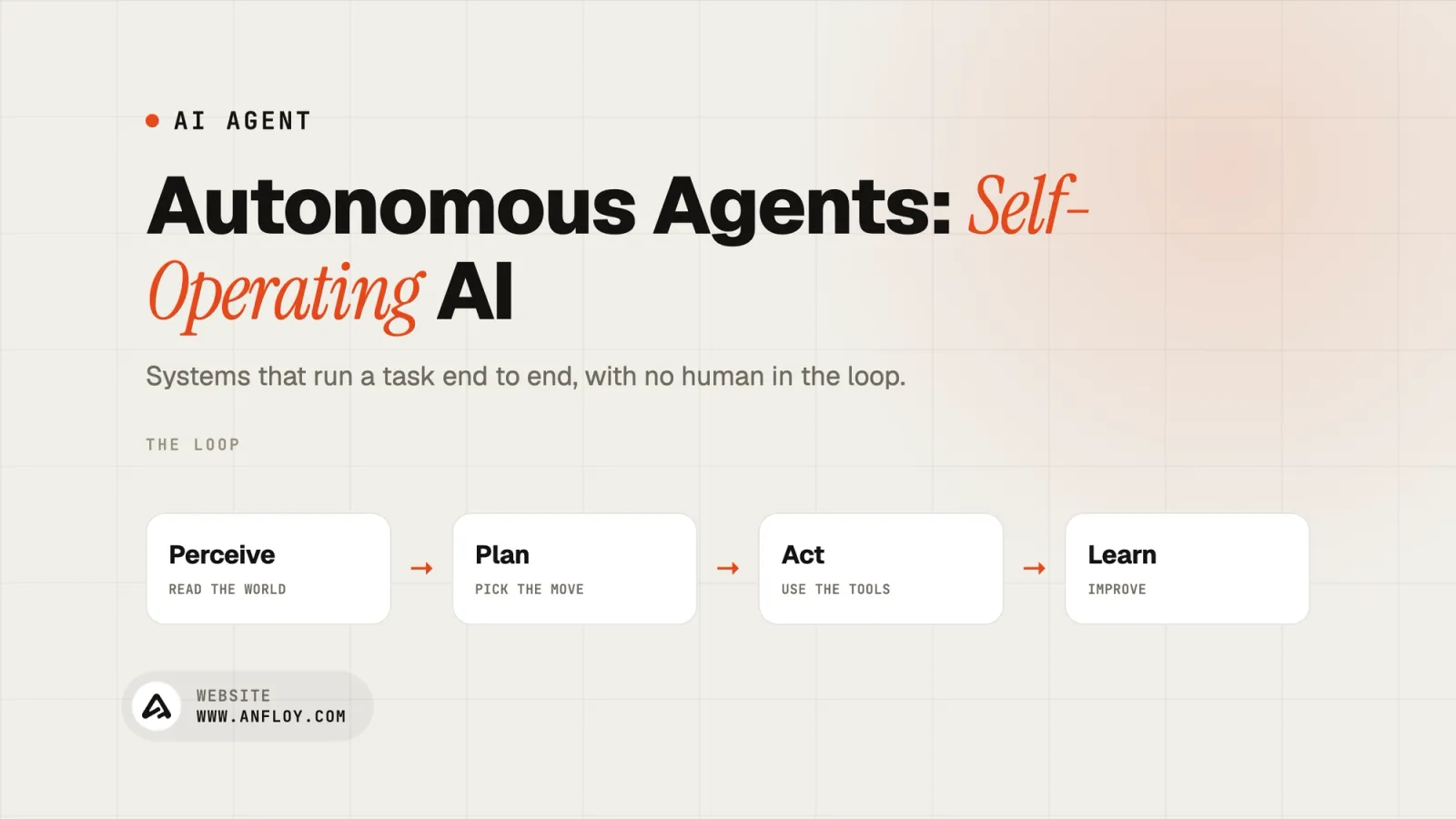
Autonomous agents operate through a continuous execution cycle that combines reasoning, planning, knowledge retrieval, and action.
Rather than generating an immediate response, they evaluate the situation before deciding what to do next.
A typical autonomous execution loop looks like this:
This cycle allows autonomous agents to handle dynamic business environments where new information becomes available throughout the workflow.
Let's examine each stage in more detail.
1. Goal interpretation
Everything begins with a clearly defined objective.
Unlike traditional automation, autonomous agents focus on outcomes rather than individual instructions.
Examples include:
- qualify new inbound leads
- reduce support response time
- prepare a quarterly business report
- identify high-intent prospects
- onboard new employees
The goal becomes the foundation for every decision that follows.
2. Context understanding
Before taking action, the agent gathers relevant context.
This may include:
- customer history
- previous conversations
- CRM records
- operational status
- business policies
- user permissions
- active workflows
Context engineering plays a critical role here.
Providing the right information improves reasoning while reducing unnecessary computation.
3. Knowledge retrieval
Modern autonomous agents rarely rely only on model training.
Instead, they retrieve trusted information from a centralized knowledge system using Retrieval-Augmented Generation (RAG).
A production AI environment might retrieve:
- product documentation
- pricing information
- company policies
- sales playbooks
- technical manuals
- customer contracts
- onboarding resources
Access to current business knowledge dramatically improves accuracy while reducing hallucinations.
4. Planning
Once sufficient context has been gathered, the agent develops an execution plan.
Instead of acting immediately, it breaks the objective into smaller tasks.
For example, qualifying an enterprise prospect might involve:
- Research the company.
- Analyze recent buying signals.
- Retrieve CRM history.
- Evaluate ICP fit.
- Generate lead score.
- Recommend next action.
- Notify the sales team.
Planning enables autonomous agents to solve complex business problems that require multiple coordinated steps.
5. Reasoning
Reasoning allows the agent to evaluate different options before making a decision.
For example:
Should this support ticket be escalated?
Should the lead receive an email or a phone call?
Is more information required before completing the workflow?
Rather than following one predefined rule, autonomous agents evaluate available evidence and select the most appropriate action.
6. Tool execution
Autonomous agents create value by interacting with business software.
Depending on the workflow, they may:
- update CRM records
- search databases
- send emails
- schedule meetings
- generate reports
- create support tickets
- retrieve documents
- call APIs
Tool calling transforms AI from a conversational interface into an operational system capable of completing work.
7. Evaluation
After executing a task, the agent evaluates the outcome.
Questions include:
- Was the objective achieved?
- Did the workflow succeed?
- Is additional information required?
- Should another tool be used?
- Does a human need to review the result?
Evaluation improves reliability while reducing unnecessary errors.
8. Continuous improvement
The best autonomous agents continuously learn from operational feedback.
Businesses may evaluate:
- workflow completion rates
- customer satisfaction
- response accuracy
- sales conversion
- operational efficiency
- human corrections
These insights refine prompts, workflows, retrieval quality, and orchestration logic over time.
What are the core components of autonomous agents?
Although autonomous agents appear intelligent from the outside, their capabilities come from several interconnected architectural components.
Each component plays a specific role in helping the system reason, execute, and improve.
Goal management
Every autonomous agent begins with a clearly defined objective.
Goals provide direction and help prioritize decisions throughout the workflow.
Without a goal, the agent has no basis for determining success.
Planning engine
The planning engine decomposes large objectives into manageable tasks.
Rather than attempting to solve everything at once, it creates a logical execution strategy that can adapt as new information becomes available.
Memory
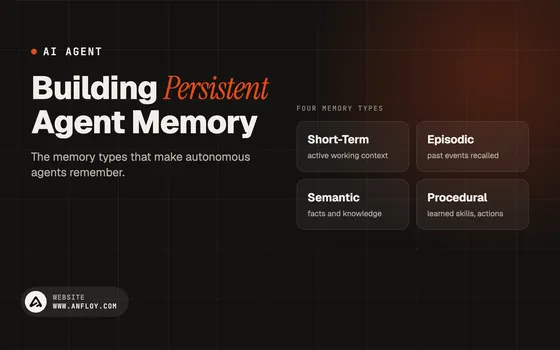
Modern autonomous agents use multiple forms of memory.
Short-term memory
Maintains context during an active conversation or workflow.
Long-term memory
Stores customer history, preferences, and previous interactions across multiple sessions.
Persistent business memory
Retrieves organizational knowledge from a centralized Company AI Brain rather than relying solely on conversational history.
Choosing the right memory strategy improves personalization while keeping operational costs under control.
Company AI brain
A Company AI Brain acts as the trusted knowledge foundation for every autonomous agent.
Instead of connecting agents to scattered documentation, it centralizes business knowledge using:
- Retrieval-Augmented Generation (RAG)
- vector embeddings
- semantic search
- hybrid search
- reranking
- metadata filtering
This ensures every agent retrieves consistent, up-to-date information before making decisions.
Tool calling
Autonomous agents become significantly more useful when they can interact with external systems.
Typical integrations include:
- CRM platforms
- ERP software
- internal APIs
- project management tools
- communication platforms
- databases
- analytics systems
Secure tool calling enables AI to complete workflows instead of simply generating text.
Workflow orchestration
Complex objectives often require multiple AI agents working together.
Workflow orchestration coordinates:
- task sequencing
- agent communication
- approvals
- exception handling
- workflow completion
This orchestration layer enables organizations to automate entire business processes rather than isolated tasks.
Security and governance
As autonomous agents gain access to business systems, governance becomes essential.
Production AI environments should include:
- role-based access control
- least-privilege permissions
- audit logging
- approval workflows
- secure API authentication
- continuous monitoring
These safeguards allow organizations to scale autonomous AI responsibly while protecting business data.
Evaluation and monitoring
No autonomous system should operate without visibility.
Organizations should continuously monitor:
- workflow success rates
- tool execution
- knowledge retrieval
- operational costs
- latency
- customer outcomes
- business KPIs
Monitoring transforms autonomous agents from experimental technology into reliable business infrastructure.
What are the levels of AI autonomy?
Not every AI system operates with the same level of independence.
Some AI applications simply assist employees, while others can execute complete business workflows with minimal human involvement. Understanding these levels helps organizations deploy AI responsibly while balancing automation with governance.
The appropriate level of autonomy depends on the business process, operational risk, regulatory requirements, and the potential impact of incorrect decisions.
Level 1: AI assistance
At the first level, AI acts as an intelligent assistant.
It responds to prompts, generates content, summarizes information, and answers questions, but it never takes action on its own.
Examples include:
- writing emails
- summarizing meetings
- answering internal knowledge questions
- translating documents
- brainstorming ideas
The human remains responsible for every decision and every action.
This is the lowest-risk form of AI adoption and often serves as an organization's introduction to enterprise AI.
Level 2: Human-in-the-loop autonomy
At this level, the AI agent performs research, planning, and recommendations, but every important decision requires human approval.
Examples include:
- drafting customer proposals
- recommending pricing adjustments
- preparing legal documents
- generating financial reports
- qualifying enterprise leads
The AI reduces manual work while humans maintain complete control over execution.
This model works particularly well in industries with strict compliance requirements.
Level 3: Human-on-the-loop autonomy
The AI agent executes approved workflows independently while humans supervise overall performance.
Instead of approving every action, employees intervene only when exceptions occur.
Examples include:
- CRM enrichment
- customer support automation
- knowledge retrieval
- sales outreach sequencing
- pipeline updates
- operational reporting
This level significantly improves operational efficiency while maintaining governance.
Most enterprise AI deployments today operate at this level.
Level 4: Fully autonomous agents
Fully autonomous agents receive objectives rather than instructions.
They determine:
- what actions to take
- which tools to use
- what information to retrieve
- how to solve problems
- when workflows are complete
Examples include:
- autonomous research
- multi-agent software development
- autonomous infrastructure monitoring
- supply chain optimization
- predictive maintenance
Even fully autonomous systems should operate within clearly defined business policies, security controls, and approval boundaries.
Autonomy should never mean unlimited authority.
What is the difference between autonomous and agentic agents?
The terms "AI agent" and "autonomous agent" are often used interchangeably, but they represent different levels of capability.
Every autonomous agent is an AI agent.
Not every AI agent is autonomous.
An AI agent may perform one specific task after receiving explicit instructions.
An autonomous agent actively plans, reasons, adapts, and executes workflows with minimal supervision.
| Feature | AI Agent | Autonomous Agent |
|---|---|---|
| Goal Execution | User-directed | Goal-directed |
| Planning | Limited | Advanced multi-step planning |
| Decision-Making | Guided | Independent within defined boundaries |
| Tool Usage | Optional | Core capability |
| Memory | Often limited | Multi-layer memory |
| Adaptability | Moderate | High |
| Workflow Automation | Individual tasks | End-to-end workflows |
| Human Supervision | Frequent | Exception-based |
| Enterprise Use | Task automation | Business process automation |
Organizations typically begin with AI agents for business before evolving toward autonomous agents as governance, infrastructure, and operational confidence mature.
Autonomous agents vs AI chatbots
Traditional chatbots were designed to answer questions.
Autonomous agents are designed to achieve goals.
A chatbot might answer:
"How do I reset my password?"
An autonomous IT agent could:
- verify the user's identity
- reset the password
- notify the employee
- update the audit log
- close the support ticket
The difference is execution.
Chatbots primarily communicate.
Autonomous agents complete work.
Autonomous agents vs AI workflows
AI workflows automate predefined sequences of tasks.
Autonomous agents determine the sequence dynamically.
Consider invoice processing.
A workflow follows the same path every time.
- Receive invoice.
- Validate supplier.
- Match purchase order.
- Approve payment.
- Archive records.
An autonomous agent evaluates each situation individually.
If supplier information is missing, it retrieves additional data.
If pricing appears unusual, it requests approval.
If duplicate invoices exist, it pauses the workflow.
Rather than following fixed logic, autonomous agents continuously adapt to changing business conditions.
What are the benefits of autonomous agents?
Organizations are adopting autonomous agents because they improve far more than operational efficiency.
When designed correctly, they become an intelligent operating layer across the business.
Increased productivity
Autonomous agents eliminate repetitive manual work by executing complete workflows instead of isolated tasks.
Employees spend more time solving strategic problems while AI handles operational activities.
Examples include:
- qualifying leads
- updating CRM records
- retrieving documentation
- preparing reports
- scheduling meetings
This allows teams to accomplish significantly more without increasing headcount.
Faster decision-making
Autonomous agents continuously retrieve information, evaluate business context, and recommend actions in real time.
Instead of waiting for manual analysis, organizations receive immediate operational insights.
For sales teams, this could mean identifying buying signals before competitors.
For customer support, it means resolving issues without unnecessary escalation.
Improved consistency
Unlike manual processes, autonomous agents execute workflows consistently.
Every customer receives the same qualification criteria.
Every approval follows the same governance policies.
Every workflow adheres to established business rules.
Consistency improves customer experience while reducing operational risk.
Better knowledge utilization
Many organizations struggle because valuable knowledge exists across disconnected systems.
Autonomous agents connected to a centralized Company AI Brain can instantly retrieve:
- product documentation
- internal policies
- customer history
- pricing information
- technical documentation
- sales playbooks
This dramatically reduces the time employees spend searching for information.
Continuous operations
Unlike human teams, autonomous agents can operate continuously.
They monitor systems, process requests, analyze data, and execute workflows around the clock.
This makes them particularly valuable for:
- global support operations
- infrastructure monitoring
- cybersecurity
- eCommerce
- manufacturing
- financial services
Lower operating costs
When repetitive tasks are automated, organizations reduce manual effort without sacrificing quality.
Cost savings often come from:
- reduced administrative work
- faster workflow execution
- fewer operational errors
- improved employee productivity
- better resource allocation
The greatest return on investment typically comes from automating complete business processes rather than isolated tasks.
What are the top challenges of autonomous agents?
Although autonomous agents provide significant benefits, they also introduce new technical and operational challenges.
Successful organizations design these challenges into the architecture rather than addressing them after deployment.
Hallucinations
Language models occasionally generate inaccurate or fabricated information.
Connecting autonomous agents to trusted knowledge through Retrieval-Augmented Generation (RAG) significantly reduces this risk.
Security
Autonomous agents often access:
- CRM systems
- internal databases
- APIs
- financial systems
- customer information
Strong governance, authentication, and least-privilege access controls are essential for protecting sensitive business data.
Governance
Greater autonomy requires stronger oversight.
Organizations should define:
- approval workflows
- escalation rules
- operational policies
- audit logging
- compliance controls
Governance allows businesses to increase autonomy without increasing risk.
Observability
Every autonomous decision should be traceable.
Organizations need visibility into:
- retrieved knowledge
- planning decisions
- tool execution
- workflow completion
- operational failures
Observability enables continuous optimization while supporting compliance requirements.
Cost management
Autonomous agents may execute thousands of model calls, retrieval requests, and API interactions each day.
Without optimization, operational costs can increase rapidly.
Businesses should monitor:
- model usage
- retrieval efficiency
- caching opportunities
- workflow duplication
- unnecessary reasoning
Efficient architecture usually reduces costs more effectively than changing models.
Enterprise use cases for autonomous agents
Autonomous agents are no longer experimental technology.
Organizations across industries are deploying them to automate complex business operations.
Sales and revenue operations
Autonomous agents can:
- identify buying signals
- research prospects
- enrich CRM records
- qualify opportunities
- generate personalized outreach
- recommend next actions
Customer support
Support agents retrieve company knowledge, answer customer questions, escalate complex issues, and continuously improve from previous interactions.
Human resources
HR teams automate:
- employee onboarding
- policy retrieval
- benefits administration
- document management
- interview scheduling
Finance
Autonomous finance agents support:
- invoice processing
- expense approvals
- financial reporting
- fraud detection
- compliance monitoring
IT Operations
IT teams use autonomous agents to:
- monitor infrastructure
- diagnose incidents
- manage tickets
- provision user accounts
- retrieve technical documentation
Healthcare
Healthcare organizations use autonomous systems to assist with:
- patient scheduling
- documentation
- clinical knowledge retrieval
- administrative workflows
- operational reporting
Manufacturing
Manufacturers deploy autonomous agents for:
- predictive maintenance
- inventory monitoring
- production scheduling
- quality assurance
- supply chain optimization
Across every industry, the common goal remains the same:
Automate complete business workflows while maintaining governance, transparency, and measurable business outcomes.
What are the top best practices for building autonomous agents?
Building an autonomous agent involves much more than connecting a language model to a business application.
Production-ready autonomous agents require a well-designed architecture that balances intelligence, security, governance, scalability, and operational efficiency.
The following best practices help organizations build AI systems that deliver measurable business value while remaining reliable as they scale.
1. Start with clear business objectives
Every autonomous agent should solve a specific business problem.
Avoid building AI simply because the technology is available.
Instead, define measurable outcomes such as:
- increasing qualified pipeline
- reducing customer response time
- automating employee onboarding
- improving knowledge retrieval
- reducing operational costs
A clearly defined objective guides every design decision, from knowledge architecture to workflow orchestration and evaluation.
2. Build a company AI brain
Knowledge is the foundation of every autonomous agent.
Without accurate business knowledge, even the most advanced language model produces inconsistent or outdated responses.
A centralized Company AI Brain should become the single source of truth for every AI system.
It typically includes:
- Retrieval-Augmented Generation (RAG)
- vector embeddings
- semantic search
- hybrid search
- reranking
- metadata filtering
This enables autonomous agents to retrieve trusted information before making decisions or executing workflows.
3. Design specialized agents
One autonomous agent shouldn't own every business process.
Instead, create specialized agents responsible for individual functions.
Examples include:
- Sales Agent
- Company Intelligence Agent
- CRM Agent
- Customer Support Agent
- Revenue Intelligence Agent
- Knowledge Agent
- Operations Agent
Specialization improves maintainability, simplifies evaluation, and allows organizations to scale their AI ecosystem gradually.
4. Secure every workflow
Autonomous agents frequently access sensitive business systems.
Security should be designed into the architecture rather than added after deployment.
Essential controls include:
- role-based access control (RBAC)
- least-privilege permissions
- secure API authentication
- audit logging
- approval workflows
- encrypted communication
These controls ensure autonomous agents operate safely while protecting business data.
5. Keep humans in control
Autonomy doesn't eliminate human responsibility.
Instead, organizations should decide where human oversight is required.
Examples include:
- financial approvals
- legal decisions
- compliance reviews
- contract generation
- strategic recommendations
The appropriate level of autonomy depends on the operational risk associated with each workflow.
6. Continuously monitor and improve
Autonomous agents should evolve alongside the business.
Track metrics such as:
- workflow completion
- retrieval accuracy
- customer satisfaction
- response quality
- operational costs
- revenue impact
Continuous evaluation enables organizations to refine prompts, workflows, and knowledge while improving long-term performance.
Common mistakes when building autonomous agents
Many AI initiatives fail because of architectural decisions rather than technology limitations.
Understanding these common mistakes helps businesses build more reliable autonomous systems.
Building one AI agent for everything
A single AI assistant responsible for sales, marketing, customer support, HR, finance, and operations quickly becomes difficult to manage.
Instead, distribute responsibilities across specialized agents that collaborate through shared business knowledge.
Relying only on language models
Large Language Models are powerful reasoning engines, but they shouldn't become the only source of business knowledge.
Without Retrieval-Augmented Generation (RAG) and a centralized Company AI Brain, autonomous agents may generate inaccurate or outdated information.
Ignoring workflow design
Many businesses focus on prompts rather than workflows.
Production AI should automate complete business processes instead of isolated conversations.
Successful implementations prioritize planning, orchestration, and measurable outcomes.
Giving AI excessive permissions
Autonomous agents should receive only the permissions required to complete their responsibilities.
Overly broad access increases operational and security risks.
Following the Principle of Least Privilege significantly improves governance.
Skipping evaluation
Deploying an autonomous agent without monitoring its performance is one of the fastest ways to lose trust in AI.
Organizations should regularly evaluate:
- workflow quality
- business outcomes
- employee feedback
- customer experience
- operational efficiency
Continuous improvement should become part of the AI lifecycle.
How Anfloy builds autonomous AI systems?
At Anfloy, we don't build standalone AI assistants.
We design autonomous AI systems that integrate with your business, automate complete workflows, and remain scalable as your organization grows.
Every implementation follows a structured methodology designed around business outcomes rather than technology trends.
Business discovery
Every project begins by understanding:
- business objectives
- operational workflows
- customer journey
- decision-making processes
- existing software ecosystem
- automation opportunities
This ensures AI is aligned with measurable business value before development begins.
Company AI brain
We build a centralized Company AI Brain that becomes the trusted knowledge source for every autonomous agent.
Using Retrieval-Augmented Generation (RAG), vector embeddings, semantic search, and hybrid retrieval, AI agents access accurate business information in real time.
This improves response quality while reducing hallucinations.
Agentic systems
Instead of deploying one general-purpose assistant, we create specialized Agentic Ai Systems where multiple AI agents collaborate across different business functions.
Examples include:
- Sales Agents
- Revenue Intelligence Agents
- Company Intelligence Agents
- Customer Support Agents
- Internal Operations Agents
Each agent focuses on one responsibility while sharing the same business knowledge and workflow orchestration.
GTM engines
Our AI-powered GTM Engines automate revenue operations by combining:
- buying signal monitoring
- CRM enrichment
- lead qualification
- pipeline intelligence
- personalized outreach
- workflow automation
This enables sales teams to focus on high-value customer interactions rather than repetitive administrative work.
Internal operations systems
Autonomous AI can also transform internal business operations.
We build AI systems for:
- employee onboarding
- documentation retrieval
- operational reporting
- approval workflows
- internal knowledge management
- cross-functional collaboration
The result is a more efficient organization where employees spend less time searching for information and more time making strategic decisions.
Infrastructure you own
Every AI system is deployed on infrastructure owned by the client.
You own:
- the code
- the workflows
- the Company AI Brain
- the integrations
- the operational logic
There is no platform lock-in or dependency on proprietary AI software.
Your AI infrastructure remains a long-term business asset.
Build Autonomous AI That Delivers Real Business Value
Autonomous agents create the greatest impact when they're designed around your workflows, data, and business objectives not generic templates.
Our Free AI Infrastructure Audit helps you identify high-value automation opportunities, evaluate your AI readiness, and create a practical roadmap for deploying production-ready autonomous systems.
Get Your Free AI Audit
What is the future of autonomous agents?
Autonomous agents are becoming the foundation of modern enterprise AI.
Over the next few years, businesses will move beyond isolated AI assistants toward connected ecosystems where multiple autonomous agents collaborate across every department.
Several trends are driving this transformation.
Multi-agent organizations
Organizations will deploy specialized autonomous agents for sales, customer support, finance, HR, operations, and engineering.
These agents will share business knowledge while coordinating complex workflows through orchestration platforms.
Company AI brains
Centralized knowledge systems will become standard infrastructure.
Rather than relying on scattered documentation, autonomous agents will retrieve trusted information from a shared Company AI Brain, ensuring consistent decisions across the organization.
AI operating systems
Businesses will increasingly manage autonomous agents through unified AI operating systems that coordinate planning, tool execution, governance, monitoring, and optimization.
This will make AI a core layer of enterprise infrastructure rather than another standalone application.
Stronger governance
As AI systems gain more autonomy, governance will become a competitive advantage.
Future autonomous systems will rely on:
- policy-driven permissions
- continuous monitoring
- automated compliance
- workflow approvals
- AI observability
Organizations that invest in governance today will be better positioned to scale autonomous AI tomorrow.
Conclusion
Autonomous agents represent a significant shift in how businesses use artificial intelligence.
Rather than simply responding to prompts, they can understand goals, retrieve business knowledge, plan multi-step workflows, interact with enterprise software, evaluate outcomes, and continuously improve through operational feedback.
However, autonomy alone isn't enough.
Successful AI systems combine intelligent reasoning with trusted knowledge, secure integrations, governance, workflow orchestration, and continuous evaluation.
Organizations that invest in these architectural foundations will build AI systems that scale confidently while delivering measurable business value.
At Anfloy, we help businesses design and deploy production-ready autonomous AI through Company AI Brains, Agentic Systems, GTM Engines, Internal Operations Systems, and Full-Stack AI Products. Every solution is tailored to your workflows, integrated with your existing technology stack, and deployed on infrastructure you fully own.
The future of AI isn't simply about smarter models.
It's about autonomous systems that help businesses operate more intelligently, efficiently, and securely.
Ready to Deploy Autonomous AI Across Your Business?
Whether you're building a Company AI Brain, Agentic Systems, AI-powered GTM Engine, or internal workflow automation, Anfloy helps you design secure, scalable AI solutions that grow with your business.
Book a Strategy Call
Frequently Asked Questions
How is an autonomous agent different from an AI chatbot?
A chatbot primarily answers questions and responds to prompts. An autonomous agent plans, reasons, retrieves knowledge, uses tools, and executes complete business workflows to achieve specific objectives.
Can autonomous agents make decisions independently?
Yes, autonomous agents can make decisions within predefined boundaries. Most enterprise systems combine autonomous decision-making with governance, approval workflows, and security controls to ensure safe operation.
What technologies power autonomous agents?
Modern autonomous agents typically combine Large Language Models (LLMs), Retrieval-Augmented Generation (RAG), memory, planning engines, workflow orchestration, tool calling, vector databases, and business integrations.
What industries benefit most from autonomous agents?
Autonomous agents are widely used across sales, customer support, finance, healthcare, manufacturing, human resources, IT operations, logistics, and knowledge management, where they automate complex workflows and improve operational efficiency.
Is ChatGPT an autonomous agent?
No. ChatGPT is not an autonomous agent. It responds to user prompts and can assist with planning, analysis, and tasks, but it does not independently pursue goals or take actions without user direction or authorization.
Let's build
what your
company needs.
Drop your email. We'll send The Custom Agent Blueprint on what we'd build first for a company like yours, before you ever take a meeting.