
How AI Agents Personalize Cold Outreach at Scale
Learn how AI agents personalize cold outreach at scale using buying signals, CRM data, and company intelligence to improve reply rates and pipeline growth.
On this page
- What is AI-powered cold outreach?
- Why traditional cold outreach no longer works?
- Why is personalization so important in outbound sales?
- How do AI agents personalize cold outreach?
- What data do AI agents use for personalization?
- What are the benefits of AI-powered personalization?
- AI agents vs Traditional personalization
- Common mistakes businesses make
- How does Anfloy build AI-powered cold outreach systems?
- Conclusion
Personalization has become one of the biggest challenges in outbound sales.
Buyers expect every email and LinkedIn message to be relevant to their business, role, and current priorities. At the same time, sales teams are expected to reach hundreds or even thousands of prospects every month.
These two goals often conflict.
The more prospects a team contacts, the harder it becomes to personalize every message. As a result, many outbound campaigns rely on templates with little context, leading to lower reply rates and missed opportunities.
AI agents are changing that.
Instead of simply writing emails, AI agents collect company intelligence, monitor buying signals, enrich CRM records, and generate outreach based on real business context. This allows businesses to deliver highly relevant messages without sacrificing scale.
In this guide, you'll learn how AI agents personalize cold outreach, the technologies behind the process, and how businesses are building AI-powered outbound engines that generate better conversations.
What is AI-powered cold outreach?
AI-powered cold outreach is the process of using AI agents to research prospects, gather business intelligence, personalize messaging, and automate outbound workflows.
Instead of sending the same message to every prospect, AI builds outreach around each company's current situation.
The goal isn't simply to automate email writing.
The goal is to send the right message to the right person at the right time.
Why traditional cold outreach no longer works?
Most outbound campaigns still follow the same process:
- build a prospect list
- write email templates
- personalize the first sentence
- launch the campaign
- hope for replies
This approach creates several challenges.
Common problems include:
- generic messaging
- outdated prospect data
- poor timing
- low reply rates
- manual research
- inconsistent personalization
Today's buyers can quickly recognize automated outreach that lacks relevance.
The result is lower engagement and wasted sales effort.
Why is personalization so important in outbound sales?
Personalization is no longer just adding someone's first name to an email.
Modern buyers expect outreach to reflect:
- their industry
- company growth
- current challenges
- technology stack
- recent business activity
- role and responsibilities
When outreach demonstrates genuine understanding of a prospect's business, it becomes significantly more likely to start a conversation.
The challenge is doing this consistently at scale.
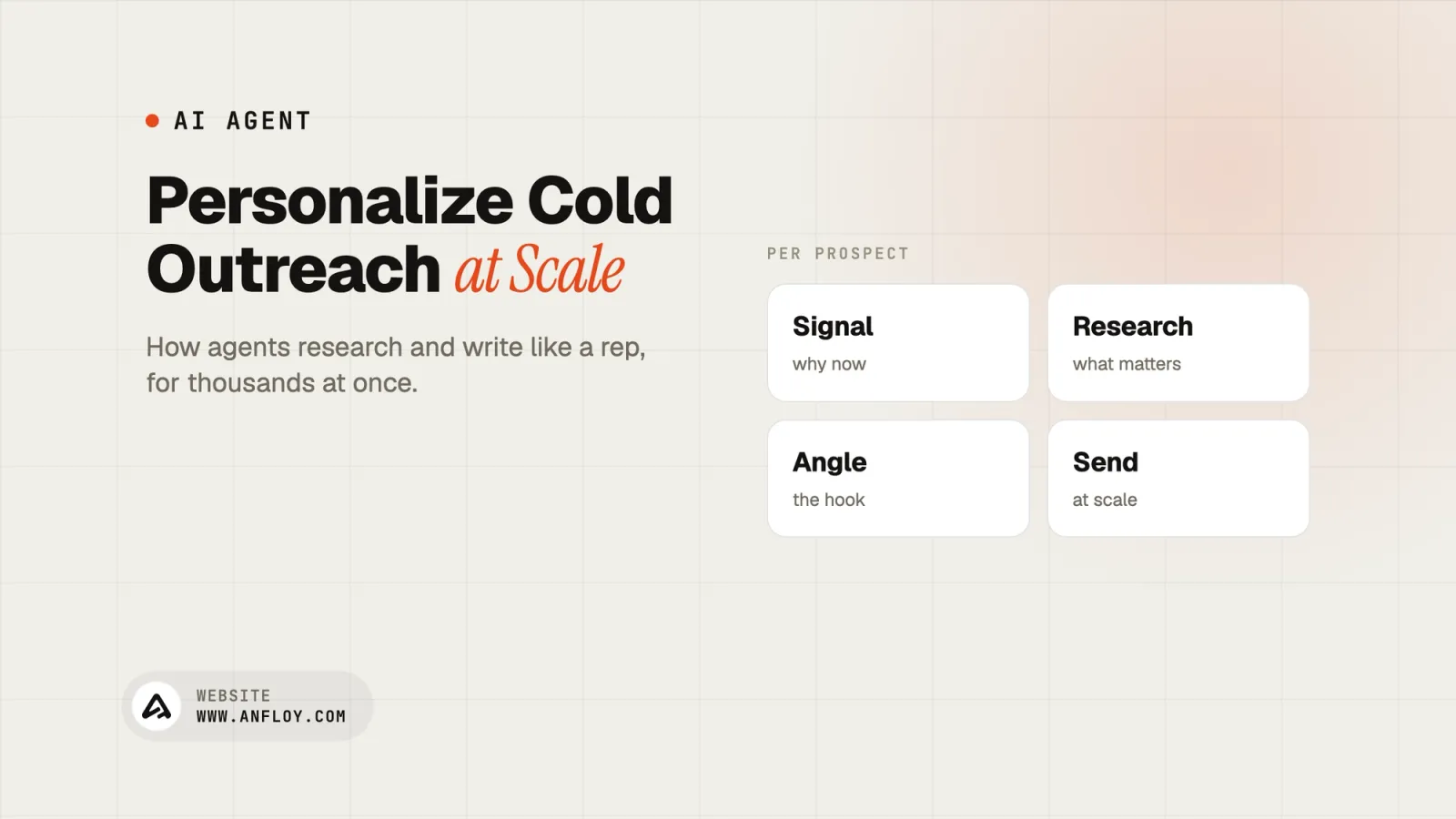
How do AI agents personalize cold outreach?
AI agents combine multiple sources of business intelligence before generating outreach.
A typical workflow looks like this.
Step 1: Identify target accounts
AI finds companies that match your Ideal Customer Profile (ICP).
Step 2: Monitor buying signals
The system tracks events such as:
- funding announcements
- hiring activity
- executive changes
- technology adoption
- expansion plans
- website engagement
These signals help determine the best time to reach out.
Step 3: Gather company intelligence
AI enriches each account with:
- company information
- decision-makers
- industry insights
- CRM history
- previous interactions
- firmographic and technographic data
This creates a complete picture of every prospect.
Step 4: Understand business context
Instead of generating generic messages, AI analyzes why the prospect may benefit from your solution.
This creates messaging based on business relevance rather than assumptions.
Step 5: Generate personalized outreach
Using the collected information, AI prepares emails and LinkedIn messages tailored to the prospect's current business situation.
Every message reflects the account's context instead of relying on generic templates.
Step 6: Update CRM and trigger workflows
AI automatically:
- enriches CRM records
- assigns opportunities
- schedules follow-ups
- tracks engagement
- supports sales pipeline management
The personalization process becomes part of a connected revenue workflow.
What data do AI agents use for personalization?
The quality of outreach depends on the quality of information.
Modern AI agents use multiple data sources, including:
CRM data
- account history
- previous conversations
- deal stage
- customer interactions
Buying signals
- funding
- hiring
- leadership changes
- technology adoption
- product launches
Company intelligence
- industry
- company size
- business model
- growth trends
- organizational structure
Company knowledge
Internal sales playbooks, case studies, messaging frameworks, pricing information, and product documentation help AI create outreach that accurately reflects your business.
What are the benefits of AI-powered personalization?
Businesses implementing AI-driven outreach often experience improvements across multiple areas.
Higher reply rates
Relevant messaging generates more conversations.
Better lead quality
Sales teams engage with prospects showing genuine buying intent.
Faster sales development
AI reduces manual research while accelerating outreach preparation.
Improved sales productivity
Representatives spend more time building relationships instead of researching accounts.
Consistent messaging
Every prospect receives outreach aligned with your positioning and sales strategy.
AI agents vs Traditional personalization
| Traditional Personalization | AI Agent Personalization |
|---|---|
| Manual research | Automated research |
| Limited account context | Multi-source company intelligence |
| Generic templates | Context-aware messaging |
| Static prospect lists | Signal-based prospecting |
| Manual CRM updates | Automated CRM enrichment |
| One-size-fits-all outreach | Personalized at scale |
The biggest difference is context.
AI agents understand why a prospect may be interested before creating outreach.
Common mistakes businesses make
Personalizing only the opening line
Mentioning a company name or recent LinkedIn post is not enough.
Strong personalization connects your solution to the prospect's business challenges.
Ignoring buying signals
Timing often matters more than messaging.
Reaching out after a funding round or expansion announcement is more effective than contacting prospects at random.
Using AI only for email writing
The greatest value comes from AI handling the complete outbound workflow, not just generating copy.
Sending every lead to sales
Not every prospect should enter the sales pipeline.
AI qualification improves efficiency by filtering low-intent opportunities.
Treating outreach as a standalone process
Cold outreach performs best when connected to CRM, pipeline management, and revenue operations.
How does Anfloy build AI-powered cold outreach systems?
At Anfloy, personalization starts long before an email is written.
We build AI-powered outbound systems that combine company intelligence, buying signals, AI agents, and GTM automation to help businesses reach the right prospects with the right message at the right time.
Every implementation begins by understanding:
- your Ideal Customer Profile (ICP)
- sales process
- qualification framework
- messaging strategy
- CRM architecture
- revenue goals
From there, we build a custom outbound engine around your business.
Signal-based prospecting
AI agents continuously monitor buying signals such as funding announcements, hiring activity, technology adoption, leadership changes, and customer engagement to identify accounts most likely to convert.
Company AI brain
Every AI agent connects to a centralized Company AI Brain powered by Retrieval-Augmented Generation (RAG), embeddings, hybrid search, reranking, and persistent memory.
This gives AI access to:
- sales playbooks
- product knowledge
- pricing information
- customer success stories
- messaging frameworks
- internal documentation
Instead of generic prompts, outreach is based on your business knowledge.
Multi-agent GTM engine
Specialized AI agents work together across the outbound workflow.
Dedicated agents handle:
- account research
- buying signal detection
- CRM enrichment
- lead qualification
- message generation
- workflow automation
This collaborative approach delivers more accurate personalization and greater scalability.
CRM & workflow automation
Once outreach is prepared, AI agents automatically:
- update CRM records
- assign opportunities
- schedule follow-ups
- notify sales teams
- support pipeline management
Every workflow remains synchronized across your GTM stack.
Infrastructure you own
Unlike generic outbound platforms, every AI system is deployed on infrastructure owned by your business.
You own:
- the code
- the workflows
- the AI logic
- the integrations
- the operational infrastructure
No platform lock-in.
No recurring software dependency.
The result is a custom AI outreach engine that continuously improves personalization, scales with your business, and becomes a long-term competitive advantage.
What Is the future of AI-powered cold outreach?
Cold outreach is moving beyond templates and sequences.
Future AI systems will:
- detect buying intent automatically
- retrieve company knowledge in real time
- personalize outreach across multiple channels
- coordinate sales workflows
- optimize messaging based on performance
- collaborate through multi-agent architectures
Instead of manually researching prospects, sales teams will increasingly rely on AI agents that identify opportunities and prepare highly relevant conversations before the first email is sent.
Conclusion
Personalization is no longer a competitive advantage.
It is an expectation.
The challenge is delivering meaningful personalization without slowing down your outbound efforts.
AI agents solve this by combining:
- company intelligence
- buying signals
- CRM enrichment
- lead qualification
- workflow automation
- Company AI Brains
into one intelligent outbound system.
At Anfloy, we help businesses build custom AI infrastructure through:
- GTM Engines
- Agentic Systems
- Company AI Brains
- Internal Operations Systems
- Full-Stack AI Products
Because the future of outbound sales isn't about sending more emails.
It's about building AI systems that understand your prospects, personalize every interaction, and help your team generate predictable pipeline at scale.
Frequently Asked Questions
How do AI agents personalize cold outreach?
AI agents analyze CRM data, buying signals, company intelligence, and business context to create personalized outreach tailored to each prospect.
Can AI write personalized cold emails?
Yes. AI can generate personalized emails using company research, sales playbooks, customer data, and real-time business signals instead of generic templates.
Does AI improve cold email response rates?
When combined with accurate data and strong messaging, AI-powered personalization can improve reply rates by making outreach more relevant and timely.
What data do AI agents use for personalization?
AI commonly uses CRM records, buying signals, company information, customer interactions, sales documentation, and internal business knowledge.
Can AI replace human SDRs?
AI automates research, qualification, and outreach preparation, while human SDRs continue to build relationships, handle objections, and close opportunities.
Let's build
what your
company needs.
Drop your email. We'll send The Custom Agent Blueprint on what we'd build first for a company like yours, before you ever take a meeting.