
Production Systems in AI: The Complete Guide to Rule-Based Intelligence in 2026
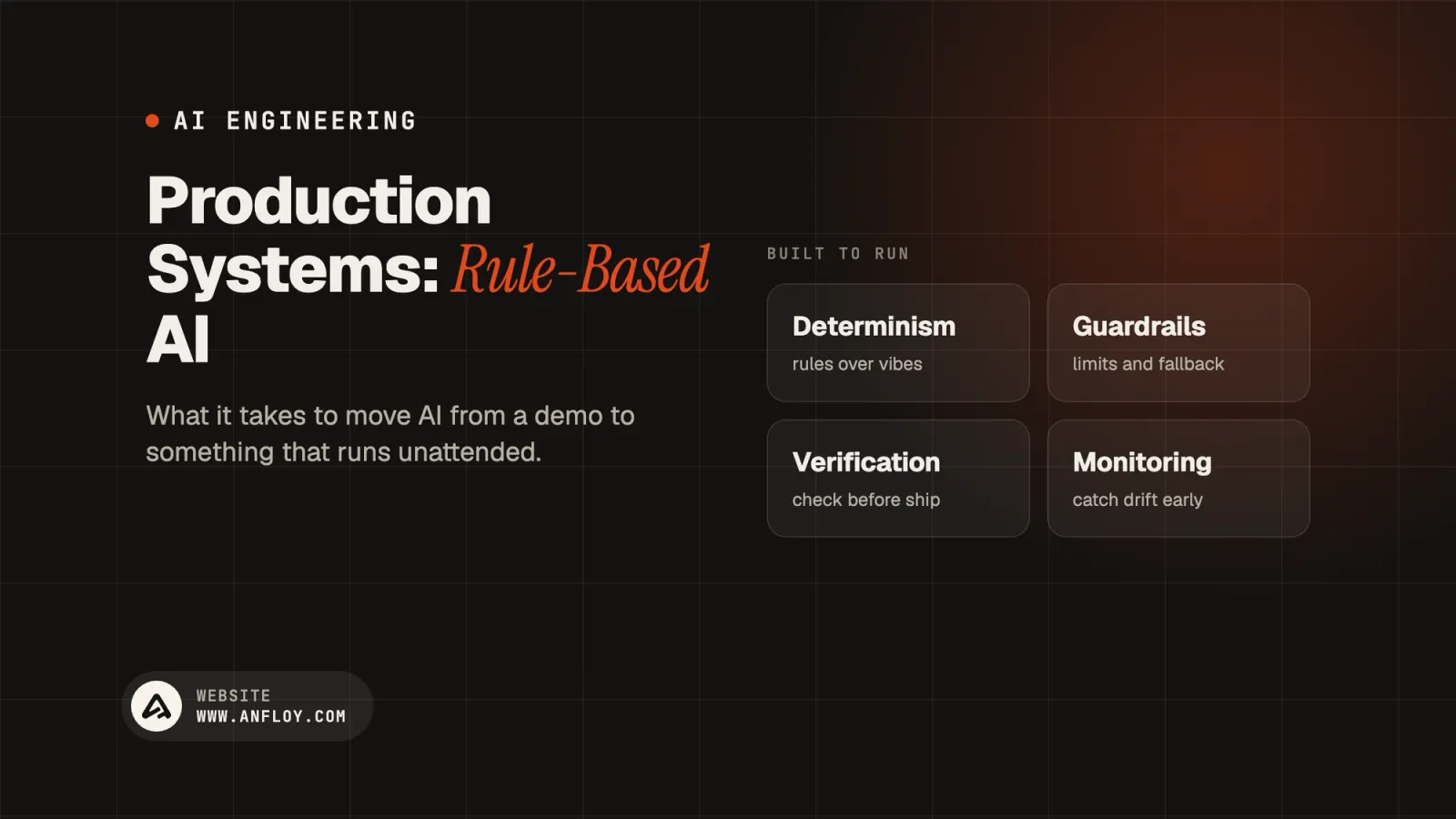
Learn what production systems in AI are, how they work, their components, types, advantages, limitations, enterprise applications, and how they compare to modern AI agents.
On this page
- What is a production system in AI?
- Why production systems still matter in 2026?
- What are the core components of a production system?
- How does a production system work?
- Types of production systems
- Forward chaining vs backward chaining
- What is forward chaining?
- What is backward chaining?
- Forward chaining vs backward chaining
- Production systems vs expert systems
- Production systems vs rule engines
- Production systems vs modern AI agents
- Production systems vs large language models (LLMs)
- Real-world applications of production systems
- Common design mistakes
- How Anfloy builds production AI systems?
- What is the future of production systems?
- Conclusion
Artificial intelligence has changed dramatically over the past decade.
Businesses are now deploying AI agents that qualify leads, automate customer support, retrieve company knowledge, generate reports, coordinate workflows, and even collaborate with other AI agents. Large Language Models (LLMs), Retrieval-Augmented Generation (RAG), and Agentic AI dominate today's AI conversations.
Yet one of the most influential concepts in artificial intelligence was introduced decades before generative AI became mainstream.
That concept is the production system.
Although production systems are often taught as part of classical AI, their principles continue to influence many of today's enterprise AI architectures. Business rule engines, workflow automation platforms, fraud detection systems, recommendation engines, and even modern AI agents all rely on structured decision-making that originated from production systems.
Understanding production systems isn't simply about learning AI history.
It helps explain how intelligent systems make decisions, execute workflows, enforce business rules, and solve problems systematically.
More importantly, it reveals why modern AI doesn't replace rule-based reasoning. Instead, it combines production systems with language models, knowledge retrieval, memory, and workflow orchestration to create intelligent business systems.
In this guide, you'll learn:
- what a production system in AI is
- how production systems work
- their core architecture
- different types of production systems
- real-world business applications
- how production systems compare with AI agents and LLMs
- why production systems remain relevant in modern enterprise AI
- how businesses combine rule-based logic with Agentic AI to build production-ready AI infrastructure
Whether you're a student learning artificial intelligence, an AI engineer designing intelligent systems, or a business leader exploring enterprise automation, understanding production systems provides an essential foundation for building reliable AI.
What is a production system in AI?
A production system is a rule-based problem-solving framework used in artificial intelligence that applies predefined IF–THEN rules to transform an initial state into a desired goal state.
Instead of learning patterns from historical data, a production system relies on explicit knowledge created by domain experts.
Every rule defines two parts:
- Condition (IF) – the situation that must be true.
- Action (THEN) – the operation performed when the condition is satisfied.
For example:
IF a customer has an overdue invoice AND their subscription is active,
THEN send a payment reminder and notify the finance team.
The system repeatedly evaluates available information, identifies which rules apply, executes the appropriate rule, updates its knowledge, and continues until it reaches a solution.
Unlike modern generative AI, production systems don't generate new knowledge or reason creatively.
Instead, they follow structured logic to solve well-defined problems consistently and transparently.
This predictability is why production systems continue to play an important role in enterprise software.
Why production systems still matter in 2026?
Production systems may seem outdated compared to modern AI agents, but they remain a critical component of enterprise AI architecture.
Many business decisions must be consistent, explainable, and governed by predefined policies.
For example:
- approving expense claims
- validating insurance applications
- processing loan requests
- checking compliance requirements
- applying pricing rules
- routing customer support tickets
These tasks require deterministic decision-making rather than open-ended reasoning.
Even advanced AI agents frequently depend on production-system principles to ensure they operate safely within business constraints.
For example, an AI customer support agent may generate responses using a language model, but production rules determine:
- which customers receive refunds
- when human approval is required
- which documentation should be retrieved
- which security policies must be followed
- how customer requests are prioritized
In other words:
Modern AI provides intelligence.
Production systems provide structure.
Together they create AI solutions that are both flexible and reliable.
What are the core components of a production system?
Every production system consists of three fundamental components that work together to solve problems.
Understanding these components makes it easier to understand both classical AI and many modern enterprise AI architectures.
1. Rule base (Production rules)
The rule base stores the kAI agentsnowledge used by the system.
Knowledge is represented as a collection of IF–THEN rules.
For example:
IF inventory falls below the reorder level,
THEN create a purchase request.
Or:
IF a support ticket is marked as high priority,
THEN assign it to the escalation queue.
Each rule represents business knowledge collected from subject matter experts.
Unlike machine learning models, production systems don't discover these rules automatically.
They must be designed, reviewed, and maintained by people who understand the business domain.
A high-quality rule base should be:
- accurate
- modular
- easy to update
- free from duplicate rules
- consistent across departments
As organizations grow, maintaining the rule base becomes one of the most important aspects of production-system design.
2. Working memory
Working memory contains the facts that describe the current state of the problem.
Think of it as the system's temporary workspace.
Examples include:
- customer information
- account status
- product inventory
- workflow progress
- employee records
- order details
- support requests
Unlike the rule base, working memory changes continuously.
Every time a rule executes, working memory is updated with new information.
This updated information may trigger additional rules.
For example:
A customer submits an order.
↓
Working memory stores the order.
↓
Inventory rules are evaluated.
↓
Stock availability changes.
↓
Shipping rules become applicable.
↓
Notification rules execute.
The production system continues until no additional rules can be applied.
This iterative process enables complex workflows to emerge from relatively simple rules.
3. Inference engine
The inference engine is the decision-making mechanism of the production system.
It determines which production rule should execute next.
Its responsibilities include:
- evaluating current facts
- matching applicable rules
- resolving conflicts
- selecting the next rule
- executing actions
- updating working memory
Without the inference engine, production rules remain passive knowledge.
The inference engine transforms those rules into intelligent behavior.
Modern workflow orchestration platforms perform many similar functions, coordinating business logic across multiple applications.
How does a production system work?
A production system follows a continuous reasoning cycle that evaluates information, applies rules, and updates the problem state until a solution is reached.
This process is often called the recognize–act cycle.
The workflow follows these stages.
Step 1: Receive the initial state
The system begins with a collection of known facts.
For example:
- customer information
- transaction details
- inventory status
- employee request
- support ticket
These facts populate the working memory.
Step 2: Match applicable rules
The inference engine compares every fact stored in working memory against the production rules.
Any rule whose conditions are satisfied becomes a candidate for execution.
For example:
IF customer is premium
AND issue priority is high
THEN assign senior support representative.
If both conditions are true, the rule becomes eligible.
Step 3: Resolve rule conflicts
Often, multiple rules satisfy the available conditions.
The system must determine which rule executes first.
Conflict resolution strategies may include:
- priority-based execution
- specificity
- recency of information
- rule ordering
- business importance
Choosing the appropriate conflict resolution strategy improves consistency while preventing unexpected behavior.
Step 4: Execute the selected rule
Once the system selects the most appropriate rule, it performs the associated action.
Examples include:
- updating a database
- sending an email
- changing workflow status
- approving a request
- creating a support ticket
Executing the rule changes the current state of the system.
Step 5: Update working memory
The executed action produces new facts.
These facts are added to working memory.
The system now evaluates the updated information.
This often activates additional production rules.
Step 6: Repeat until the goal is achieved
The recognize act cycle continues until:
- the goal has been reached
- no rules remain applicable
- a stopping condition is triggered
At this point, the production system has completed its reasoning process.
This structured approach makes production systems highly effective for solving problems that follow explicit business logic and clearly defined decision rules.
Types of production systems
Production systems are classified according to how rules interact with one another and how the system's state changes as rules are executed.
Understanding these categories helps AI engineers and business leaders choose the right approach for different types of problems.
Although modern AI applications rarely implement these models exactly as described in academic literature, their principles continue to influence workflow automation, business rule engines, and enterprise AI systems.
1. Monotonic production systems
A monotonic production system ensures that applying one rule never prevents another previously applicable rule from executing later.
In simple terms, the system only moves forward.
New facts may be added, but previously valid reasoning does not become invalid.
This makes monotonic systems:
- predictable
- easier to test
- simpler to verify
- suitable for structured reasoning
Business example
Consider an employee onboarding workflow.
Rules may include:
- Create employee account.
- Assign company email.
- Generate ID card.
- Enroll in payroll.
- Schedule orientation.
Each completed task enables the next one without undoing earlier work.
Monotonic reasoning works well because the workflow progresses in one direction.
2. Non-monotonic production systems
A non-monotonic production system allows new information to change previous conclusions.
Instead of simply adding knowledge, the system may revise earlier decisions when circumstances change.
This mirrors how real businesses operate.
Business example
An AI loan approval system initially approves an application based on available financial information.
Later, new credit data becomes available showing a significant increase in outstanding debt.
The system revises its earlier approval and requests manual review.
Unlike monotonic reasoning, the original decision is no longer valid.
Modern AI systems frequently use non-monotonic reasoning because business environments constantly evolve.
3. Commutative production systems
In a commutative production system, the order of rule execution does not affect the final outcome.
Different execution paths produce the same result.
This simplifies testing because developers do not need to evaluate every possible sequence.
Example
Whether inventory is checked before customer validation or afterward, the final order confirmation remains identical.
Commutative systems are easier to maintain because workflow order has less impact on correctness.
4. Partially commutative production systems
Many enterprise workflows are only partially commutative.
Some rules may execute in different orders, while others must follow a strict sequence.
Example
An employee reimbursement workflow may require:
- receipt validation
- manager approval
- finance approval
- payment processing
Manager approval and receipt validation might occur independently, but payment cannot happen before both approvals are complete.
Most business automation platforms operate using partially commutative logic because they balance flexibility with operational control.
Forward chaining vs backward chaining
One of the most important concepts in production systems is the direction of reasoning.
Production systems generally use either forward chaining or backward chaining.
Both approaches rely on production rules but solve problems differently.
What is forward chaining?
Forward chaining is a data-driven reasoning process.
The system starts with known facts and repeatedly applies rules until it reaches a conclusion.
The reasoning flows from available information toward a goal.
Example
Working memory contains:
- Customer subscribed.
- Payment overdue.
- Subscription active.
Rules evaluate these facts.
The system concludes:
- Send payment reminder.
- Restrict premium features.
- Notify finance.
Forward chaining is commonly used for:
- workflow automation
- fraud detection
- monitoring systems
- CRM automation
- business process automation
What is backward chaining?
Backward chaining is a goal-driven reasoning process.
Instead of starting with facts, the system begins with a desired outcome and works backward to determine whether the required conditions are true.
Example
Goal:
Approve a loan.
The system checks:
- Is income verified?
- Is credit score sufficient?
- Are documents complete?
- Is debt within policy?
Only after verifying each condition does the system approve the application.
Backward chaining works well for:
- diagnostics
- troubleshooting
- compliance validation
- expert systems
- recommendation engines
Forward chaining vs backward chaining
| Feature | Forward Chaining | Backward Chaining |
|---|---|---|
| Starting Point | Known facts | Desired goal |
| Reasoning Style | Data-driven | Goal-driven |
| Best For | Automation workflows | Decision validation |
| Common Applications | CRM, operations, monitoring | Diagnosis, compliance, expert systems |
| Efficiency | Better with continuous data | Better with specific objectives |
Modern enterprise AI often combines both approaches depending on the workflow.
Production systems vs expert systems
Production systems and expert systems are closely related, but they are not the same.
A production system provides the reasoning mechanism.
An expert system is a complete application built around that reasoning.
| Feature | Production | Expert System |
|---|---|---|
| Purpose | Execute production rules | Replicate expert decision-making |
| Knowledge | IF–THEN rules | Rules plus domain expertise |
| Components | Rules, memory, inference engine | Knowledge base, inference engine, explanation module, user interface |
| Scope | General reasoning framework | Complete AI application |
| Example | Business rule engine | Medical diagnosis system |
Think of a production system as the engine.
The expert system is the complete vehicle.
Production systems vs rule engines
Businesses often confuse production systems with rule engines.
Although they share many similarities, their objectives differ.
A production system is an artificial intelligence concept focused on problem-solving through logical reasoning.
A rule engine is software designed to execute business rules inside enterprise applications.
| Feature | Production System | Rule Engine |
|---|---|---|
| Origin | Artificial intelligence | Enterprise software |
| Purpose | Intelligent reasoning | Business rule execution |
| Knowledge | AI production rules | Business policies |
| Intelligence | Includes inference | Usually deterministic |
| Example | Classical AI | Insurance pricing engine |
Many modern rule engines implement production-system concepts while integrating with enterprise software.
Production systems vs modern AI agents
This comparison is particularly important because many organizations are evaluating whether traditional rule-based systems should be replaced with AI agents.
The answer is usually no.
Modern AI combines both approaches.
| Feature | Production System | AI Agent |
|---|---|---|
| Decision-Making | Rule-based | Context-aware reasoning |
| Learning | Manual rule updates | Can improve through evaluation and feedback |
| Knowledge | Static rule base | Dynamic knowledge retrieval using RAG |
| Memory | Working memory only | Short-term, long-term, and persistent memory |
| Planning | Predefined | Dynamic planning |
| Tool Usage | Limited | Extensive tool calling and API integration |
| Flexibility | Low | High |
| Explainability | Very high | Depends on implementation |
| Governance | Rule-driven | Rules plus AI guardrails |
| Best Use Cases | Compliance, approvals, workflows | Sales, customer support, operations, research |
Instead of replacing production systems, AI agents extend them with reasoning, natural language understanding, memory, and adaptive decision-making.
Production systems vs large language models (LLMs)
Large Language Models such as GPT, Claude, and Gemini are fundamentally different from production systems.
Production systems execute explicit rules.
LLMs generate responses by predicting the most likely sequence of tokens based on patterns learned during training.
| Feature | Production System | LLM |
|---|---|---|
| Knowledge Source | Human-defined rules | Trained neural network |
| Reasoning | Deterministic | Probabilistic |
| Explainability | High | Lower without additional tooling |
| Adaptability | Limited | High |
| Creativity | None | Strong |
| Hallucination Risk | None | Possible |
| Business Rules | Excellent | Requires guardrails |
The most capable enterprise AI systems combine both technologies.
Production rules enforce governance.
LLMs provide reasoning and natural language capabilities.
Together they deliver both flexibility and reliability.
Real-world applications of production systems
Although production systems originated in classical AI research, they continue to power many enterprise applications.
Banking and financial services
Financial institutions use production rules to:
- detect fraud
- approve loans
- calculate risk
- enforce compliance
- process transactions
Rules ensure decisions remain consistent while satisfying regulatory requirements.
Healthcare
Hospitals and healthcare providers use production systems to:
- recommend treatments
- identify drug interactions
- validate diagnoses
- support clinical decision-making
These systems improve consistency while assisting medical professionals.
Manufacturing
Manufacturers automate:
- quality inspections
- production scheduling
- equipment monitoring
- inventory management
- maintenance planning
Rule-based reasoning reduces operational delays while improving efficiency.
Customer support
Support teams use production systems to:
- route tickets
- prioritize requests
- trigger escalations
- assign specialists
- automate responses
When combined with AI agents, production rules ensure every customer interaction follows company policies.
Revenue operations
Sales and RevOps teams use production logic to:
- qualify leads
- assign territories
- prioritize accounts
- trigger outbound campaigns
- enforce approval workflows
Modern GTM systems combine deterministic rules with AI-driven insights to improve pipeline management and revenue forecasting.
Common design mistakes
Production systems are designed to make decision-making predictable and reliable. However, poor architecture can quickly turn a rule-based system into one that is difficult to maintain, debug, and scale.
Whether you're building a traditional production system or integrating production rules into modern AI agents, avoiding the following mistakes will improve long-term performance and reduce operational complexity.
Creating too many rules without structure
As businesses grow, it's tempting to solve every new problem by adding another production rule.
Over time, this creates hundreds or even thousands of interconnected rules that are difficult to understand and maintain.
Instead of continuously expanding one large rule base, organize rules into logical domains such as:
- sales operations
- customer support
- finance
- HR
- compliance
- inventory management
A modular rule structure improves maintainability and allows teams to update business logic without affecting unrelated workflows.
Mixing business logic with application logic
Business rules should remain independent from application code.
When rules are hardcoded into software, every policy change requires development work, testing, and deployment.
Separating production rules from application logic makes systems more flexible and allows business teams to update decision-making without rebuilding the entire application.
Ignoring rule conflicts
As rule bases grow, multiple rules may apply to the same situation.
Without conflict resolution, production systems can produce inconsistent or unpredictable outcomes.
Every production system should define how conflicts are resolved using mechanisms such as:
- rule priority
- rule specificity
- execution order
- business criticality
Clear governance ensures consistent decision-making across every workflow.
Building static rule bases
Businesses evolve constantly.
Pricing changes.
Products change.
Compliance regulations change.
Customer expectations change.
If production rules remain static, they gradually become inaccurate.
Organizations should regularly review and version their rule base to ensure it reflects current business processes.
Using rules for problems that require reasoning
Production systems excel at deterministic decisions but struggle with ambiguity.
Trying to solve open-ended problems using only production rules often leads to unnecessary complexity.
Tasks such as:
- personalized customer conversations
- document summarization
- sales research
- proposal generation
- strategic recommendations
are better suited for AI agents powered by Large Language Models.
The strongest enterprise AI systems combine production rules with AI reasoning instead of choosing one over the other.
Neglecting monitoring and evaluation
Production systems should not operate as black boxes.
Organizations should continuously monitor:
- rule execution
- workflow success rates
- exception handling
- operational performance
- business outcomes
Monitoring helps identify outdated rules, workflow bottlenecks, and opportunities for optimization before they affect customers.
How Anfloy builds production AI systems?
At Anfloy, we believe modern AI systems should combine the reliability of production systems with the flexibility of intelligent AI agents.
Rather than relying solely on predefined rules or entirely on generative AI, we design hybrid architectures that balance deterministic decision-making with adaptive reasoning.
Every implementation begins with understanding how the business operates.
We analyze:
- business objectives
- operational workflows
- decision-making processes
- existing software ecosystem
- internal documentation
- security requirements
- automation opportunities
This discovery phase ensures AI is designed around measurable business outcomes rather than isolated use cases.
Step 1: Build the company AI brain
Every production AI system starts with trusted knowledge.
We create a centralized Company AI Brain that connects:
- product documentation
- SOPs
- CRM data
- customer history
- pricing information
- internal policies
- technical documentation
- operational knowledge
Using Retrieval-Augmented Generation (RAG), vector embeddings, hybrid search, reranking, and semantic retrieval, every AI agent works from the same trusted business knowledge.
Step 2: Combine production rules with AI agents
Not every business decision requires generative AI.
We use production rules for deterministic workflows such as:
- approval processes
- compliance validation
- pricing logic
- workflow routing
- operational policies
AI agents handle tasks requiring reasoning, research, personalization, and natural language understanding.
This hybrid architecture creates systems that are both reliable and adaptable.
Step 3: Build specialized agentic systems
Instead of one general-purpose assistant, we design specialized AI agents responsible for individual business functions.
Examples include:
- Lead Qualification Agent
- Company Intelligence Agent
- CRM Agent
- Customer Support Agent
- Revenue Intelligence Agent
- Knowledge Agent
- Internal Operations Agent
These agents collaborate through shared business knowledge while remaining independently scalable and easier to evaluate.
Step 4: Integrate with business systems
Production AI becomes valuable when it operates inside existing business workflows.
We integrate AI with:
- CRM platforms
- ERP systems
- communication tools
- internal APIs
- databases
- workflow automation platforms
This allows AI to execute complete business processes rather than functioning as a standalone chatbot.
Step 5: Deploy infrastructure you own
Unlike many AI platforms, every solution we build is deployed on infrastructure owned by the client.
You own:
- the code
- the AI workflows
- the Company AI Brain
- the knowledge architecture
- the integrations
- the operational logic
There is no platform lock-in or dependency on proprietary software.
Your AI infrastructure becomes a long-term business asset that evolves alongside your organization.
Ready to Build Production-Ready AI Systems?
Whether you're modernizing legacy rule-based systems or building next-generation AI agents, success begins with the right architecture.
Our Free AI Infrastructure Audit helps you identify:
high-impact AI opportunities
workflow automation gaps
knowledge management improvements
governance and security risks
AI implementation priorities
You'll receive practical recommendations tailored to your business, helping you build AI systems that scale with confidence.
Get Your Free AI Audit
What is the future of production systems?
Production systems are not disappearing.
They're evolving.
As businesses adopt Agentic AI, production systems will increasingly become one layer within larger AI architectures rather than standalone decision engines.
Several trends are shaping this evolution.
Hybrid AI architectures
Future enterprise AI will combine production rules, Large Language Models, Retrieval-Augmented Generation (RAG), memory, and workflow orchestration into unified systems.
Rule-based logic will continue to enforce governance, while AI agents provide reasoning and adaptability.
Policy-driven AI governance
Organizations will rely more heavily on production rules to enforce:
- security policies
- compliance requirements
- approval workflows
- operational standards
- data access permissions
Production systems will become the governance layer that keeps autonomous AI aligned with business objectives.
Multi-agent collaboration
Future businesses will deploy networks of specialized AI agents rather than relying on one general-purpose assistant.
Production rules will coordinate how agents communicate, share information, and execute workflows while maintaining consistency across the organization.
Intelligent workflow automation
Instead of simply automating repetitive tasks, production systems will work alongside AI agents to manage complete business processes from planning and execution to monitoring and optimization.
This combination of structured rules and adaptive reasoning will define the next generation of enterprise AI.
Conclusion
Production systems remain one of the most important foundations of artificial intelligence.
Although modern AI has expanded beyond rule-based reasoning, the principles behind production systems continue to power many of today's enterprise applications.
The most effective organizations no longer choose between production systems and AI agents.
They combine both.
Production rules provide consistency, governance, and explainability.
AI agents contribute reasoning, adaptability, knowledge retrieval, and natural language understanding.
Together, they create intelligent business systems capable of automating complex workflows while remaining secure, transparent, and scalable.
As businesses continue adopting Agentic AI, production systems will remain an essential architectural layer, helping organizations build AI that is not only intelligent but also reliable enough for real-world operations.
Build Enterprise AI with Anfloy
From Agentic Systems and Company AI Brains to GTM Engines, Internal Operations Systems, and Full-Stack AI Products, Anfloy helps organizations build AI that goes beyond automation.
We design secure, production-ready AI systems that integrate with your existing technology stack, support measurable business outcomes, and run on infrastructure you fully own.
Frequently Asked Questions
What is the primary purpose of a production system in AI?
A production system uses predefined IF–THEN rules to solve problems, automate decisions, and execute workflows consistently. It provides transparent, rule-based reasoning for structured business scenarios.
Are production systems still used in modern AI?
Yes. Production systems remain widely used in enterprise software, workflow automation, compliance, fraud detection, and business rule engines. Modern AI platforms often combine production systems with Large Language Models and AI agents.
What is the difference between a production system and an AI agent?
A production system follows predefined rules to make deterministic decisions, while an AI agent uses reasoning, context, memory, and tool calling to adapt to changing situations. Many enterprise AI solutions combine both approaches.
Can production systems work with Retrieval-Augmented Generation (RAG)?
Yes. Production rules can govern when information is retrieved, who can access it, and which workflows should execute, while RAG provides AI agents with accurate and up-to-date business knowledge.
When should a business use a production system instead of an AI agent?
Production systems are ideal for structured, rule-based decisions such as approvals, compliance, pricing, and workflow automation. AI agents are better suited for tasks involving reasoning, personalization, research, and natural language interactions.
Let's build
what your
company needs.
Drop your email. We'll send The Custom Agent Blueprint on what we'd build first for a company like yours, before you ever take a meeting.