
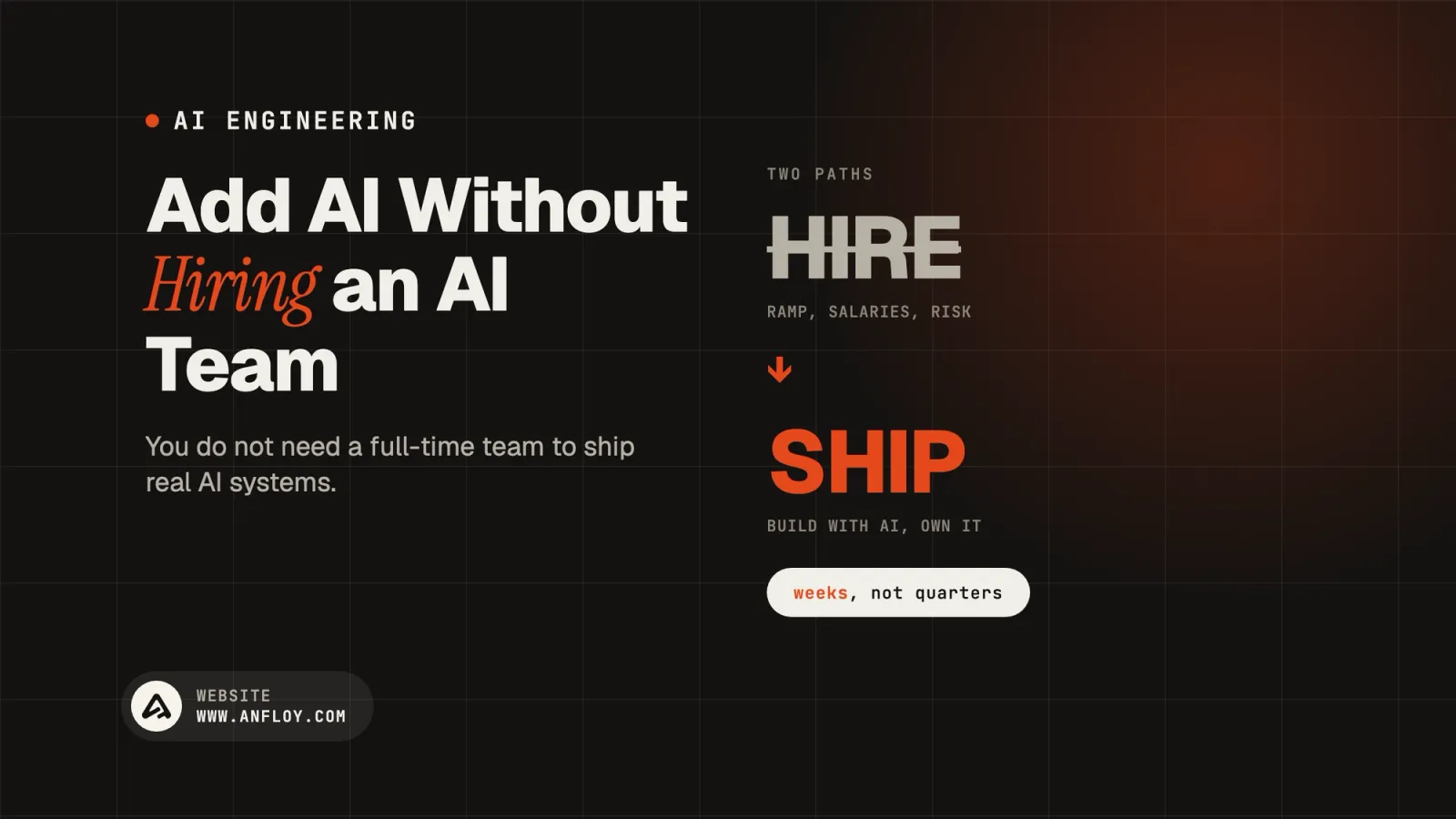
How to Implement AI in Business Without Hiring an AI Team
Learn how to implement AI in your business without hiring an in-house AI team using custom AI agents, automation, and AI infrastructure.
On this page
- Why hiring an AI team isn't always the best first step?
- When should a business invest in AI?
- What business processes should you automate first?
- What do you actually need to implement AI?
- What are the different ways to implement AI?
- How to implement AI without an internal AI team?
- Build, buy, or partner: Which AI strategy is right?
- Common mistakes businesses make when implementing AI
- How Anfloy helps businesses implement AI without hiring an AI team?
- What is the future of AI implementation?
- Conclusion
Artificial intelligence is no longer reserved for enterprise companies with large engineering teams.
Today, businesses of every size want to use AI to automate operations, improve customer experiences, increase productivity, and generate more revenue.
The challenge isn't recognizing AI's potential.
It's knowing how to implement it.
Many business owners believe they need to hire:
- AI engineers
- machine learning specialists
- data scientists
- prompt engineers
- DevOps engineers
- AI product managers
before they can successfully adopt AI.
For most growing businesses, that's simply not practical.
Hiring an internal AI team is expensive, time-consuming, and often unnecessary during the early stages of AI adoption.
The good news is that modern AI infrastructure makes it possible to deploy powerful AI systems without building an in-house AI department.
Instead of hiring an entire team, businesses can implement custom AI agents, automate workflows, connect existing software, and build AI systems around their current operations.
This guide explains how to implement AI without hiring an AI team, the common mistakes businesses make, and the approach growing companies are using to scale AI successfully.
Can You Implement AI Without Hiring an AI Team?
Yes.
Most businesses don't need a full-time AI department to begin using artificial intelligence effectively.
What they need is a clear business strategy, well-defined workflows, and the right implementation partner.
Many successful AI projects focus on improving existing operations rather than building entirely new AI products.
Examples include:
- automating lead qualification
- improving customer support
- managing company knowledge
- streamlining onboarding
- enriching CRM records
- optimizing outbound sales
- automating repetitive operational work
These use cases can often be implemented using custom AI systems without hiring permanent AI specialists.
Why hiring an AI team isn't always the best first step?
Building an internal AI team can be valuable for some organizations.
However, it also introduces several challenges.
High recruitment costs
Experienced AI engineers and machine learning specialists are expensive and difficult to hire.
For many businesses, building an entire AI department isn't financially practical.
Long implementation timelines
Recruiting talent, building infrastructure, and developing AI systems internally can take several months before delivering measurable results.
Limited business context
Even highly skilled AI engineers need time to understand your business processes, customer journey, and operational challenges.
Constant technology changes
The AI landscape evolves rapidly.
Internal teams must continuously evaluate new models, frameworks, infrastructure, and security practices.
For many organizations, this creates unnecessary complexity.
When should a business invest in AI?
Businesses should consider AI when repetitive work begins slowing growth.
Common signs include:
- employees spending hours on manual administration
- inconsistent CRM data
- slow customer support
- inefficient onboarding
- disconnected software
- repetitive reporting
- growing operational costs
- limited pipeline visibility
AI delivers the greatest value when it solves operational problems rather than simply introducing new technology.
What business processes should you automate first?
Instead of attempting to automate everything, start with workflows that produce measurable business value.
Sales operations
AI can automate:
- lead qualification
- prospect research
- CRM enrichment
- pipeline updates
- buying signal monitoring
Customer support
AI can retrieve documentation, answer common questions, route tickets, and assist support teams.
Internal operations
AI can automate:
- onboarding
- document retrieval
- approvals
- reporting
- knowledge management
Marketing operations
AI helps with:
- audience segmentation
- campaign optimization
- content workflows
- lead routing
Starting with one high-impact workflow creates faster ROI while reducing implementation risk.
What do you actually need to implement AI?
Many businesses assume AI adoption starts with hiring engineers.
In reality, successful AI implementations usually begin with understanding the business.
The essential building blocks include:
Clear business goals
Define the operational problems you want AI to solve.
Clean business data
AI performs better when connected to accurate CRM records, documentation, and operational data.
Existing software
Your CRM, project management tools, communication platforms, and databases become the foundation for AI automation.
Well-defined workflows
AI should improve existing business processes rather than replace them completely.
The right implementation partner
Many companies achieve faster results by working with AI specialists who can design, build, and deploy AI infrastructure without requiring a full internal AI team.
What are the different ways to implement AI?
There are several approaches businesses can take.
| Approach | Best For | Considerations |
|---|---|---|
| Hire an internal AI team | Large enterprises with long-term AI roadmaps | High cost, longer implementation |
| Use off-the-shelf AI tools | Simple productivity improvements | Limited customization |
| Work with an AI agency | Growing businesses needing custom solutions | Faster deployment and expert guidance |
| Build custom AI infrastructure | Businesses seeking long-term competitive advantage | Highest flexibility and ownership |
The right approach depends on your business goals, available resources, and the complexity of your workflows.
How to implement AI without an internal AI team?
Successful AI adoption is less about technology and more about solving the right business problems.
Instead of trying to automate everything at once, focus on building a strong foundation that can grow with your business.
Here's a practical framework.
Step 1: identify high-impact business problems
Don't start by asking:
"How can we use AI?"
Start by asking:
"Where are we losing time, money, or opportunities?"
Look for repetitive work such as:
- manual data entry
- lead qualification
- CRM management
- customer support
- employee onboarding
- reporting
- document retrieval
These processes often deliver the fastest return on investment.
Step 2: Prioritize one workflow
Many AI projects fail because businesses try to automate multiple departments at the same time.
Instead, choose one workflow that has:
- measurable business impact
- repetitive manual work
- clear success metrics
- reliable business data
For example, you might begin with:
- outbound prospecting
- CRM automation
- customer support
- internal knowledge management
Once that workflow delivers value, expand gradually.
Step 3: Organize your business knowledge
AI performs best when it understands your business knowledge.
Before deploying AI, organize information such as:
- SOPs
- product documentation
- pricing
- customer FAQs
- sales playbooks
- internal policies
- onboarding documents
This gives AI the context it needs to make accurate decisions and provide reliable answers.
Step 4: Connect your existing systems
Modern AI should work with the tools your team already uses.
Typical integrations include:
- CRM platforms
- email systems
- Slack or Microsoft Teams
- Notion or Confluence
- Google Workspace
- databases
- project management software
Instead of replacing your existing software, AI connects and enhances it.
Step 5: Automate decision-making, not just tasks
Many businesses automate individual tasks.
The biggest gains come from automating complete workflows.
For example:
Instead of simply writing an email…
AI can:
- detect a buying signal
- enrich the account
- qualify the opportunity
- update the CRM
- prepare personalized outreach
- notify the sales representative
This creates an intelligent workflow instead of isolated automation.
Step 6: Measure business outcomes
AI success shouldn't be measured by the number of automations created.
Track business metrics such as:
- hours saved
- pipeline generated
- response rates
- support resolution time
- operational cost reduction
- customer satisfaction
These metrics show whether AI is delivering real value.
Ready to Discover Where AI Can Create the Biggest Impact?
Many businesses know AI can improve productivity but aren't sure where to begin.
Our Free AI Infrastructure Audit identifies:
automation opportunities
operational bottlenecks
AI use cases with the highest ROI
workflow improvements
opportunities to reduce manual work
You'll receive a practical roadmap tailored to your business, helping you understand where AI can deliver measurable value before making a major investment.
Get Your Free AI Audit
Build, buy, or partner: Which AI strategy is right?
Businesses generally choose one of three paths.
Build an internal AI team
This approach offers maximum control but requires significant investment in hiring, infrastructure, and ongoing development.
It often makes sense for large enterprises with dedicated AI roadmaps.
Buy AI software
Off-the-shelf AI tools are useful for simple productivity improvements.
However, they often require businesses to adapt their workflows to the software instead of the other way around.
As operations become more complex, these limitations become more noticeable.
Partner with an AI development company
Many growth-stage businesses choose to work with AI specialists.
This approach provides:
- faster implementation
- lower hiring costs
- access to experienced AI engineers
- custom development
- ongoing optimization
It allows companies to adopt AI without building an internal department from scratch.
Common mistakes businesses make when implementing AI
Starting with technology instead of business problems
AI should solve operational challenges.
Technology is simply the tool.
Buying too many AI applications
Using multiple disconnected AI tools often creates more complexity.
A connected AI infrastructure delivers greater long-term value.
Ignoring company knowledge
Generic AI cannot understand your business unless it has access to your documentation, workflows, and internal knowledge.
Expecting immediate transformation
AI implementation is a journey.
Start with one workflow, measure results, and expand over time.
Building without scalability
Choose solutions that can grow as your business grows.
Avoid creating isolated automations that are difficult to maintain.
How Anfloy helps businesses implement AI without hiring an AI team?
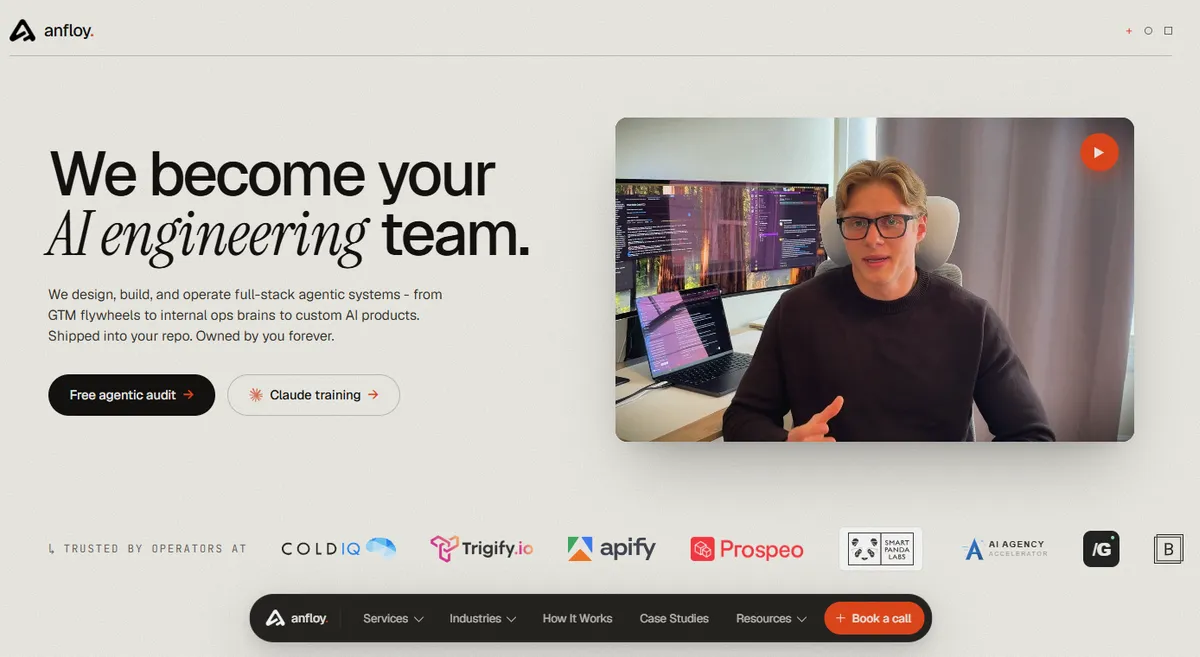
At Anfloy, we help businesses adopt AI without the cost and complexity of building an internal AI department.
Rather than selling another AI tool, we build custom AI infrastructure around your business, your workflows, and your long-term growth goals.
Every engagement begins with understanding:
- your business objectives
- operational bottlenecks
- customer journey
- existing technology stack
- internal knowledge
- automation opportunities
From there, we design AI systems that integrate with your existing operations instead of disrupting them.
Agentic systems
We build multi-agent AI systems where specialized agents collaborate to automate complex workflows across sales, operations, customer support, and internal processes.
Instead of relying on a single AI assistant, each agent owns a specific responsibility, making your automation more reliable and scalable.
Company AI brain
Every AI solution is powered by a centralized Company AI Brain built using Retrieval-Augmented Generation (RAG), embeddings, hybrid search, reranking, and persistent memory.
This gives AI access to your:
- documentation
- SOPs
- CRM history
- product knowledge
- customer information
- internal policies
The result is AI that understands your business instead of generating generic responses.
AI-powered GTM engines
For revenue teams, we build GTM Engines that automate:
- buying signal monitoring
- lead enrichment
- lead qualification
- outbound prospecting
- CRM management
- pipeline automation
This creates a connected revenue system rather than isolated sales tools.
Internal operations systems
Beyond customer-facing workflows, we automate:
- onboarding
- approvals
- reporting
- documentation retrieval
- internal knowledge management
- operational workflows
This allows teams to spend less time on repetitive work and more time on strategic initiatives.
Full-stack AI products
Some businesses need more than automation.
We also design and develop custom AI-powered platforms, internal SaaS products, and customer-facing AI applications that are deployed directly on your cloud infrastructure.
Infrastructure you own
Unlike subscription-based AI platforms, every system we build belongs to your business.
You own:
- the code
- the workflows
- the AI logic
- the knowledge architecture
- the integrations
- the infrastructure
No vendor lock-in.
No recurring software dependency.
The result is AI infrastructure that continues creating value as your business grows.
Ready to Build Custom AI Without Hiring an Internal Team?
Whether you want to automate sales, streamline operations, build a Company AI Brain, or launch a custom AI product, Anfloy can help.
We design and build:
Agentic Systems
GTM Engines
Company AI Brains
Internal Operations Systems
Full-Stack AI Products
Every solution is custom-built around your workflows, integrates with your existing software, and runs on infrastructure that you own.
Book a Strategy Call
What is the future of AI implementation?
Over the next few years, businesses won't compete based on who uses AI.
They'll compete based on how well AI is integrated into their operations.
Future organizations will rely on AI to:
- automate repetitive work
- coordinate workflows across departments
- retrieve company knowledge instantly
- monitor revenue opportunities
- support employee decision-making
- improve customer experiences
Instead of hiring large AI teams, many companies will partner with AI specialists to build scalable systems while keeping their internal teams focused on core business activities.
AI will become part of everyday business infrastructure rather than a standalone technology initiative.
Conclusion
Implementing AI doesn't require building an expensive internal AI department.
It requires identifying the right business problems, connecting your existing systems, and building AI around the way your business already operates.
By combining:
- AI agents
- Company AI Brains
- Retrieval-Augmented Generation (RAG)
- workflow automation
- GTM Engines
- Internal Operations Systems
businesses can automate repetitive work, improve decision-making, and create scalable operational infrastructure without hiring a dedicated AI team.
At Anfloy, we help growing companies design, build, and deploy custom AI systems that integrate with their existing technology stack and remain fully owned by the client.
Because successful AI implementation isn't about hiring more engineers.
It's about building intelligent systems that help your business operate more efficiently, generate more revenue, and scale with confidence.
Frequently Asked Questions
Can a small business implement AI without hiring AI engineers?
Yes. Many small and growing businesses successfully implement AI by working with specialized AI development partners instead of building an internal AI team.
What is the fastest way to implement AI in a business?
Start with one high-impact workflow, such as customer support, lead qualification, CRM automation, or internal knowledge management, and expand after proving ROI.
Is it better to hire an AI team or outsource AI development?
It depends on your goals. Large enterprises may benefit from internal AI teams, while many growth-stage companies achieve faster results by partnering with AI specialists who build custom AI systems.
How much does it cost to implement AI in a business?
Costs vary depending on the complexity of the solution. Off-the-shelf AI tools generally have lower upfront costs, while custom AI systems require a larger initial investment but provide greater flexibility and long-term ownership.
What types of businesses benefit most from AI?
SaaS companies, agencies, consulting firms, recruiting businesses, professional services, and organizations with repetitive operational workflows often achieve the greatest return from AI implementation.
Let's build
what your
company needs.
Drop your email. We'll send The Custom Agent Blueprint on what we'd build first for a company like yours, before you ever take a meeting.