
AI Agency vs In-House AI Team: Which Is Better for Your Business?
Compare AI agencies and in-house AI teams across cost, speed, expertise, scalability, ownership, and implementation timelines.
On this page
- Why companies need AI talent?
- What is an in-house AI team?
- What is an AI agency?
- AI agency vs in-house AI team: The core difference
- Agency vs In-house: Stress level & AI impact
- Where AI agencies win?
- Where in-house teams win?
- The hidden cost of building an in-house AI team
- The Hidden Risk of AI Agencies
- When should you hire an in-house AI team?
- When should you work with an AI agency?
- How Anfloy differs from traditional AI agencies?
- Common mistakes companies make
- Conclusion
As AI adoption accelerates, many companies eventually face the same question:
Should we hire an in-house AI team or work with an AI agency?
On the surface, building internally seems attractive.
You control the roadmap.
You hire dedicated talent.
You keep expertise inside the business.
However, reality is often more complicated.
Hiring AI engineers is expensive.
Finding experienced talent is difficult.
Building production-ready AI systems takes time.
Meanwhile, competitors are already deploying AI across sales, operations, customer support, and internal workflows.
This is why many growth-stage companies are evaluating AI agencies as an alternative.
The decision is not simply about cost.
It is about:
- speed
- expertise
- operational complexity
- ownership
- long-term scalability
The right choice depends on your business goals, resources, and stage of growth.
This guide explains the differences between AI agencies and in-house AI teams, the advantages of each approach, and how companies should evaluate both options.
Why companies need AI talent?
Most businesses are no longer asking whether AI matters.
They are asking how to implement it.
Common initiatives include:
- AI agents
- GTM automation
- CRM automation
- company AI brains
- customer support systems
- internal operations automation
- custom AI products
Building these systems requires expertise across:
- AI engineering
- software development
- integrations
- infrastructure
- data systems
- workflow design
The question is how to acquire that expertise.
What is an in-house AI team?
An in-house AI team consists of employees hired directly by the company.
Depending on the project, this may include:
- AI engineers
- machine learning engineers
- software developers
- data engineers
- product managers
The team works exclusively on internal projects and becomes part of the organization.
This approach provides maximum control but also requires significant investment.
What is an AI agency?
An AI agency provides external expertise to design, build, and deploy AI systems.
Depending on the agency, services may include:
- AI automation
- AI agents
- workflow orchestration
- GTM systems
- CRM automation
- custom AI products
The company gains access to an experienced team without hiring internally.
The strongest agencies function as implementation partners rather than consultants.
They build systems, not presentations.
AI agency vs in-house AI team: The core difference
The biggest difference is simple.
In-house teams build capability
You invest in people and internal expertise.
AI agencies build outcomes
You invest in systems and implementation.
Both approaches can work.
The best option depends on what the business needs right now.
AI agency vs in-house AI team comparison
| Category | AI Agency | In-House AI Team |
|---|---|---|
| Speed to Launch | Excellent | Moderate |
| Upfront Cost | Lower | Higher |
| Hiring Required | No | Yes |
| AI Expertise | Immediate | Must Build |
| Scalability | Excellent | Moderate |
| Long-Term Internal Knowledge | Limited | Excellent |
| Operational Complexity | Lower | Higher |
| Management Overhead | Low | High |
| Time to First Deployment | Days or Weeks | Months |
| Ownership | Depends on Agency | Full Ownership |
The biggest tradeoff is speed versus internal capability.
Agency vs In-house: Stress level & AI impact
One factor that rarely gets discussed is operational stress.
Building AI systems is not just a technical challenge.
It is also a management challenge.
When companies choose the in-house route, they take responsibility for:
- recruiting AI talent
- onboarding new hires
- managing projects
- maintaining infrastructure
- solving technical roadblocks
- keeping up with rapidly changing AI technology
For many leadership teams, this creates significant overhead before any business value is delivered.
An AI engineer may take months to hire and even longer to become fully productive.
Meanwhile, competitors continue shipping.
With an AI agency, much of that complexity is handled externally.
The company can focus on business outcomes while experienced engineers manage implementation, integrations, testing, and deployment.
In-house AI impact
Advantages include:
- long-term internal expertise
- direct control over development
- dedicated team resources
Challenges include:
- slower execution
- hiring risk
- management overhead
- ongoing salary commitments
Agency AI impact
Advantages include:
- faster deployment
- immediate expertise
- lower operational burden
- quicker time-to-value
Challenges include:
- choosing the right partner
- ensuring ownership of systems
- aligning workflows with business goals
For most growth-stage companies, the biggest challenge is not building AI.
It is building AI fast enough to create an advantage.
That is why many organizations start with an AI engineering partner to accelerate implementation and reduce operational stress while still retaining ownership of the systems they deploy.
Where AI agencies win?
Faster deployment
Building an internal AI team can take months.
An experienced AI engineering partner can often begin immediately.
For companies facing competitive pressure, speed matters.
Access to specialized expertise
Most businesses do not need one AI engineer.
They need:
- AI expertise
- software expertise
- integration expertise
- infrastructure expertise
An agency provides access to an entire team.
Lower hiring risk
Hiring AI talent is expensive and competitive.
Agencies remove recruiting risk from the equation.
Lower initial investment
Many companies can deploy AI systems without committing to full-time salaries.
Proven implementation experience
Experienced agencies have already solved similar problems for other organizations.
This often accelerates deployment.
Where in-house teams win?
Full internal control
The company controls priorities, timelines, and development direction.
Long-term knowledge retention
Expertise remains inside the organization.
Continuous development
Internal teams can support ongoing product evolution.
Deep business context
Employees often develop a stronger understanding of company operations over time.
Strategic AI initiatives
Organizations building AI as a core competitive advantage may eventually require dedicated internal teams.
The hidden cost of building an in-house AI team
Many companies underestimate the true cost of hiring AI talent.
Typical expenses include:
- recruiting
- salaries
- onboarding
- management
- infrastructure
- benefits
A single experienced AI engineer may cost $150,000 to $250,000+ annually.
Many organizations compare the cost of hiring internally against working with a specialized implementation partner before committing to long-term AI recruitment.
The challenge is not just hiring talent.
It is creating an environment where that talent can succeed.
The Hidden Risk of AI Agencies
Not all AI agencies are the same.
Many agencies focus on:
- strategy documents
- consulting retainers
- endless workshops
- ongoing billable hours
Businesses should evaluate whether an agency actually ships systems.
Companies should also understand the difference between agencies that provide strategic guidance and partners that build company-owned AI infrastructure.
The goal should be implementation.
Not presentations.
When should you hire an in-house AI team?
An internal team often makes sense when:
- AI is a core company product
- continuous development is required
- long-term AI investment is a strategic priority
- engineering resources already exist
For large organizations, this can be the right path.
When should you work with an AI agency?
An agency is often the better option when:
- speed matters
- hiring is difficult
- expertise is missing
- operational systems need implementation
- AI is important but not the company's primary product
This is especially common among growth-stage companies.
The Best Approach: Agency First, Team Later
Many successful organizations follow a hybrid approach.
Phase 1:
Use an AI engineering partner to deploy systems quickly and establish proven workflows before investing in a larger internal team.
Phase 2:
Build internal capabilities over time.
This approach provides:
- faster results
- reduced hiring risk
- practical learning
- operational momentum
without delaying implementation.
Building AI systems doesn't require months of recruiting, onboarding, and experimentation.
At Anfloy, we design and deploy company-owned AI infrastructure that helps businesses automate operations, streamline GTM workflows, and create leverage across the organization.
Explore how our implementation process works and what happens from discovery to deployment.
→ See How It Works
How Anfloy differs from traditional AI agencies?
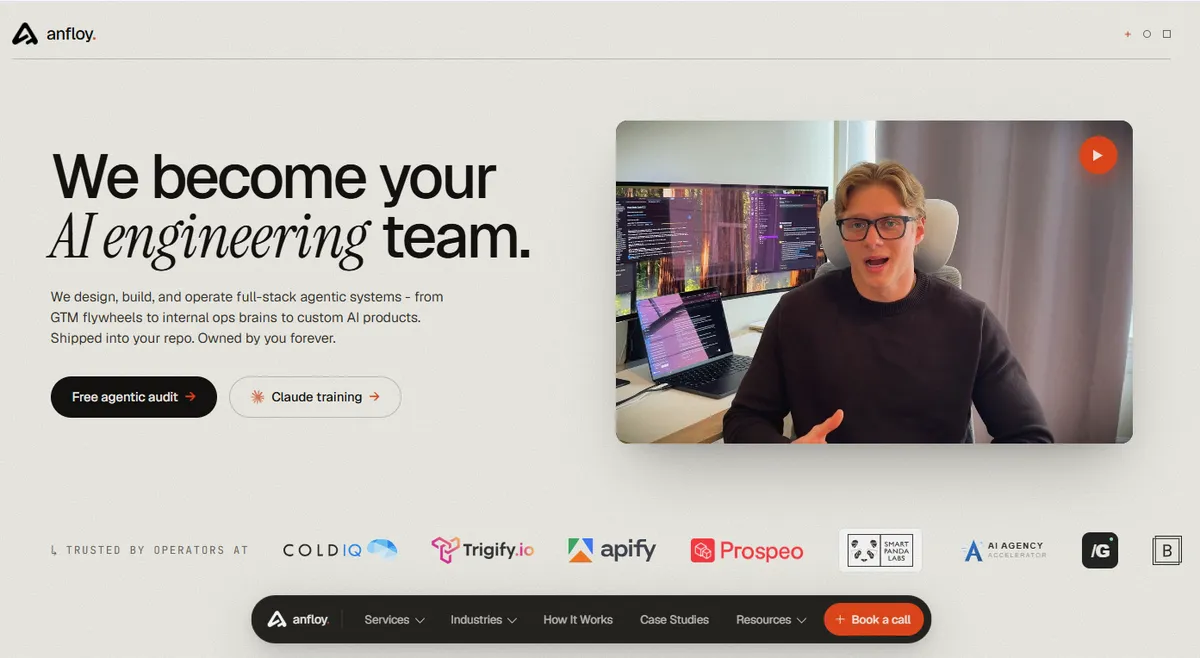
Most AI agencies sell labor.
Anfloy builds systems.
Instead of charging ongoing retainers and creating dependency, Anfloy focuses on delivering company-owned infrastructure.
The process starts by understanding:
- your ICP
- business workflows
- operational bottlenecks
- revenue goals
- automation opportunities
From there, custom systems are built around your business.
Agentic systems
Multi-agent architectures that can reason and execute across workflows.
GTM engines
Signal → Enrichment → Qualification → Personalization → CRM
automated through AI infrastructure.
Company AI brains
Knowledge systems that connect employees, SOPs, and business information.
Internal operations systems
Automation designed to replace repetitive operational work.
Full-stack AI products
Custom Full-stack AI products built directly on your cloud infrastructure.
Most importantly:
You own:
- the code
- the workflows
- the infrastructure
- the integrations
- the operational logic
No lock-in.
No platform dependency.
No software tax.
The result is an AI asset rather than an ongoing agency dependency.
Common mistakes companies make
Hiring too early
Many businesses hire AI talent before defining the problem.
Choosing consultants instead of builders
Strategy is valuable.
Execution creates outcomes.
Underestimating hiring costs
Internal AI teams require significant investment.
Ignoring ownership
Long-term flexibility often depends on infrastructure ownership.
Waiting too long
The biggest risk may be delaying implementation altogether.
Conclusion
The choice between an AI agency and an in-house AI team is not about finding a universally better option.
It is about choosing the approach that aligns with your current stage of growth.
In-house teams provide long-term capability.
AI agencies provide speed and execution.
For many companies, the fastest path to results is implementing AI systems first and building internal expertise later.
The businesses gaining the most value from AI today are not waiting until they have perfect teams.
They are deploying operational systems that improve how the company works.
At Anfloy, that means helping businesses build:
- agentic systems
- GTM engines
- company AI brains
- internal operations infrastructure
- full-stack AI products
without creating platform dependency or long-term lock-in.
Because the real competitive advantage is not hiring AI talent.
The real advantage comes from building AI systems that create leverage across revenue generation, operations, and decision-making.
It is building AI infrastructure that compounds in value as your business grows.
Build First. Hire Later.
Many companies use Anfloy to deploy AI systems before investing in an internal AI team.
We help businesses launch agentic workflows, GTM engines, company AI brains, and operational automation on infrastructure they fully own.
→ Book a Call
Frequently Asked Questions
Is it cheaper to hire an AI engineer or work with an AI agency?
For many projects, working with an AI agency is significantly less expensive than building a full internal AI team.
How much does an in-house AI team cost?
Costs vary, but a single experienced AI engineer may cost $150,000–$250,000+ annually before infrastructure and management expenses.
When should a company hire an AI team?
Typically when AI becomes a long-term strategic capability requiring continuous development.
Are AI agencies worth it?
They can be, especially when businesses need expertise, speed, and implementation without hiring internally.
What is the biggest advantage of an AI agency?
Faster deployment and access to experienced specialists without the cost of building a full team.
Let's build
what your
company needs.
Drop your email. We'll send The Custom Agent Blueprint on what we'd build first for a company like yours, before you ever take a meeting.