
Hire an AI Engineer or Build Faster With Anfloy? The Real Cost Comparison
On this page
- What companies actually need?
- What does an AI engineer actually do?
- What is the real cost of hiring an AI engineer?
- What is the hiring timeline problem?
- Why most companies don't need an AI engineer?
- Why companies choose Anfloy instead of an AI engineer?
- Anfloy vs Hire AI engineer: Direct comparison
- Why does ownership matter?
- What Anfloy builds?
- Which companies benefit most from Anfloy?
- What is the biggest mistake companies make?
- Conclusion
- Not sure whether you need an AI engineer or an AI system?
AI has become a strategic priority for modern businesses.
Growth-stage SaaS companies, agencies, consulting firms, and operations-heavy organizations are all looking for ways to deploy AI across their workflows.
The challenge is no longer deciding whether to use AI.
The challenge is deciding how to build it.
Most companies eventually face two options:
- Hire an AI engineer
- Partner with a specialized AI engineering firm like Anfloy
At first glance, hiring seems like the logical choice.
You bring expertise in-house. You gain a dedicated resource. You build internal capabilities.
But once companies begin evaluating timelines, costs, and implementation complexity, the decision becomes less straightforward.
The reality is that most organizations are not looking for an AI employee.
They are looking for a working AI system.
That distinction changes everything.
This guide compares hiring an AI engineer versus working with Anfloy, including:
- costs
- timelines
- expertise
- ownership
- scalability
- and long-term business impact
What companies actually need?
When founders start searching for AI talent, they often believe they need an engineer.
In reality, they usually need one of the following:
- GTM AI agents
- AI lead generation systems
- internal AI assistants
- RAG infrastructure
- company AI brains
- workflow automation
- onboarding systems
- AI-powered software products
The goal is not hiring.
The goal is solving an operational problem.
This is where many businesses make an expensive mistake.
They optimize for hiring instead of outcomes.
What does an AI engineer actually do?
An AI engineer is responsible for building and maintaining AI-powered systems.
That may involve:
- LLM integrations
- agent frameworks and multi-agent architectures
- RAG systems
- vector databases
- API integrations
- infrastructure management
- prompt engineering
- workflow orchestration
A strong AI engineer often needs expertise across:
- OpenAI
- Claude
- embeddings
- retrieval systems
- Python
- cloud infrastructure
- databases
- DevOps
- automation frameworks
The challenge is finding someone who can do all of it.
Those engineers are expensive and highly competitive.
What is the real cost of hiring an AI engineer?
Most companies underestimate the true cost of hiring.
Salary is only one piece of the equation.
Typical costs include:
What will be the direct costs?
- salary
- benefits
- bonuses
- recruiting fees
- onboarding
What will be the hidden costs?
- management time
- delayed implementation
- failed hires
- opportunity cost
- training
For experienced AI talent, annual costs often exceed:
- $150,000
- $200,000
- $250,000+
And that is before a single system is deployed.
For many growth-stage companies, that investment is difficult to justify.
What is the hiring timeline problem?
Even if budget is not a concern, speed often becomes the bottleneck.
A typical hiring process looks like:
Month 1
Job description and recruiting.
Month 2
Candidate sourcing and interviews.
Month 3
Offer negotiation and acceptance.
Month 4
Notice period.
Month 5
Onboarding.
Month 6
Meaningful production work begins.
That means six months may pass before the company sees results.
Meanwhile, operational bottlenecks remain unsolved.
Why most companies don't need an AI engineer?
This may sound surprising.
But most organizations do not actually need a full-time AI engineer.
They need:
- a GTM engine
- a company AI brain
- an onboarding system
- an outbound automation stack
- a custom AI product
- or operational infrastructure
Once those systems are deployed, ongoing engineering requirements are often much lower than expected.
The business needs outcomes.
Not necessarily headcount.
Why companies choose Anfloy instead of an AI engineer?
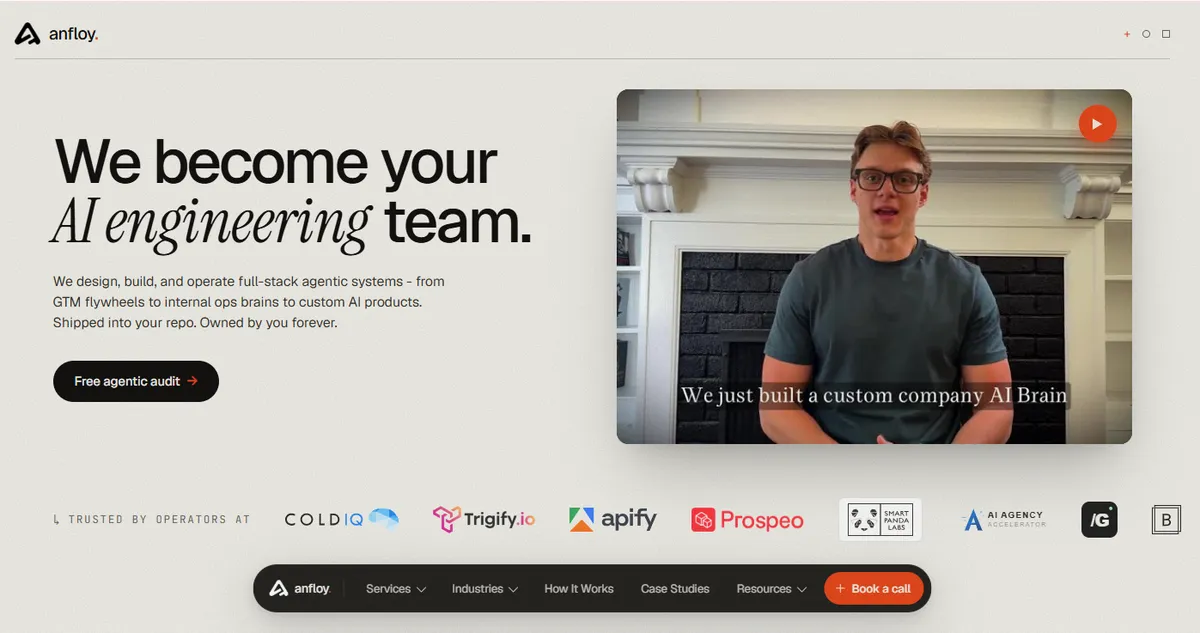
Anfloy takes a completely different approach.
Instead of providing labor, Anfloy builds custom AI infrastructure tailored to business operations.
That means:
- AI agentic systems
- GTM engines
- RAG architecture
- Internal operations systems
- Full-stack AI products
- AI Automation
The focus is on delivering operational assets rather than staffing resources.
Clients receive working systems designed around their workflows.
Not generic software.
Not no-code automations.
Not consulting recommendations.
Actual infrastructure.
Anfloy vs Hire AI engineer: Direct comparison
| Category | Hire AI Engineer | Anfloy |
|---|---|---|
| Time to Start | Months | Days |
| Time to Deployment | 3–6 months | 1–5 weeks |
| Upfront Cost | Very High | Fixed Scope |
| Hiring Risk | High | None |
| AI Expertise | One person | Specialized team |
| Infrastructure Ownership | Yes | Yes |
| Operational Frameworks | Built from scratch | Proven systems |
| Scalability | Limited | Flexible |
The biggest difference is simple.
One option hires talent.
The other delivers systems.
Why does ownership matter?
Many AI agencies create dependency.
The workflows live inside their platform.
The infrastructure remains under their control.
The client becomes locked into ongoing contracts.
Anfloy operates differently.
Every system is built on your stack.
You own:
- code
- workflows
- infrastructure
- integrations
- operational logic
No platform tax.
No lock-in.
No recurring software hostage situation.
This creates long-term leverage instead of long-term dependency.
What Anfloy builds?
Most companies do not wake up wanting an AI engineer.
They want outcomes.
Examples include:
Agentic systems
Multi-agent systems that reason, coordinate, and execute.
GTM engines
Signal → Enrichment → Personalization → CRM.
Built directly into your workflow.
Company AI brains
Internal knowledge systems powered by:
- RAG
- embeddings
- hybrid search
- retrieval architecture
Internal operations systems
Replace repetitive operational work with AI-driven workflows.
Full-stack AI products
Custom SaaS products, portals, platforms, and member experiences.
Built on your infrastructure.
Which companies benefit most from Anfloy?
The strongest fit includes:
High-growth agencies
Need to scale delivery without increasing headcount.
Growth-stage SaaS
Need AI infrastructure but cannot justify a full AI team.
Info businesses
Need better operational systems and knowledge management.
Coaching businesses
Need onboarding, follow-up, and member automation.
Recruiting agencies
Need sourcing, matching, and qualification systems.
Consulting firms
Need operational leverage without increasing staff.
What is the biggest mistake companies make?
Most businesses start with the wrong question.
They ask:
"Should we hire an AI engineer?"
The better question is:
"What AI system do we actually need?"
Once that question is answered, the solution often becomes obvious.
The objective is not expanding headcount.
The objective is increasing leverage.
Conclusion
Hiring an AI engineer is not inherently a bad decision.
For some companies, it is absolutely the right move.
But for many growth-stage businesses, the real challenge is not finding AI talent.
It is implementing AI systems that create measurable business outcomes.
Hiring can take months.
Costs can exceed six figures before deployment begins.
Execution risk remains high.
Anfloy offers a different path.
Instead of selling labor, the company builds AI infrastructure designed around your operations.
You receive:
- custom agentic systems
- GTM engines
- company AI brains
- internal operations systems
- and full-stack AI products
Most importantly, you own everything.
No lock-in.
No platform dependency.
No recurring software tax.
Because the goal is not to hire AI talent.
The goal is to build AI systems that create operational leverage for years to come.
Not sure whether you need an AI engineer or an AI system?
Most companies don't need another hire.
They need a GTM engine, a Company AI Brain, an internal operations system, or a custom AI product that creates leverage immediately.
On a free 30-minute strategy call, we'll map your workflows, identify the highest-impact AI opportunities inside your business, and show you what we'd build first.
No generic consultation. No sales deck.
Just a practical roadmap for implementing AI in your company.
Book your free strategy call →
Frequently Asked Questions
Is Anfloy cheaper than hiring an AI engineer?
For most growth-stage companies, yes. Hiring often exceeds $200,000 annually before meaningful systems are deployed.
Do I own the systems Anfloy builds?
Yes. Ownership is a core part of the model. Clients own the infrastructure, workflows, and code.
Can Anfloy replace an internal AI team?
For many companies, yes. Especially when the goal is to deploy operational systems rather than build a dedicated AI department.
How quickly can Anfloy build AI systems?
Most systems are delivered significantly faster than a traditional hiring cycle.
When should I hire an internal AI engineer instead?
If AI is becoming a core product function requiring continuous long-term development, building an internal team may make sense.
Will AI replace cost engineers?
No. AI can automate quantity takeoffs, cost estimation, and reporting, but cost engineers remain essential for judgment, risk assessment, contract management, and strategic decision-making on complex projects.
Do AI engineers make a lot of money?
Yes. AI engineers are among the highest-paid technology professionals, with experienced engineers often earning $150,000–$250,000+ annually due to strong demand and specialized expertise.
Let's build
what your
company needs.
Drop your email. We'll send The Custom Agent Blueprint on what we'd build first for a company like yours, before you ever take a meeting.