
GTM Engineering Agency vs RevOps Agency vs Freelancer
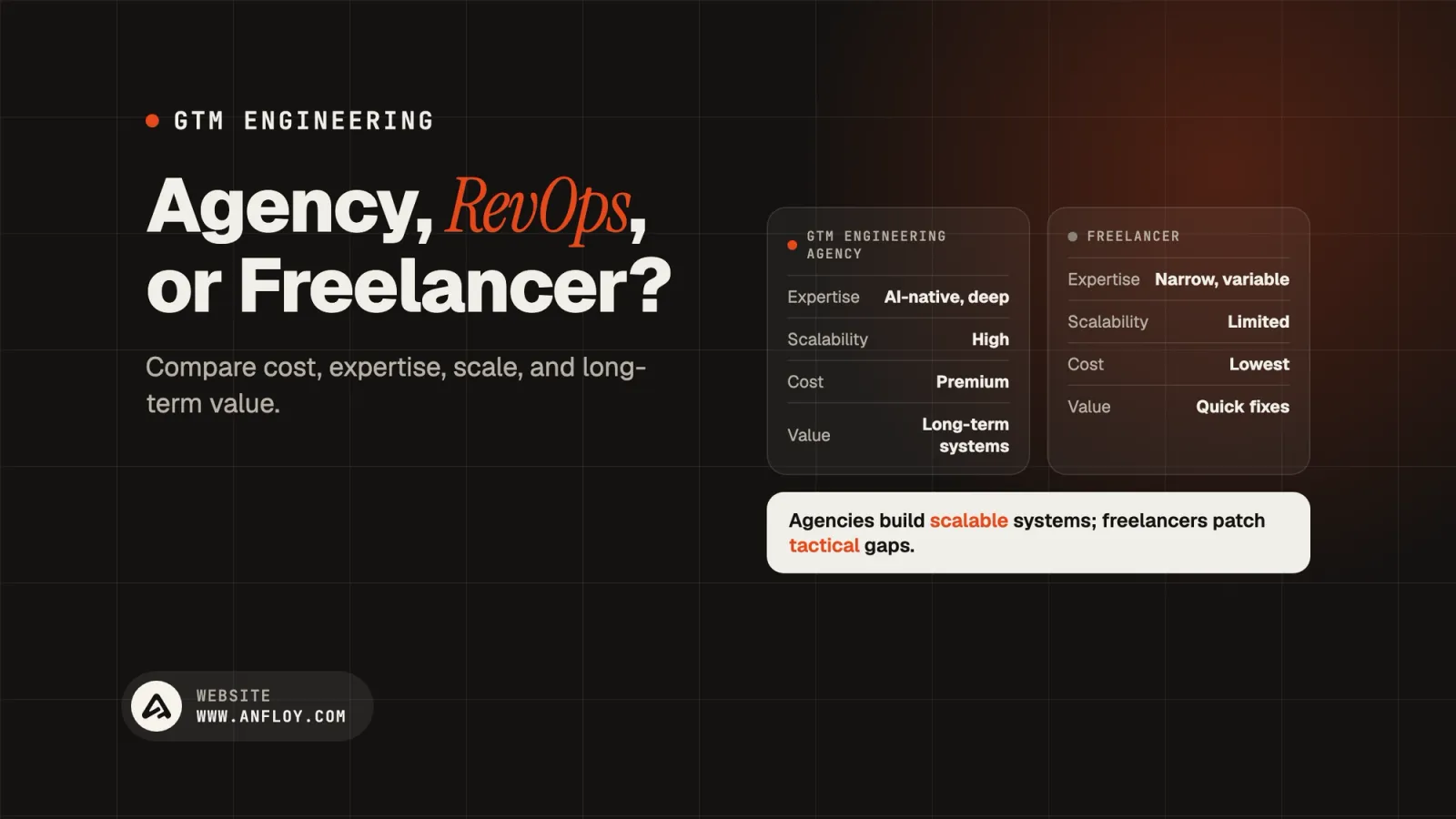
Compare GTM Engineering agencies, RevOps agencies, and freelancers across cost, expertise, scalability, AI, operations, and long-term business value.
On this page
- Understanding the three GTM delivery models
- What is a GTM engineering agency?
- What is a RevOps agency?
- What does a freelancer typically do?
- How these models fit into modern GTM organizations?
- Primary difference between the three
- Why this decision matters more than ever?
- Cost comparison: GTM engineering agency vs RevOps agency vs freelancer
- GTM engineering agency cost structure
- Direct cost vs business value
- Expertise comparison
- AI readiness comparison
- Which model scales best?
- Which option is best for startups?
- When a GTM engineering agency is the better choice?
- Which option is best for SaaS companies?
- Which option is best for enterprise businesses?
- Hybrid delivery models: why businesses combine multiple partners?
- Decision framework
- Common mistakes businesses make
- What is the future of GTM service delivery?
- Why businesses choose Anfloy?
- Conclusion
Modern B2B companies have more options than ever when building their go-to-market capabilities.
Instead of hiring every specialist internally, businesses can partner with a GTM Engineering agency, work with a Revenue Operations (RevOps) agency, or hire an independent freelancer for specific projects.
Each model offers unique advantages.
However, choosing the wrong delivery model can lead to fragmented systems, inconsistent execution, delayed implementations, and higher long-term costs.
The right choice depends on your company's operational maturity, technology stack, growth objectives, internal expertise, and the complexity of your go-to-market organization.
This guide compares all three options across cost, implementation speed, technical capabilities, AI readiness, scalability, and long-term return on investment.
Understanding the three GTM delivery models
Although all three support revenue growth, they solve different operational challenges.
Understanding their core responsibilities helps businesses choose the right partner.
What is a GTM engineering agency?
A GTM Engineering agency designs, builds, integrates, and optimizes the operational systems that power a company's go-to-market execution.
Unlike traditional consultants who primarily deliver strategic recommendations, GTM Engineering agencies focus on implementation.
Their work typically includes:
- GTM strategy execution
- CRM architecture
- Workflow automation
- API integrations
- Revenue Operations implementation
- AI workflow automation
- AI lead scoring
- Customer lifecycle automation
- Data enrichment
- Revenue Intelligence
- Executive dashboards
The primary objective is to transform business strategy into scalable operational systems.
What is a RevOps agency?
A Revenue Operations (RevOps) agency focuses on improving operational alignment across marketing, sales, and customer success.
Typical RevOps responsibilities include:
- Revenue forecasting
- CRM governance
- Pipeline management
- Sales process optimization
- KPI reporting
- Territory planning
- Revenue analytics
- Operational alignment
- Process documentation
While RevOps agencies may support CRM optimization and automation, their primary focus is operational governance rather than technical implementation.
What does a freelancer typically do?
Freelancers usually provide specialized expertise within a narrower scope.
Common freelance services include:
- CRM configuration
- HubSpot administration
- Salesforce customization
- Workflow automation
- Marketing automation
- API development
- Reporting
- Data cleanup
- Technical consulting
Unlike agencies, freelancers generally work independently and may not provide multidisciplinary support across GTM strategy, Revenue Operations, AI implementation, and GTM Engineering simultaneously.
How these models fit into modern GTM organizations?
Each model contributes differently to the go-to-market ecosystem.
Business Strategy
        │
        ▼
Go-to-Market Strategy
        │
        ├───────────────┬────────────────┐
        ▼               ▼                ▼
GTM Engineering     RevOps Agency    Freelancer
Agency
        │               │                │
        └───────Supports Revenue Execution───────┐
                                                 │
                                                 ▼
CRM • AI • Revenue Operations • Automation
                                                 │
                                                 ▼
Revenue Growth
Although their responsibilities overlap in some areas, their primary business objectives remain distinct.
Primary difference between the three
The biggest difference is scope of ownership.
A GTM Engineering agency owns operational implementation across multiple systems.
A RevOps agency primarily improves revenue processes and operational governance.
A freelancer usually completes individual technical tasks or specialized projects.
Understanding this distinction helps organizations avoid selecting a partner that solves only part of the problem.
High-level comparison
| Capability | GTM Engineering Agency | RevOps Agency | Freelancer |
|---|---|---|---|
| GTM Strategy Execution | Excellent | Moderate | Limited |
| CRM Architecture | Excellent | Strong | Depends on expertise |
| Revenue Operations | Strong | Excellent | Limited |
| Workflow Automation | Excellent | Strong | Strong |
| API Integrations | Excellent | Moderate | Depends on expertise |
| AI Implementation | Excellent | Moderate | Variable |
| Customer Lifecycle Automation | Excellent | Moderate | Limited |
| Revenue Intelligence | Excellent | Strong | Limited |
| Executive Advisory | Strong | Strong | Limited |
| Scalability | Excellent | Strong | Limited |
This comparison demonstrates that each model addresses different operational needs rather than directly replacing one another.
Why this decision matters more than ever?
Go-to-market organizations have become increasingly interconnected.
Revenue growth now depends on multiple disciplines working together, including:
- GTM strategy
- GTM Engineering
- Revenue Operations
- CRM architecture
- AI implementation
- Workflow automation
- Customer lifecycle management
- Revenue Intelligence
- Data enrichment
As operational complexity grows, choosing the right delivery model becomes a strategic decision rather than simply a staffing decision.
In the next section, we'll compare costs, implementation speed, expertise, AI capabilities, scalability, and long-term ROI to determine which option creates the greatest value for different types of businesses.
Cost comparison: GTM engineering agency vs RevOps agency vs freelancer
Cost is one of the first factors businesses evaluate when choosing an implementation partner.
However, comparing hourly rates alone rarely leads to the right decision.
The real comparison should consider:
- Scope of work
- Specialized expertise
- Speed of delivery
- Long-term business value
- Operational scalability
- Risk of implementation
- Ongoing support
A freelancer may appear less expensive than an agency, but a lower project cost does not necessarily translate into a lower total cost of ownership.
The same applies when comparing a RevOps agency with a GTM Engineering agency.
The value comes from how effectively each model solves business problems.
GTM engineering agency cost structure
A GTM Engineering agency generally prices engagements based on project scope, operational complexity, implementation effort, or ongoing partnership models.
Typical engagement models include:
- Fixed implementation projects
- Monthly retainers
- Fractional GTM Engineering
- Outcome-based engagements
- Ongoing optimization programs
Rather than paying for individual specialists, businesses gain access to a multidisciplinary delivery team.
That team often includes:
- GTM Engineers
- RevOps specialists
- CRM Architects
- Automation Engineers
- AI specialists
- Data Engineers
- Technical Consultants
This consolidated expertise often reduces the need for multiple vendor relationships.
RevOps agency cost structure
RevOps agencies primarily focus on operational optimization.
Pricing commonly reflects:
- CRM governance
- Revenue reporting
- Process optimization
- Forecasting
- Sales operations
- Customer success operations
- Operational advisory
Many RevOps agencies also offer ongoing monthly retainers because Revenue Operations is a continuous function rather than a one-time implementation.
Freelancer cost structure
Freelancers generally charge using one of four models:
- Hourly
- Daily
- Project-based
- Monthly contract
Because freelancers usually specialize in one area, businesses often hire multiple freelancers for larger initiatives.
For example:
- CRM configuration
- API development
- Workflow automation
- HubSpot administration
- Salesforce customization
Managing multiple freelancers may increase coordination effort, project management overhead, and delivery risk.
Direct cost vs business value
Instead of evaluating only project pricing, organizations should compare overall business value.
| Evaluation Area | GTM Engineering Agency | RevOps Agency | Freelancer |
|---|---|---|---|
| Initial investment | Moderate | Moderate | Low |
| Cross-functional expertise | Excellent | Strong | Limited |
| Technology implementation | Excellent | Moderate | Depends on specialist |
| AI implementation | Excellent | Moderate | Variable |
| Long-term optimization | Excellent | Excellent | Limited |
| Vendor management | Single partner | Single partner | Multiple specialists may be required |
| Total business value | High | High | Project dependent |
The least expensive option often becomes the most expensive if it creates operational inefficiencies or requires additional specialists later.
Speed comparison
Implementation speed directly influences revenue growth.
Launching CRM systems, automating workflows, deploying AI, and improving Revenue Operations earlier allows organizations to realize value sooner.
Each delivery model approaches implementation differently.
GTM engineering agency speed
Most GTM Engineering agencies already have:
- Proven implementation frameworks
- Technical playbooks
- CRM specialists
- AI experts
- Automation engineers
- Revenue Operations consultants
Projects typically begin with:
- Discovery
- Architecture planning
- Workflow design
- CRM implementation
- AI integration
- User enablement
Because multidisciplinary teams already exist, execution usually starts immediately after project kickoff.
RevOps agency speed
RevOps agencies typically move quickly when optimizing existing revenue operations.
They excel at:
- Process standardization
- Forecasting
- Pipeline management
- KPI reporting
- CRM governance
However, technical implementation involving AI, APIs, or complex workflow engineering may require additional engineering resources.
Freelancer speed
Freelancers can often begin work quickly.
However, implementation speed depends on:
- Individual availability
- Technical specialization
- Project complexity
- Communication cycles
- Dependencies on other contractors
Single-person delivery models generally work well for focused projects but become more challenging as project scope expands.
Expertise comparison
Although all three models contribute expertise, the breadth of that expertise varies considerably.
GTM engineering agency expertise
A GTM Engineering agency combines multiple disciplines under one delivery model.
Common expertise includes:
- GTM strategy execution
- GTM Engineering
- CRM architecture
- Revenue Operations
- Workflow automation
- API integrations
- AI implementation
- Revenue Intelligence
- Customer lifecycle automation
- Data enrichment
Because agencies solve similar challenges across many organizations, they often identify optimization opportunities that internal teams or individual contractors may overlook.
RevOps agency expertise
RevOps agencies specialize in operational excellence.
Their expertise typically includes:
- Sales Operations
- Marketing Operations
- Customer Success Operations
- Forecasting
- Reporting
- CRM governance
- Pipeline optimization
- Revenue analytics
Organizations seeking stronger operational consistency often benefit significantly from RevOps expertise.
Freelancer expertise
Freelancers usually develop deep expertise within a single domain.
Examples include:
- HubSpot administration
- Salesforce development
- Zapier automation
- Make automation
- n8n workflows
- CRM migrations
- API integrations
This specialization is valuable for targeted technical work but may not provide the strategic coordination required for large GTM transformation initiatives.
AI readiness comparison
Artificial intelligence has become a major differentiator among GTM service providers.
Businesses increasingly require support for:
- AI lead scoring
- AI SDR workflows
- Company AI Brains
- Agentic AI
- Revenue Intelligence
- Workflow automation
- Predictive forecasting
- Autonomous reporting
GTM engineering agency
Typically provides the broadest AI implementation capabilities because AI is integrated into CRM architecture, workflow automation, Revenue Operations, and customer lifecycle management.
RevOps agency
Generally focuses on operational reporting, forecasting, and AI-assisted Revenue Operations rather than end-to-end AI engineering.
Freelancer
AI capability depends entirely on the individual's experience.
Some freelancers specialize in advanced AI automation, while others focus primarily on CRM administration or workflow development.
As AI becomes central to GTM execution, evaluating implementation experience becomes just as important as comparing pricing.
Which model scales best?
Scalability becomes increasingly important as businesses grow.
New products, international expansion, additional revenue teams, and evolving customer journeys all introduce operational complexity.
GTM Engineering agencies generally scale most effectively because they can expand resources across multiple disciplines without requiring businesses to manage separate vendors.
RevOps agencies scale well for organizations focused on operational governance, reporting, and process optimization.
Freelancers are highly effective for specialized projects but may require additional contractors as implementation scope grows.
In the next section, we'll compare which model is best for startups, SaaS companies, and enterprise organizations, explore hybrid engagement strategies, and provide a decision framework to help determine the best fit for different business scenarios.
Which option is best for startups?
Startups operate with limited budgets, lean teams, and aggressive growth targets.
Every hiring decision must generate measurable business value.
In most cases, founders need expertise across multiple disciplines, including:
- GTM strategy
- CRM implementation
- Revenue Operations
- Workflow automation
- AI implementation
- Sales enablement
- Customer onboarding
Hiring specialists for each function internally is often unrealistic during the early stages of growth.
This is why many startups begin with either a GTM Engineering agency or carefully selected freelancers before building an internal GTM organization.
When a GTM engineering agency is the better choice?
A GTM Engineering agency is often the right investment when a startup needs to:
- Build its first GTM infrastructure
- Launch a SaaS product
- Implement CRM systems
- Automate revenue workflows
- Deploy AI-powered sales processes
- Build scalable Revenue Operations
- Connect multiple GTM tools
Instead of coordinating several independent contractors, founders gain access to an integrated team capable of delivering end-to-end execution.
When a freelancer makes sense?
Freelancers are well suited for clearly defined projects such as:
- HubSpot setup
- Salesforce customization
- Workflow automation
- Landing page development
- API integrations
- CRM cleanup
They are particularly valuable when internal leadership already owns the broader GTM strategy.
However, relying on multiple freelancers for complex GTM transformation projects often creates coordination challenges.
Which option is best for SaaS companies?
SaaS companies require continuous optimization rather than one-time implementation.
As customer acquisition scales, organizations typically need improvements across:
- Product launches
- Product-qualified leads (PQLs)
- Customer onboarding
- Customer success
- Expansion revenue
- Revenue forecasting
- AI implementation
- GTM Engineering
A GTM Engineering agency often provides the broadest operational support because it combines strategic execution with technical implementation.
RevOps agencies remain valuable for organizations focused on improving forecasting, operational governance, and sales process alignment.
Many SaaS companies successfully combine both capabilities.
Which option is best for enterprise businesses?
Enterprise organizations operate within far more complex revenue environments.
Typical challenges include:
- Global CRM architecture
- Multiple business units
- Enterprise security
- Regulatory compliance
- AI governance
- Cross-functional Revenue Operations
- Large API ecosystems
- Executive reporting
Because these initiatives require both strategic planning and technical execution, enterprises frequently adopt a hybrid delivery model.
Internal teams maintain business ownership while GTM Engineering agencies and RevOps agencies contribute specialized expertise where required.
Hybrid delivery models: why businesses combine multiple partners?
The comparison is not always limited to one option.
Many high-growth organizations intentionally combine delivery models.
A typical hybrid structure looks like this:
| Responsibility | Best Owner |
|---|---|
| Business strategy | Internal leadership |
| Product knowledge | Internal teams |
| Revenue Operations governance | RevOps Agency |
| CRM architecture | GTM Engineering Agency |
| AI implementation | GTM Engineering Agency |
| Specialized technical tasks | Freelancer |
| Long-term optimization | Internal team + Agency |
This structure allows organizations to retain strategic ownership while accelerating implementation through external specialists.
Decision framework
Choosing the right partner becomes easier when the decision is based on operational needs rather than job titles.
| Business Requirement | GTM Engineering Agency | RevOps Agency | Freelancer |
|---|---|---|---|
| Build complete GTM infrastructure | ✅ Best Choice | ❌ | ❌ |
| Optimize Revenue Operations | ✅ | ✅ Best Choice | ❌ |
| CRM implementation | ✅ Best Choice | ✅ | ✅ |
| AI implementation | ✅ Best Choice | Limited | Depends on expertise |
| Workflow automation | ✅ Best Choice | ✅ | ✅ |
| Revenue forecasting | ✅ | ✅ Best Choice | Limited |
| Small technical project | Possible | Possible | ✅ Best Choice |
| Long-term GTM transformation | ✅ Best Choice | Strong | Limited |
The most effective choice depends on whether your primary challenge is operational execution, Revenue Operations maturity, or a narrowly defined technical requirement.
Common mistakes businesses make
Selecting the wrong delivery model often creates more operational complexity than the original business challenge.
Avoid these common mistakes.
Choosing based only on price
The least expensive option is not always the most cost-effective.
Businesses should compare:
- Business outcomes
- Delivery quality
- Technical expertise
- AI capabilities
- Scalability
- Long-term operational support
Rather than simply comparing hourly rates.
Hiring a freelancer for enterprise transformation
Freelancers often deliver exceptional technical work.
However, enterprise-wide GTM transformation typically requires expertise across:
- CRM architecture
- Revenue Operations
- AI implementation
- Workflow orchestration
- Data governance
- Change management
These initiatives usually benefit from multidisciplinary agency teams.
Expecting RevOps agencies to deliver full GTM engineering
Although RevOps agencies excel at operational alignment, forecasting, governance, and reporting, they may not provide the deep engineering capabilities required for:
- API development
- AI workflow implementation
- Company AI Brain architecture
- Complex CRM engineering
- Multi-system automation
Understanding these differences prevents unrealistic project expectations.
Delaying AI adoption
Modern GTM organizations increasingly depend on:
- AI lead scoring
- AI SDR workflows
- Predictive forecasting
- Revenue Intelligence
- Agentic AI
- Autonomous workflow automation
Organizations that delay AI implementation often spend more time rebuilding operational systems later.
Integrating AI into GTM architecture early generally produces greater long-term efficiency.
What is the future of GTM service delivery?
The boundaries between GTM Engineering, Revenue Operations, AI implementation, and automation continue to evolve.
Over the next several years, successful delivery partners will increasingly combine:
- GTM strategy
- GTM Engineering
- Revenue Operations
- CRM architecture
- AI agents
- Workflow automation
- Customer lifecycle automation
- Revenue Intelligence
Rather than purchasing isolated services, businesses will invest in integrated revenue systems capable of continuous optimization.
This evolution is shifting the market away from siloed specialists toward multidisciplinary GTM partners that combine strategic thinking with technical execution.
Why businesses choose Anfloy?
At Anfloy, we combine GTM strategy, GTM Engineering, and Revenue Operations to help businesses build modern, AI-ready revenue systems.
Our multidisciplinary team delivers:
- GTM strategy execution
- GTM Engineering
- CRM architecture
- Revenue Operations
- Workflow automation
- AI implementation
- AI lead scoring
- SDR workflow automation
- Data enrichment
- Customer lifecycle automation
- Revenue Intelligence
- Executive dashboards
Rather than treating strategy, operations, and technology as separate functions, we integrate them into one scalable GTM ecosystem designed to accelerate growth.
Conclusion
Choosing between a GTM Engineering agency, a RevOps agency, and a freelancer is not simply a pricing decision it is a decision about how your business will build, optimize, and scale its go-to-market organization.
GTM Engineering agencies provide end-to-end technical implementation and AI-driven execution. RevOps agencies strengthen operational alignment, forecasting, and governance. Freelancers contribute focused expertise for well-defined projects.
The most successful organizations evaluate these models based on business outcomes, operational maturity, implementation complexity, and long-term scalability rather than hourly rates alone.
For many modern B2B companies, the strongest approach combines strategic ownership with specialized external expertise to create a connected, AI-enabled revenue engine capable of supporting sustainable growth.
Build a modern GTM organization with Anfloy
Growth today depends on more than great strategy it requires connected systems, intelligent automation, and operational excellence.
Anfloy helps organizations accelerate revenue through GTM Engineering, Revenue Operations, CRM architecture, AI implementation, workflow automation, data enrichment, Revenue Intelligence, and customer lifecycle automation. We build scalable GTM ecosystems that transform business strategy into predictable revenue growth.
Frequently Asked Questions
What is the difference between a GTM Engineering agency and a RevOps agency?
A GTM Engineering agency focuses on designing, building, and optimizing the technical systems that support go-to-market execution, including CRM architecture, workflow automation, AI implementation, and integrations. A RevOps agency focuses primarily on operational alignment, forecasting, reporting, governance, and process optimization across marketing, sales, and customer success.
Is a freelancer a good alternative to a GTM agency?
Freelancers are an excellent choice for clearly defined technical projects such as CRM customization or workflow automation. However, larger GTM transformation initiatives usually benefit from the multidisciplinary expertise and structured delivery model of an agency.
Which option is best for startups?
Startups often benefit from GTM Engineering agencies because they provide strategic and technical expertise without requiring multiple full-time hires. Freelancers can also be valuable for targeted implementation work when project scope is limited.
Can businesses use all three models together?
Yes. Many organizations combine internal leadership with a GTM Engineering agency for implementation, a RevOps agency for operational optimization, and freelancers for specialized technical tasks. This hybrid approach provides flexibility while maintaining strategic control.
Which model offers the best long-term ROI?
The answer depends on business objectives. Organizations requiring broad GTM transformation, AI implementation, and operational scalability typically achieve greater long-term value through GTM Engineering agencies. Businesses focused primarily on Revenue Operations may benefit more from a RevOps agency, while freelancers deliver strong ROI for specialized, short-term projects.
Let's build
what your
company needs.
Drop your email. We'll send The Custom Agent Blueprint on what we'd build first for a company like yours, before you ever take a meeting.