
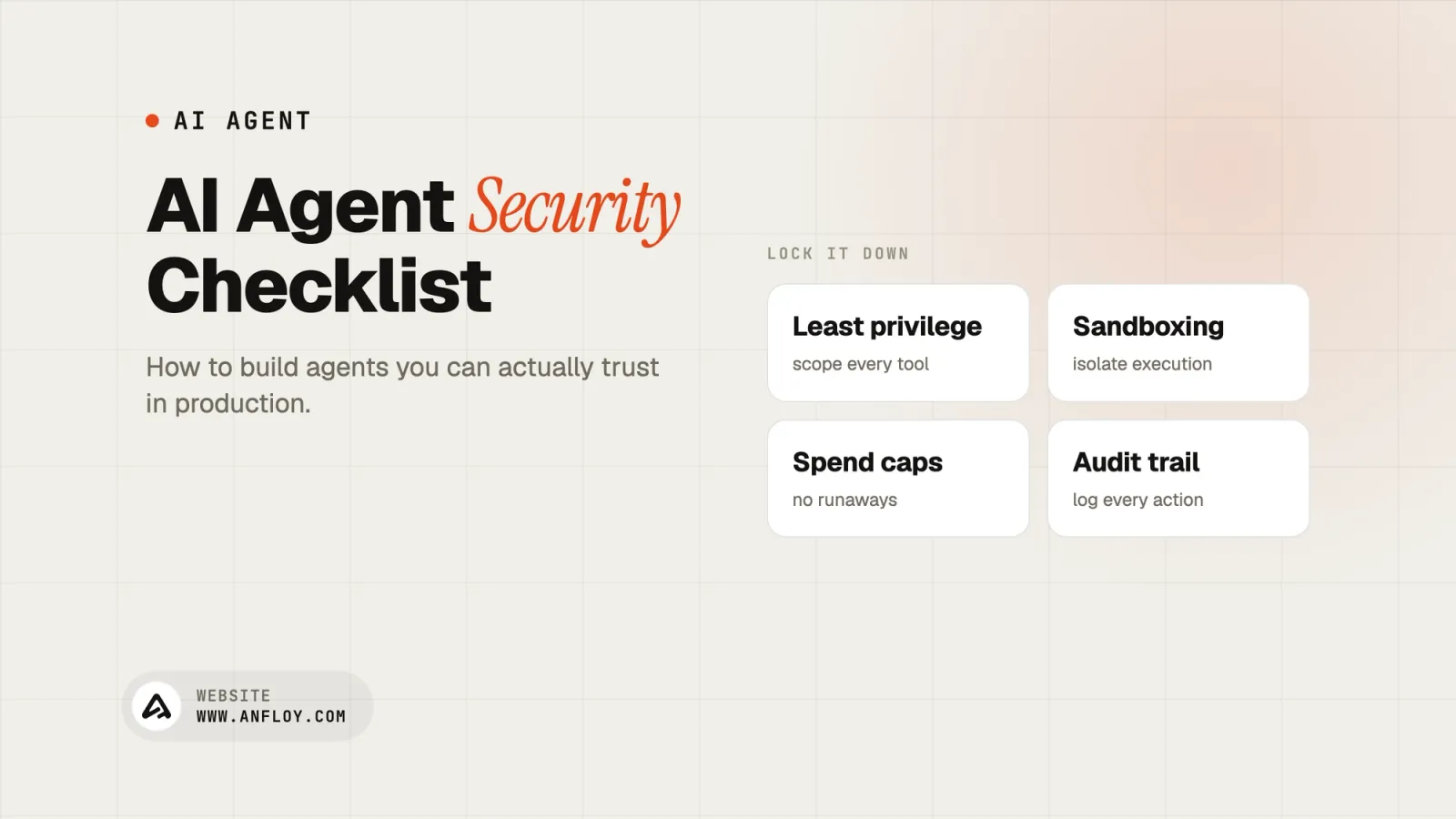
AI Agent Security Checklist: How to Build Secure AI Systems
Learn how to secure AI agents with this practical security checklist covering data protection, access controls, RAG, governance, monitoring, and AI infrastructure.
On this page
- What Is AI Agent Security?
- AI agent security vs traditional application security
- Why AI Agent Security Matters?
- What makes AI agents different from traditional software?
- AI agent threat model
- What are the top AI agent security checklist?
- Secure your company AI brain
- Secure retrieval-augmented generation (RAG)
- Secure tool calling and integrations
- Protect sensitive business data
- How to add human approval workflows?
- Monitoring, logging, and observability
- Continuously test AI security
- AI agent security best practices
- Common AI agent security mistakes
- AI Agent Security Framework
- How Anfloy builds secure AI infrastructure?
- What Is the future of AI agent security?
- Conclusion
AI agents are becoming one of the most valuable assets inside modern businesses.
Unlike traditional software that follows predefined rules, AI agents can understand objectives, retrieve company knowledge, interact with business applications, make decisions, and execute workflows with minimal human intervention.
Today's organizations are deploying AI agents to:
- qualify sales leads
- automate customer support
- manage CRM data
- retrieve company knowledge
- onboard employees
- analyze business documents
- coordinate operational workflows
- support software engineering
As these agents become more autonomous, they also gain access to increasingly sensitive business information.
An AI agent may have permission to:
- read internal documentation
- access CRM records
- communicate with customers
- retrieve financial information
- modify operational systems
- trigger automated workflows
This level of access creates enormous business value.
It also introduces entirely new security challenges.
Traditional cybersecurity focuses on protecting applications, servers, and networks.
AI agent security goes much further.
Organizations must now protect:
- company knowledge
- AI reasoning
- workflow execution
- tool usage
- business decisions
- customer data
- operational automation
A single misconfigured AI agent can expose confidential information, execute the wrong workflow, retrieve outdated knowledge, or perform actions that negatively affect customers and employees.
As businesses move toward Agentic AI, security is no longer an optional consideration.
It becomes part of the architecture itself.
This guide explains how to secure AI agents throughout their entire lifecycle, from knowledge retrieval and access control to governance, monitoring, and production deployment.
Whether you're deploying one AI assistant or an enterprise-wide multi-agent system, these principles will help you build AI infrastructure that is both intelligent and secure.
What Is AI Agent Security?
AI agent security is the practice of protecting AI agents, the systems they interact with, and the business data they access.
Unlike traditional software security, AI agent security focuses on both technology and decision-making.
An AI agent doesn't simply process requests.
It can:
- understand business context
- retrieve company knowledge
- choose actions
- interact with external tools
- communicate with customers
- automate workflows
Each capability introduces additional security considerations.
A secure AI agent should:
- access only authorized information
- retrieve trusted company knowledge
- use approved business tools
- protect customer data
- follow organizational policies
- maintain detailed audit logs
- operate within clearly defined permissions
The goal isn't to limit what AI can do.
The goal is to ensure AI performs useful work safely, reliably, and responsibly.
AI agent security vs traditional application security
Many organizations assume traditional cybersecurity practices are enough for AI systems.
While many security principles still apply, AI introduces entirely new operational risks.
| Traditional Application Security | AI Agent Security |
|---|---|
| Protects applications | Protects autonomous decision-making |
| Focuses on users | Focuses on users and AI agents |
| Secures databases | Secures company knowledge and RAG systems |
| API authentication | API authentication + tool permissions |
| Access control | Dynamic role-based AI permissions |
| Infrastructure monitoring | Workflow, reasoning, and execution monitoring |
| Static software behavior | Adaptive AI behavior |
The biggest difference is autonomy.
Traditional software waits for instructions.
AI agents actively make decisions within the boundaries you've defined.
That makes governance just as important as infrastructure security.
Why AI Agent Security Matters?
As AI agents become more integrated into business operations, security directly affects revenue, customer trust, operational continuity, and regulatory compliance.
A security issue no longer impacts just one application.
It can affect multiple departments simultaneously.
Let's explore why this matters.
Protecting company knowledge
Every business has information that creates competitive advantage.
Examples include:
- pricing strategies
- sales playbooks
- customer contracts
- operational procedures
- internal documentation
- proprietary research
- engineering documentation
Modern AI agents retrieve this information every day.
Without proper access controls, confidential knowledge can be exposed to unauthorized users or external systems.
Protecting customer data
AI agents frequently process sensitive customer information.
This may include:
- names
- email addresses
- purchase history
- support conversations
- CRM records
- billing information
Organizations must ensure AI agents comply with privacy regulations while protecting customer trust.
Poor security can quickly become both a legal and reputational issue.
Preventing unauthorized actions
Unlike traditional chatbots, AI agents can perform work.
They may:
- update CRM records
- trigger workflows
- approve requests
- retrieve confidential documents
- send emails
- modify operational systems
Every action should occur within clearly defined permissions.
Otherwise, an AI agent could unintentionally perform actions beyond its intended responsibilities.
Maintaining business continuity
Many businesses now rely on AI for critical operations.
If an AI system becomes unreliable, employees may lose access to:
- company knowledge
- customer information
- operational workflows
- sales automation
- internal documentation
Building secure AI infrastructure also means building resilient AI infrastructure.
Supporting regulatory compliance
Organizations operating in regulated industries often need AI systems that comply with:
- GDPR
- SOC 2
- ISO 27001
- HIPAA
- internal governance policies
Security should be incorporated into AI architecture from the beginning rather than added later.
What makes AI agents different from traditional software?
Understanding the differences between AI agents and conventional applications helps explain why security requirements are changing.
Traditional software follows predefined logic.
If a user clicks a button, the application performs one expected action.
AI agents behave differently.
They evaluate information before deciding how to proceed.
This flexibility creates tremendous business value but also introduces new responsibilities.
AI agents reason
Rather than following one fixed workflow, AI evaluates context before selecting the next action.
This means organizations must monitor not only outputs but also the reasoning process that leads to those outputs.
AI agents retrieve knowledge
Modern AI agents don't rely only on what they learned during training.
Instead, they retrieve information from:
- Company AI Brains
- vector databases
- document repositories
- CRM systems
- knowledge bases
Protecting these knowledge sources becomes part of AI security.
AI agents use business tools
Production AI agents commonly interact with:
- CRM platforms
- Slack
- Microsoft Teams
- databases
- internal APIs
- email systems
- project management platforms
Every integration expands the potential attack surface.
Each connection should be secured using authentication, authorization, and least-privilege access.
AI agents execute workflows
Unlike chatbots, AI agents perform business operations.
Examples include:
- routing leads
- approving requests
- updating customer records
- retrieving contracts
- generating reports
- assigning support tickets
This makes workflow governance essential.
AI agents remember context
Persistent memory improves personalization and workflow continuity.
However, it also increases the amount of business information stored within the AI system.
Organizations must carefully manage:
- retention policies
- encryption
- access permissions
- compliance requirements
Memory should improve business outcomes without creating unnecessary security risks.
AI agent threat model
Before deploying AI into production, businesses should understand the types of threats AI agents may encounter.
A threat model helps identify risks before they become security incidents.
Below are some of the most important attack vectors.
Prompt injection
Prompt injection occurs when an attacker attempts to manipulate an AI agent through carefully crafted instructions.
Examples include:
- bypassing system prompts
- revealing confidential information
- ignoring safety instructions
- executing unintended workflows
Organizations should validate inputs, restrict tool access, and continuously test AI systems against prompt injection attacks.
Knowledge poisoning
AI is only as trustworthy as the information it retrieves.
If incorrect, outdated, or malicious documents enter your knowledge base, the AI may confidently generate inaccurate recommendations.
Protecting your Company AI Brain requires:
- document validation
- version control
- trusted data sources
- approval workflows
High-quality knowledge improves both security and accuracy.
Excessive permissions
One of the most common security mistakes is giving AI agents unrestricted access.
For example, a customer support agent should not have permission to modify financial systems or access HR documentation.
Every AI agent should receive only the permissions required to complete its assigned responsibilities.
This follows the Principle of Least Privilege, a foundational concept in modern cybersecurity.
Tool abuse
AI agents often interact with external tools through APIs.
If these integrations aren't secured properly, attackers may attempt to:
- execute unauthorized actions
- retrieve sensitive information
- manipulate business workflows
- access internal systems
Every tool connection should include authentication, authorization, and monitoring.
Hallucinations
Hallucinations remain one of the most widely discussed AI risks.
While they are primarily an accuracy issue, they can also become a security issue if AI generates incorrect business guidance, retrieves the wrong documentation, or automates actions based on false information.
Retrieval-Augmented Generation (RAG), trusted knowledge sources, and human approval workflows significantly reduce this risk.
Identity and authentication risks
AI agents should always verify who is requesting information.
Employees, customers, partners, and administrators often require different levels of access.
Strong identity management ensures AI retrieves only the information each user is authorized to see.
Without authentication, even accurate AI systems can expose confidential business knowledge.
Supply chain risks
Modern AI systems depend on multiple external services, including:
- foundation models
- APIs
- vector databases
- cloud providers
- third-party integrations
Every dependency should be evaluated for reliability, security, compliance, and operational resilience.
A secure AI system depends on a secure technology ecosystem.
What are the top AI agent security checklist?
Building secure AI agents isn't about adding one security feature before deployment.
Security should be integrated into every layer of your AI architecture, from how knowledge is stored to how workflows are executed.
The following checklist provides a practical framework for building AI agents that are secure, reliable, and ready for production.
Identity and access management (IAM)
Identity is the foundation of AI security.
Every AI agent should know:
- who is making the request
- what information they can access
- what actions they are allowed to perform
Without strong identity management, even an intelligent AI system can expose sensitive business information.
Apply the principle of least privilege
One of the most effective security practices is limiting permissions.
Each AI agent should receive only the access required to complete its assigned responsibilities.
For example:
- A sales agent should access CRM records but not payroll information.
- A customer support agent should retrieve product documentation but not financial reports.
- An HR agent should access employee policies without modifying customer records.
Smaller permission scopes reduce the impact of configuration mistakes and security incidents.
Use role-based access control (RBAC)
Permissions should be assigned based on user roles rather than individual requests.
Examples include:
- Sales
- Marketing
- HR
- Customer Support
- Engineering
- Finance
- Executives
When employees interact with AI, the system should automatically respect their existing organizational permissions.
The AI should never become a shortcut around your access controls.
Authenticate every request
AI agents should verify both users and connected systems before retrieving information or executing actions.
Authentication may include:
- Single Sign-On (SSO)
- Multi-Factor Authentication (MFA)
- OAuth
- API authentication
- Service accounts
Strong authentication reduces unauthorized access while improving auditability.
Secure your company AI brain
Every production AI agent depends on knowledge.
Protecting that knowledge is one of the most important responsibilities in AI security.
A centralized Company AI brain should become the trusted source of business information.
Validate every knowledge source
Not every document should automatically become part of your AI system.
Before adding information, verify:
- accuracy
- ownership
- version history
- business relevance
- approval status
High-quality knowledge produces high-quality AI decisions.
Organize information properly
Well-structured knowledge improves both security and retrieval quality.
Organize documentation into categories such as:
- product documentation
- customer information
- SOPs
- policies
- engineering documentation
- legal resources
- sales enablement
Clear organization simplifies permission management and retrieval.
Version your documentation
Business knowledge changes constantly.
Without version control, AI agents may retrieve outdated:
- pricing
- policies
- contracts
- procedures
- technical documentation
Versioning ensures AI always retrieves the most appropriate information.
Secure retrieval-augmented generation (RAG)
Retrieval-Augmented Generation (RAG) is one of the most powerful technologies behind enterprise AI agents.
It can also become a security risk if implemented poorly.
Retrieve only authorized information
RAG should retrieve documents based on user permissions.
For example:
- HR employees should not retrieve legal contracts.
- Marketing teams should not access payroll documentation.
- External users should never access internal operational documents.
Retrieval should respect organizational access policies.
Filter sensitive content
Not every document belongs inside AI retrieval.
Examples that may require additional controls include:
- financial records
- legal agreements
- personally identifiable information (PII)
- confidential customer information
- acquisition plans
Filtering sensitive content reduces unnecessary exposure.
Continuously improve retrieval quality
Poor retrieval leads to poor decisions.
Regularly evaluate:
- document relevance
- retrieval accuracy
- missing knowledge
- outdated content
- duplicate documentation
Maintaining your knowledge layer is an ongoing process rather than a one-time project.
Secure tool calling and integrations
AI becomes significantly more valuable when it interacts with business software.
Every integration also expands the security surface.
Authenticate every integration
Every connected tool should require secure authentication.
Examples include:
- CRM platforms
- databases
- internal APIs
- email providers
- communication platforms
- project management software
Never rely on unsecured or anonymous API access.
Restrict available actions
An AI agent should not automatically receive full administrative permissions.
Instead, define exactly which actions each agent can perform.
Examples include:
Allowed:
- retrieve CRM data
- create support tickets
- schedule meetings
Restricted:
- delete customer records
- change billing information
- modify security settings
Limiting actions significantly reduces operational risk.
Protect API keys and secrets
API credentials should never be stored directly inside prompts or application code.
Instead:
- use secure secret management systems
- rotate credentials regularly
- restrict key permissions
- monitor API usage
Credential management is one of the most overlooked areas of AI security.
Protect sensitive business data
AI systems frequently process confidential business information.
Protecting that data should remain a top priority throughout the AI lifecycle.
Encrypt data everywhere
Sensitive information should be encrypted:
- at rest
- in transit
- during storage
- across integrations
Encryption protects business information even if other security controls fail.
Minimize data exposure
Avoid sending unnecessary information to language models.
Only include the context required to complete the task.
Reducing unnecessary data sharing improves both privacy and operational efficiency.
Define retention policies
Not every AI interaction needs to be stored forever.
Determine:
- what conversations should be retained
- retention duration
- deletion schedules
- compliance requirements
Well-defined retention policies simplify governance while reducing risk.
How to add human approval workflows?
AI agents should not operate with unlimited autonomy.
Some business actions deserve human review.
Human-in-the-loop
A human approves every important decision before execution.
Best for:
- financial approvals
- legal workflows
- customer contracts
Human-on-the-loop
AI executes most tasks automatically while humans supervise overall system behavior.
Suitable for:
- customer support
- CRM automation
- operational reporting
Fully autonomous workflows
Only low-risk, well-tested workflows should operate without human intervention.
Examples include:
- document classification
- CRM enrichment
- internal reporting
- knowledge retrieval
Choosing the right approval model improves both efficiency and security.
Monitoring, logging, and observability
Production AI systems should never operate as black boxes.
Organizations need visibility into how AI agents behave.
Create detailed audit logs
Track:
- user requests
- retrieved documents
- model responses
- tool usage
- workflow execution
- approval decisions
Audit logs simplify troubleshooting while supporting compliance requirements.
Monitor operational health
Track key metrics including:
- workflow success rate
- response quality
- latency
- retrieval accuracy
- failed API calls
- security incidents
Operational monitoring allows teams to identify problems before they affect customers.
Detect unusual behavior
AI systems should identify abnormal patterns such as:
- excessive document retrieval
- repeated failed authentication
- unexpected API usage
- abnormal workflow execution
Early detection significantly improves incident response.
Continuously test AI security
AI security is never finished.
Business knowledge changes.
New integrations are added.
Threats evolve.
Continuous testing helps organizations stay ahead of emerging risks.
Test for prompt injection
Attempt to bypass system instructions.
Verify that the AI:
- ignores malicious prompts
- respects permissions
- refuses unauthorized requests
Prompt injection testing should become part of every release cycle.
Perform red team exercises
Simulate realistic attacks against AI systems.
Evaluate whether agents:
- expose confidential information
- misuse tools
- ignore governance rules
- retrieve unauthorized knowledge
Red teaming reveals weaknesses before attackers do.
Review permissions regularly
As AI systems evolve, permissions often expand.
Schedule regular reviews to ensure every AI agent still follows the Principle of Least Privilege.
Reducing unnecessary permissions is one of the simplest ways to strengthen AI security.
AI agent security best practices
Beyond technical controls, successful organizations build security into the way they design AI systems.
Key best practices include:
- Start with clearly defined business objectives.
- Build specialized AI agents instead of one all-purpose assistant.
- Centralize company knowledge into one secure Company AI Brain.
- Apply least-privilege access to every agent.
- Secure every API integration.
- Use Retrieval-Augmented Generation (RAG) instead of relying only on model knowledge.
- Keep humans involved in high-risk workflows.
- Monitor continuously instead of relying on periodic reviews.
- Test AI systems regularly against new threats.
- Treat AI security as an ongoing operational discipline rather than a one-time deployment task.
Organizations that follow these practices build AI systems that remain reliable as they scale.
Common AI agent security mistakes
Many AI security incidents result from architectural decisions rather than sophisticated cyberattacks.
Common mistakes include:
- giving AI agents excessive permissions
- connecting directly to production databases without safeguards
- allowing unrestricted tool execution
- using multiple disconnected knowledge bases
- ignoring audit logging
- storing API keys insecurely
- skipping human approval workflows
- failing to validate retrieved knowledge
- trusting AI outputs without verification
- treating security as a deployment task instead of an ongoing process
Avoiding these mistakes creates a much stronger foundation for enterprise AI adoption.
AI Agent Security Framework
A checklist helps ensure individual security controls are in place.
A framework ensures those controls work together throughout the AI lifecycle.
As organizations deploy more AI agents across sales, customer support, operations, finance, and engineering, security must become part of the entire AI operating model rather than an afterthought.
The framework below can help businesses design secure AI systems that remain reliable as they scale.
Phase 1: Understand the business before building AI
Security begins long before the first AI agent is deployed.
Every implementation should start by understanding:
- business objectives
- operational workflows
- customer journey
- regulatory requirements
- existing software
- internal knowledge
- sensitive data
This helps identify where AI should operate, what information it needs, and which risks require additional controls.
Without understanding the business, it's impossible to design secure AI infrastructure.
Phase 2: Build a secure knowledge foundation
Every AI agent depends on business knowledge.
Before connecting documents to AI, organizations should establish a secure Company AI Brain.
This includes:
- validating documentation
- removing duplicate information
- organizing content into logical categories
- applying role-based permissions
- maintaining version history
- defining ownership for every knowledge source
A secure knowledge layer improves both AI accuracy and security.
Phase 3: Secure models, APIs, and tools
Modern AI agents rarely operate in isolation.
They interact with:
- language models
- CRM platforms
- ERP systems
- communication tools
- databases
- internal APIs
- cloud services
Every connection should be secured using:
- authentication
- authorization
- encrypted communication
- scoped API permissions
- secret management
The goal is to ensure AI agents only access the systems and actions required for their responsibilities.
Phase 4: Govern AI decisions
Not every workflow should be fully autonomous.
Organizations should define governance rules for:
- customer communications
- financial transactions
- legal approvals
- HR decisions
- operational changes
These workflows often benefit from human approval before execution.
Governance creates consistency while reducing operational risk.
Phase 5: Monitor everything
Deployment is the beginning of AI security, not the end.
Businesses should continuously monitor:
- workflow execution
- retrieval quality
- system performance
- permission usage
- API activity
- user feedback
- operational outcomes
Continuous visibility allows teams to identify issues before they affect customers or business operations.
Phase 6: Improve continuously
Business processes evolve.
Documentation changes.
Employees adopt new tools.
AI security should evolve alongside them.
Regular reviews should include:
- permission audits
- knowledge updates
- security testing
- workflow optimization
- performance evaluation
- compliance reviews
Organizations that continuously improve their AI systems build more resilient infrastructure over time.
How Anfloy builds secure AI infrastructure?
At Anfloy, security isn't a feature that's added after deployment.
It's part of every architectural decision we make.
Rather than building isolated AI assistants, we design secure AI infrastructure that integrates with your business while protecting your knowledge, systems, and operations.
Every implementation begins with understanding:
- business objectives
- operational workflows
- customer lifecycle
- existing technology stack
- compliance requirements
- security policies
- automation opportunities
From there, we design AI systems that balance intelligence, automation, and governance.
Security by design
Before writing a single workflow, we identify:
- sensitive business data
- permission boundaries
- approval requirements
- compliance obligations
- operational risks
Security becomes part of the architecture instead of an afterthought.
Company AI brain
Every AI implementation includes a centralized company AI brain powered by:
- Retrieval-Augmented Generation (RAG)
- embeddings
- hybrid search
- reranking
- persistent memory
Instead of allowing AI to search uncontrolled data sources, every agent retrieves trusted business information from one secure knowledge layer.
This improves:
- accuracy
- consistency
- security
- governance
while reducing hallucinations.
Agentic systems
Rather than building one large AI assistant with broad permissions, we develop specialized AI agents.
Each agent owns a specific responsibility.
Examples include:
- lead qualification
- customer support
- CRM automation
- onboarding
- reporting
- knowledge retrieval
Every agent operates with clearly defined permissions and responsibilities.
This follows the Principle of Least Privilege while making systems easier to maintain and secure.
Secure GTM engines
Revenue operations involve large amounts of sensitive customer information.
Our GTM Engines include secure workflows for:
- buying signal monitoring
- lead enrichment
- CRM synchronization
- pipeline management
- outbound automation
- sales intelligence
Every integration is designed with authentication, access controls, and operational governance in mind.
Internal operations systems
Internal AI systems often access:
- employee documentation
- SOPs
- HR policies
- operational procedures
- internal reports
We secure these workflows using role-based permissions, controlled retrieval, and approval mechanisms to ensure employees access only the information appropriate for their roles.
Governance layer
Every production AI system includes governance mechanisms such as:
- role-based access controls
- human approval workflows
- audit logging
- monitoring
- workflow evaluation
- continuous optimization
These controls help businesses deploy AI confidently while maintaining operational oversight.
Infrastructure you own
Many AI platforms create long-term vendor dependency.
Our approach is different.
Every AI system is deployed directly on infrastructure owned by your business.
You own:
- the code
- the AI workflows
- the Company AI Brain
- the knowledge architecture
- the integrations
- the operational logic
No platform lock-in.
No recurring software dependency.
You retain complete control over how your AI infrastructure evolves.
Build Secure AI Systems with Anfloy
Whether you're developing AI agents, a Company AI brain, GTM automation, or internal AI workflows, security should be built into the architecture from day one.
At Anfloy, we design and deploy custom AI systems that combine intelligent automation with enterprise-grade security, governance, and infrastructure ownership.
Book a Strategy Call
What Is the future of AI agent security?
AI security is rapidly evolving.
As organizations deploy larger agentic systems, security will become increasingly automated, intelligent, and proactive.
Several trends are shaping the future.
Zero-trust AI
Future AI systems will assume no user, tool, or workflow should be trusted automatically.
Every interaction will require verification before access is granted.
Policy-driven AI governance
Instead of manually configuring every workflow, businesses will define organization-wide policies that AI agents automatically follow.
These policies will govern:
- data access
- approvals
- workflow execution
- compliance
- reporting
Autonomous security monitoring
AI will increasingly help secure AI.
Dedicated monitoring agents will identify:
- unusual behavior
- permission misuse
- workflow failures
- abnormal retrieval patterns
- security anomalies
before they become operational problems.
Multi-agent governance
As businesses deploy dozens or even hundreds of AI multi agents, governance will extend beyond individual agents.
Organizations will need centralized oversight of:
- agent permissions
- knowledge access
- inter-agent communication
- workflow coordination
- operational performance
Managing secure collaboration between agents will become just as important as managing individual AI systems.
Conclusion
AI agents are becoming an essential part of modern business operations.
As they gain access to company knowledge, customer data, and operational workflows, security must evolve alongside their capabilities.
Protecting AI isn't just about securing a language model.
It's about securing the entire AI ecosystem, including knowledge, integrations, permissions, workflows, governance, monitoring, and infrastructure.
Organizations that treat AI security as a continuous business discipline will build systems that employees trust, customers rely on, and leadership can confidently scale.
At Anfloy, we help businesses build secure AI infrastructure through:
- Agentic Systems
- Company AI Brains
- GTM Engines
- Internal Operations Systems
- Full-Stack AI Products
Every solution is designed with security, governance, and long-term scalability at its core while remaining fully owned by the client.
Because the future of AI belongs to organizations that don't just build intelligent agents.
They build intelligent agents that businesses can trust.
Frequently Asked Questions
Why is AI agent security different from traditional cybersecurity?
Traditional cybersecurity protects applications and infrastructure. AI agent security also protects autonomous decision-making, knowledge retrieval, workflow execution, and interactions between AI agents and business systems.
What is the biggest security risk for AI agents?
Excessive permissions are one of the biggest risks. AI agents should only access the information and tools required for their specific responsibilities.
How does Retrieval-Augmented Generation (RAG) improve AI security?
RAG allows AI agents to retrieve approved business information from trusted knowledge sources instead of relying only on model knowledge, improving accuracy and reducing hallucinations.
Can AI agents be hacked?
Like any software system, AI agents can be targeted through techniques such as prompt injection, insecure APIs, excessive permissions, or compromised integrations. Proper security architecture significantly reduces these risks.
Should AI agents access production databases?
They can, but access should be tightly controlled using authentication, role-based permissions, auditing, and least-privilege principles. Direct unrestricted database access should be avoided.
How do you monitor AI agents?
Organizations should monitor workflow execution, document retrieval, API activity, permissions, response quality, security events, and operational performance through centralized logging and observability tools.
What is the Principle of Least Privilege for AI agents?
It means every AI agent receives only the minimum permissions required to complete its assigned responsibilities, reducing the impact of errors or security incidents.
How often should AI agent security be reviewed?
Security should be reviewed continuously. Permission audits, knowledge updates, security testing, and workflow evaluations should be performed regularly as business processes evolve.
Can small businesses implement secure AI systems?
Yes. Even smaller organizations can build secure AI infrastructure by applying role-based access controls, secure knowledge management, authenticated integrations, and governance from the beginning.
Let's build
what your
company needs.
Drop your email. We'll send The Custom Agent Blueprint on what we'd build first for a company like yours, before you ever take a meeting.