
In-House GTM Team vs GTM Agency: Cost & Speed Compared
Compare an in-house GTM team vs a GTM agency across cost, speed, scalability, expertise, AI, RevOps, and long-term ROI to choose wisely.
On this page
- Understanding the two GTM models
- What is an in-house GTM team?
- What is a GTM agency?
- How both models fit within a modern GTM organization?
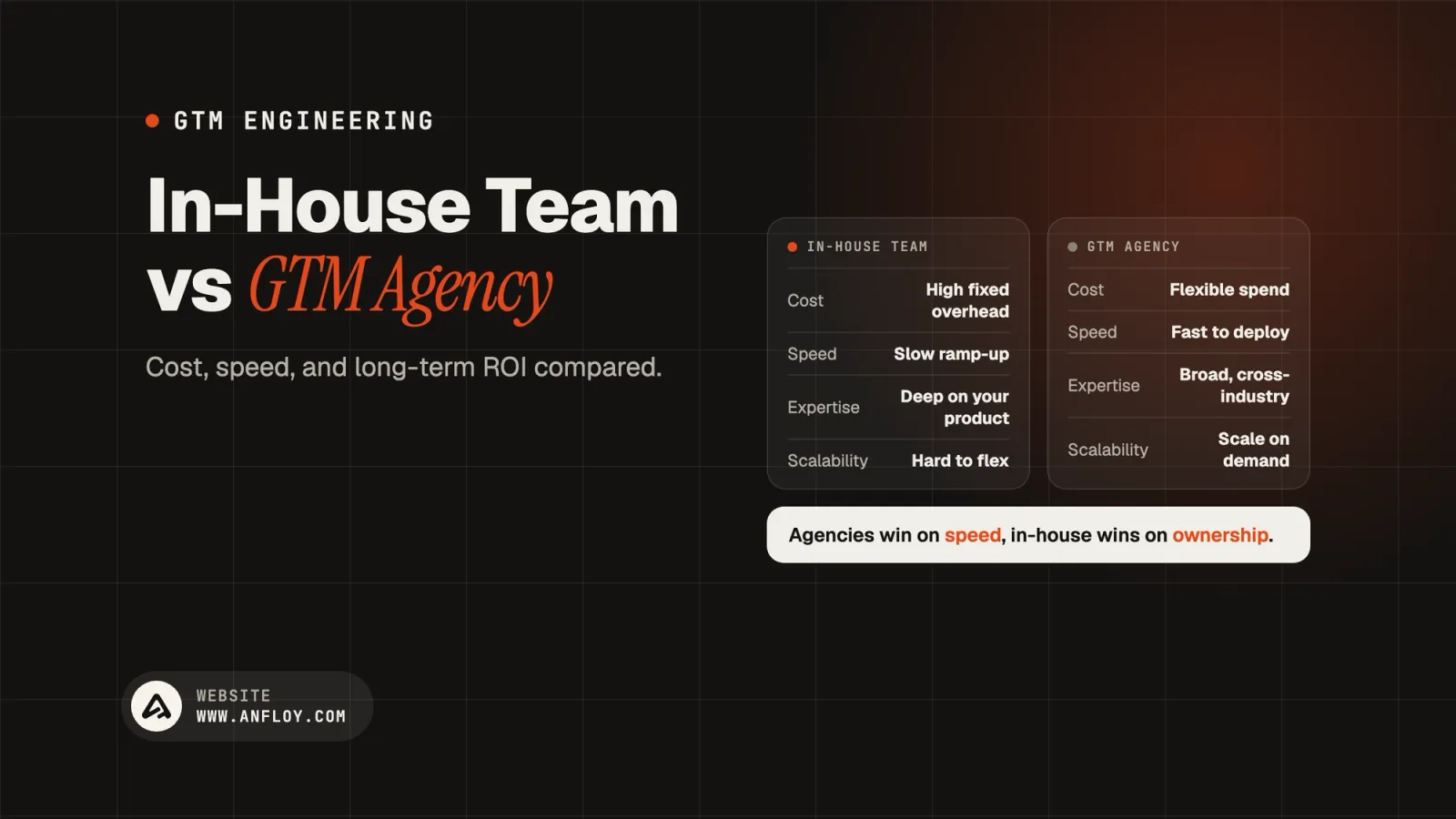
- In-house GTM team vs GTM agency: The core difference
- Why this decision matters more in 2026?
- Cost comparison: In-house GTM team vs GTM agency
- Building an internal team takes time
- GTM agencies begin with existing expertise
- Speed across common GTM activities
- Which model scales more easily?
- Which model is best for startups?
- Which model is best for SaaS companies?
- Which model is best for enterprise organizations?
- The hybrid model: why many businesses choose both
- Decision framework: which option fits your business?
- Common mistakes businesses make
- What is the future of GTM organizations?
- Why businesses choose Anfloy?
- Conclusion
Every growing company eventually reaches a point where it must answer an important operational question:
Should we build an in-house GTM team or partner with a GTM agency?
The decision affects far more than hiring costs.
It influences implementation speed, access to expertise, operational scalability, technology adoption, Revenue Operations maturity, AI implementation, and ultimately how quickly the business can generate predictable revenue.
Many organizations assume building an internal team provides greater control, while others believe outsourcing to a GTM agency offers faster execution. In reality, the best choice depends on your company's growth stage, operational complexity, available resources, and long-term go-to-market objectives.
Understanding the relationship between these two models helps leadership teams make better investment decisions while avoiding unnecessary hiring costs, implementation delays, and fragmented revenue operations.
Understanding the two GTM models
Before comparing costs or implementation speed, it's important to define both entities.
Although they pursue similar business outcomes, they operate very differently.
What is an in-house GTM team?
An in-house GTM team consists of full-time employees responsible for planning, executing, and optimizing a company's go-to-market activities.
Depending on business size, the team may include specialists across multiple functions.
Typical roles include:
- GTM Manager
- Product Marketing Manager
- Demand Generation Manager
- Sales Manager
- SDRs
- Revenue Operations Manager
- CRM Administrator
- Marketing Operations Specialist
- Customer Success Manager
- GTM Engineer
These professionals work exclusively on the company's products, customers, and internal processes.
Because they operate within the business every day, in-house teams often develop deep institutional knowledge and long-term ownership of GTM initiatives.
What is a GTM agency?
A GTM agency is an external partner that helps businesses design, implement, optimize, and scale go-to-market systems.
Unlike traditional marketing agencies, modern GTM agencies combine strategic consulting with operational execution.
Services commonly include:
- GTM strategy
- GTM Engineering
- CRM architecture
- Revenue Operations
- Workflow automation
- AI implementation
- Data enrichment
- Sales enablement
- Marketing automation
- Customer lifecycle optimization
- Revenue Intelligence
Rather than hiring multiple internal specialists, businesses gain access to a multidisciplinary team with experience across different industries, technologies, and growth stages.
How both models fit within a modern GTM organization?
Both approaches support the same business objective: sustainable revenue growth.
However, they contribute in different ways.
Business Goals
        │
        ▼
Go-to-Market Strategy
        │
        ├───────────────┐
        │               │
        ▼               ▼
In-House GTM Team    GTM Agency
        │               │
        ├───────Shared Objectives───────┐
        │                               │
        ▼                               ▼
Marketing • Sales • RevOps • GTM Engineering
        │
        ▼
Customer Acquisition
        │
        ▼
Revenue Growth
Rather than viewing these approaches as competitors, many successful businesses combine both to balance strategic ownership with specialized execution.
In-house GTM team vs GTM agency: The core difference
The primary difference is not where people work.
The primary difference is how expertise, execution, and operational capacity are delivered.
An in-house team builds internal knowledge over time.
A GTM agency brings proven frameworks, implementation experience, and cross-company best practices from day one.
This distinction affects cost, implementation speed, scalability, innovation, and operational risk throughout the entire revenue organization.
Comparing business objectives
| Business Goal | In-House GTM Team | GTM Agency |
|---|---|---|
| Long-term operational ownership | Excellent | Moderate |
| Rapid implementation | Moderate | Excellent |
| Specialized technical expertise | Depends on hiring | Excellent |
| AI implementation | Depends on internal skills | Excellent |
| Revenue Operations maturity | Builds over time | Immediate expertise |
| CRM implementation | Variable | Strong |
| Workflow automation | Variable | Strong |
| GTM Engineering | Usually limited | Core capability |
| Organizational flexibility | Moderate | High |
Understanding these differences provides the context for evaluating cost and implementation speed throughout the remainder of this guide.
Why this decision matters more in 2026?
Go-to-market execution has become significantly more complex over the past few years.
Modern revenue organizations now depend on:
- CRM architecture
- Revenue Operations
- AI workflows
- Workflow automation
- API integrations
- Customer lifecycle automation
- Revenue Intelligence
- Data enrichment
- GTM Engineering
Building expertise across all these disciplines internally requires significant investment.
For many businesses, partnering with a GTM agency accelerates implementation while reducing the operational burden of hiring multiple specialists.
In the next section, we'll compare cost structures, hiring investments, operational expenses, and implementation timelines to understand where each model creates the greatest business value.
Cost comparison: In-house GTM team vs GTM agency
Cost is usually the first factor businesses evaluate when deciding between hiring internally and partnering with a GTM agency.
However, salary alone rarely reflects the true investment.
A complete comparison should include recruitment, onboarding, software, management, employee benefits, training, operational overhead, and implementation risk.
When viewed from a total cost of ownership (TCO) perspective, the difference between the two models becomes much clearer.
The true cost of building an in-house GTM team
Building an internal GTM capability involves much more than hiring a single employee.
Most growing companies eventually need specialists across multiple disciplines.
A typical in-house GTM function may include:
- GTM Manager
- Product Marketing Manager
- Revenue Operations Manager
- GTM Engineer
- CRM Administrator
- Marketing Operations Specialist
- SDR Manager
- Sales Operations Specialist
- Customer Success Operations
In addition to salaries, businesses invest in:
- Recruitment fees
- Interview time
- Onboarding
- Training
- Employee benefits
- Management overhead
- Software licenses
- Office equipment
- Professional development
These investments continue long after the initial hiring process.
The cost structure of a GTM agency
A GTM agency operates differently.
Instead of hiring individual specialists, businesses gain access to an existing multidisciplinary team.
That team often includes expertise in:
- GTM strategy
- GTM Engineering
- CRM architecture
- Revenue Operations
- AI implementation
- Workflow automation
- API integrations
- Data enrichment
- Customer lifecycle automation
- Revenue Intelligence
Rather than paying separately for each specialist, companies invest in a unified delivery model aligned with project scope or ongoing operational support.
This approach often reduces fixed employment costs while expanding access to specialized knowledge.
Direct costs vs hidden costs
When comparing options, businesses should separate visible costs from hidden operational expenses.
| Cost Category | In-House GTM Team | GTM Agency |
|---|---|---|
| Salaries | High | Included in engagement |
| Recruitment | High | None |
| Employee benefits | High | None |
| Training | Continuous | Included |
| Software expertise | Build internally | Already available |
| Implementation methodology | Develop internally | Established framework |
| Management overhead | High | Low |
| Operational risk | Higher during hiring | Lower through experienced teams |
| Scalability | Requires hiring | Expand engagement as needed |
This comparison shows why many organizations evaluate GTM agencies based on overall business value rather than hourly rates.
Speed comparison: which model delivers faster results?
Implementation speed directly affects revenue.
Every month spent hiring, onboarding, and building operational processes may delay pipeline generation, product launches, workflow automation, and AI initiatives.
For growing businesses, speed often becomes as important as cost.
Building an internal team takes time
Creating a high-performing GTM team is rarely immediate.
The process typically includes:
- Workforce planning
- Recruitment
- Candidate interviews
- Offer negotiations
- Notice periods
- Employee onboarding
- Internal training
- Process documentation
- Technology setup
Even after hiring, new employees require time to understand the company's products, customers, systems, and internal workflows before contributing at full capacity.
GTM agencies begin with existing expertise
A GTM agency starts from a different position.
Instead of assembling a team, agencies already have specialists, implementation frameworks, technical playbooks, and delivery methodologies.
Projects often begin with:
- Discovery workshops
- Technology audits
- GTM assessments
- Solution architecture
- CRM planning
- Workflow design
Because these processes are standardized, implementation can begin much sooner.
For organizations launching products, entering new markets, or modernizing Revenue Operations, faster execution can translate directly into faster revenue generation.
Speed across common GTM activities
| Activity | In-House GTM Team | GTM Agency |
|---|---|---|
| Hiring specialists | Slow | Immediate access |
| CRM implementation | Moderate | Fast |
| Workflow automation | Moderate | Fast |
| Revenue Operations setup | Build internally | Proven methodology |
| AI implementation | Depends on expertise | Specialized experience |
| GTM Engineering | Often requires additional hiring | Existing capability |
| Documentation | Built over time | Delivered as part of engagement |
The difference is not simply about working faster.
It is about reducing the time between strategic planning and operational execution.
Expertise comparison
Expertise is another major differentiator between the two models.
An internal team develops deep knowledge of one business.
A GTM agency develops broad knowledge by solving similar problems across dozens of organizations.
Both perspectives create value, but they produce different advantages.
Strengths of an in-house GTM team
Internal teams typically excel in:
- Product knowledge
- Company culture
- Customer relationships
- Long-term ownership
- Cross-functional collaboration
- Strategic continuity
Over time, these advantages become increasingly valuable as the business matures.
Strengths of a GTM agency
Agencies typically bring:
- Cross-industry experience
- Proven implementation methodologies
- CRM expertise
- GTM Engineering capability
- AI implementation knowledge
- Revenue Operations best practices
- Workflow automation experience
- Technology partnerships
Because agencies work across multiple organizations, they often identify operational improvements that internal teams may overlook.
Innovation and AI adoption
Artificial intelligence is rapidly changing go-to-market execution.
Organizations now implement:
- AI lead scoring
- AI SDR workflows
- AI-powered forecasting
- Customer lifecycle automation
- Revenue Intelligence
- Agentic AI
- Company AI Brains
Keeping pace with these technologies requires continuous learning.
Many GTM agencies invest heavily in testing emerging AI platforms, automation frameworks, and operational best practices across multiple client environments.
This experience enables businesses to adopt new technologies more quickly while reducing implementation risk.
Which model scales more easily?
Business growth introduces new operational challenges.
Additional products, larger sales teams, international expansion, and increasing customer complexity all place greater demands on GTM systems.
Scaling an in-house team often requires:
- Additional hiring
- Management restructuring
- New software
- Internal training
- Expanded operational processes
Scaling with a GTM agency generally involves expanding the engagement scope rather than rebuilding internal capabilities from scratch.
For rapidly growing companies, this flexibility can significantly reduce operational friction while supporting faster execution.
In the next section, we'll compare startups, SaaS companies, and enterprise organizations, explore hybrid GTM models, and provide a practical decision framework to determine which approach best fits different stages of business growth.
Which model is best for startups?
Startups operate under unique constraints.
Limited budgets, small teams, evolving products, and rapid market changes require founders to make careful investment decisions.
The goal is not simply to reduce costs it is to maximize execution speed while preserving flexibility.
For many early-stage companies, hiring specialists across GTM strategy, Revenue Operations, CRM administration, GTM Engineering, AI implementation, and customer success is financially unrealistic.
This is one reason startups frequently partner with GTM agencies during their early growth stages.
Advantages of an in-house team for startups
An internal team may be the right choice when:
- Founders already have GTM expertise.
- The product requires deep industry knowledge.
- Long-term ownership is the highest priority.
- The company has funding to build a dedicated revenue organization.
Advantages of a GTM agency for startups
A GTM agency is often beneficial when the business needs to:
- Launch quickly
- Build CRM infrastructure
- Implement AI workflows
- Establish Revenue Operations
- Develop GTM Engineering capabilities
- Scale without hiring multiple specialists
Many successful SaaS startups begin with agency support before gradually building internal GTM leadership.
Which model is best for SaaS companies?
SaaS businesses rarely stop evolving.
New features, pricing changes, customer expansion, onboarding improvements, and product-led growth initiatives require continuous optimization.
As a result, SaaS organizations often need expertise across multiple operational disciplines simultaneously.
Typical SaaS priorities include:
- Product launches
- Customer acquisition
- Pipeline generation
- Product-qualified leads (PQLs)
- Customer onboarding
- Expansion revenue
- Customer retention
- Revenue Intelligence
Maintaining expertise across all these areas internally can become expensive.
Many SaaS companies therefore adopt a hybrid model that combines internal product knowledge with external GTM Engineering and Revenue Operations expertise.
Which model is best for enterprise organizations?
Enterprise businesses face a different challenge.
Their systems are usually more complex.
Multiple business units, regional sales teams, compliance requirements, and extensive technology stacks increase implementation complexity.
Enterprise GTM initiatives frequently include:
- Multi-region CRM architecture
- Revenue Operations governance
- Enterprise AI implementation
- API ecosystems
- Workflow orchestration
- Executive reporting
- Customer lifecycle optimization
- Change management
Rather than replacing internal teams, enterprise organizations often use GTM agencies to accelerate transformation projects while internal teams retain strategic ownership.
This approach minimizes disruption while expanding implementation capacity.
The hybrid model: why many businesses choose both
The decision is not always either/or.
Many high-growth organizations combine an internal GTM team with an external GTM agency.
The in-house team provides:
- Product expertise
- Customer knowledge
- Executive alignment
- Long-term ownership
The GTM agency contributes:
- Specialized technical expertise
- GTM Engineering
- Revenue Operations
- AI implementation
- Workflow automation
- CRM optimization
- Cross-company best practices
Together, they create a scalable operating model that balances internal knowledge with external specialization.
Decision framework: which option fits your business?
Instead of asking, "Which model is better?" ask, "Which model solves our current business challenges?"
Use the following framework.
| Business Situation | Recommended Approach |
|---|---|
| Launching a startup | GTM Agency |
| Entering a new market | GTM Agency |
| Building first CRM | GTM Agency |
| Long-term GTM ownership | In-House Team |
| Enterprise transformation | Hybrid Model |
| AI implementation | GTM Agency or Hybrid |
| Revenue Operations modernization | Hybrid Model |
| Scaling internationally | Hybrid Model |
| Continuous operational optimization | Hybrid Model |
The appropriate model changes as your organization grows.
Common mistakes businesses make
Organizations often struggle because they evaluate staffing decisions through the wrong lens.
Avoid these common mistakes.
Comparing only salaries
A GTM Engineer's salary represents only one part of the investment.
Recruitment, onboarding, software, management, training, and operational risk all contribute to the total cost.
Hiring too early
Some startups hire multiple GTM specialists before validating their go-to-market strategy.
Without established processes, those hires often spend time creating systems that may need to change later.
Building a scalable operational foundation first usually produces better long-term results.
Outsourcing without internal ownership
Even when partnering with an agency, internal leadership remains essential.
Someone within the organization should own:
- Business objectives
- Product vision
- Customer feedback
- Strategic priorities
- Decision-making
Agencies accelerate execution, but business direction should remain internal.
Delaying AI adoption
Many businesses postpone AI implementation until after major growth.
However, integrating AI into CRM architecture, Revenue Operations, workflow automation, and GTM Engineering early often reduces future implementation complexity.
What is the future of GTM organizations?
Go-to-market organizations are evolving rapidly.
Over the next several years, successful revenue teams will increasingly combine:
- GTM strategy
- GTM Engineering
- Revenue Operations
- AI agents
- Workflow automation
- Revenue Intelligence
- Customer lifecycle automation
- Autonomous reporting
Instead of asking whether an activity should be performed internally or externally, organizations will focus on assembling the best combination of people, processes, AI, and technology to maximize business outcomes.
The distinction between internal teams and external agencies will become less important than the ability to execute quickly, adapt continuously, and build scalable revenue systems.
Why businesses choose Anfloy?
At Anfloy, we don't simply function as an external service provider we become an extension of your GTM organization.
Our multidisciplinary team helps businesses accelerate growth through:
- GTM strategy
- GTM Engineering
- Revenue Operations
- CRM architecture
- Workflow automation
- AI implementation
- Data enrichment
- AI lead scoring
- SDR workflow automation
- Revenue Intelligence
- Customer lifecycle automation
Whether you need complete GTM execution or specialized support for an existing in-house team, we build scalable systems that reduce operational complexity and accelerate revenue growth.
Conclusion
The decision between an in-house GTM team and a GTM agency is not about choosing one universally superior model. It is about selecting the structure that best supports your current stage of growth, operational maturity, and long-term business objectives.
Internal teams provide continuity, organizational knowledge, and long-term ownership. GTM agencies contribute specialized expertise, faster implementation, proven methodologies, and broader experience across CRM architecture, Revenue Operations, GTM Engineering, AI, and workflow automation.
For many modern B2B organizations, the strongest strategy is not choosing one over the other it is combining both to create a flexible, scalable go-to-market organization capable of adapting as the business grows.
Build a high-performance GTM organization with Anfloy
Whether you're building your first GTM function or scaling an established revenue organization, success depends on combining strategy with operational excellence.
Anfloy helps businesses accelerate growth through GTM strategy, GTM Engineering, Revenue Operations, CRM architecture, workflow automation, AI implementation, Revenue Intelligence, and customer lifecycle automation creating connected systems that support predictable, scalable revenue.
Frequently Asked Questions
Is an in-house GTM team cheaper than a GTM agency?
Not necessarily. While salaries may appear predictable, the total cost of an in-house team includes recruitment, onboarding, employee benefits, software, management, training, and ongoing operational expenses. A GTM agency often provides broader expertise with lower fixed overhead.
Which option is faster?
A GTM agency generally delivers faster implementation because experienced specialists, proven methodologies, and established workflows are already in place. Internal teams typically require time for hiring, onboarding, and process development.
Which model is better for startups?
Many startups benefit from partnering with a GTM agency during early growth because they gain access to specialized expertise without hiring multiple full-time employees. As the business matures, internal GTM capabilities can gradually expand.
Can an in-house team and a GTM agency work together?
Yes. Many organizations use a hybrid model where internal teams provide strategic ownership while GTM agencies deliver specialized capabilities such as GTM Engineering, Revenue Operations, CRM optimization, AI implementation, and workflow automation.
Which approach offers better long-term ROI?
The answer depends on business goals. Companies seeking rapid implementation and specialized expertise often achieve faster ROI through agencies. Businesses requiring long-term operational ownership may eventually invest more heavily in internal teams. Many organizations achieve the best results through a hybrid approach.
Let's build
what your
company needs.
Drop your email. We'll send The Custom Agent Blueprint on what we'd build first for a company like yours, before you ever take a meeting.