
AI for Revenue Operations vs Traditional RevOps: What's the Difference?
Compare AI-powered Revenue Operations with traditional RevOps. Learn the key differences, benefits, use cases, and how AI transforms revenue growth.
On this page
- What is traditional revenue operations?
- What is AI for revenue operations?
- AI RevOps vs traditional RevOps
- Why are companies moving toward AI RevOps?
- How AI improves revenue operations?
- When is traditional RevOps still enough?
- Common mistakes businesses make
- How Anfloy builds AI-powered revenue operations?
- What is the future of revenue operations?
- Conclusion
Revenue Operations (RevOps) has become one of the most important functions in modern businesses.
By aligning sales, marketing, and customer success, RevOps helps companies improve pipeline visibility, forecast revenue more accurately, and create a better customer experience.
However, many RevOps teams still rely on manual processes.
Pipeline reviews happen once a week.
CRM updates depend on sales representatives.
Reports are created after problems have already occurred.
Data is scattered across multiple platforms, making it difficult to make decisions in real time.
Artificial intelligence is changing this model.
Instead of simply organizing revenue data, AI continuously monitors pipelines, identifies buying signals, qualifies opportunities, automates workflows, and recommends the next best action.
The result is a more proactive and scalable approach to Revenue Operations.
This guide compares AI-powered Revenue Operations with traditional RevOps, explains the strengths and limitations of each, and explores how businesses can build a modern AI-driven revenue engine.
Use sentence case with only the first word capitalized, while keeping proper nouns and acronyms capitalized:
What is traditional revenue operations?
Traditional Revenue Operations is the process of aligning sales, marketing, and customer success through shared systems, data, and processes.
The goal is to improve efficiency, eliminate operational silos, and create predictable revenue growth.
A traditional RevOps team typically manages:
- CRM administration
- lead routing
- sales reporting
- forecasting
- pipeline management
- revenue analytics
- marketing and sales alignment
While this approach creates operational consistency, much of the work remains manual and reactive.
What is AI for revenue operations?
AI for Revenue Operations uses AI agents, automation, and business intelligence to optimize revenue workflows in real time.
Instead of relying on manual reports and scheduled reviews, AI continuously analyzes data, identifies opportunities, and executes operational tasks across the revenue organization.
AI can help automate:
- lead qualification
- buying signal monitoring
- CRM enrichment
- opportunity prioritization
- pipeline management
- forecasting
- workflow orchestration
- revenue reporting
Rather than replacing RevOps teams, AI enables them to focus on strategy while repetitive operational work is handled automatically.
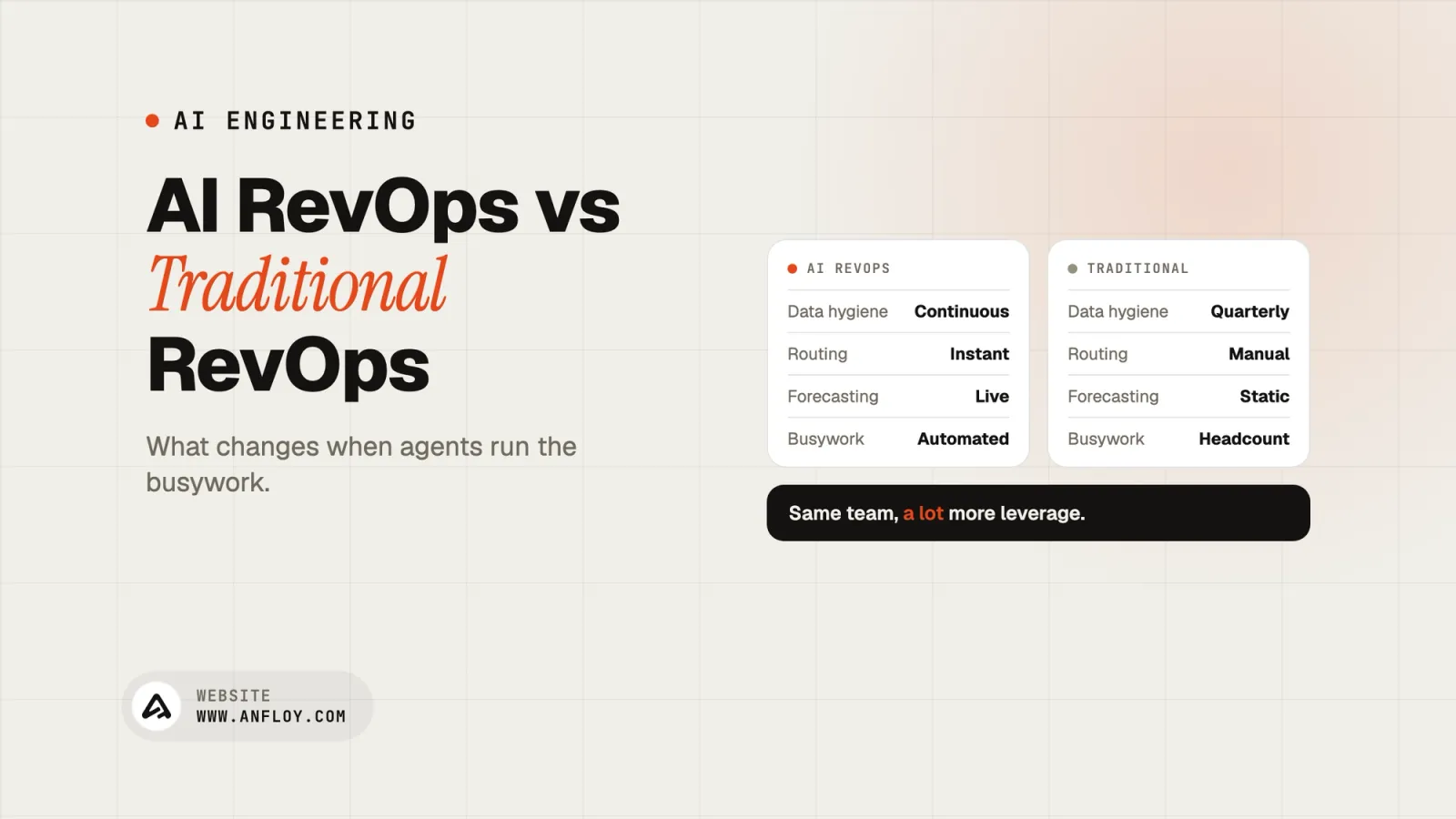
AI RevOps vs traditional RevOps
| Traditional RevOps | AI-Powered RevOps |
|---|---|
| Manual CRM updates | Automated CRM enrichment |
| Weekly pipeline reviews | Continuous pipeline monitoring |
| Historical reporting | Real-time revenue intelligence |
| Rule-based workflows | AI-driven workflow automation |
| Static lead scoring | Dynamic lead qualification |
| Manual forecasting | AI-assisted forecasting |
| Reactive operations | Proactive revenue optimization |
| Department-specific tools | Connected AI infrastructure |
The biggest difference is timing.
Traditional RevOps explains what has already happened.
AI RevOps helps teams decide what to do next.
Why are companies moving toward AI RevOps?
Growing businesses need more than dashboards.
They need systems that can identify problems before revenue is affected.
AI enables this by continuously analyzing operational data across the customer lifecycle.
Key drivers include:
Better pipeline visibility
AI monitors deal progression in real time and highlights stalled opportunities before they become lost revenue.
Faster lead qualification
Instead of manually reviewing every lead, AI evaluates buying intent, ICP fit, engagement history, and account quality automatically.
More accurate forecasting
AI combines historical performance with live pipeline activity to improve revenue forecasts.
Improved sales productivity
Sales teams spend less time updating CRM records and more time speaking with qualified prospects.
Stronger cross-department alignment
Marketing, sales, and customer success operate from the same connected intelligence layer instead of isolated reports.
How AI improves revenue operations?
AI transforms almost every stage of the revenue lifecycle.
Lead management
AI qualifies leads, enriches customer records, and routes opportunities to the appropriate sales representatives.
Pipeline management
AI identifies stalled deals, recommends follow-up actions, and prioritizes high-value opportunities.
CRM automation
Customer records stay accurate through continuous enrichment and automated updates.
Revenue intelligence
AI analyzes customer behavior, buying signals, and pipeline trends to provide actionable insights instead of static reports.
Workflow automation
AI agents automate repetitive operational tasks across sales, marketing, and customer success teams.
When is traditional RevOps still enough?
Traditional RevOps can still work well for organizations that:
- have a small sales team
- manage a simple sales process
- operate with limited customer data
- have minimal automation requirements
However, as customer volume, revenue complexity, and operational demands increase, manual processes become more difficult to scale.
This is where AI creates the greatest impact.
Common mistakes businesses make
Treating AI as another reporting tool
AI should improve execution, not simply generate dashboards.
Automating without clean data
Poor CRM data produces poor AI decisions.
Maintaining accurate customer information remains essential.
Ignoring business context
AI performs significantly better when connected to company knowledge, workflows, and operational processes.
Keeping revenue teams in silos
Revenue grows faster when marketing, sales, customer success, and RevOps share one connected intelligence layer.
Buying multiple AI tools without a strategy
Disconnected AI applications often create more complexity than value.
A unified AI infrastructure delivers stronger long-term results.
How Anfloy builds AI-powered revenue operations?
At Anfloy, we don't replace your RevOps team.
We build AI infrastructure that enables your RevOps team to operate faster, make better decisions, and automate repetitive operational work.
Every implementation begins by understanding:
- your revenue process
- sales methodology
- marketing workflows
- customer lifecycle
- CRM architecture
- operational bottlenecks
- business objectives
From there, we build a custom AI-powered Revenue Operations system around your business.
AI-powered GTM engines
Our GTM Engines connect buying signals, lead enrichment, qualification, outbound execution, CRM automation, and revenue intelligence into one connected operational system.
Company AI brain
Every AI agent connects to a centralized Company AI Brain powered by Retrieval-Augmented Generation (RAG), embeddings, hybrid search, reranking, and persistent memory.
This allows AI to retrieve:
- sales playbooks
- qualification frameworks
- customer history
- product knowledge
- pricing information
- internal documentation
before making recommendations or executing workflows.
Multi-agent revenue operations
Instead of relying on a single AI assistant, specialized AI agents collaborate across:
- lead qualification
- CRM management
- pipeline monitoring
- forecasting
- revenue reporting
- workflow automation
Each AI agent owns a specific responsibility, creating a scalable and reliable RevOps system.
Internal operations systems
Beyond revenue workflows, AI automates documentation, approvals, onboarding, reporting, and operational processes, allowing your teams to spend more time on strategic work.
Infrastructure you own
Every AI Revenue Operations platform is deployed on infrastructure owned by your business.
You own:
- the code
- the workflows
- the AI logic
- the integrations
- the operational infrastructure
No vendor lock-in.
No recurring software dependency.
The result is an AI-powered RevOps system that continuously improves revenue visibility, operational efficiency, and business performance as your company grows.
What is the future of revenue operations?
Revenue Operations is evolving from manual coordination into intelligent orchestration.
Future RevOps teams will increasingly rely on AI agents that can:
- detect buying intent automatically
- prioritize pipeline opportunities
- automate CRM management
- coordinate cross-functional workflows
- generate accurate forecasts
- recommend next-best actions in real time
Rather than replacing RevOps professionals, AI will enable them to focus on strategy, optimization, and revenue growth instead of repetitive operational work.
Conclusion
Traditional Revenue Operations helped businesses align teams and improve operational consistency.
AI-powered Revenue Operations takes the next step by transforming RevOps from a reporting function into an intelligent operating system.
By combining:
- AI agents
- Company AI brains
- GTM Engines
- CRM automation
- revenue intelligence
- workflow orchestration
businesses can improve pipeline visibility, forecast revenue more accurately, automate repetitive work, and create a more predictable growth engine.
At Anfloy, we build AI-powered Revenue Operations systems through custom Agentic Systems, Company AI Brains, GTM Engines, Internal Operations Systems, and Full-Stack AI Products that are tailored to your business and deployed on infrastructure you own.
Because the future of Revenue Operations isn't managing more dashboards.
It's building intelligent AI systems that continuously optimize how your business generates, manages, and grows revenue.
Frequently Asked Questions
What is the difference between AI RevOps and traditional RevOps?
Traditional RevOps relies on manual reporting, CRM management, and scheduled reviews, while AI RevOps continuously analyzes data, automates workflows, and provides real-time recommendations.
Can AI replace a Revenue Operations team?
No. AI supports RevOps professionals by automating repetitive tasks and providing better insights, allowing teams to focus on strategic decision-making.
Does AI improve revenue forecasting?
Yes. AI analyzes historical trends, live pipeline activity, buying signals, and customer engagement to generate more accurate forecasts.
Which businesses benefit most from AI Revenue Operations?
Growth-stage SaaS companies, agencies, consulting firms, B2B service providers, and organizations with complex revenue processes often benefit the most.
Let's build
what your
company needs.
Drop your email. We'll send The Custom Agent Blueprint on what we'd build first for a company like yours, before you ever take a meeting.