
What is AI Knowledge Management Systems?: The Complete Guide
Learn how AI knowledge management systems organize company knowledge, improve search, power AI agents, and help businesses scale smarter.
On this page
- What is an AI knowledge management system?
- Why traditional knowledge management breaks?
- How does an AI knowledge management system work?
- Why are AI knowledge management systems important?
- AI knowledge management vs traditional knowledge bases
- Common business use cases
- What technologies power AI knowledge management systems?
- Common mistakes businesses make
- How Anfloy builds AI knowledge management systems?
- What is the future of AI knowledge management?
- Conclusion
Every growing business faces the same problem.
Knowledge is everywhere.
Customer conversations live in your CRM.
Standard operating procedures are stored in Google Drive.
Product documentation sits in Notion.
Support teams use internal wikis.
Sales teams have their own playbooks.
Marketing creates content in multiple platforms.
The information exists.
Finding the right information at the right time is the challenge.
Employees waste hours searching across different tools, asking colleagues the same questions, or working with outdated documentation.
As organizations grow, these knowledge gaps become operational bottlenecks.
This is where AI knowledge management systems are changing how businesses operate.
Instead of acting as digital document libraries, modern AI knowledge management systems understand your business, retrieve relevant information, and help employees and AI agents use that knowledge to complete work.
This guide explains what AI knowledge management systems are, how they work, and why they are becoming essential for AI-powered businesses.
What is an AI knowledge management system?
An AI knowledge management system is a centralized platform that collects, organizes, retrieves, and applies company knowledge using artificial intelligence.
Unlike traditional document management systems that simply store information, AI-powered knowledge systems understand context and provide relevant answers based on business data.
They can organize information such as:
- company documentation
- SOPs
- product information
- customer knowledge
- CRM records
- internal policies
- onboarding materials
- project documentation
- sales playbooks
Instead of forcing employees to search manually, AI retrieves the most relevant information in seconds.
Why traditional knowledge management breaks?
Most businesses already have documentation.
The problem is that it lives across disconnected systems.
Knowledge is often spread between:
- Google Drive
- Notion
- Confluence
- Slack
- CRM platforms
- shared folders
- internal databases
This creates several challenges.
Common problems include:
- duplicate documentation
- outdated information
- inconsistent answers
- knowledge silos
- poor search experiences
- lost institutional knowledge
As businesses scale, finding information becomes slower and more expensive.
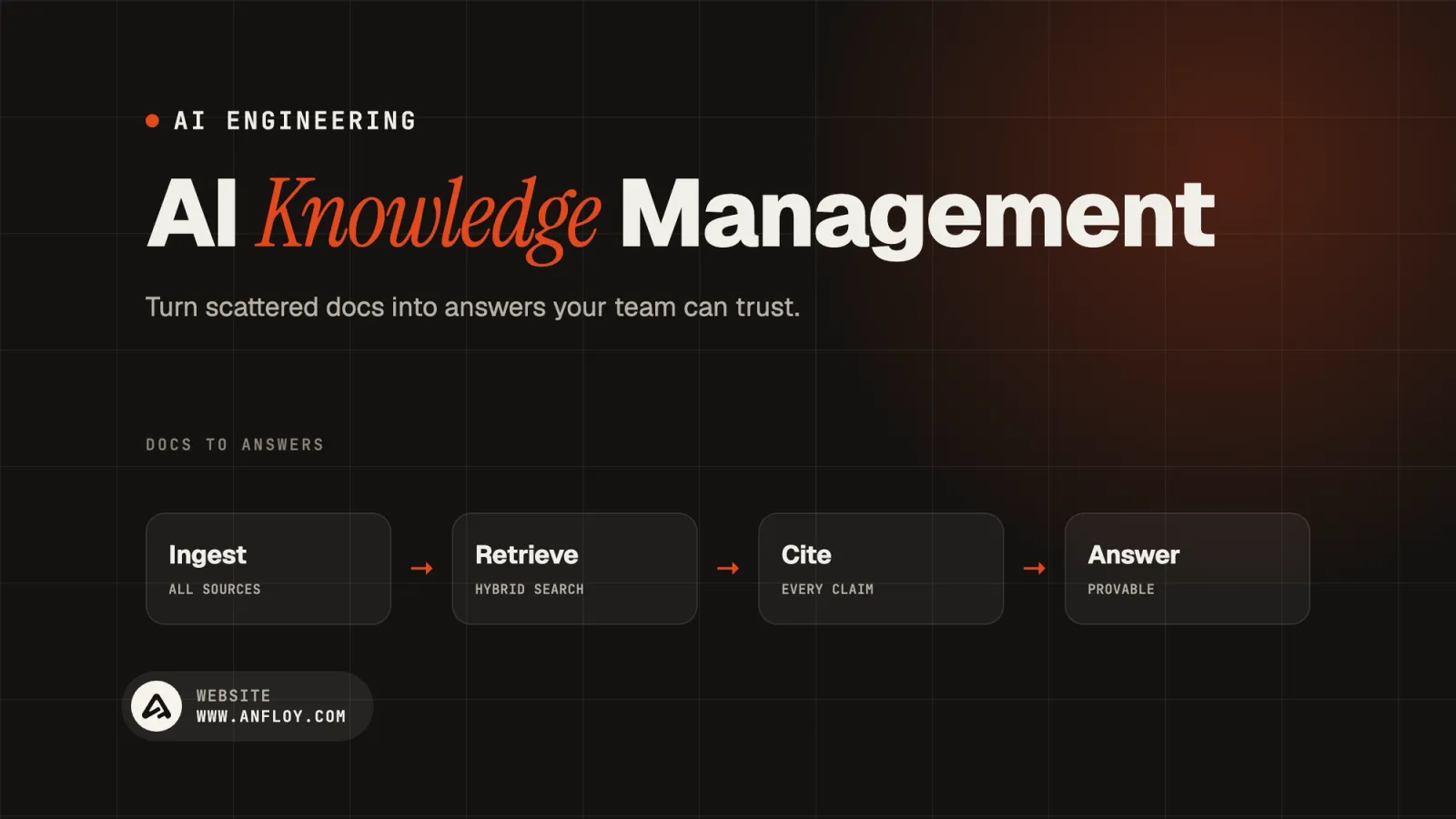
How does an AI knowledge management system work?
Modern AI knowledge systems do much more than store documents.
They continuously organize, retrieve, and apply knowledge across the business.
A typical workflow looks like this.
Step 1: Connect knowledge sources
AI connects to existing systems including:
- document platforms
- CRM software
- cloud storage
- internal databases
- communication tools
Step 2: Organize business knowledge
Information is indexed, categorized, and structured into a searchable knowledge layer.
This creates a single source of truth.
Step 3: Retrieve relevant information
When employees or AI agents ask questions, the system searches across connected knowledge sources instead of relying on one document repository.
Step 4: Understand context
AI evaluates the user's question, business context, and available documentation before returning the most relevant information.
Step 5: Support business workflows
Knowledge can then be used to:
- answer questions
- support employees
- automate workflows
- power AI agents
- improve customer service
The knowledge system becomes an operational asset rather than a storage location.
Why are AI knowledge management systems important?
As businesses grow, access to accurate information becomes increasingly important.
AI knowledge management systems help organizations:
Reduce time spent searching
Employees find answers in seconds instead of searching multiple tools.
Improve decision-making
Teams work from current, verified business knowledge.
Increase operational efficiency
AI eliminates repetitive questions and manual document searches.
Preserve institutional knowledge
Important business knowledge remains available even as teams grow or change.
Power AI systems
AI agents perform better when connected to trusted company information.
AI knowledge management vs traditional knowledge bases
| Traditional Knowledge Base | AI Knowledge Management System |
|---|---|
| Stores documents | Understands business knowledge |
| Keyword search | Context-aware retrieval |
| Static documentation | Continuously updated knowledge |
| Manual navigation | Natural language search |
| Limited automation | Powers AI workflows |
| Passive information | Actionable intelligence |
The biggest difference is intelligence.
Traditional systems store knowledge.
AI systems help people and AI use knowledge.
Common business use cases
Employee onboarding
Provide new employees with instant access to company documentation and training resources.
Customer support
Retrieve product documentation and troubleshooting guides in real time.
Sales enablement
Help sales teams access pricing, case studies, competitive positioning, and product information.
Internal operations
Support HR, finance, legal, and operations teams with centralized business knowledge.
AI agent development
Provide AI agents development with accurate company context before they execute workflows.
Following your requested style (only the first letter of the entire heading capitalized, while keeping acronyms and brand names like AI uppercase):
What technologies power AI knowledge management systems?
Several technologies work together to create modern AI knowledge platforms.
Retrieval-augmented generation (RAG)
Allows AI to retrieve company knowledge before generating responses.
Vector databases
Store information based on semantic meaning instead of simple keywords.
Embeddings
Help AI understand relationships between documents and concepts.
Hybrid search
Combines semantic search with keyword search for greater accuracy.
Large language models (LLMs)
Generate natural language answers using retrieved business knowledge.
Together, these technologies create a system that understands company information rather than simply storing it.
Common mistakes businesses make
Treating documentation as a knowledge system
Documents alone don't create accessible knowledge.
AI helps connect and retrieve information intelligently.
Keeping knowledge in department silos
Sales, marketing, operations, and support should share one connected knowledge layer.
Ignoring knowledge quality
AI performs best when documentation is accurate, current, and well organized.
Building AI without business context
Generic AI produces generic answers.
Business-specific knowledge produces reliable outcomes.
Choosing search over intelligence
Employees don't just need documents.
They need answers that help them complete work.
How Anfloy builds AI knowledge management systems?
At Anfloy, we don't build document repositories.
We build intelligent knowledge systems that become the foundation of your AI infrastructure.
Every implementation begins by understanding:
- your business workflows
- internal documentation
- customer journey
- operational processes
- existing software
- knowledge architecture
From there, we create a centralized knowledge platform that supports employees, AI agents, and business operations.
Company AI brain
We build a Company AI Brain powered by Retrieval-Augmented Generation (RAG), embeddings, hybrid search, reranking, and persistent memory. This enables both employees and AI agents to retrieve accurate business knowledge instantly.
Connected knowledge layer
Instead of keeping information isolated across multiple tools, we connect documentation, CRM data, SOPs, product information, customer history, and internal systems into a unified knowledge architecture.
Agentic systems
Our AI agents use company knowledge to automate customer support, sales enablement, onboarding, internal operations, and workflow execution using real business context.
Internal operations systems
Knowledge becomes actionable by supporting approvals, documentation retrieval, reporting, employee onboarding, and operational workflows across departments.
Infrastructure you own
Every AI knowledge management system is deployed directly on infrastructure owned by your business.
You own:
- the code
- the knowledge architecture
- the AI logic
- the workflows
- the integrations
- the infrastructure
No vendor lock-in.
No recurring software dependency.
The result is an AI knowledge management system that becomes smarter as your business grows and serves as the foundation for every future AI initiative.
What is the future of AI knowledge management?
Knowledge management is evolving beyond search.
Future systems will:
- retrieve information proactively
- support AI agents in real time
- automate knowledge-driven workflows
- connect every business system
- continuously learn from operational data
Instead of asking employees to search for information, AI will increasingly deliver the right knowledge at the exact moment it's needed.
Conclusion
Knowledge is one of the most valuable assets a business owns.
The challenge isn't creating it.
The challenge is making it available when people and AI need it most.
AI knowledge management systems solve this by combining:
- Company AI Brains
- Retrieval-Augmented Generation
- semantic search
- workflow automation
- AI agents
- connected business knowledge
into one intelligent platform.
At Anfloy, we build AI knowledge management systems as part of a complete AI infrastructure through:
- Company AI Brains
- Agentic Systems
- GTM Engines
- Internal Operations Systems
- Full-Stack AI Products
Because the future of knowledge management isn't storing more documents.
It's building intelligent systems that transform company knowledge into faster decisions, smarter automation, and better business outcomes.
Frequently Asked Questions
How does AI improve knowledge management?
AI understands natural language, retrieves relevant information, connects multiple knowledge sources, and helps employees and AI agents find accurate answers faster.
What is the difference between traditional and AI knowledge management?
Traditional systems store documents. AI knowledge management systems understand context, retrieve information intelligently, and support business workflows.
Can AI knowledge management integrate with existing business software?
Yes. Modern AI knowledge management systems connect with CRMs, cloud storage, documentation platforms, databases, and communication tools.
Why do AI agents need a knowledge management system?
AI agents rely on accurate company knowledge to make informed decisions, answer questions, automate workflows, and execute business tasks reliably.
Let's build
what your
company needs.
Drop your email. We'll send The Custom Agent Blueprint on what we'd build first for a company like yours, before you ever take a meeting.