
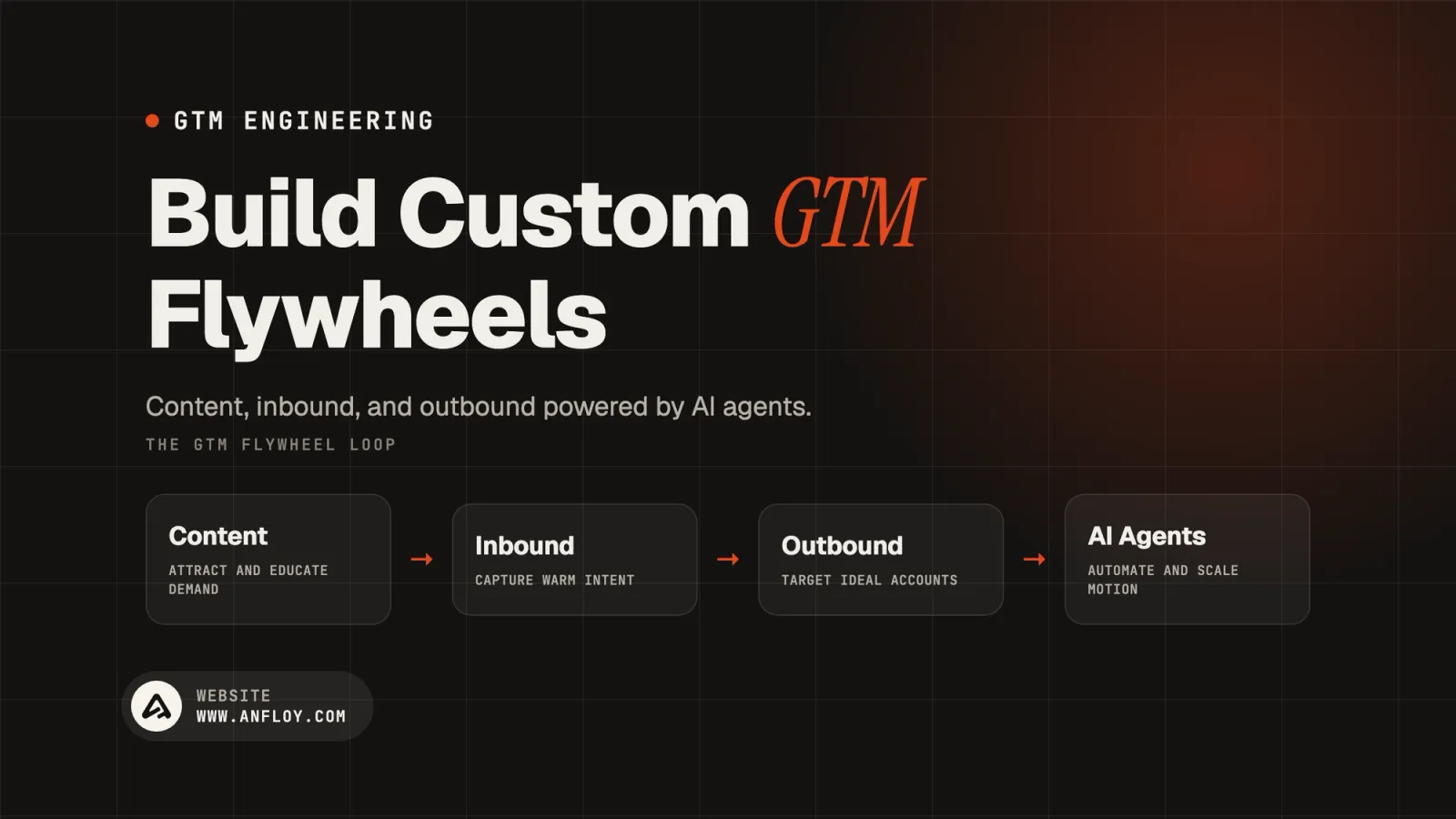
How to Build Custom GTM Flywheels (Content, Inbound, and Outbound) in 2026
Learn how to build custom GTM flywheels using content, inbound, outbound, AI agents, and GTM engineering to create scalable and predictable revenue growth.
On this page
- What is a GTM flywheel?
- Why GTM teams are moving beyond funnels?
- The anatomy of a modern GTM flywheel
- Flywheel #1: The content flywheel
- Flywheel #2: The inbound flywheel
- Flywheel #3: The outbound flywheel
- The AI layer
- How to building a custom GTM flywheel?
- What are the top KPIs for GTM flywheels?
- What are the common GTM flywheel mistakes?
- How Anfloy builds GTM flywheels?
- What is the future of GTM flywheels?
- Conclusion
For years, businesses have relied on funnels to drive growth.
The traditional model is simple:
Traffic
↓
Leads
↓
Opportunities
↓
Customers
Funnels are useful because they're easy to understand.
They're also incomplete.
Funnels assume that growth is linear. Prospects enter at the top, move through a sequence of stages, and eventually convert or leave.
Modern go-to-market teams operate differently.
Today's buyers:
- consume content across multiple channels
- interact with brands repeatedly before converting
- research independently
- engage with communities
- respond to personalized outreach
- influence other buyers
Growth is no longer linear.
It's compounding.
This is why high-performing organizations are moving from funnels to flywheels.
A GTM flywheel is a self-reinforcing growth system where every activity creates momentum for the next.
Content generates traffic.
Traffic generates leads.
Leads generate customers.
Customers generate advocacy.
Advocacy improves content.
The cycle repeats.
Artificial intelligence is accelerating this shift.
Modern GTM flywheels increasingly include:
- Company AI Brains
- AI Agents
- GTM Engineering
- Revenue Intelligence
- AI Orchestration
- Company Intelligence
- Personalized Outbound Systems
These technologies transform growth from a collection of campaigns into an intelligent operating system.
What is a GTM flywheel?
A GTM flywheel is a self-reinforcing system where marketing, sales, customer success, and intelligence continuously generate momentum and revenue.
Unlike a funnel, a flywheel doesn't end after a customer converts.
Instead, customers contribute to future growth through:
- referrals
- testimonials
- reviews
- content
- data
- product feedback
The result is a compounding growth engine.
Modern GTM flywheels typically include:
- content
- inbound
- outbound
- customer success
- revenue intelligence
- AI systems
The objective isn't simply to generate more leads.
The objective is to create systems that improve as they operate.
Why GTM teams are moving beyond funnels?
Funnels remain useful for reporting.
They are less useful for understanding modern buyer behavior.
Several trends are driving the transition toward flywheels.
Rising customer acquisition costs
Paid acquisition continues to become more expensive across nearly every industry.
Businesses need growth systems that generate compounding returns.
Buyer behavior has changed
Modern buyers:
- research independently
- compare vendors
- consume educational content
- rely on peer recommendations
Many customers interact with brands dozens of times before speaking with sales.
AI has changed GTM
AI enables organizations to:
- personalize at scale
- identify buying signals
- automate workflows
- improve forecasting
- optimize continuously
Flywheels benefit significantly from these capabilities.
Revenue teams need better systems
Disconnected tools frequently create:
- fragmented data
- poor visibility
- weak attribution
- inconsistent experiences
Flywheels provide a framework for connecting these activities into one coordinated system.
The anatomy of a modern GTM flywheel
A simplified GTM flywheel looks like this:
Content
   ↓
Traffic
   ↓
Leads
   ↓
Pipeline
   ↓
Customers
   ↓
Advocacy
   ↓
Data
   ↓
Intelligence
   ↓
Better Content
Every stage contributes to future growth.
For example:
- Content attracts prospects.
- Prospects generate customer data.
- Customer data improves personalization.
- Personalization improves conversions.
- Better conversions create additional customers.
- Customers generate additional content opportunities.
Momentum compounds over time.
Flywheel #1: The content flywheel
Content remains one of the most powerful GTM channels because it scales.
Unlike outbound, content continues to create value long after publication.
A modern content flywheel typically includes:
- SEO
- Semantic SEO
- AI Overview optimization
- GEO
- content clusters
- internal linking
- distribution
The framework looks like this:
Research
↓
Create
↓
Publish
↓
Distribute
↓
Rank
↓
Capture Data
↓
Improve Content
Step 1: Research
Identify:
- customer questions
- keyword opportunities
- industry trends
- buying intent
Step 2: Create
Develop content aligned with:
- ICPs
- search intent
- customer pain points
Step 3: Publish
Publish across:
- websites
- newsletters
- communities
Step 4: Distribute
Content without distribution rarely performs.
High-performing teams actively promote content across multiple channels.
Step 5: Capture data
Monitor:
- rankings
- traffic
- AI Overview visibility
- conversions
Step 6: Improve
Use data to refine:
- headlines
- internal links
- CTAs
- content depth
The content flywheel compounds because every article contributes to future authority.
Flywheel #2: The inbound flywheel
Inbound focuses on converting interest into pipeline.
A typical inbound flywheel looks like this:

Traffic
   ↓
Lead Capture
   ↓
Qualification
   ↓
CRM
   ↓
Nurturing
   ↓
Sales
   ↓
Customer
Key components include:
Traffic
Examples:
- SEO
- referrals
- social media
- newsletters
Lead capture
Methods include:
- forms
- demos
- lead magnets
- webinars
Qualification
Organizations should evaluate:
- ICP fit
- buying intent
- engagement
CRM
The CRM becomes the system of record for:
- accounts
- contacts
- opportunities
Nurturing
Prospects frequently require multiple touchpoints before converting.
Examples include:
- email sequences
- newsletters
- remarketing
Customer conversion
The objective of inbound isn't traffic.
It's revenue.
High-performing inbound teams consistently connect marketing activities to pipeline and customer outcomes.
Flywheel #3: The outbound flywheel
Outbound is evolving from volume-based outreach to intelligence-driven engagement.
Modern outbound flywheels look like this:

Buying Signals
   ↓
Research
   ↓
Personalization
   ↓
Outreach
   ↓
Meetings
   ↓
Pipeline
   ↓
Revenue Intelligence
Key components include:
Buying signals
Examples:
- funding announcements
- hiring activity
- leadership changes
- technology adoption
Company intelligence
Outbound teams should understand:
- employee count
- technology stack
- market position
- operational priorities
Personalization
AI enables teams to personalize:
- emails
- LinkedIn messages
- subject lines
- follow-ups
Revenue intelligence
Revenue Intelligence provides visibility into:
- reply rates
- meetings booked
- conversion rates
- pipeline generated
Outbound becomes significantly more effective when connected to Company Intelligence and AI systems.
The AI layer
AI is becoming the intelligence layer across all GTM flywheels.
Examples include:
AI Agents
AI Agents for business responsible for:
- research
- enrichment
- personalization
- reporting
Company AI brain
Provides centralized knowledge across:
- CRM
- documentation
- customer history
AI SDRs
Support:
- prospecting
- qualification
- outreach
AI orchestration
Coordinates:
- workflows
- agents
- approvals
- monitoring
AI doesn't replace flywheels.
It accelerates them.
How to building a custom GTM flywheel?
Every business has a different customer journey.
A SaaS company selling to mid-market buyers will require a different GTM flywheel than a healthcare company targeting enterprise organizations.
This is why the best GTM systems are custom-built.
A modern GTM flywheel typically consists of eight layers:

ICP
 ↓
Company Intelligence
 ↓
Content Engine
 ↓
Inbound Engine
 ↓
Outbound Engine
 ↓
Revenue Intelligence
 ↓
AI Orchestration
 ↓
Optimization
Let's examine each layer.
Layer 1: ICP
Everything begins with a clearly defined Ideal Customer Profile.
Examples include:
- industry
- employee count
- geography
- revenue
- technology stack
- operational challenges
Without an ICP, GTM systems optimize for volume rather than relevance.
Layer 2: Company intelligence
Company Intelligence helps organizations understand:
- buying signals
- account changes
- funding activity
- hiring trends
- technology adoption
This intelligence informs both inbound and outbound strategies.
Layer 3: Content engine
Your content engine should continuously produce:
- blog articles
- case studies
- comparison pages
- thought leadership
- newsletters
Content serves as the fuel for the broader GTM flywheel.
Layer 4: Inbound engine
Inbound systems should include:
- lead capture
- CRM integration
- lead scoring
- nurturing workflows
The objective is to convert attention into opportunities.
Layer 5: Outbound engine
Modern outbound should leverage:
- AI personalization
- buying signals
- account intelligence
- multi-channel sequences
Outbound becomes significantly more effective when informed by Company Intelligence.
Layer 6: Revenue intelligence
Revenue Intelligence provides visibility into:
- pipeline
- conversion rates
- customer acquisition cost
- revenue attribution
Without Revenue Intelligence, optimization becomes difficult.
Layer 7: AI orchestration
AI orchestration coordinates:
- AI agents
- workflows
- approvals
- reporting
This layer transforms disconnected automations into one coordinated system.
Layer 8: Optimization
Every flywheel should improve over time.
Examples include:
- content optimization
- sequence testing
- ICP refinement
- AI prompt optimization
- workflow improvements
Optimization is what transforms GTM systems into compounding assets.
What are the top KPIs for GTM flywheels?
Flywheels require measurement.
Recommended KPIs include:
Content metrics
- organic traffic
- keyword rankings
- AI Overview visibility
- backlinks
- conversions
Inbound metrics
- MQLs
- SQLs
- demo requests
- conversion rates
Outbound metrics
- reply rate
- positive reply rate
- meetings booked
- pipeline generated
Business metrics
- customer acquisition cost (CAC)
- customer lifetime value (LTV)
- revenue influenced
- payback period
AI metrics
- workflow completion rates
- AI adoption
- automation savings
- operational efficiency
The most important KPI remains:
Revenue generated by the flywheel.
Everything else supports that objective.
What are the common GTM flywheel mistakes?
Many organizations struggle because they misunderstand how flywheels operate.
Treating flywheels like campaigns
Campaigns have:
- start dates
- end dates
Flywheels are continuous systems.
Ignoring AI
Modern GTM systems benefit significantly from:
- AI agents
- Company AI Brains
- AI orchestration
Organizations that ignore AI often struggle to scale.
Weak attribution
If businesses cannot answer:
Which activities generated revenue?
optimization becomes difficult.
Poor CRM hygiene
Examples include:
- duplicate records
- outdated information
- incomplete profiles
Flywheels depend on high-quality data.
No company intelligence
Without Company Intelligence, organizations lose context around:
- accounts
- customers
- buying signals
No GTM engineering support
Modern GTM engineering systems require technical ownership.
GTM engineers frequently become responsible for:
- automation
- integrations
- AI implementation
- orchestration
How Anfloy builds GTM flywheels?
At Anfloy, we don't build isolated marketing campaigns.
We build GTM infrastructure.
Every engagement follows a structured methodology.
Step 1: Discovery
We identify:
- business objectives
- revenue goals
- ICPs
- operational bottlenecks
Step 2: Company AI brain
We centralize:
- CRM data
- documentation
- customer history
- sales playbooks
This becomes the intelligence layer across all GTM systems.
Step 3: GTM engineering
We implement:
- automation
- integrations
- reporting
- workflow infrastructure
Step 4: Content engine
We build content systems optimized for:
- Semantic SEO
- AI Overviews
- GEO
- topical authority
Step 5: Inbound engine
We design:
- lead capture
- nurturing workflows
- CRM automation
Step 6: Outbound Engine
We deploy:
- Company Intelligence
- AI personalization
- AI SDR workflows
- buying signal monitoring
Step 7: Revenue intelligence
We connect every GTM activity to:
- pipeline
- forecasting
- customer outcomes
Step 8: AI orchestration
AI orchestration coordinates:
- agents
- workflows
- approvals
- monitoring
Step 9: Continuous optimization
Flywheels are never complete.
They improve continuously through:
- testing
- reporting
- customer feedback
- AI insights
What is the future of GTM flywheels?
The next generation of GTM systems will become increasingly autonomous.
Organizations will deploy:
- AI coworkers
- AI SDRs
- Company Intelligence Agents
- Revenue Intelligence Agents
- autonomous workflows
Future GTM flywheels will:
- identify opportunities automatically
- personalize communications
- optimize continuously
- forecast revenue
- improve without manual intervention
In many ways, GTM flywheels are evolving into AI operating systems for revenue teams.
Businesses that invest in these capabilities today will be better positioned to compete tomorrow.
Conclusion
Funnels helped define the last generation of go-to-market strategy.
Flywheels will define the next.
The companies that win over the next decade won't simply run better campaigns.
They'll build better systems.
By combining content, inbound, outbound, Company Intelligence, Revenue Intelligence, and AI Orchestration, businesses can create GTM flywheels that become stronger with every interaction.
At Anfloy, we help organizations build these systems from the ground up designed around ownership, intelligence, and measurable business outcomes.
Because the future of GTM isn't linear.
It's compounding.
Ready to Build an AI-Powered GTM Engine?
From Company AI Brains and AI Agents to GTM Engineering and Revenue Intelligence, Anfloy helps businesses build GTM flywheels designed for the AI era.
Book a Strategy Call
Frequently Asked Questions
How is a flywheel different from a funnel?
Funnels are linear. Flywheels are continuous systems designed to compound over time.
How does AI improve GTM?
AI improves personalization, automation, forecasting, reporting, and workflow orchestration.
Can startups build GTM flywheels?
Yes. In fact, startups often benefit significantly because flywheels create scalable growth systems without requiring proportional increases in headcount.
What KPIs should I track?
Track: traffic pipeline revenue conversion rates customer acquisition cost AI adoption
Should GTM flywheels be built in-house?
For many organizations, owning GTM infrastructure creates long-term competitive advantages.


Let's build
what your
company needs.
Drop your email. We'll send The Custom Agent Blueprint on what we'd build first for a company like yours, before you ever take a meeting.