
GTM Engineering vs RevOps: Difference and Which Does Your Business Need in 2026?
Compare GTM Engineering vs RevOps, including responsibilities, tools, AI capabilities, hiring recommendations, and which role your business needs in 2026.
On this page
- What is revenue operations (RevOps)?
- What is GTM engineering?
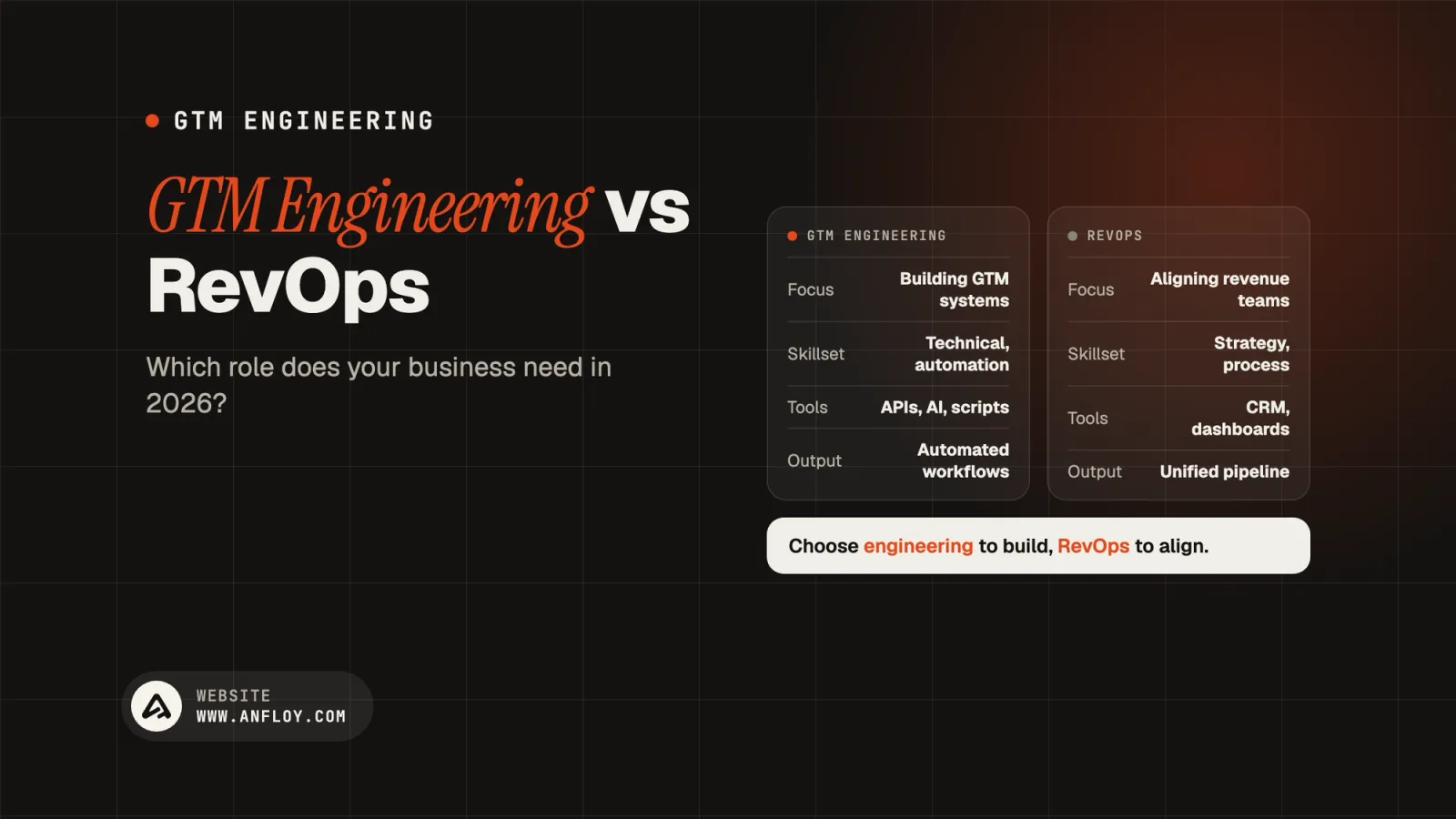
- GTM Engineer vs RevOps: The short answer
- What RevOps actually owns?
- What a GTM engineer actually does?
- GTM engineer vs RevOps: Key differences
- Why GTM engineering exists in the AI era?
- GTM engineer vs RevOps by company stage
- Should you hire RevOps or a GTM engineer first?
- Can GTM engineers replace RevOps?
- Common hiring mistakes
- How Anfloy supports GTM engineering and RevOps?
- What is the future of GTM engineering and RevOps?
- Conclusion
Over the last decade, Revenue Operations (RevOps) has become one of the most important functions in modern B2B organizations.
RevOps helped businesses solve critical challenges around:
- revenue alignment
- forecasting
- attribution
- reporting
- pipeline visibility
But over the last few years, a new role has emerged:
The GTM Engineer.
As organizations adopt AI, workflow automation, and increasingly complex GTM systems, businesses are beginning to ask an important question:
"Do we need RevOps, GTM Engineering, or both?"
It's a fair question.
At first glance, the two functions appear similar.
Both work closely with:
- sales
- marketing
- customer success
- CRM systems
- revenue teams
However, their responsibilities are fundamentally different.
A simple way to think about it is:
RevOps aligns revenue teams.
GTM Engineering builds the systems that power those teams.
Or put another way:
RevOps optimizes what exists.
GTM Engineering builds what doesn't exist yet.
This distinction has become increasingly important in the AI era.
Modern revenue organizations now require:
- AI Agents
- Revenue Intelligence
- GTM automation
- Company AI Brains
- workflow orchestration
- multi-system integrations
Someone needs to build and maintain that infrastructure.
That's where GTM Engineering comes in.
What is revenue operations (RevOps)?
Revenue Operations (RevOps) is the practice of aligning sales, marketing, and customer success teams to improve revenue performance.
Its primary objective is to create operational consistency across the customer lifecycle.
RevOps teams typically focus on:
- forecasting
- reporting
- attribution
- pipeline management
- process optimization
- revenue alignment
Examples of RevOps responsibilities include:
- creating dashboards
- improving forecast accuracy
- establishing SLAs
- defining handoffs between teams
- maintaining CRM standards
RevOps asks questions like:
- Why are conversion rates declining?
- Where is pipeline leaking?
- Which channels generate the most revenue?
- How can teams operate more efficiently?
In many organizations, RevOps acts as the connective tissue between revenue functions.
Without RevOps, businesses frequently experience:
- poor alignment
- inconsistent reporting
- operational silos
- weak attribution
RevOps isn't responsible for building systems.
It's responsible for ensuring revenue teams work together effectively.
What is GTM engineering?
GTM Engineering is the discipline of designing, building, and maintaining the technical systems that power modern go-to-market organizations.
Unlike RevOps, GTM Engineering is infrastructure-focused.
Common GTM Engineering responsibilities include:
- CRM architecture
- workflow automation
- AI implementation
- Revenue Intelligence
- GTM systems
- integrations
- AI orchestration
A GTM engineer might build:
- AI SDR workflows
- automated lead routing
- Revenue Intelligence dashboards
- Company AI Brains
- CRM automations
Their role is increasingly similar to an internal product or systems engineer for revenue teams.
Examples of questions GTM engineers ask include:
- Which systems need to be connected?
- How should workflows operate?
- Where can AI improve efficiency?
- How do we automate repetitive work?
Modern GTM engineers frequently work with:
- HubSpot
- Salesforce
- Clay
- n8n
- Zapier
- OpenAI
- Anthropic
As AI becomes more prevalent, GTM Engineering is quickly becoming one of the most valuable capabilities inside revenue organizations.
GTM Engineer vs RevOps: The short answer
If you only remember one thing from this article, remember this:
| Function | Primary Responsibility |
|---|---|
| RevOps | Align revenue teams |
| GTM Engineering | Build revenue systems |
RevOps determines:
- what should happen
- who owns it
- how success is measured
GTM Engineering determines:
- how it works
- which systems are required
- how automation is implemented
Think about it this way:

RevOps Strategy
       ↓
GTM Engineering
       ↓
Systems
       ↓
Automation
       ↓
Revenue Outcomes
Neither discipline replaces the other.
They're complementary.
What RevOps actually owns?
RevOps ownership typically includes:
Revenue alignment
Ensuring:
- sales
- marketing
- customer success
operate effectively together.
Forecasting
Examples include:
- revenue forecasts
- pipeline forecasts
- conversion projections
Reporting
RevOps teams frequently own:
- executive dashboards
- KPI reporting
- performance analysis
Process optimization
Examples include:
- sales handoffs
- lifecycle definitions
- SLA management
Data governance
Examples include:
- CRM standards
- naming conventions
- reporting requirements
Ultimately, RevOps is responsible for improving revenue efficiency.
What a GTM engineer actually does?
GTM engineers own the technical implementation layer.
CRM architecture
Examples include:
- object creation
- field mapping
- pipeline design
Workflow automation
Examples include:
- lead routing
- meeting scheduling
- notifications
AI integration
Examples include:
- AI SDRs
- AI Agents
- Company AI Brains
Systems integration
Examples include:
- Salesforce ↔ HubSpot
- CRM ↔ Product
- CRM ↔ Support Tools
Revenue infrastructure
Examples include:
- Revenue Intelligence
- attribution systems
- AI orchestration
In short:
RevOps improves revenue processes.
GTM Engineering builds revenue infrastructure.
GTM engineer vs RevOps: Key differences
While GTM Engineering and RevOps work closely together, their day-to-day responsibilities are very different.
Another way to think about it is:
| Category | GTM Engineer | RevOps |
|---|---|---|
| Primary Goal | Build systems | Optimize |
| Focus | Infrastructure | Operations |
| Skill Set | Technical | Strategic |
| KPIs | Workflow performance | Revenue performance |
| Tools | CRM, AI, Automation | CRM, Analytics |
| Ownership | Systems | Revenue alignment |
| AI Responsibilities | High | Moderate |
| Forecasting | Limited | Core Responsibility |
RevOps identifies problems.
GTM Engineering builds solutions.
The most successful revenue organizations understand that these functions are strongest when they operate together.
Why GTM engineering exists in the AI era?
Ten years ago, GTM Engineering wasn't a common role.
Revenue organizations were relatively simple:
- CRM
- marketing automation
- spreadsheets
- reporting dashboards
Today's GTM stack looks very different.
Modern businesses now operate across:
- CRM platforms
- AI tools
- enrichment platforms
- sales engagement software
- Revenue Intelligence platforms
- workflow automation systems
In addition, organizations increasingly deploy:
- AI SDRs
- AI Agents
- Company AI Brains
- AI Orchestration
- multi-agent systems
Someone needs to:
- build these systems
- maintain them
- optimize them
- connect them
That responsibility has naturally evolved into GTM Engineering.
In many ways, GTM Engineering exists because modern go-to-market systems have become too technical for traditional operational roles.
The rise of AI has only accelerated this trend.
GTM engineer vs RevOps by company stage
One of the most common questions businesses ask is:
"Who should we hire first?"
The answer depends largely on company stage and revenue.
| Annual Recurring Revenue (ARR) | Recommendation |
|---|---|
| Pre-$1M | Founder-led operations |
| $1M–$5M | RevOps |
| $5M–$10M | RevOps + Fractional GTM Engineer |
| $10M+ | Dedicated GTM Engineering + RevOps Teams |
Pre-$1M ARR
Most startups should focus on:
- validating product-market fit
- basic CRM implementation
- lightweight automation
Founders often handle GTM responsibilities themselves during this stage.
$1M–$5M ARR
Organizations typically begin experiencing:
- reporting challenges
- attribution issues
- operational inefficiencies
RevOps becomes increasingly valuable.
$5M–$10M ARR
At this stage, companies frequently encounter:
- CRM complexity
- automation requirements
- data quality challenges
This is where GTM Engineering starts becoming important.
$10M+ ARR
Enterprise organizations usually require:
- dedicated RevOps teams
- GTM engineers
- Revenue Intelligence
- AI orchestration
By this point, both functions become critical.
Should you hire RevOps or a GTM engineer first?
Use the following questions to guide your decision.
Hire RevOps first if:
- forecasting is inaccurate
- teams are misaligned
- attribution is weak
- reporting is inconsistent
- pipeline visibility is poor
Hire a GTM engineer first if:
- CRM workflows are broken
- systems don't integrate properly
- automation is limited
- AI implementation is a priority
- operational complexity is increasing
Hire both if:
- ARR exceeds $10M
- GTM systems are highly complex
- multiple revenue teams exist
- AI adoption is accelerating
Most organizations eventually need both disciplines.
The question isn't:
"Which role is better?"
It's:
"Which problem are we trying to solve first?"
Can GTM engineers replace RevOps?
No.
And RevOps can't replace GTM Engineering either.
RevOps focuses on:
- revenue alignment
- forecasting
- reporting
- optimization
GTM Engineering focuses on:
- infrastructure
- automation
- AI
- systems
Attempting to combine both functions into a single role often creates challenges.
For example:
| Responsibility | Best Owner |
|---|---|
| Forecasting | RevOps |
| CRM Architecture | GTM Engineering |
| Revenue Reporting | RevOps |
| AI Agents | GTM Engineering |
| Pipeline Analysis | RevOps |
| Workflow Automation | GTM Engineering |
In smaller organizations, one person may temporarily perform both functions.
However, as complexity increases, specialization becomes increasingly important.
Common hiring mistakes
Expecting RevOps to build technical systems
RevOps professionals are excellent at operational alignment.
They are not necessarily:
- automation specialists
- AI engineers
- systems architects
Expecting GTM engineers to own revenue strategy
GTM engineers build systems.
They typically don't own:
- forecasting
- revenue targets
- sales methodology
No ownership model
Many businesses fail to define ownership across:
- CRM
- reporting
- automation
- AI systems
This creates confusion and operational inefficiencies.
Ignoring AI
Organizations that fail to invest in:
- AI Agents
- Revenue Intelligence
- AI Orchestration
risk falling behind competitors.
Weak CRM hygiene
Poor CRM practices negatively impact both GTM Engineering and RevOps.
Examples include:
- duplicate records
- missing fields
- inconsistent naming conventions
Clean data remains the foundation of modern revenue operations.
How Anfloy supports GTM engineering and RevOps?
At Anfloy, we help organizations build AI-powered revenue systems by combining GTM Engineering with Revenue Operations best practices.
Our services include:
GTM engineering
- workflow automation
- CRM architecture
- systems integration
- AI implementation
Revenue intelligence
- forecasting
- attribution
- pipeline visibility
- executive reporting
Company AI brains
We centralize:
- customer knowledge
- CRM context
- sales documentation
- operational insights
AI agents
Examples include:
- Revenue Intelligence Agents
- Company Intelligence Agents
- CRM Agents
- Content Agents
AI orchestration
AI orchestration coordinates:
- workflows
- agents
- reporting
- approvals
The result is a revenue organization capable of scaling efficiently in the AI era.
What is the future of GTM engineering and RevOps?
The next generation of revenue organizations will increasingly rely on:
- AI coworkers
- autonomous workflows
- Revenue Intelligence
- AI orchestration
- multi-agent systems
RevOps will continue focusing on:
- strategy
- alignment
- optimization
GTM Engineering will increasingly focus on:
- AI implementation
- infrastructure
- automation
- intelligent systems
Together, these disciplines will form the foundation of modern revenue organizations.
Conclusion
GTM Engineering and RevOps are not competing disciplines.
They're complementary.
RevOps creates alignment.
GTM Engineering creates capability.
Together, they help businesses build:
- scalable revenue systems
- intelligent workflows
- AI-powered operations
- predictable growth
The organizations that win over the next decade won't choose between GTM Engineering and RevOps.
They'll invest in both.
Because modern revenue organizations require more than great strategy.
They require great systems.
And that's where GTM Engineering and RevOps work best together.
Ready to build an AI-powered revenue organization?
From GTM Engineering and Revenue Intelligence to Company AI Brains and AI Orchestration, Anfloy helps businesses build the systems that power modern growth.
Book a Strategy Call
Frequently Asked Questions
Should GTM Engineering and RevOps be outsourced?
Many businesses use external partners to accelerate implementation before building internal capabilities.
Can one person perform both functions?
Yes, in early-stage organizations. However, specialization becomes increasingly important as businesses grow.
Which role should startups hire first?
Most startups should prioritize RevOps first, followed by GTM Engineering as operational complexity increases.
Why is GTM Engineer not just RevOps rebranded?
A GTM Engineer builds and automates GTM systems using technical skills, while RevOps focuses on strategy, process optimization, forecasting, and cross-functional operational alignment.
Will GTM Engineers replace Revenue Operations in the coming years?
No. GTM Engineers and RevOps solve different problems. Most organizations will benefit from both roles working together as revenue teams become increasingly data-driven and automated
What are your thoughts on GTM Engineer vs. RevOps?
GTM Engineering and RevOps complement each other. GTM Engineers execute technical solutions, while RevOps drives operational strategy, governance, planning, and revenue performance across teams.
What are your thoughts on GTM Engineer vs. RevOps career-wise?
Choose GTM Engineering if you enjoy automation and coding. Choose RevOps if you prefer strategy, operations, analytics, and leading cross-functional business initiatives.
When should a company hire RevOps vs. a GTM Engineer?
Hire RevOps to improve revenue processes and alignment. Hire a GTM Engineer when automation, integrations, CRM architecture, and scalable technical execution become business priorities.
What does a GTM Engineer actually do, and how is that different from RevOps?
A GTM Engineer builds automations, integrations, and technical workflows. RevOps designs processes, manages performance, and aligns sales, marketing, and customer success to drive revenue.


Let's build
what your
company needs.
Drop your email. We'll send The Custom Agent Blueprint on what we'd build first for a company like yours, before you ever take a meeting.