
How to Build a GTM Engineering Function in 2026
Learn how to build a GTM Engineering function in 2026 using AI, Revenue Operations, CRM architecture, workflow automation, and modern GTM systems.
On this page
- Why GTM engineering became essential in 2026?
- What is a GTM engineering function?
- The shift from departments to revenue systems
- What is GTM engineering operating model?
- What problems does a GTM engineering function solve?
- What are the core principles for building a GTM engineering function?
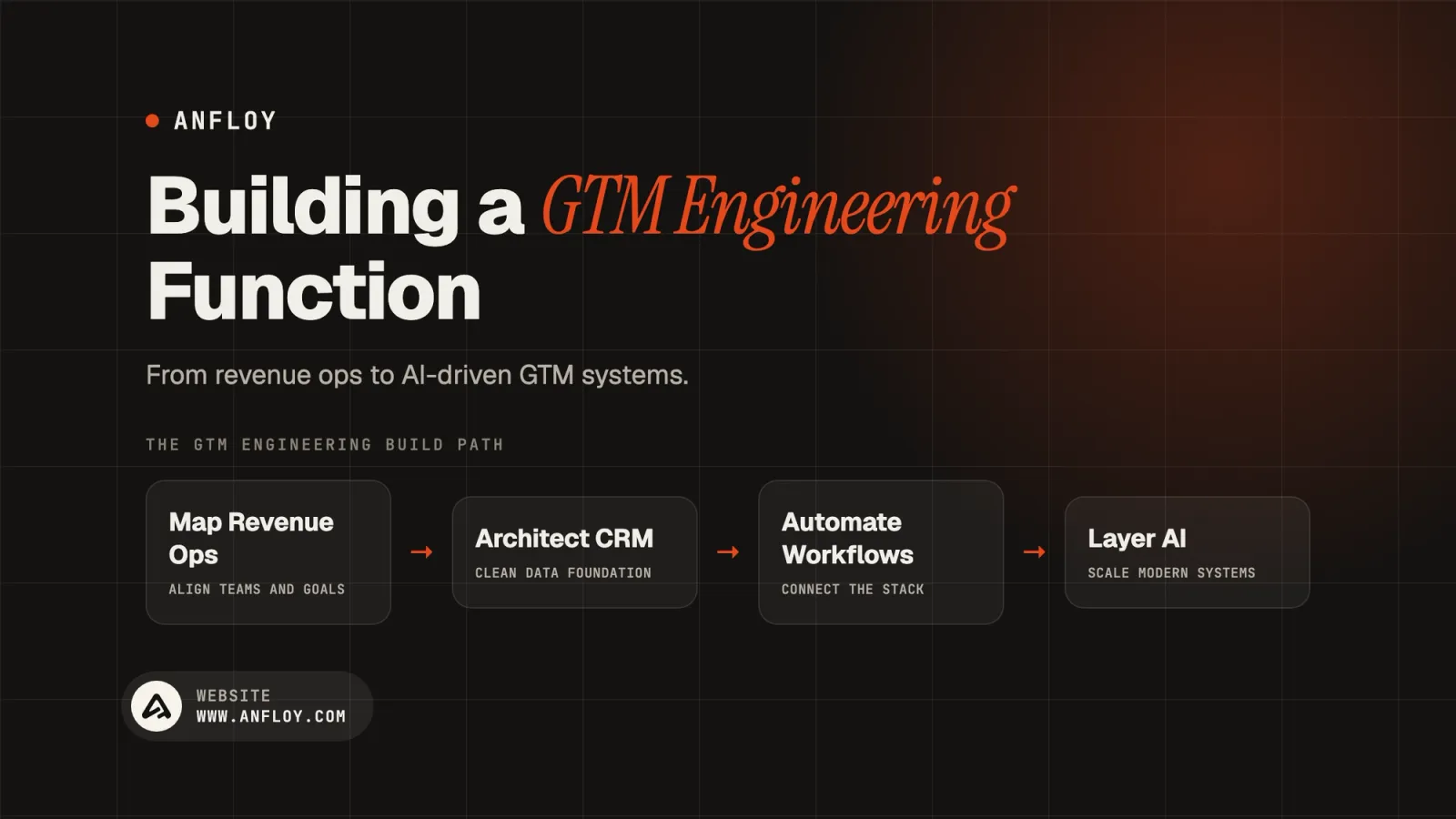
- What is the step-by-step framework to build a GTM engineering function?
- What are the team structure for a GTM engineering function?
- What are the common mistakes faced when building a GTM engineering function?
- Building a GTM engineering function by company stage
- The future of GTM engineering beyond 2026
- Why Anfloy's GTM engineering framework is different?
- Conclusion
The responsibilities of go-to-market teams have changed dramatically over the past few years.
Marketing teams are expected to personalize campaigns at scale.
Sales teams need accurate buying signals and AI-assisted prospecting.
Customer Success must proactively identify expansion opportunities.
Revenue Operations is responsible for forecasting, reporting, and process governance.
Meanwhile, organizations continue adding new tools, AI platforms, automation software, and customer data sources.
The result is a growing operational challenge.
Many companies have invested heavily in CRM platforms, sales engagement software, marketing automation, and AI. Yet these technologies often operate independently, creating disconnected workflows, inconsistent customer data, and fragmented revenue operations.
This is why leading B2B companies are building a dedicated GTM Engineering function.
Rather than managing a single platform, GTM Engineering designs the operational infrastructure that connects strategy, technology, automation, and AI into one scalable revenue system.
Why GTM engineering became essential in 2026?
Five years ago, many businesses could manage their go-to-market operations using a CRM administrator, a RevOps manager, and a few marketing specialists.
That operating model no longer scales.
Modern revenue organizations rely on dozens of interconnected systems.
Typical platforms include:
- CRM
- Marketing automation
- Sales engagement
- Data enrichment
- Revenue Intelligence
- AI copilots
- Customer success software
- Workflow automation
- Product analytics
- API integrations
Every new platform increases operational complexity.
Without dedicated ownership, businesses often experience:
- Duplicate customer records
- Manual lead routing
- Broken automations
- Poor AI outputs
- Inconsistent forecasting
- Reporting discrepancies
- Low CRM adoption
- Slow operational execution
GTM Engineering emerged to solve these problems by treating the revenue engine as a connected operating system instead of a collection of independent tools.
What is a GTM engineering function?
A GTM Engineering function is a cross-functional team responsible for designing, implementing, optimizing, and governing the technical systems that power go-to-market execution.
Unlike traditional departments that optimize individual functions, GTM Engineering focuses on the connections between them.
Its objective is to ensure that customer data, workflows, AI models, CRM systems, and Revenue Operations work together as one integrated ecosystem.
Core responsibilities typically include:
- CRM architecture
- Workflow automation
- Revenue Operations implementation
- API integrations
- Customer lifecycle automation
- AI implementation
- Revenue Intelligence
- Data governance
- Sales enablement systems
- GTM technology management
The function becomes the operational backbone of the revenue organization.
The shift from departments to revenue systems
Traditional organizational structures often separate teams by function.
For example:
Marketing generates demand.
Sales manages opportunities.
Customer Success supports customers.
Revenue Operations measures performance.
Engineering builds products.
Each department performs well individually.
The challenge appears between departments.
Important questions often remain unanswered:
- Who owns customer data consistency?
- Who connects AI across the revenue stack?
- Who designs CRM architecture?
- Who builds automation?
- Who manages integrations?
- Who optimizes operational efficiency?
These responsibilities increasingly belong to GTM Engineering.
What is GTM engineering operating model?
Rather than functioning as another department, GTM Engineering connects every revenue-producing function.
Business Strategy
        │
        ▼
Go-to-Market Strategy
        │
        ▼
GTM Engineering
        │
        ├── CRM Architecture
        ├── Revenue Operations
        ├── Workflow Automation
        ├── AI Systems
        ├── Data Enrichment
        ├── API Integrations
        ├── Revenue Intelligence
        └── Customer Lifecycle Automation
        │
        ▼
Marketing • Sales • Customer Success
        │
        ▼
Revenue Growth
Instead of replacing existing teams, GTM Engineering creates the operational foundation that enables them to perform more effectively.
What problems does a GTM engineering function solve?
Organizations typically build this function after encountering operational bottlenecks that cannot be solved by hiring additional sales or marketing staff.
Common problems include:
CRM complexity
As businesses grow, CRM platforms become increasingly difficult to maintain.
Common issues include:
- Duplicate records
- Inconsistent lifecycle stages
- Broken automations
- Poor reporting
- Low user adoption
GTM Engineering establishes scalable CRM architecture that supports long-term growth.
Workflow fragmentation
Many organizations automate processes independently.
Marketing builds one workflow.
Sales creates another.
Customer Success introduces additional automation.
Without coordination, workflows become difficult to manage.
GTM Engineering creates standardized automation frameworks across the entire customer lifecycle.
AI adoption challenges
Artificial intelligence is now embedded across nearly every GTM platform.
However, AI requires:
- Accurate CRM data
- Standardized workflows
- Clean customer records
- Connected systems
- Reliable governance
Without these foundations, AI produces inconsistent recommendations.
GTM Engineering prepares organizations for scalable AI adoption.
Revenue operations at scale
Revenue Operations depends on high-quality operational systems.
GTM Engineering strengthens RevOps by improving:
- CRM architecture
- Data quality
- Workflow automation
- Reporting consistency
- System integrations
Rather than competing with RevOps, GTM Engineering expands its implementation capabilities.
What are the core principles for building a GTM engineering function?
At Anfloy, we've found that successful GTM Engineering teams consistently follow a small number of operating principles.
Build systems before buying software
Technology should support business processes.
It should never define them.
Start with:
- Customer journey
- Revenue process
- Operational ownership
- Business objectives
Only then should technology decisions be made.
Standardize customer data
Every automation, AI model, dashboard, and forecast depends on customer data.
Without consistent governance, downstream systems become unreliable.
Standardization should include:
- Naming conventions
- Lifecycle stages
- Customer attributes
- Revenue metrics
- Ownership rules
Data consistency creates the foundation for everything that follows.
Design around the customer lifecycle
Rather than organizing systems around internal departments, organize them around customer progression.
A modern GTM Engineering function should support every stage of the lifecycle:
- Visitor
- Lead
- MQL
- SQL
- Opportunity
- Customer
- Expansion
- Renewal
- Advocacy
This customer-first architecture reduces operational friction while improving cross-functional alignment.
What is the step-by-step framework to build a GTM engineering function?
Building a GTM Engineering function is not about hiring one engineer.
It is about designing an operating model that aligns people, processes, technology, and AI around the customer lifecycle.
Based on our experience at Anfloy, the following framework provides a scalable approach.
Step 1: Define business outcomes first
Every GTM Engineering initiative should begin with business objectives rather than technology.
Ask questions such as:
- What revenue goals are we trying to achieve?
- Which customer segments are most valuable?
- Where are operational bottlenecks slowing growth?
- Which manual processes reduce productivity?
- What metrics define success?
Typical business outcomes include:
- Faster pipeline generation
- Higher win rates
- Lower customer acquisition cost (CAC)
- Improved customer retention
- Shorter sales cycles
- Better forecasting
- Increased Annual Recurring Revenue (ARR)
Clear business outcomes help prioritize implementation work and prevent unnecessary technology investments.
Step 2: Map the entire customer journey
Before configuring a CRM or deploying AI, document how customers move through your business.
A complete customer journey typically includes:
- Anonymous visitor
- Marketing lead
- Marketing Qualified Lead (MQL)
- Sales Qualified Lead (SQL)
- Opportunity
- Customer
- Product adoption
- Expansion
- Renewal
- Advocacy
For each stage, define:
- Entry criteria
- Exit criteria
- Responsible team
- Required data
- Automation opportunities
- Success metrics
This customer journey becomes the operational blueprint for every future system.
Step 3: Build a scalable CRM architecture
The CRM becomes the operational source of truth.
Instead of simply storing contacts, it should model the entire revenue engine.
Design considerations include:
Data model
Standardize:
- Accounts
- Contacts
- Opportunities
- Companies
- Products
- Activities
- Customer lifecycle stages
Ownership rules
Clearly define:
- Lead assignment
- Account ownership
- Opportunity management
- Customer success transitions
Reporting structure
Build dashboards around:
- Revenue
- Pipeline
- Forecasting
- Customer health
- Operational KPIs
Well-designed CRM architecture reduces operational confusion while improving data quality.
Step 4: Build your GTM technology stack
Technology should enable execution not create additional complexity.
A modern GTM Engineering stack often includes:
CRM
- Salesforce
- HubSpot
Marketing automation
- HubSpot
- Marketo
Sales engagement
- Apollo
- Outreach
- Salesloft
Data enrichment
- Clay
- ZoomInfo
- Clearbit
- Cognism
Workflow automation
- n8n
- Zapier
- Make
Revenue intelligence
- Gong
- Clari
- 6sense
AI layer
- ChatGPT
- Claude
- Gemini
- Custom AI agents
Rather than selecting every available platform, choose technologies that integrate effectively and support your operational goals.
Step 5: Build workflow automation
Once systems are connected, automation becomes the next priority.
Common GTM workflows include:
- Lead routing
- CRM updates
- Meeting scheduling
- Opportunity notifications
- Renewal reminders
- Customer onboarding
- SDR task creation
- AI research
- Data enrichment
- Executive reporting
Automation should eliminate repetitive work while maintaining visibility and governance.
Step 6: Integrate AI across the revenue engine
In 2026, AI should not operate as a standalone assistant.
Instead, embed AI into existing GTM processes.
Examples include:
Sales
- AI lead scoring
- Account prioritization
- Personalized outreach
- Opportunity summaries
Marketing
- Content recommendations
- Customer segmentation
- Campaign optimization
- Predictive targeting
Customer success
- Churn prediction
- Health scoring
- Renewal recommendations
- Expansion signals
Leadership
- Revenue forecasting
- Executive reporting
- Pipeline analysis
- Operational recommendations
Embedding AI throughout the revenue engine creates compounding value over time.
Step 7: Establish revenue operations governance
Technology alone does not create consistency.
Strong governance ensures systems remain reliable as the organization grows.
Governance should include:
- Data quality standards
- Lifecycle definitions
- KPI ownership
- Reporting guidelines
- Automation reviews
- AI governance
- Documentation
- Change management
This prevents operational complexity from increasing as new tools and workflows are introduced.
Step 8: Measure GTM engineering success
A GTM Engineering function should be evaluated using business outcomes rather than technical activity.
Key metrics include:
Operational metrics
- CRM adoption
- Workflow reliability
- Automation coverage
- Data quality
- API performance
Revenue metrics
- Pipeline velocity
- Lead conversion
- Win rate
- Sales cycle length
- Forecast accuracy
- Annual Recurring Revenue (ARR)
- Net Revenue Retention (NRR)
Customer metrics
- Time to onboarding
- Product adoption
- Customer health
- Expansion revenue
- Renewal rate
These metrics demonstrate how operational improvements contribute directly to revenue growth.
What are the team structure for a GTM engineering function?
As organizations scale, the GTM Engineering function often expands into specialized roles.
A mature team may include:
Head of GTM engineering
Owns strategy, roadmap, and cross-functional alignment.
GTM engineers
Design CRM systems, automation, integrations, and operational workflows.
RevOps specialists
Focus on forecasting, governance, reporting, and operational processes.
Automation engineers
Build workflow automation, API connections, and orchestration.
AI Engineers
Implement AI workflows, copilots, lead scoring, and intelligent automation.
Data engineers
Maintain customer data quality, enrichment pipelines, and reporting infrastructure.
Not every company requires every role immediately.
Many organizations begin with one or two GTM Engineers before expanding into specialized functions.
What are the common mistakes faced when building a GTM engineering function?
Organizations often encounter similar challenges.
Avoid these mistakes.
Starting with technology
Technology should support business processes not replace strategic planning.
Begin with customer journeys and operational objectives.
Ignoring data governance
Poor customer data reduces the effectiveness of CRM systems, automation, reporting, and AI.
Governance should be established before scaling technology.
Treating AI as a separate initiative
AI creates the most value when integrated into existing workflows.
Disconnected AI pilots rarely produce sustainable operational improvements.
Building in departmental silos
Marketing, Sales, Customer Success, RevOps, and GTM Engineering should share data, workflows, and KPIs.
Disconnected systems increase operational complexity and reduce scalability.
Measuring technical outputs instead of business outcomes
Success should be evaluated by improvements in revenue growth, operational efficiency, forecasting accuracy, and customer experience not by the number of workflows created or integrations deployed.
Building a GTM engineering function by company stage
The structure of a GTM Engineering function should evolve alongside the business.
A startup, a scaling SaaS company, and an enterprise organization face different operational challenges, technology requirements, and resource constraints.
Rather than copying another company's organizational chart, build the function based on your current growth stage.
Startup stage
Early-stage companies typically have:
- Founder-led sales
- Small marketing teams
- One CRM
- Limited automation
- Few operational specialists
The first GTM Engineering priorities should be:
- CRM implementation
- Customer lifecycle design
- Lead routing
- Workflow automation
- Data enrichment
- Basic Revenue Operations
At this stage, one GTM Engineer or an external GTM Engineering agency is often sufficient.
The focus should be on building a scalable foundation rather than implementing every available tool.
Growth stage
As pipeline volume increases, operational complexity grows rapidly.
Organizations often introduce:
- SDR teams
- Customer Success
- Product Marketing
- RevOps
- AI tools
- Sales engagement platforms
The GTM Engineering function expands to support:
- CRM architecture
- AI lead scoring
- Revenue Intelligence
- API integrations
- Customer lifecycle automation
- Forecasting support
- Operational governance
Cross-functional collaboration becomes increasingly important because multiple teams now rely on shared customer data.
Enterprise stage
Enterprise organizations require a mature GTM Engineering capability.
Operational priorities typically include:
- Multi-region CRM architecture
- AI governance
- Enterprise workflow orchestration
- Revenue Operations standardization
- Data governance
- Security and compliance
- Executive reporting
- Multi-product support
Instead of supporting one revenue team, GTM Engineering often enables multiple business units operating across different markets.
The future of GTM engineering beyond 2026
The GTM Engineering function will continue evolving as AI becomes more deeply integrated into business operations.
Future responsibilities are likely to include:
AI-native revenue systems
Rather than adding AI to existing workflows, organizations will design revenue systems where AI participates in decision-making from the beginning.
Examples include:
- Autonomous lead qualification
- AI pipeline management
- Predictive opportunity routing
- Intelligent customer segmentation
- Automated account research
Multi-agent GTM workflows
Instead of one AI assistant, businesses will coordinate multiple specialized AI agents responsible for different operational functions.
Potential examples include:
- Prospect research agents
- CRM management agents
- Forecasting agents
- Customer success agents
- Sales coaching agents
- Reporting agents
GTM Engineers will increasingly design the orchestration logic connecting these systems.
Real-time revenue intelligence
Reporting will evolve from historical dashboards to continuous operational intelligence.
Leaders will receive recommendations instead of static reports.
Examples include:
- Pipeline risk alerts
- Expansion opportunities
- Customer health changes
- Forecast adjustments
- AI-generated action plans
This shift will transform GTM Engineering from workflow management into revenue system optimization.
Why Anfloy's GTM engineering framework is different?
Many organizations approach GTM Engineering as a collection of software implementations.
Our philosophy is fundamentally different.
We build connected revenue systems around five principles.
1. Customer-centric architecture
Every workflow, CRM object, and automation begins with the customer journey rather than internal organizational charts.
2. Systems thinking
Instead of optimizing isolated departments, we optimize the relationships between marketing, sales, customer success, Revenue Operations, and AI.
3. AI-native design
AI is embedded throughout the GTM ecosystem from lead scoring and customer segmentation to forecasting and workflow automation.
4. Operational scalability
Every implementation is designed to support future growth without requiring complete system redesigns.
5. Continuous optimization
A GTM Engineering function should evolve continuously as customer behavior, technology, and business objectives change.
Our focus is not only implementation but long-term operational maturity.
Conclusion
Building a GTM Engineering function in 2026 is no longer about adding another operational role it is about creating the technical and strategic foundation that connects every part of the revenue engine.
As AI, Revenue Operations, workflow automation, and CRM ecosystems continue to evolve, businesses need dedicated ownership for the systems that enable consistent execution across marketing, sales, customer success, and leadership.
Organizations that approach GTM Engineering as an integrated business capability rather than a collection of software projects will be better positioned to improve operational efficiency, scale revenue, and adapt to future market changes.
Build Your GTM Engineering Function with Anfloy
Whether you're creating your first GTM Engineering capability or modernizing an existing revenue organization, Anfloy helps businesses design AI-ready go-to-market systems built for long-term growth.
Our expertise includes GTM strategy, GTM Engineering, Revenue Operations, CRM architecture, workflow automation, AI implementation, data enrichment, Revenue Intelligence, API integrations, and customer lifecycle automation helping organizations transform disconnected operations into scalable, intelligent revenue engines.
Frequently Asked Questions
Why are companies building GTM Engineering teams in 2026?
Companies are adopting GTM Engineering because modern revenue organizations depend on connected CRM systems, AI, automation, and operational workflows. A dedicated function helps manage this complexity while improving scalability and execution.
Who should own GTM Engineering?
Ownership varies by organization. In smaller companies, a GTM Engineer or GTM Engineering agency may lead the function. Larger organizations often establish dedicated GTM Engineering teams that work closely with Revenue Operations, Sales, Marketing, IT, and Customer Success.
Is GTM Engineering the same as Revenue Operations?
No. Revenue Operations focuses on governance, reporting, forecasting, and process alignment. GTM Engineering designs and implements the technical infrastructure including CRM systems, automation, AI workflows, and integrations that enables Revenue Operations to operate effectively.
How long does it take to build a GTM Engineering function?
The timeline depends on organizational complexity. Startups may establish foundational GTM Engineering capabilities within a few months, while enterprise organizations often develop the function incrementally over multiple phases as systems, teams, and operational requirements expand.
Let's build
what your
company needs.
Drop your email. We'll send The Custom Agent Blueprint on what we'd build first for a company like yours, before you ever take a meeting.