
How to Use AI Engineering for Your Content Systems
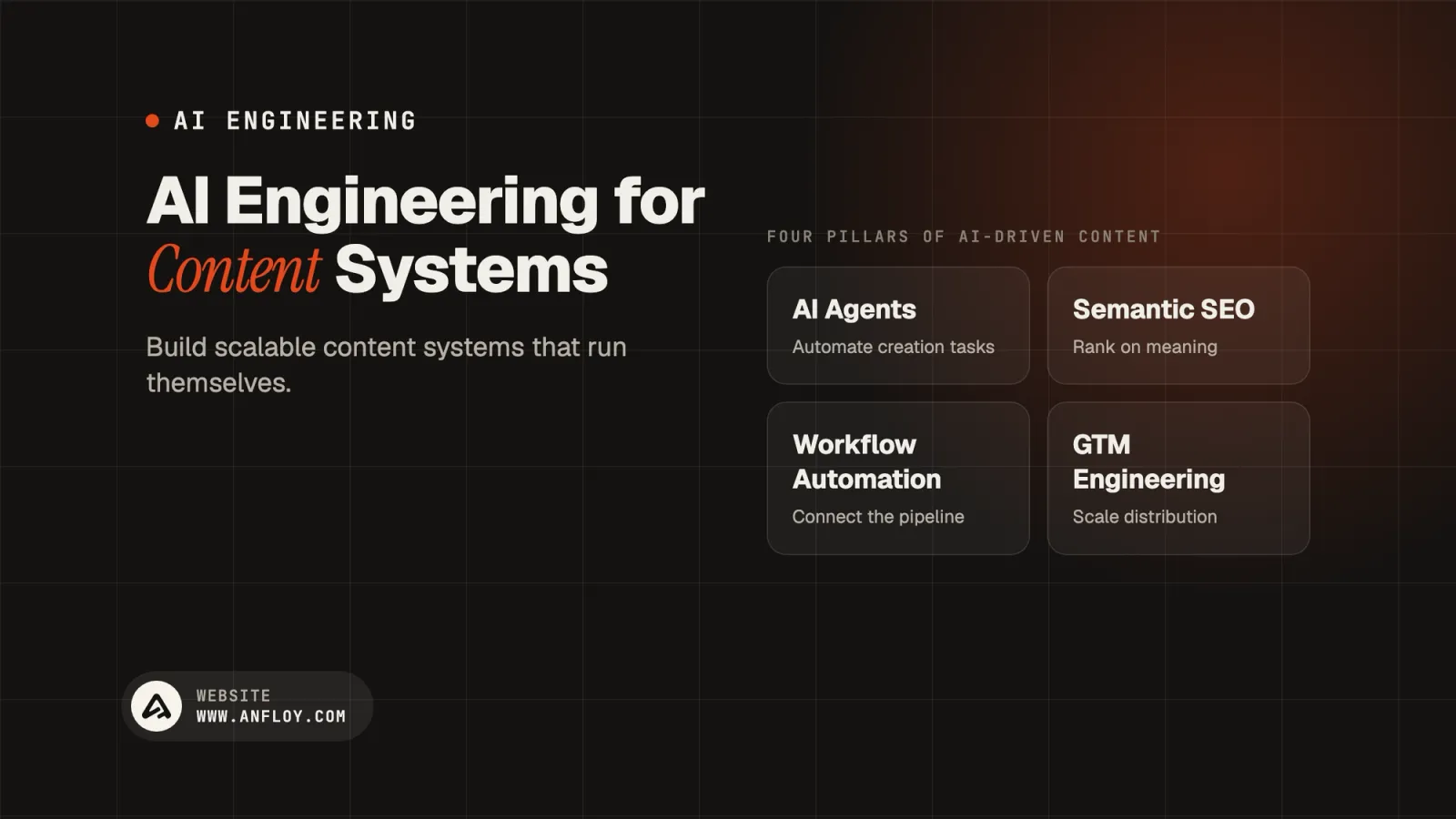
Learn how to use AI engineering to build scalable content systems with AI agents, semantic SEO, workflow automation, and GTM engineering.
On this page
- What is AI engineering for content systems?
- Why content teams need AI engineering?
- The AI content systems stack
- What are the top AI engineering use cases for content teams?
- What are the top AI agents for content teams?
- Try to building an AI content workflow
- What are the Pros and Cons of AI content systems?
- What are the common mistakes made by businesses?
- How Anfloy builds AI content systems?
- What is the future of AI content engineering?
- Conclusion
Content has become one of the most important growth channels for modern businesses.
Organizations use content to:
- generate demand
- educate buyers
- build trust
- improve search visibility
- support sales teams
- establish thought leadership
However, content operations have become significantly more complex over the past few years.
Modern content teams are expected to:
- publish consistently
- optimize for AI Overviews
- support multiple channels
- maintain quality
- update existing content
- demonstrate ROI
At the same time, competition continues to increase.
Every day, businesses publish millions of articles, newsletters, videos, and social posts.
The challenge isn't creating content.
It's creating systems.
Traditional content operations often rely on:
- spreadsheets
- manual research
- disconnected tools
- inconsistent workflows
These approaches don't scale.
This is why organizations are increasingly investing in AI engineering for content systems.
AI engineering enables businesses to create intelligent content workflows that support:
- research
- production
- optimization
- distribution
- reporting
Increasingly, these systems include:
- Company AI Brains
- AI Agents
- Semantic SEO workflows
- AI Orchestration
- GTM Engineering
- Content Intelligence
The result is a content organization capable of continuously improving over time.
What is AI engineering for content systems?
AI engineering for content systems is the practice of designing, building, and optimizing AI-powered workflows that support content strategy, production, distribution, and optimization.
Rather than treating content as a series of one-off projects, businesses create systems capable of operating continuously.
Examples include:
- keyword clustering
- content briefs
- AI-assisted writing
- internal linking
- semantic enrichment
- performance reporting
- content refresh workflows
A simplified AI content workflow looks like this:
Keyword Research
        ↓
Entity Mapping
        ↓
Content Brief
        ↓
Content Creation
        ↓
Optimization
        ↓
Distribution
        ↓
Performance Tracking
        ↓
Content Refresh
The objective isn't to replace content teams.
It's to help them operate more efficiently.
Why content teams need AI engineering?
Content demands continue to increase.
Many organizations now manage:
- blogs
- newsletters
- YouTube
- webinars
- documentation
At the same time, buyers expect increasingly personalized experiences.
Several trends are driving AI adoption across content operations.
Growing Content Requirements
Businesses are expected to publish more content across more channels than ever before.
AI overview competition
Search behavior is changing.
Organizations now compete not only for traditional rankings but also for visibility within AI-generated experiences.
Limited headcount
Many content teams are responsible for supporting multiple business functions without proportional increases in staffing.
Operational inefficiencies
Common challenges include:
- duplicate work
- inconsistent processes
- delayed publishing
- weak reporting
Demand for better attribution
Leadership teams increasingly ask:
Which content generated revenue?
AI engineering helps organizations answer this question.
The AI content systems stack
Most AI content systems consist of several layers.
Company AI Brain
       ↓
Keyword Intelligence
       ↓
Content Database
       ↓
AI Agents
       ↓
Content Production
       ↓
Distribution
       ↓
Performance Tracking
       ↓
Optimization
Let's explore each layer.
Company AI brain
Company AI Brain acts as the knowledge system for:
- brand guidelines
- customer insights
- product information
- historical content
Keyword intelligence
Provides:
- keyword opportunities
- entity relationships
- search intent analysis
Content database
Stores:
- content inventory
- briefs
- performance metrics
- publishing history
AI agents
Examples include:
- Keyword Intelligence Agents
- Content Brief Agents
- Reporting Agents
- Internal Linking Agents
Performance tracking
Measures:
- traffic
- rankings
- conversions
- AI Overview visibility
Optimization
Supports:
- content refreshes
- internal linking
- semantic improvements
What are the top AI engineering use cases for content teams?
AI engineering supports nearly every stage of content operations.
Research automation
Examples include:
- keyword discovery
- entity extraction
- SERP analysis
- competitor research
Production automation
Examples include:
- content briefs
- article outlines
- first drafts
- metadata generation
Optimization automation
Examples include:
- internal linking
- semantic enrichment
- schema recommendations
- content updates
Distribution automation
Examples include:
- LinkedIn posts
- newsletter creation
- social repurposing
- scheduling
Reporting automation
Examples include:
- ranking reports
- traffic analysis
- conversion tracking
- content performance dashboards
AI enables content teams to spend less time managing workflows and more time creating value.
What are the top AI agents for content teams?
Modern content organizations increasingly deploy specialized AI agents.
Keyword intelligence agent
Responsible for:
- keyword research
- topic clustering
- search intent analysis
Content brief agent
Responsible for:
- outline generation
- entity recommendations
- competitor analysis
Internal linking agent
Responsible for:
- identifying opportunities
- suggesting anchors
- maintaining link architecture
Semantic SEO agent
Responsible for:
- entity mapping
- vector coverage
- attribute optimization
Content refresh agent
Responsible for:
- identifying outdated content
- recommending updates
- tracking performance changes
Distribution agent
Responsible for:
- repurposing content
- publishing recommendations
- channel optimization
Reporting agent
Responsible for:
- traffic reports
- ranking analysis
- conversion tracking
Together, these agents create an AI-native content operation.
Try to building an AI content workflow
The best AI content systems are built around processes rather than tools.
Many organizations make the mistake of adopting AI before understanding how content moves through their business.
A practical AI content workflow looks like this:

Keyword Research
       ↓
Semantic Clustering
       ↓
Content Brief
       ↓
Draft Creation
       ↓
Human Review
       ↓
SEO Optimization
       ↓
Publishing
       ↓
Distribution
       ↓
Performance Analysis
       ↓
Content Refresh
Step 1: Research keywords
Start by identifying:
- primary keywords
- secondary keywords
- long-tail opportunities
- search intent
Keyword Intelligence Agents can significantly accelerate this process.
Step 2: Build semantic clusters
Modern SEO is increasingly entity-driven.
Map:
- entities
- vectors
- attributes
- related topics
This improves:
- topical authority
- AI Overview visibility
- semantic relevance
Step 3: Generate content briefs
Content briefs should include:
- target audience
- outline
- entities
- FAQs
- internal linking opportunities
Step 4: Create drafts
AI can assist with:
- introductions
- outlines
- supporting sections
- metadata
Human expertise remains critical for:
- insights
- examples
- accuracy
- brand voice
Step 5: Optimize
Examples include:
- internal linking
- schema recommendations
- semantic enrichment
- metadata optimization
Step 6: Publish and distribute
Repurpose content into:
- newsletters
- LinkedIn posts
- videos
- social content
Step 7: Track performance
Monitor:
- rankings
- traffic
- conversions
- AI Overview visibility
Step 8: Refresh continuously
Content systems should continuously improve.
Examples include:
- updating statistics
- adding internal links
- expanding sections
- improving FAQs
What are the Pros and Cons of AI content systems?
AI content systems provide significant advantages, but they also introduce new challenges.
Pros
Faster production
Teams can produce significantly more content without increasing headcount.
Greater consistency
AI systems help standardize:
- workflows
- formatting
- metadata
- reporting
Improved scalability
Organizations can support multiple channels simultaneously.
Better semantic coverage
AI can help identify:
- entities
- vector relationships
- content gaps
Lower production costs
AI reduces the operational overhead associated with repetitive tasks.
Cons
Requires human oversight
AI remains susceptible to:
- hallucinations
- inaccuracies
- generic recommendations
Poor prompts produce poor outputs
AI systems are only as effective as the instructions they receive.
Risk of generic content
Businesses that publish unedited AI content frequently struggle to differentiate themselves.
Workflow complexity
Large organizations often require significant planning to coordinate AI across multiple teams.
Dependency on data quality
AI systems depend heavily on:
- clean content databases
- accurate performance metrics
- reliable workflows
The best content organizations treat AI as an accelerator rather than a replacement for human expertise.
What are the common mistakes made by businesses?
Many businesses adopt AI enthusiastically but struggle to achieve meaningful outcomes.
Publishing without human review
AI-generated content should always be reviewed for:
- accuracy
- clarity
- brand alignment
Ignoring semantic SEO
Modern search engines increasingly evaluate:
- entities
- topical authority
- relationships between concepts
Ignoring Semantic SEO limits visibility.
No entity strategy
Organizations should intentionally map:
- primary entities
- secondary entities
- related concepts
No content refresh process
Content is not static.
Organizations should continuously update:
- statistics
- examples
- internal links
- FAQs
Treating AI as a replacement
The most successful teams combine:
- human expertise
- AI capabilities
- operational workflows
AI is a force multiplier not a substitute for strategy.
How Anfloy builds AI content systems?
At Anfloy, I help organizations build AI-native content operations designed for scale.
Our methodology includes:
Discovery
I identify:
- business objectives
- content challenges
- operational bottlenecks
- revenue goals
Company AI brain
I centralize:
- brand guidelines
- customer insights
- historical content
- internal documentation
Semantic SEO
Every content system includes:
- entity mapping
- vector analysis
- attribute optimization
- topical clustering
Content agents
I deploy:
- Keyword Intelligence Agents
- Content Brief Agents
- Internal Linking Agents
- Reporting Agents
GTM engineering
I implement:
- workflows
- automations
- integrations
- reporting systems
AI orchestration
AI orchestration coordinates:
- agents
- approvals
- publishing workflows
- performance monitoring
Continuous optimization
Content systems improve through:
- testing
- reporting
- semantic analysis
- AI insights
The result is a content organization capable of continuously producing and optimizing high-quality content.
Build an AI-Powered Content System
Discover how AI Agents, Semantic SEO, and GTM Engineering can help your business create scalable content operations.
👉 Get Your Free Content Audit
What is the future of AI content engineering?
AI content engineering is still in its early stages.
Over the next decade, several trends are likely to emerge.
Autonomous content agents
Organizations will increasingly deploy agents capable of:
- identifying opportunities
- creating briefs
- recommending updates
Multi-agent content teams
Future content organizations will coordinate networks of specialized AI agents.
Self-updating knowledge bases
Content systems will automatically identify and refresh outdated information.
AI-native publishing systems
Businesses will increasingly manage content through intelligent publishing platforms capable of continuous optimization.
In many ways, AI content engine and engineering is becoming the operating system for modern content organizations.
Conclusion
The future of content isn't human versus AI.
It's humans working alongside intelligent systems.
Organizations that continue relying exclusively on manual processes will increasingly struggle to compete in an environment defined by AI Overviews, Semantic SEO, and multi-channel distribution.
AI engineering provides a path forward.
By combining AI agents, GTM engineering, Semantic SEO, and workflow automation, businesses can build content systems that continuously improve over time.
At Anfloy, I believe content should be treated as infrastructure not simply a marketing activity.
Because the organizations that win over the next decade won't necessarily publish the most content.
They'll build the best content systems.
Ready to Scale Your Content Operations?
From Company AI Brains and Content Agents to AI Orchestration and Semantic SEO, Anfloy helps businesses build AI-native content systems designed for the future.
👉 Book a Strategy Call
Frequently Asked Questions
How does AI improve content marketing?
AI improves efficiency, scalability, reporting, personalization, and content optimization.
Which content tasks can be automated?
Examples include: keyword research content briefs internal linking reporting distribution
What are AI content agents?
AI content agents are specialized systems responsible for tasks such as research, optimization, reporting, and distribution.
Can small teams implement AI content systems?
Yes. Modern AI tools make it possible for even small teams to build scalable content operations.
What tools are required?
Typical categories include: AI platforms workflow automation tools SEO tools reporting platforms
Should AI content systems be built in-house?
Many organizations partner with specialists initially and transition ownership internally over time.

Let's build
what your
company needs.
Drop your email. We'll send The Custom Agent Blueprint on what we'd build first for a company like yours, before you ever take a meeting.