
Why It Is Important to Have GTM Engineers on Your Team?
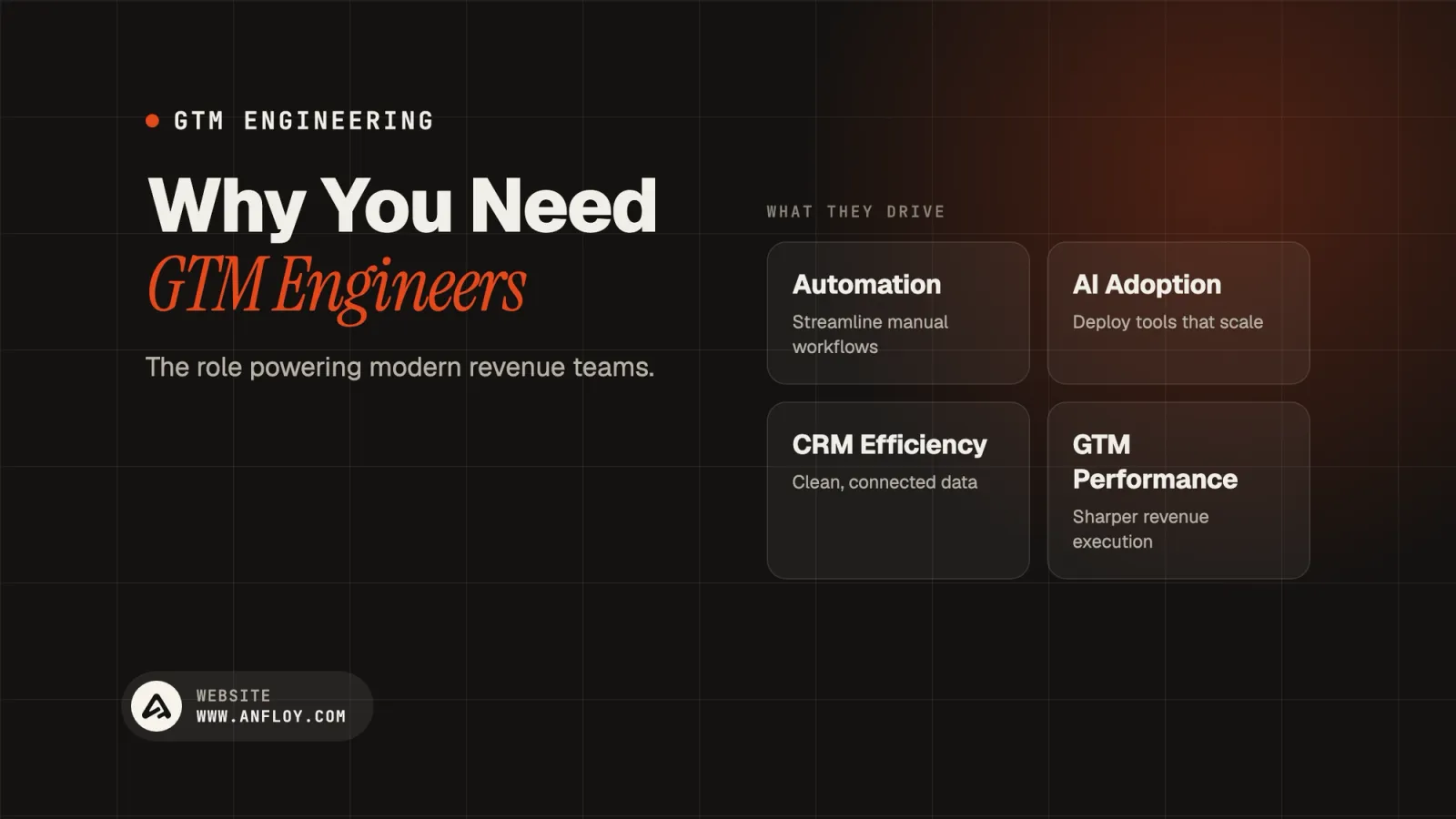
Discover why GTM engineers are essential for modern revenue teams, driving automation, AI adoption, CRM efficiency, and GTM performance.
On this page
- What is a GTM engineer?
- Why GTM engineers are becoming essential?
- How GTM engineers help revenue teams?
- GTM engineer vs Revenue operations
- Where GTM engineers create the greatest impact?
- Why GTM engineers matter in an AI-first world?
- How to hire a GTM engineer?
- GTM engineer vs Sales engineer
- GTM engineer vs Solutions engineer
- What are the modern GTM engineering tech stack?
- How Anfloy builds GTM engineering systems?
- What are the future of GTM engineering?
- Conclusion
Revenue teams are changing.
For years, go-to-market (GTM) organizations were built around sales, marketing, customer success, and revenue operations. Each function owned a specific part of the customer journey, while technology teams supported the underlying infrastructure.
That model is beginning to evolve.
Modern GTM teams now depend on an increasingly complex technology stack that includes:
- CRM platforms
- data enrichment tools
- AI agents
- workflow automation
- sales engagement platforms
- analytics systems
- revenue intelligence
- internal APIs
As organizations adopt more AI and automation, a new role has emerged at the intersection of engineering and revenue operations:
The GTM Engineer.
GTM engineers are responsible for building, connecting, and optimizing the systems that power modern go-to-market teams.
They don't just manage tools.
They create infrastructure.
A GTM engineer may build automated lead qualification workflows, integrate AI into the CRM, orchestrate outbound campaigns, enrich account data, deploy internal dashboards, or connect multiple systems into one intelligent GTM platform.
In many organizations, GTM engineers are becoming as important as SDRs, RevOps specialists, and account executives.
The reason is simple.
Revenue teams no longer compete solely on headcount.
They compete on intelligence, automation, and execution speed.
Businesses that can identify opportunities faster, personalize outreach more effectively, and automate operational work are gaining a significant advantage.
What is a GTM engineer?
A GTM (Go-to-Market) Engineer is a technical professional responsible for designing, building, and maintaining the systems that support revenue generation.
They operate at the intersection of:
- engineering
- revenue operations
- sales
- marketing
- customer success
- AI and automation
Unlike traditional software engineers, GTM engineers focus specifically on improving how businesses acquire, convert, and retain customers.
Their responsibilities often include:
- CRM architecture
- workflow automation
- AI implementation
- API integrations
- data enrichment
- reporting
- GTM analytics
- pipeline operations
Think of GTM engineers as infrastructure builders for revenue teams.
Instead of shipping customer-facing products, they build internal systems that help GTM teams operate more efficiently.
Why GTM engineers are becoming essential?
The average GTM team now uses more tools than ever before.
A typical revenue stack may include:
- CRM software
- sales engagement platforms
- enrichment tools
- customer support systems
- marketing automation
- AI tools
- analytics platforms
- internal databases
Without dedicated ownership, these systems become fragmented.
This leads to:
- poor CRM hygiene
- duplicate workflows
- inconsistent reporting
- manual processes
- operational bottlenecks
GTM engineers solve this problem by creating a connected revenue infrastructure.
Rather than adding another tool, they ensure existing systems work together effectively.
How GTM engineers help revenue teams?
They improve CRM operations
Most CRM implementations degrade over time.
Common problems include:
- duplicate records
- outdated information
- inconsistent fields
- poor segmentation
GTM engineers build workflows that continuously improve CRM quality through automation and enrichment.
They build revenue automation
Examples include:
- lead routing
- account assignment
- pipeline updates
- meeting summaries
- reporting workflows
- customer onboarding
This reduces manual work while improving consistency across the organization.
They enable AI adoption
AI is becoming a core part of GTM.
GTM engineers help organizations implement:
- AI agents
- AI SDR workflows
- Company Intelligence systems
- Revenue Intelligence
- AI orchestration
- Retrieval-Augmented Generation (RAG)
Without technical ownership, many AI initiatives remain isolated experiments rather than scalable business capabilities.
They connect systems
Modern GTM requires data to move seamlessly across applications.
GTM engineers connect:
- CRM platforms
- support systems
- internal databases
- analytics tools
- AI agents
- marketing platforms
This creates a unified view of the customer journey.
GTM engineer vs Revenue operations
Although GTM Engineers and RevOps professionals collaborate closely, their responsibilities differ.
| Area | RevOps | GTM Engineer |
|---|---|---|
| Primary Focus | Revenue processes | GTM infrastructure |
| CRM Management | Strategic ownership | Technical implementation |
| Reporting | Yes | Supports reporting systems |
| Automation | Workflow design | Workflow implementation |
| AI Systems | Adoption strategy | Technical deployment |
| APIs | Limited | Core responsibility |
| Engineering | Minimal | Significant |
In simple terms:
- RevOps decides what should happen.
- GTM Engineering determines how it happens.
The strongest revenue organizations typically have both functions working together.
Where GTM engineers create the greatest impact?
GTM engineers create value across multiple areas.
Lead generation
They improve:
- enrichment
- qualification
- routing
- account prioritization
Outbound prospecting
They build:
- signal-based workflows
- personalized outreach systems
- AI-powered sequences
Revenue intelligence
They support:
- forecasting
- pipeline visibility
- deal analysis
- reporting
Customer success
They automate:
- onboarding
- account monitoring
- renewal workflows
- customer reporting
Internal operations
They improve:
- documentation
- approvals
- notifications
- operational dashboards
The result is a GTM organization that operates faster, more intelligently, and more consistently.
Why GTM engineers matter in an AI-first world?
AI is increasing the importance of GTM engineering.
Every new AI capability introduces questions such as:
- How does it connect to the CRM?
- Which systems can it access?
- How is data secured?
- How are workflows monitored?
- Who maintains the integrations?
These are GTM engineering problems.
As businesses deploy AI Agents, Company AI Brains, Revenue Intelligence platforms, and AI orchestration systems, GTM engineers become responsible for ensuring everything works together.
Over the next five years, many organizations will have:
- AI SDRs
- AI Revenue Analysts
- AI Customer Success Agents
- AI Company Intelligence Agents
Someone will need to build and maintain that infrastructure.
That someone is increasingly becoming the GTM engineer.
How to hire a GTM engineer?
Hiring the right GTM engineer requires a different mindset than hiring a traditional software engineer or RevOps specialist.
The ideal candidate understands both technology and revenue operations.
Look for experience with:
- CRM platforms
- APIs and integrations
- workflow automation
- SQL and data analysis
- AI tools and agents
- GTM analytics
- sales operations
- customer success workflows
Strong GTM engineers are typically comfortable working across multiple departments and translating business requirements into technical solutions.
Questions to ask during interviews include:
- How would you improve CRM data quality?
- How would you automate lead qualification?
- What would your GTM architecture look like?
- How would you integrate AI into our revenue workflows?
- How would you measure the success of a GTM system?
As AI adoption accelerates, businesses should prioritize candidates who understand AI orchestration, retrieval systems, and automation frameworks.
Build a Modern GTM Infrastructure
If your revenue team is struggling with disconnected tools, manual processes, or AI implementation challenges, it's time to rethink your GTM architecture.
Our Free GTM Audit helps identify:
operational bottlenecks
AI opportunities
workflow automation gaps
CRM improvements
revenue intelligence opportunities
Get Your Free Audit
GTM engineer vs Sales engineer
These roles are often confused but serve very different purposes.
| Area | GTM Engineer | Sales Engineer |
|---|---|---|
| Focus | Internal GTM infrastructure | Customer-facing technical support |
| Team | Revenue Operations | Sales |
| Responsibilities | Automation, AI, CRM | Product demonstrations |
| Primary Goal | Improve GTM efficiency | Support sales conversations |
| Success Metric | Revenue operations performance | Deal support and technical validation |
Sales engineers help customers understand products.
GTM engineers help organizations improve how they sell those products.
GTM engineer vs Solutions engineer
Similarly, GTM engineers differ from solutions engineers.
| Area | GTM Engineer | Solutions Engineer |
|---|---|---|
| Primary Focus | Internal systems | Customer implementations |
| Responsibilities | GTM automation | Technical solutions for clients |
| Team Alignment | RevOps and Sales | Customer-facing teams |
| Technical Scope | CRM, AI, workflows | Product architecture |
Solutions engineers build for customers.
GTM engineers build for revenue teams.
What are the modern GTM engineering tech stack?
A GTM engineer's toolkit continues to evolve.
Modern GTM teams commonly use:
CRM platforms
- Salesforce
- HubSpot
- Pipedrive
Automation platforms
- n8n
- Zapier
- Make
AI tools
- ChatGPT
- Claude
- Gemini
Data and enrichment
- Clay
- Apollo
- Clearbit
- LinkedIn Sales Navigator
Analytics
- Google Analytics
- Looker Studio
- Power BI
Infrastructure
- APIs
- Databases
- Cloud services
The exact stack varies by organization, but the trend is clear:
GTM engineering is becoming increasingly AI-driven.
How Anfloy builds GTM engineering systems?
At Anfloy, we see GTM engineering as the foundation of modern revenue infrastructure.
Our methodology focuses on six key areas.
1. Business discovery
We begin by understanding:
- revenue objectives
- customer journey
- GTM bottlenecks
- technology stack
- operational challenges
2. Company AI brain
We centralize business knowledge across:
- CRM systems
- documentation
- customer history
- sales playbooks
- support resources
This becomes the intelligence layer for every GTM workflow.
3. Agentic systems
We deploy specialized AI agents for:
- Company Intelligence
- CRM enrichment
- Lead Qualification
- Revenue Intelligence
- Customer Success
4. AI orchestration
AI orchestration coordinates:
- workflows
- agent communication
- approvals
- monitoring
- reporting
This creates a unified GTM platform instead of disconnected automations.
5. Revenue intelligence
We implement systems that provide:
- forecasting
- pipeline visibility
- opportunity scoring
- performance analytics
6. Infrastructure you own
Every implementation is deployed on infrastructure owned by the client.
You own:
- the code
- the workflows
- the AI systems
- the data
- the integrations
No vendor lock-in.
No recurring dependency.
What are the future of GTM engineering?
GTM engineering is still in its early stages.
Over the next decade, several trends will shape the role.
AI coworkers
Revenue teams will work alongside:
- AI SDRs
- AI Analysts
- AI Customer Success Agents
- AI Revenue Intelligence Agents
Multi-agent organizations
Businesses will deploy networks of specialized AI agents coordinated through AI orchestration platforms.
Autonomous revenue operations
Many operational tasks will become fully autonomous, including:
- lead qualification
- CRM updates
- reporting
- outreach preparation
- pipeline analysis
Company-owned infrastructure
Organizations will increasingly move from renting GTM capabilities to owning them.
GTM engineers will play a central role in building and maintaining these systems.
Conclusion
Go-to-market is no longer just a people problem.
It's an infrastructure problem.
As revenue organizations become increasingly dependent on AI, automation, data, and interconnected systems, the need for technical ownership inside GTM teams continues to grow.
GTM engineers sit at the center of this transformation.
They help businesses connect fragmented tools, automate repetitive workflows, improve CRM quality, deploy AI agents, and build scalable systems that enable revenue teams to operate more efficiently.
More importantly, they help organizations move from simply using software to creating a competitive advantage through technology.
The companies that outperform over the next decade won't necessarily have the largest sales teams or the biggest technology budgets.
They'll have the best GTM infrastructure.
And that infrastructure will increasingly be powered by GTM engineers working alongside RevOps leaders, AI agents, and revenue teams.
Whether you're implementing AI for the first time or building a fully orchestrated GTM engine, investing in GTM engineering capabilities today is an investment in the future of your business.
Ready to Build AI-Powered GTM Systems?
From Company AI Brains and AI Agents to Revenue Intelligence and GTM Engineering, Anfloy helps businesses build scalable revenue infrastructure designed for the AI era.
Book a Strategy Call
Frequently Asked Questions
Is GTM engineering a good career?
Yes. GTM engineering is one of the fastest-growing roles at the intersection of sales, operations, and AI.
Can GTM engineers work with AI?
Absolutely. AI implementation is becoming one of the most important responsibilities of modern GTM engineers.
What industries hire GTM engineers?
SaaS, B2B technology, fintech, healthcare, and enterprise software companies are increasingly hiring GTM engineers.
Do startups need GTM engineers?
Growing startups often benefit significantly from GTM engineering because it helps them scale operations without proportionally increasing headcount.
Why are GTM engineers important?
They help organizations improve efficiency, implement AI, automate workflows, and create scalable revenue infrastructure.


Let's build
what your
company needs.
Drop your email. We'll send The Custom Agent Blueprint on what we'd build first for a company like yours, before you ever take a meeting.