
Zapier vs Custom AI Agents: Which Is Better for B2B SaaS?
Compare Zapier vs custom AI agents for B2B SaaS. Learn the differences between workflow automation, AI orchestration, scalability, ownership, and operational flexibility.
On this page
- What Is Zapier?
- How AI Agents work: Intelligent automation
- Zapier vs custom AI agents: Core difference
- Why are AI agents different?
- AI Agents vs Zapier for sales automation
- AI Agents vs Zapier for CRM automation
- AI Agents vs Zapier for internal operations
- When is Zapier the better choice?
- Where Zapier wins?
- Where custom AI agents win?
- When are custom AI agents the better choice?
- How modern SaaS companies use both?
- Replacing everything with AI immediately
- Using AI Without Operational Design
- Treating Zapier like a full AI system
- Building Fragmented AI Stacks
- What is the future of automation?
- Conclusion
Automation is no longer optional for modern B2B SaaS companies.
As operations become more complex, teams rely on automation to manage:
- Lead routing
- outbound workflows
- CRM updates
- onboarding
- reporting
- content operations
- and internal coordination
For years, tools like Zapier have helped companies connect apps and automate repetitive workflows without engineering support.
That worked well when workflows were simple.
But modern SaaS operations are no longer simple.
Today’s GTM systems require:
- contextual decision-making
- personalized execution
- operational intelligence
- signal-based workflows
- and AI-powered orchestration across multiple systems
This is where the difference between traditional automation and custom AI agents becomes important.
Many companies are discovering that:
- No-code automations break under complexity
- Workflows become difficult to maintain
- AI tools operate in silos
- Static automation cannot adapt dynamically to business logic
At the same time, AI agents are changing how operational systems work.
Instead of following rigid “if-this-then-that” workflows, AI agents can:
- analyze context
- reason dynamically
- coordinate workflows
- execute operational tasks
- Support GTM teams intelligently
That does not mean Zapier is obsolete.
It means the problem categories are different.
What Is Zapier?
Zapier is a no-code workflow automation platform designed to connect apps and automate repetitive tasks.
It works using trigger-based workflows.
Example:
- When a lead submits a form → create a CRM contact.
- When a Slack message appears → create a task.
- When a payment is completed → send an email.
Zapier is extremely useful for:
- simple workflows
- app integrations
- repetitive operational tasks
- and lightweight automation
The platform became popular because it allowed non-technical teams to automate processes without engineering resources.
For many businesses, Zapier remains highly effective for:
- Notifications
- CRM syncing
- form automation
- internal alerts
- and lightweight operational workflows
But modern SaaS operations increasingly require more than trigger-based automation.
That is where limitations begin to appear.
What are custom AI agents?
Custom AI agents are AI-powered operational systems designed around a company’s workflows, business logic, and operational infrastructure.
Unlike traditional automation tools, AI agents can:
- reason contextually
- analyze information
- make decisions
- coordinate workflows
- retrieve knowledge
- generate outputs
- Execute operational tasks dynamically
AI agents are not simply automation workflows with AI added on top.
They are operational intelligence systems.
A modern AI agent can:
- monitor buying signals
- enrich lead data
- analyze ICP fit
- generate personalized outreach
- Update CRM systems
- coordinate RevOps workflows
- trigger outbound campaigns
- and optimize execution automatically
This is a completely different operational model from static automation.
At AI Agents, the focus is on building custom AI systems designed specifically around how B2B SaaS companies operate.
That includes:
- GTM AI agents
- AI lead generation systems
- CRM orchestration
- AI content workflows
- and internal AI operations
How AI Agents work: Intelligent automation
Traditional automation follows fixed rules.
AI agents operate with context, reasoning, and intelligent execution.
A traditional workflow might:
“If a lead submits a form → create a CRM contact.”
An AI agent system can:
- analyze the company
- enrich lead data
- Evaluate ICP fit
- Identify buying signals
- generate personalized outreach
- Update the CRM
- and trigger outbound workflows automatically
That is the difference between automation and intelligent orchestration.
The Three Core Layers of AI Agents
1. Signal Layer
This layer collects operational data from:
- CRM systems
- website activity
- outbound engagement
- LinkedIn signals
- and internal workflows
The goal is to give the AI system awareness across the business.
2. Reasoning Layer
This is where AI models analyze information and make decisions.
The AI evaluates:
- lead quality
- buying intent
- workflow priority
- personalization logic
- and operational actions
Unlike traditional automation, AI agents can adapt dynamically based on context.
3. Execution Layer
This layer performs actions automatically.
That includes:
- updating CRMs
- generating outreach
- assigning leads
- triggering workflows
- sending notifications
- and coordinating operations across systems
Why intelligent automation matters?
Modern B2B SaaS operations are dynamic.
Sales workflows change constantly. Buyer behavior evolves rapidly. GTM teams need personalization and operational flexibility.
Static automation struggles in these environments.
AI agents improve execution by:
- reducing manual work
- coordinating workflows intelligently
- personalizing operations at scale
- and automating complex operational systems
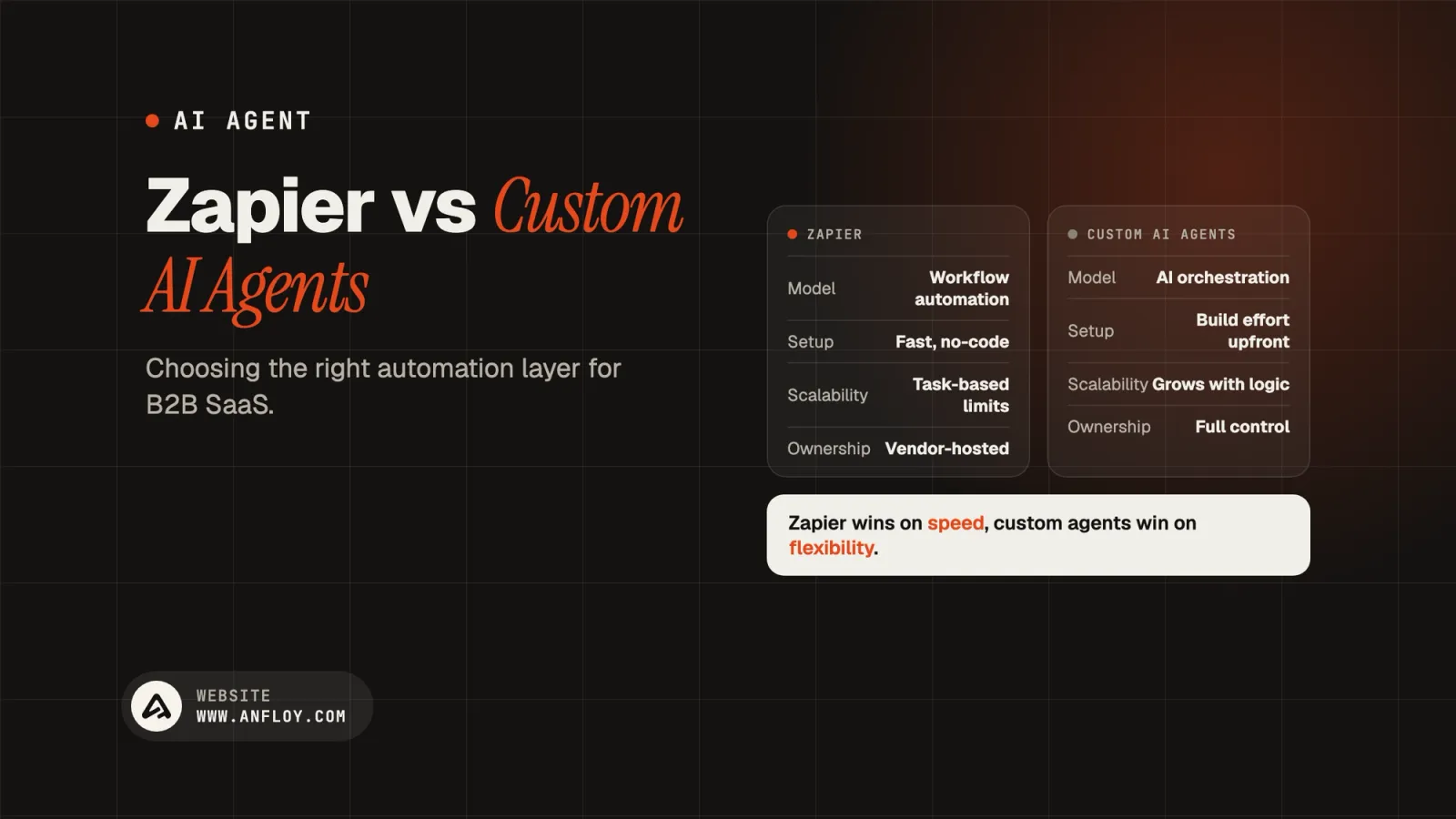
Zapier vs custom AI agents: Core difference
The biggest difference is simple:
Zapier automates predefined workflows.
AI agents orchestrate operational systems.
Zapier follows rules.
AI agents reason dynamically.
| Zapier | Custom AI Agents |
|---|---|
| Trigger-based automation | Context-aware orchestration |
| Static workflows | Adaptive workflows |
| No-code integrations | AI-powered operational systems |
| Limited reasoning | Dynamic decision-making |
| App connectivity | Multi-system orchestration |
| Workflow automation | Operational intelligence |
| Generic templates | Custom business logic |
| SaaS dependency | Owned infrastructure |
This distinction becomes critical as SaaS companies scale operational complexity.
Where does Zapier work best?
Zapier is still extremely effective for lightweight automation.
Especially for:
- startups with simple workflows
- operational notifications
- app integrations
- form submissions
- CRM syncing
- internal alerts
- and repetitive rule-based tasks
Examples include:
- sending Slack notifications
- syncing Google Sheets
- updating CRM records
- automating calendar workflows
- and triggering email alerts
For structured workflows with predictable logic, Zapier works very well.
The issue appears when workflows become dynamic.
Where does Zapier start breaking?
Zapier works extremely well for simple and structured workflows.
The problem starts when operations become more dynamic and complex.
As B2B SaaS companies scale, workflows often require:
- contextual decision-making
- personalization
- operational coordination
- and real-time adaptability
This is where traditional no-code automation starts becoming fragile.
Explore how AI Agents help B2B SaaS companies build scalable AI-powered operational systems for GTM, RevOps, and workflow automation.
Common signs that Zapier starts breaking
Growing SaaS companies usually notice issues like:
- Workflows are becoming difficult to maintain
- automations breaking across edge cases
- Complex zaps are creating operational debt
- disconnected systems causing workflow fragmentation
- limited personalization in outbound workflows
- increasing dependency on manual oversight
- Scaling automation is becoming harder to manage
- Static logic is struggling with dynamic operations
For example:
A simple Zapier workflow can:
- Create a CRM contact after form submission
But modern GTM systems often require:
- analyzing buying intent
- enriching account data
- scoring ICP fit
- generating personalized outreach
- coordinating RevOps workflows
- and prioritizing opportunities dynamically
That level of orchestration requires reasoning, not just triggers.
The issue is not Zapier itself.
The issue is that modern SaaS operations are no longer fully rule-based.
They are context-driven.
That is why many growing companies eventually move from disconnected automation workflows toward custom AI systems designed around operational intelligence and workflow orchestration.
What are the common limitations of Zapier?
Growing B2B SaaS companies often discover:
- Workflows become difficult to maintain
- Complex automations create operational debt
- Scaling workflows increases fragility
- Static logic cannot adapt dynamically
- Personalization remains limited
- workflows break across edge cases
- Operational reasoning is missing
- integrations become increasingly complex
- and automation visibility becomes fragmented
The problem is not Zapier itself.
The problem is operational complexity.
Traditional workflow automation was designed for structured systems.
Modern SaaS operations are increasingly unstructured and context-driven.
Why are AI agents different?
AI agents introduce operational reasoning into workflows.
That changes the entire system architecture.
Instead of relying entirely on predefined rules, AI agents can:
- evaluate context
- interpret signals
- prioritize actions
- adapt messaging
- and coordinate workflows dynamically
For example:
A Zapier workflow might:
- Create a CRM contact after form submission
An AI agent system might:
- analyze the account
- enrich the company automatically
- score ICP fit
- Identify buying signals
- generate personalized outreach
- Route the lead intelligently
- Notify the correct sales rep
- and launch outbound sequences automatically
This is not simple automation.
It is AI orchestration.
AI Agents vs Zapier for sales automation
Sales workflows are one of the clearest examples of the difference between automation and AI orchestration.
Modern outbound requires:
- contextual personalization
- signal-based prospecting
- dynamic lead scoring
- operational intelligence
- and multi-system coordination
Static automation struggles in these environments.
AI agents perform much better because they can:
- analyze intent signals
- personalize messaging
- coordinate enrichment workflows
- support RevOps operations
- and optimize GTM execution dynamically
At AI Lead Generation, AI systems are built around signal-driven GTM workflows rather than static automation sequences.
That distinction matters because modern outbound is no longer about volume.
It is about relevance and timing.
AI Agents vs Zapier for CRM automation
CRM workflows become increasingly complex as companies scale.
Most RevOps teams eventually experience:
- inconsistent CRM hygiene
- fragmented lifecycle stages
- delayed lead routing
- duplicate records
- and workflow coordination issues
Zapier can automate parts of these workflows.
But AI agents can intelligently orchestrate CRM operations.
For example, AI systems can:
- Identify duplicate accounts
- analyze lead quality
- route opportunities dynamically
- Prioritize high-intent leads
- summarize account activity
- and support pipeline management automatically
At CRM Automation, the focus is on building AI-powered CRM workflows designed around operational execution rather than static automation logic.
AI Agents vs Zapier for internal operations
Internal operational systems are another area where AI agents outperform traditional automation.
Most SaaS companies struggle with:
- fragmented documentation
- scattered operational knowledge
- inconsistent SOP execution
- and workflow coordination across teams
Zapier can automate notifications and triggers.
AI agents can:
- retrieve operational knowledge
- summarize information
- execute SOPs
- coordinate internal workflows
- and support operational execution dynamically
This is why many companies are building internal AI systems instead of relying entirely on disconnected automation tools.
Why ownership matters?
One of the biggest strategic differences between Zapier and custom AI systems is ownership.
With traditional SaaS automation platforms:
- The infrastructure belongs to the vendor
- Workflows depend on the platform
- Operational logic lives inside third-party systems
That creates dependency.
Custom AI systems operate differently.
The workflows belong to the company.
The operational logic becomes an internal asset.
The infrastructure evolves with the business.
At Anfloy vs Zapier, the focus is on helping B2B SaaS companies move from fragmented SaaS automation toward owned AI infrastructure.
That means:
- no lock-in
- no platform dependency
- no operational limitations caused by rigid tooling
When is Zapier the better choice?
Zapier is often the better option when:
- Workflows are simple
- Operational logic is predictable
- Teams need fast no-code automation
- Engineering resources are limited
- Workflow complexity is still relatively low
Not every company needs custom AI infrastructure immediately. For many startups, Zapier is still extremely valuable.
Where Zapier wins?
Zapier wins when workflows are simple, predictable, and rule-based.
It is one of the best tools for lightweight automation because teams can launch workflows quickly without engineering resources.
Zapier works especially well for:
- App integrations
- notifications
- form submissions
- CRM syncing
- calendar automation
- Slack alerts
- spreadsheet workflows
- and repetitive operational tasks
For example:
- When a lead submits a form → create a HubSpot contact.
- When a meeting is booked → send a Slack notification.
- When a payment is completed → trigger an onboarding email.
These workflows are deterministic.
They follow fixed rules with very little operational complexity.
Zapier is also a strong fit for:
- early-stage startups
- lean operations teams
- non-technical teams
- and companies needing fast no-code automation
The biggest advantage of Zapier is speed and simplicity.
Teams can automate workflows quickly without building custom infrastructure.
That is why Zapier remains highly valuable for straightforward operational automation.
Where custom AI agents win?
Custom AI agents win when workflows become dynamic, context-driven, and operationally complex.
Modern B2B SaaS operations require more than trigger-based automation.
Sales workflows change constantly. Buyer behavior evolves. Outbound messaging needs personalization. RevOps systems require coordination across multiple platforms.
This is where AI agents outperform traditional automation tools.
Custom AI agents are better for:
- AI outbound systems
- signal-based prospecting
- personalized sales workflows
- RevOps orchestration
- AI lead qualification
- operational decision-making
- internal AI systems
- workflow coordination
- and multi-system execution
Unlike static automation, AI agents can:
- analyze context
- reason dynamically
- prioritize tasks
- personalize outputs
- coordinate workflows
- and adapt execution automatically
For example:
Instead of simply creating a CRM contact, an AI agent can:
- enrich company data
- Identify ICP fit
- analyze buying intent
- generate personalized outreachThe
- route leads intelligently
- notify sales teams
- and trigger outbound workflows automatically
This creates operational leverage that traditional automation platforms cannot provide alone.
When are custom AI agents the better choice?
Custom AI agents become more valuable when:
- Workflows require reasoning
- Outbound needs personalization
- operations span multiple systems
- RevOps complexity increases
- Teams need signal-based execution
- workflows evolve constantly
- Operational scale becomes difficult to manage manually
This is especially true for:
- B2B SaaS companies
- GTM teams
- RevOps leaders
- and operationally complex scale-ups
How modern SaaS companies use both?
The reality is not “Zapier or AI agents.”
Modern companies often use both together.
Zapier still works well for:
- lightweight integrations
- notifications
- and deterministic workflows
AI agents handle:
- reasoning
- orchestration
- personalization
- operational intelligence
- and dynamic execution
The best GTM systems combine:
- APIs
- Automation workflows
- CRMs
- AI agents
- enrichment systems
- Operational orchestration layers
This creates a scalable operational infrastructure.
Common Mistakes Companies Make
Replacing everything with AI immediately
Not every workflow requires AI reasoning.
Simple workflows should remain simple.
Overengineering creates unnecessary complexity.
Using AI Without Operational Design
AI systems fail when workflows are poorly designed.
The best AI infrastructure starts with operational bottlenecks and strong strategy consulting, not AI hype.
Treating Zapier like a full AI system
Zapier is excellent for workflow automation.
But it was not designed to function as a reasoning engine or operational intelligence layer.
Building Fragmented AI Stacks
Many companies stack:
- AI tools
- no-code automations
- outbound software
- enrichment platforms
- and copilots
without creating centralized operational coordination.
This creates workflow chaos.
What is the future of automation?
Automation is evolving from:
- Trigger-based workflows
to: - AI-powered customer interaction systems like AI chatbots can also operate as part of broader operational orchestration.
The future stack will include:
- AI agents
- Operational intelligence systems
- Orchestration layers
- Signal-based workflows
- Fewer disconnected SaaS tools
Companies that win will not simply automate tasks.
They will build AI-native operational infrastructure.
Conclusion
Zapier changed how companies automate workflows.
It made automation accessible without requiring engineering resources.
For simple workflows, it remains an excellent platform.
But modern B2B SaaS operations increasingly require more than static automation.
Today’s GTM systems depend on:
- Contextual reasoning
- Personalized execution
- Signal-based workflows
- Operational intelligence
- AI-powered orchestration
That is where custom AI agents outperform traditional no-code automation.
The future advantage is not simply connecting apps.
It is building operational systems that can reason, coordinate, and execute intelligently across the business.
At Anfloy, the focus is on helping B2B SaaS companies build an AI-powered operational infrastructure they actually own.
From:
- AI Agents
- AI Lead Generation
- CRM Automation
- Fully custom GTM systems
Ready to move beyond static automation?
→ Book a strategy call
Frequently Asked Questions
Is Zapier an AI agent?
No. Zapier is a workflow automation platform designed for trigger-based workflows and app integrations. AI agents use reasoning, contextual analysis, and operational decision-making.
Are AI agents better than Zapier?
AI agents are better suited to dynamic workflows that require personalization, reasoning, and orchestration. Zapier works best for simple, predictable automation tasks with structured workflows.
Can Zapier and AI agents work together?
Yes. Many companies use Zapier for lightweight automation while AI agents handle contextual reasoning, personalization, operational intelligence, and workflow orchestration.
When should a SaaS company move beyond Zapier?
Companies usually outgrow Zapier when workflows become highly complex, operations span multiple systems, personalization becomes critical, and manual workflow coordination slows execution.
Why do B2B SaaS companies build custom AI systems?
Custom AI systems provide operational flexibility, ownership, scalability, personalization, and orchestration capabilities that traditional automation tools cannot support effectively.
Let's build
what your
company needs.
Drop your email. We'll send The Custom Agent Blueprint on what we'd build first for a company like yours, before you ever take a meeting.