
How we turned LinkedIn buying signals into $234,000 in pipeline with Apify.
Apify, the web-scraping and automation platform, published a case study on how Anfloy uses Apify Actors to power its outbound engine. The system captures buying intent from LinkedIn, enriches and qualifies it automatically, and reaches the right people with messages personalized to each one. The payoff: reply rates as high as 11%, several times the cold outbound norm, and $234,000 in qualified pipeline across three campaigns, all powered by Apify Actors. With Apify at the data layer, campaigns are capped by how many high-fit prospects actually exist, not by how many a researcher can enrich by hand.

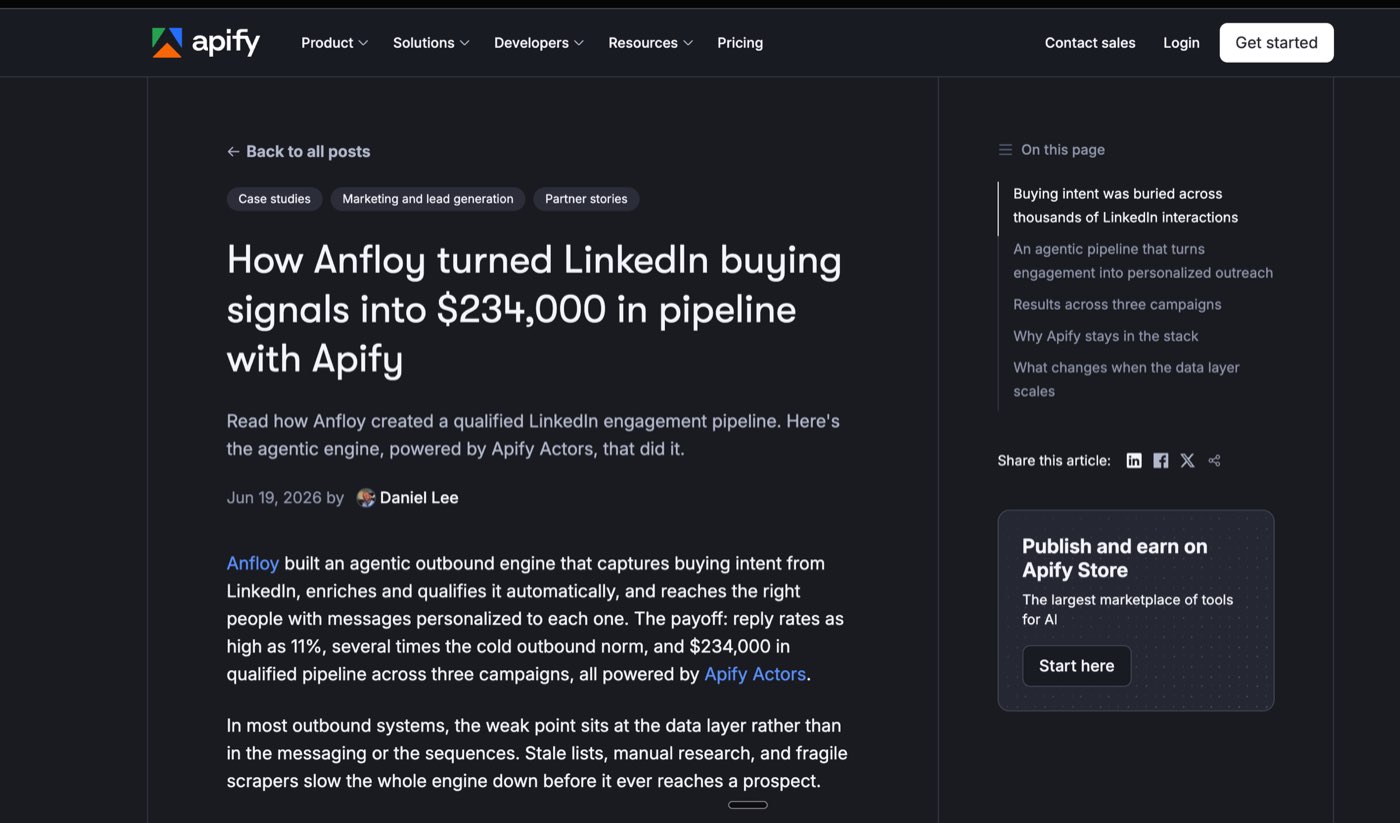
How Anfloy turned LinkedIn buying signals into $234,000 in pipeline with Apify
“Anfloy built an agentic outbound engine that captures buying intent from LinkedIn, enriches and qualifies it automatically, and reaches the right people with messages personalized to each one.”
Read the full case study on ApifyBuying intent was buried in LinkedIn
Every day, the right buyers are active on LinkedIn: commenting, reacting, and following the accounts that matter in their market. That engagement is buying intent, but it sits buried across thousands of interactions, impossible to act on by hand.
In most outbound systems the weak point is not the messaging or the sequences, it is the data layer underneath them. Stale lists, manual research, and fragile scrapers slow the whole engine down before it ever reaches a prospect. That was the constraint to break.
An agentic pipeline that turns engagement into outreach
We built an agentic outbound engine that reads that intent in real time. It captures the people engaging with the right accounts, enriches and qualifies each one automatically, and keeps only the high-fit prospects, the top of the list rather than the whole list.
From there it reaches each person with a message personalized to them specifically, not a template with a first-name token. The result is outreach that lands as relevant because it is built on a real signal and real research, end to end, with no manual list-building in the middle.
Apify Actors at the data layer
The data layer runs on Apify Actors. Instead of brittle in-house scrapers that break the moment a page changes, Apify gives the engine a reliable, maintained source of LinkedIn and company data that holds up at volume.
That is why Apify stays in the stack: it shifts the constraint. The pipeline used to be capped by how many leads a researcher could enrich by hand. Now it is capped only by how many high-fit prospects actually exist, and the sourcing layer is no longer the bottleneck.
The results across three campaigns
Run across three campaigns, the engine produced reply rates as high as 11%, several times the cold-outbound norm, and $234,000 in qualified pipeline. The copy and the targeting were strong enough to build the brand rather than burn it.
Apify published the whole story on their own blog as a partner case study, independent proof that the system works and that Apify is the data layer behind it.
Signal in, pipeline out.
Apify Actors feed a reliable stream of LinkedIn and company data into an agentic pipeline that enriches, qualifies, and personalizes, so outreach is built on real intent instead of a stale list.
Apify Actors capture the people engaging with the right accounts on LinkedIn, then enrich and qualify each one automatically.
Only the high-fit prospects get personalized outreach, producing an 11% reply rate and $234,000 in pipeline across three campaigns.
Let's build
what your
company needs.
Drop your email. We'll send The Custom Agent Blueprint on what we'd build first for a company like yours, before you ever take a meeting.