
AI Agents vs ChatGPT: What's the Difference & Which One Does Your Business Need?
Compare AI agents vs ChatGPT, including capabilities, use cases, automation, business applications, and when to choose custom AI agents.
On this page
- What Is ChatGPT?
- What is an AI agent?
- AI agents vs ChatGPT: which is right for your business?
- AI agents vs ChatGPT: Side-by-side comparison
- Where ChatGPT excels?
- Where AI agents outperform ChatGPT?
- Why businesses eventually outgrow ChatGPT?
- Why do companies choose AI agents instead of ChatGPT alone?
- How do you build AI agents in Anfloy?
- When should you use ChatGPT?
- When should you use AI agents?
- Conclusion
One of the biggest misconceptions in AI today is that ChatGPT and AI agents are the same thing.
They are not.
Many business leaders hear terms like:
- AI agents
- autonomous agents
- agentic systems
- GPT agents
- AI assistants
and assume they are simply different names for ChatGPT.
That assumption creates confusion.
Because while ChatGPT is an incredibly powerful tool, it is only one component of what modern AI systems can become.
This distinction matters.
Especially for businesses exploring:
- automation
- revenue operations
- customer support
- internal operations
- AI products
- workflow orchestration
The question is no longer:
"Should we use ChatGPT?"
The question is:
"Do we need a chatbot or do we need an AI system?"
Understanding the difference can help organizations avoid investing in the wrong solution.
This guide explains exactly how AI agents differ from ChatGPT, where each excels, and why more companies are moving toward agentic infrastructure.
What Is ChatGPT?
ChatGPT is an AI chatbot powered by large language models. Many small businesses start their AI journey with chatbots before expanding into agent-based systems.
Users interact with it through conversation.
Typical use cases include:
- answering questions
- writing content
- brainstorming ideas
- summarizing information
- coding assistance
- research support
ChatGPT is designed primarily around conversation.
You ask.
It responds.
For many individuals and businesses, that capability alone creates enormous value.
However, ChatGPT is generally limited to interactions within the chat environment.
It does not automatically manage business workflows, coordinate systems, or execute operational tasks.
What is an AI agent?
An AI agent is a software system that can understand goals, gather information, make decisions, and take actions to complete tasks with minimal human intervention.
Unlike ChatGPT, AI agents are built to take action.
A modern AI agent can:
- retrieve information
- analyze data
- make decisions
- execute workflows
- update systems
- coordinate tasks
- trigger actions
- interact with multiple tools
Think of ChatGPT as a highly intelligent assistant.
Think of an AI agent as a worker capable of completing tasks.
This is why agentic systems are becoming increasingly important in business operations.
AI agents vs ChatGPT: which is right for your business?
Imagine a sales team.
ChatGPT
You ask:
"Write a cold email for a SaaS founder."
ChatGPT generates the email.
Your work starts after the response.
AI agent
The agent can:
- evaluate leads
- identify prospects
- enrich contacts
- generate personalized outreach
- update the CRM
- schedule follow-ups
- notify sales representatives
without requiring manual intervention.
One creates content.
The other executes workflows.
That is the fundamental difference.
AI agents vs ChatGPT: Side-by-side comparison
| Feature | ChatGPT | AI Agents |
|---|---|---|
| Conversational AI | Yes | Yes |
| Answers Questions | Yes | Yes |
| Generates Content | Yes | Yes |
| Accesses Business Data | Limited | Yes |
| Executes Actions | No | Yes |
| Automates Workflows | No | Yes |
| Multi-Step Reasoning | Limited | Yes |
| CRM Integration | Limited | Yes |
| Decision-Making | Limited | Yes |
| Operational Automation | No | Yes |
This is why businesses increasingly view ChatGPT as a tool and AI agents as infrastructure.
Where ChatGPT excels?
ChatGPT remains extremely valuable for many use cases.
Examples include:
Content creation
- blog writing
- email drafting
- social content
- content ideation
Research & analysis
- summarization
- brainstorming
- information gathering
Coding assistance
- debugging
- code generation
- documentation
Personal productivity
- note-taking
- planning
- writing support
For individual productivity, ChatGPT is often more than sufficient.
Where AI agents outperform ChatGPT?
AI agents become valuable when workflows require execution rather than conversation.
Examples include:
Lead qualification
The agent can:
- evaluate leads
- score opportunities
- update CRM systems
- route prospects
automatically.
Customer support operations
Agents can:
- retrieve account information
- resolve requests
- escalate issues
- coordinate workflows
across multiple systems.
Internal operations
Agents can:
- retrieve SOPs
- answer employee questions
- generate reports
- automate approvals
without human intervention.
Revenue operations
Agents can:
- enrich leads
- monitor buying signals
- manage workflows
- trigger outbound campaigns
continuously.
This is where operational leverage begins to emerge.
Why businesses eventually outgrow ChatGPT?
Many organizations begin their AI journey with ChatGPT.
This is often the right first step.
However, as AI adoption matures, limitations become apparent.
Common challenges include:
- manual workflows
- disconnected systems
- lack of automation
- repeated prompting
- limited operational context
Teams often discover that ChatGPT helps employees work faster.
But it does not fundamentally change how the business operates.
AI agents do.
This is often the transition point.
AI agents vs ChatGPT for revenue teams
Revenue operations provide a strong example.
With ChatGPT:
- generate emails
- write sequences
- create messaging
With AI agents:
- identify opportunities
- enrich leads
- qualify prospects
- update CRM records
- trigger outreach
- coordinate workflows
The second approach creates significantly more operational leverage.
This is why GTM teams are increasingly adopting agentic systems.
AI agents vs ChatGPT for internal operations
Many companies struggle with:
- onboarding
- SOP retrieval
- internal support
- knowledge management
ChatGPT can answer questions if information is provided.
AI agents can:
- retrieve information
- access internal systems
- update workflows
- complete tasks
The result is a more scalable operational model.
AI agents vs ChatGPT for customer experience
Customer interactions increasingly require:
- personalization
- context
- account awareness
- workflow coordination
ChatGPT provides conversational support.
AI agents can combine conversation with execution.
Examples include:
- booking appointments
- updating customer records
- initiating workflows
- managing requests
This creates a significantly better customer experience.
Why do companies choose AI agents instead of ChatGPT alone?
The answer is simple.
Businesses need outcomes.
Not conversations.
Most organizations are not trying to generate more text.
They are trying to:
- generate pipeline
- improve operations
- reduce costs
- automate workflows
- scale efficiently
These objectives require systems capable of action.
Not just responses.
This is why AI agents are becoming a major focus for growth-stage companies.
How do you build AI agents in Anfloy?
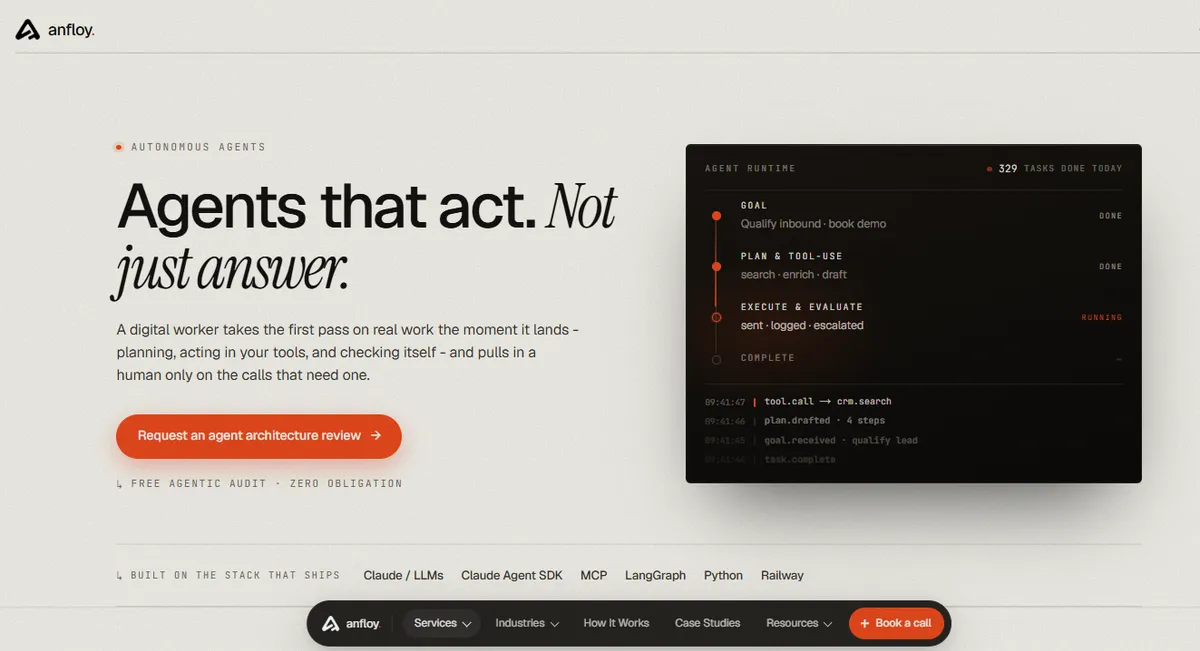
At Anfloy, AI agents are built as operational systems, not standalone chatbots.
The process starts by understanding how the business operates today. We identify bottlenecks, repetitive work, disconnected tools, and workflows that are slowing growth. The goal is to find where AI can create the most operational leverage.
Once the workflow is mapped, we design a custom agent architecture around the business process. Depending on the use case, this may include multi-agent systems, retrieval layers, company memory, workflow orchestration, and integrations with existing tools.
The agents are then connected to platforms such as:
- HubSpot
- Salesforce
- Slack
- Notion
- Google Workspace
- Internal databases
- Custom software
To make agents useful in production, we also build retrieval and memory systems so they can access company knowledge, customer information, SOPs, and operational data in real time.
Finally, the agents are deployed to perform actual work, such as:
- qualifying leads
- enriching prospect data
- updating CRM records
- retrieving knowledge
- coordinating workflows
- generating reports
- supporting internal operations
Most importantly, every system is built on infrastructure you own. The code, workflows, integrations, and operational logic belong to your company, creating a long-term asset instead of another software dependency.
When should you use ChatGPT?
Choose ChatGPT when you need:
- writing assistance
- brainstorming
- content creation
- research
- personal productivity
For many individuals, this is enough.
When should you use AI agents?
Choose AI agents when you need:
- workflow automation
- operational execution
- CRM coordination
- lead qualification
- internal operations
- customer workflows
- business system integration
This is where AI begins transforming how the company operates.
Conclusion
ChatGPT introduced millions of people to AI.
It remains one of the most useful productivity tools available today.
But for businesses, the future of AI extends far beyond conversation.
The biggest opportunities are emerging from systems that can:
- reason
- retrieve information
- coordinate workflows
- make decisions
- and execute actions
That is where AI agents come in.
ChatGPT helps people work faster.
AI agents help businesses operate differently.
As organizations move from experimentation to implementation, many discover that the real value of AI is not generating responses.
It is building systems that create operational leverage.
At Anfloy, the focus is helping companies move beyond chat interfaces through:
- agentic systems
- GTM engines
- company AI brains
- internal operations infrastructure
- and full-stack AI products
Because the future of AI is not just talking to software.
It is building software that can work alongside your business.
Frequently Asked Questions
Are AI agents the same as ChatGPT?
No. ChatGPT is a conversational AI tool, while AI agents are systems capable of reasoning, executing actions, and automating workflows.
Can ChatGPT be part of an AI agent?
Yes. Many AI agents use large language models such as GPT to power reasoning and communication.
Are AI agents better than ChatGPT?
Not necessarily. They solve different problems. ChatGPT is excellent for conversation and content generation, while AI agents are designed for operational execution.
Can AI agents access business systems?
Yes. AI agents can connect to CRMs, databases, knowledge systems, communication platforms, and operational tools.
Why are businesses investing in AI agents?
They help automate workflows, reduce manual work, improve operations, and create scalable business infrastructure.
Which AI agent is better than ChatGPT?
There is no AI agent that is universally better than ChatGPT. Alternatives such as Claude, Google Gemini, and Microsoft Copilot may perform better for specific tasks, depending on your requirements and preferred workflow.
What happens when an AI agent gets it wrong in production?
When an AI agent makes an error in production, it can lead to inaccurate outputs, failed tasks, poor user experiences, or business disruptions. Effective monitoring, human oversight, validation checks, and fallback mechanisms help reduce risks and maintain reliability.
Is ChatGPT a chatbot or AI agent?
ChatGPT is primarily a conversational AI chatbot, but it can also function as an AI agent when equipped with tools, memory, workflows, and the ability to take actions on a user's behalf. Its role depends on how it is deployed and integrated.
Let's build
what your
company needs.
Drop your email. We'll send The Custom Agent Blueprint on what we'd build first for a company like yours, before you ever take a meeting.