
7 Best Signal-Based Selling Tools For GTM Engineers in 2026
I compare the 7 best signal-based selling tools for GTM Engineers in 2026, including Clay, Common Room, Apollo, 6sense, and more.
On this page
- What are signal-based selling tools?
- How I evaluate signal-based selling tools?
- The 7 best signal-based selling tools for GTM engineers
- 1. Clay
- 2. Common Room
- 3. 6sense
- 4. Apollo
- 5. Bombora
- 6. Warmly
- 7. Leadfeeder
- How I choose the right signal-based selling tool?
- The best signal-based stack Is usually more than one tool
- Signal stacking Is more powerful than single signals
- Build the signal-to-action workflow
- How I would build a signal-based selling stack?
- The metrics I use for signal-based selling
- My recommended signal-based selling stack by company stage
- Conclusion
Most sales teams have access to more account data than ever. The problem isn't finding information. It's knowing which changes actually matter, which accounts they matter for, and what to do next.
That's where signal-based selling comes in.
Signal-based selling tools help GTM teams detect meaningful changes across target accounts, add the context needed to interpret those changes, and turn them into timely sales actions. But a signal alone isn't an opportunity. Its value comes from connecting the event to ICP fit, recency, context, and a clear next step.
For GTM Engineers, that means the real question isn't how many signals a platform can surface. It's whether the system can reliably move from raw event → qualified insight → sales action → measurable outcome.
This article breaks down the leading signal-based selling tools, what each is best at, how I evaluate them, and how to build a signal-to-action system that actually improves GTM execution.
What are signal-based selling tools?
Signal-based selling tools help GTM teams detect meaningful changes around target accounts, understand what those changes mean, and turn them into timely sales actions.
A signal might be a new executive hire, funding event, hiring spike, technology change, product activity, website behavior, or another event that changes the commercial context of an account.
But the signal itself is not the opportunity. It becomes useful when the system connects it with ICP fit, context, recency, and an actionable next step.
For GTM Engineers, that means I don't evaluate these tools simply by asking:
How many signals can this platform find?
I ask:
Can this tool help me move from a raw event to a reliable GTM action?
The architecture I care about looks like this:
Signal Source
     ↓
Signal Detection
     ↓
Identity Resolution
     ↓
Enrichment
     ↓
ICP Evaluation
     ↓
Signal Interpretation
     ↓
Scoring
     ↓
Sales Action
     ↓
Outcome
     ↓
Feedback
That distinction matters because a signal-based GTM system is not just a database of events. It is an operating system for deciding which accounts deserve attention now and why.
How I evaluate signal-based selling tools?
I use a different evaluation framework than I would for a conventional sales engagement platform.
Signal coverage
Can the tool detect the signals that matter for my ICP?
Signal freshness
How quickly does a signal become available after the underlying event occurs?
Data quality
Can I trust the event and the account identity attached to it?
Enrichment
Can the tool add the company, person, and contextual information needed to interpret the signal?
Workflow flexibility
Can I build custom logic around the signal?
API and integrations
Can I connect the tool to my CRM, data warehouse, automation layer, or custom agent?
AI capabilities
Can AI interpret the signal rather than simply surface it?
Activation
Can the signal trigger a real sales or marketing action?
Feedback
Can I measure whether the signal actually produces meetings, opportunities, pipeline, or revenue?
This last point is particularly important.
The goal is not to maximize signal volume.
The goal is to identify signals that predict useful GTM outcomes. Anfloy's signal-based selling framework explicitly recommends measuring signal outcomes and using feedback to strengthen or remove signal types over time.
The 7 best signal-based selling tools for GTM engineers
1. Clay
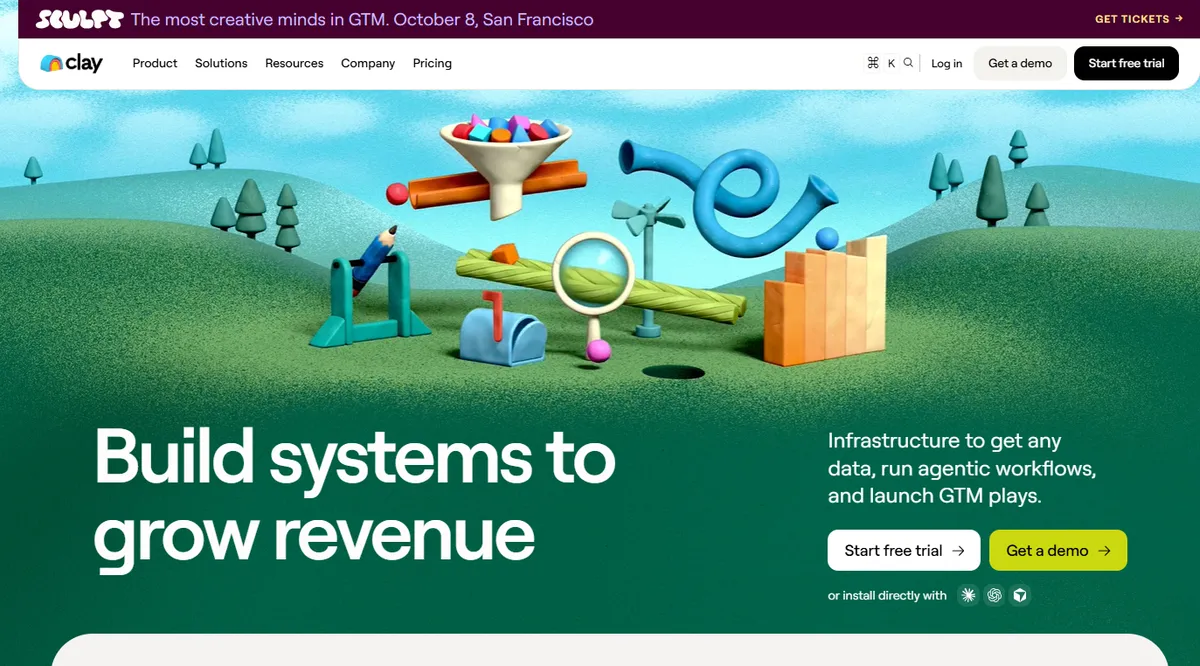
Best for: Signal enrichment, multi-source research, custom workflows, and signal-to-action orchestration.
Clay is one of the strongest choices when I want to build a signal workflow rather than simply subscribe to a signal feed.
Its biggest advantage is flexibility.
I can use Clay to combine data providers, enrich accounts, research companies, apply conditional logic, and pass the resulting information into downstream GTM workflows.
Anfloy's current GTM Engineering tools guide positions Clay around data enrichment and multi-source GTM workflows.
A typical signal workflow could look like:
Hiring Signal
     ↓
Company Identification
     ↓
Enrichment
     ↓
ICP Check
     ↓
AI Research
     ↓
Signal Qualification
     ↓
CRM / Sequencer
Why GTM Engineers use it?
Clay is particularly useful when the signal itself is not enough.
For example, suppose I detect:
Company is hiring a VP of Sales.
I can enrich the company, identify the relevant stakeholders, inspect other hiring patterns, research the business, evaluate ICP fit, and create a structured sales recommendation.
That turns the signal into context.
Best use cases
- Hiring signals
- Funding signals
- Technographic changes
- Company research
- Account enrichment
- Signal stacking
- AI research
- Custom outbound workflows
Limitation
Clay is extremely flexible, but flexibility also means more architecture work.
If a team expects a completely packaged signal-to-sales system, Clay may require more GTM Engineering effort than a specialized intent platform.
Best fit: Teams that want to build custom signal infrastructure.
2. Common Room
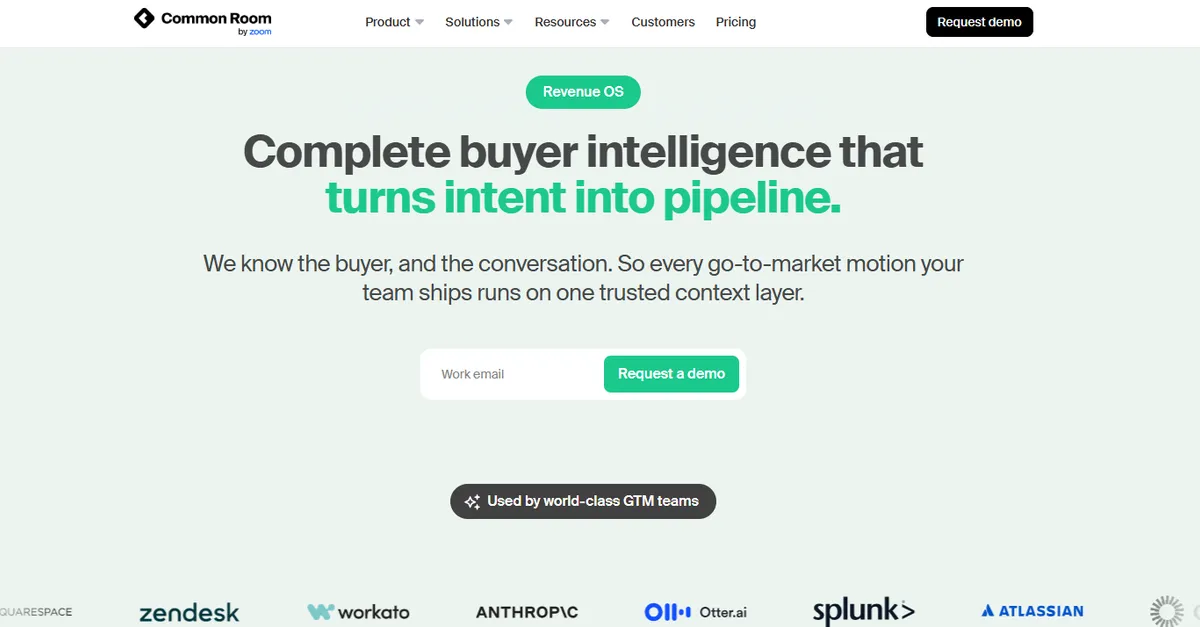
Best for: Product, community, website, social, and first-party buying signals.
Common Room is useful when the most valuable signals are already happening around your own business.
That includes signals such as:
- website activity
- product usage
- community engagement
- social activity
- developer activity
- content engagement
- customer interactions
This makes it particularly interesting for companies with product-led, community-led, or content-driven GTM motions.
Instead of asking:
Which companies might be interested?
I can ask:
Which companies are already showing behavior that suggests interest?
That distinction is important.
A first-party signal generally has more direct relevance than a generic market event because it represents an interaction with my own company or product.
Best use cases
- Product-qualified accounts
- Community signals
- Website activity
- Developer signals
- Social engagement
- First-party intent
- PLG outbound
Limitation
Common Room is strongest when the organization has meaningful first-party or community activity to analyze.
If the GTM motion depends primarily on external signals such as funding, hiring, leadership changes, or technology changes, I may need additional signal sources.
Best fit: Product-led and community-driven GTM teams.
3. 6sense
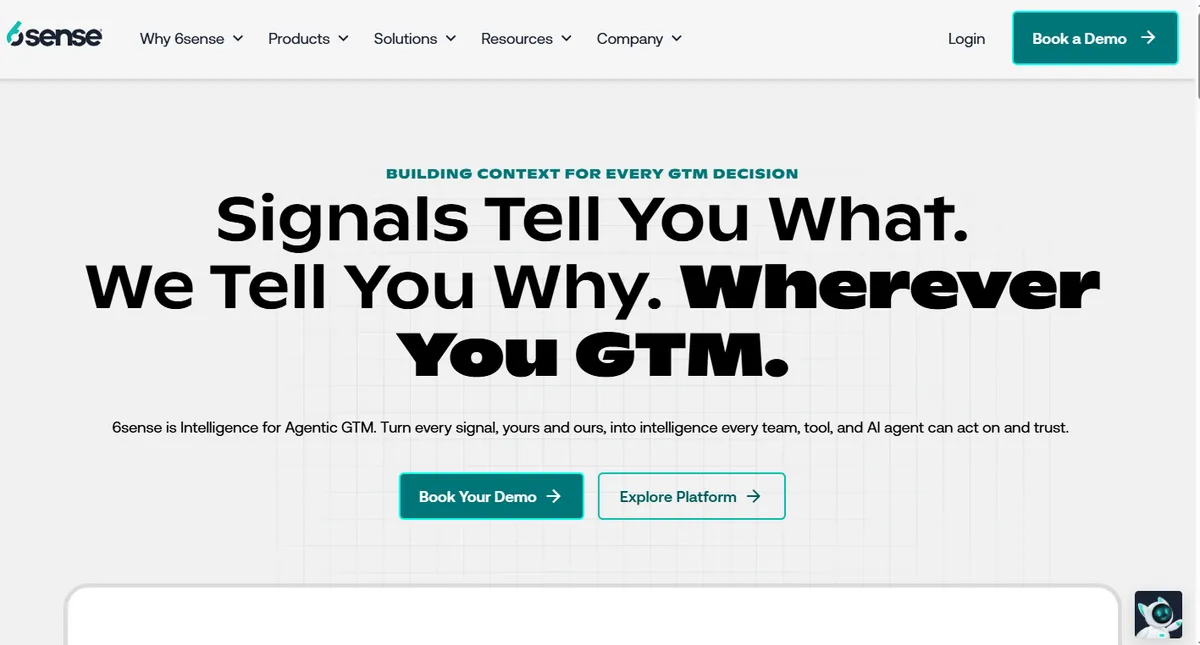
Best for: Account intent, buying-stage intelligence, and enterprise ABM.
6sense is designed around identifying accounts that are actively researching and moving through a buying journey.
That makes it particularly relevant for enterprise sales teams running account-based GTM.
Instead of simply asking whether an account fits the ICP, I can use intent intelligence to understand whether the account appears to be entering an active research or buying phase.
The architecture becomes:
ICP
 +
Intent
 +
Account Context
 ↓
Account Priority
 ↓
Sales / Marketing Action
Best use cases
- Enterprise ABM
- Intent-based account prioritization
- Buying-stage identification
- Account-based marketing
- Enterprise sales intelligence
Limitation
6sense is more useful when an organization has a mature ABM motion and enough account volume to justify sophisticated intent infrastructure.
For smaller teams, the system can be more than they need.
Best fit: Enterprise GTM and ABM teams.
4. Apollo

Best for: Combining prospecting, contact data, intent, enrichment, and outbound execution.
Apollo is useful when I want the signal workflow to connect relatively directly to prospect discovery and outreach.
Instead of separating:
Signal
+
Contacts
+
Outbound
Apollo can bring multiple parts of that workflow into one environment.
That can be valuable for teams that do not want to engineer every layer independently.
Best use cases
- Prospect discovery
- Contact identification
- Account enrichment
- Outbound
- Sales engagement
- Basic intent-driven prospecting
Limitation
Apollo is not the same type of programmable GTM infrastructure as Clay.
If I need highly customized signal interpretation, complex multi-provider enrichment, or an agentic decision layer, I may need additional tooling around Apollo.
Best fit: Teams that want prospecting and outbound close to the signal workflow.
5. Bombora
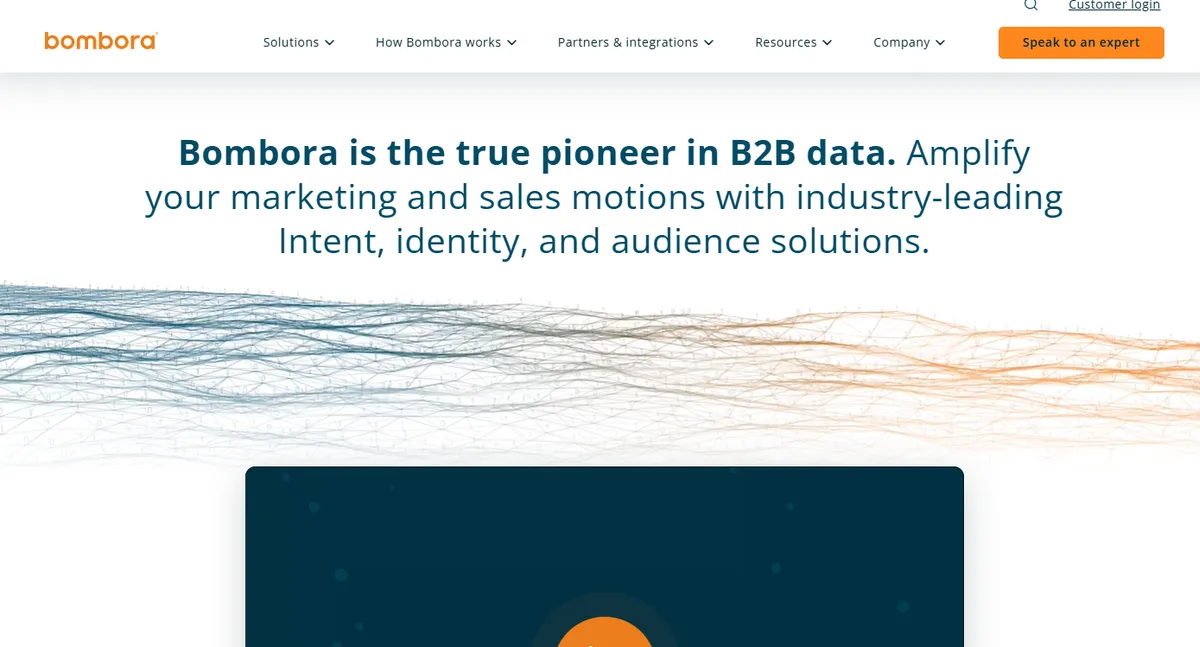
Best for: B2B intent data and topic-level research signals.
Bombora is particularly relevant when the buying signal I care about is research behavior around a topic or category.
This is different from a hiring signal.
A hiring event tells me something changed inside the company.
Intent data tells me the company may be researching a subject related to the problem I solve.
That creates another signal category:
Company
 ↓
Topic Research
 ↓
Intent
 ↓
ICP Fit
 ↓
Priority
Best use cases
- B2B intent
- Topic research
- ABM
- Account prioritization
- Marketing and sales alignment
Limitation
Intent is rarely sufficient on its own.
I prefer to combine it with:
- ICP fit
- account changes
- hiring
- technology
- first-party behavior
- existing relationships
This is signal stacking.
Best fit: B2B teams that need external intent intelligence.
6. Warmly
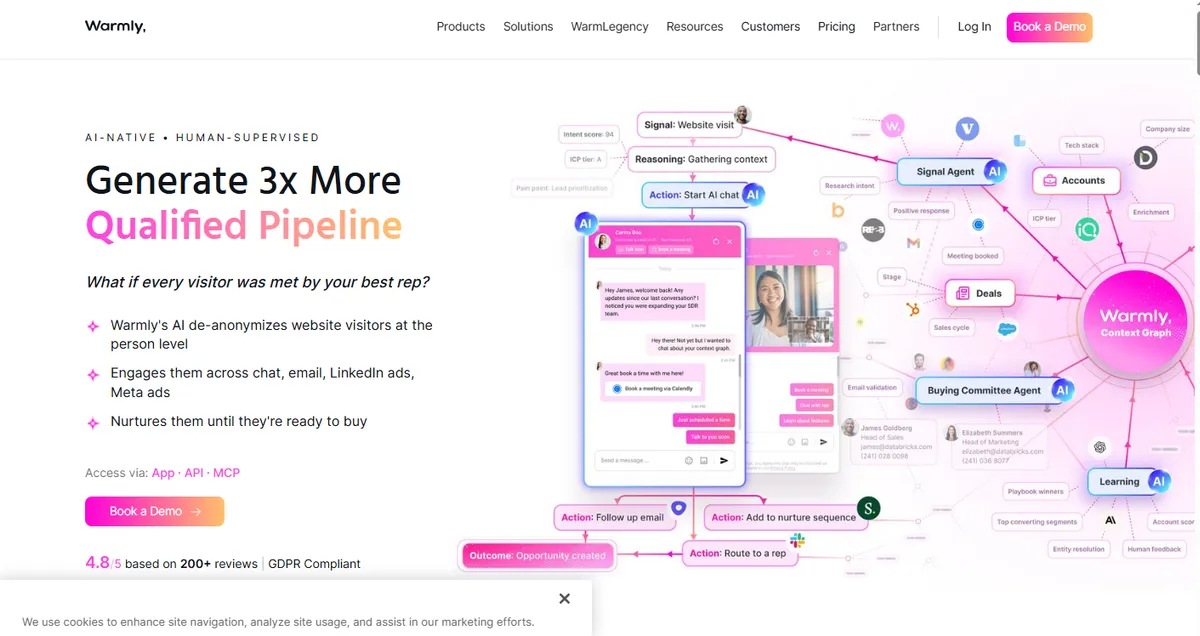
Best for: Website visitor identification and real-time website signals.
Warmly is useful when website behavior is an important part of the buying signal.
Instead of waiting for a form submission, a GTM team can use website activity as a trigger for account prioritization and sales follow-up.
For example:
Target Account
     ↓
Website Visit
     ↓
Page Behavior
     ↓
Account Identification
     ↓
ICP Check
     ↓
Sales Alert
This is particularly useful for identifying accounts that are already interacting with your website.
Best use cases
- Website visitor identification
- Anonymous traffic
- Website intent
- Sales alerts
- Inbound qualification
Limitation
Website activity can be noisy.
A visit does not necessarily indicate buying intent.
I would therefore combine website signals with account fit and additional behavioral or business signals.
Best fit: Teams with meaningful B2B website traffic.
7. Leadfeeder
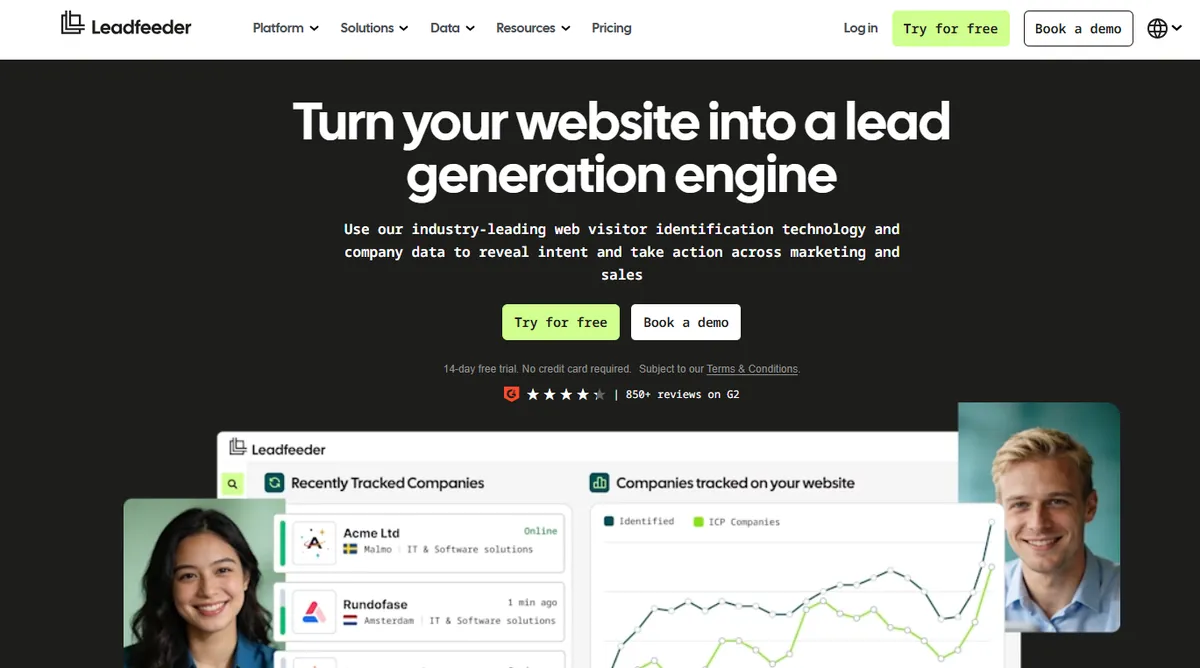
Best for: Website visitor identification and account-level web intent.
Leadfeeder is another option for teams that want to turn website traffic into account intelligence.
The basic workflow is straightforward:
Website Activity
 ↓
Company Identification
 ↓
Account Qualification
 ↓
Sales Notification
 ↓
Follow-Up
This makes it useful for teams that want a relatively simple introduction to signal-based selling.
Best use cases
- Website visitor identification
- Inbound sales
- Account-level website intent
- Sales alerts
- Lead generation
Limitation
Like other website-intent systems, visitor activity should not automatically become an outreach trigger.
A better architecture is:
Website Signal + ICP Fit + Relevant Behavior → Sales Priority
Best fit: SMB and mid-market teams beginning with web-based signal selling.
How I choose the right signal-based selling tool?
I start with the signal I want to act on.
If I need external company signals
Look at:
- Clay
- Apollo
- Anfloy
These are useful when I want to build workflows around hiring, funding, technology, company changes, or custom research.
If I need first-party signals
Look at:
- Common Room
- Warmly
- Leadfeeder
These become valuable when website, product, community, or engagement behavior is central to the GTM motion.
If I need enterprise intent
Look at:
- 6sense
- Bombora
These are better suited to mature ABM and intent-driven GTM.
If I need custom signal orchestration
I would prioritize:
- Clay
- Anfloy
The reason is flexibility.
The more specific the signal logic becomes, the more important it is to control the workflow rather than simply consume a predefined score.
The best signal-based stack Is usually more than one tool
I rarely recommend building a signal-based system around one platform.
A more realistic architecture is:
Signal Sources
      ↓
Signal Platform
      ↓
Enrichment
      ↓
ICP / Negative ICP
      ↓
AI Interpretation
      ↓
Scoring
      ↓
CRM
      ↓
Sales Engagement
      ↓
Feedback
For example:
Clay + CRM + Sales Engagement
could support a custom signal-based outbound motion.
Or:
Common Room + CRM + Sales Engagement
could support product-led signal selling.
Or:
6sense + CRM + ABM + Sales Engagement
could support enterprise intent-based GTM.
The tools are components.
The architecture determines how valuable the system becomes.
Signal stacking Is more powerful than single signals
One of the biggest mistakes I see is treating one event as proof of buying intent.
Suppose a company hires a VP of Sales.
That is interesting.
But it doesn't necessarily mean the company needs my product.
Now combine:
New VP Sales
+
20 Sales Jobs Open
+
New RevOps Role
+
CRM Migration
+
ICP Fit
The interpretation changes.
The account now has multiple related signals suggesting a broader GTM transformation.
This is signal stacking.
Anfloy's signal-based systems framework similarly recommends combining multiple relevant signals rather than treating isolated events as sufficient evidence.
The system can therefore move from:
Event Detection
to:
Account-Level Interpretation
That is where GTM Engineering becomes important.
Build the signal-to-action workflow
Once I choose the tools, I build the workflow around the action.
For example:
Hiring Signal
      ↓
Identify Account
      ↓
Enrich Company
      ↓
Identify Decision Makers
      ↓
Check ICP
      ↓
Check Negative ICP
      ↓
Find Supporting Signals
      ↓
AI Research
      ↓
Calculate Priority
      ↓
Create Sales Brief
      ↓
Human Approval
      ↓
Outbound
Notice that the signal is only the beginning.
The value is created by everything that happens after detection.
This is why Anfloy's current signal-based GTM framework describes the core loop as detect → enrich → decide → act, rather than simply “find signals.”
Build a Signal-Based Selling System, Not Just a Signal Stack
Buying another intent or signal tool does not automatically create signal-based selling.
If your team still has to manually identify the account, enrich it, interpret the event, check ICP, write the message, and decide what happens next, you have a collection of tools rather than a system.
I build signal-based GTM systems that connect your existing data sources, enrichment, AI, CRM, and sales workflows into one operating loop.
Explore Anfloy's GTM Engineering approach.
How I would build a signal-based selling stack?
I would implement the system in stages.
Stage 1: Choose one signal
Don't start with twenty.
Pick the signal most closely connected to your sales motion.
For example:
New executive hire
Stage 2: Define the action
Ask:
What should happen when this signal occurs?
For example:
Research and contact the account within 24 hours.
Anfloy's 2026 signal-based playbook emphasizes measuring how quickly a qualifying signal can move through detection, enrichment, and action rather than optimizing for email volume.
Stage 3: Define qualification
The signal should only matter when:
- account fits ICP
- signal is recent
- signal is reliable
- signal relates to a customer problem
Stage 4: Add enrichment
Find:
- company details
- relevant stakeholders
- technology
- organizational changes
- additional signals
Stage 5: Add interpretation
Use rules or AI to determine:
- what happened
- why it matters
- how strong the signal is
- what action makes sense
Stage 6: Connect execution
Send the structured result to:
- CRM
- sales engagement
- Slack
- task system
Stage 7: Measure outcomes
Track:
Signal
 ↓
Action
 ↓
Reply
 ↓
Meeting
 ↓
Opportunity
 ↓
Pipeline
 ↓
Revenue
Then improve the signal model.
The metrics I use for signal-based selling
I don't measure signal-based selling by the number of signals collected.
I measure:
Signal freshness
How quickly can the system detect the event?
Signal-to-action time
How long between detection and sales action?
Signal qualification rate
What percentage of detected signals pass the qualification criteria?
Signal-to-meeting rate
How many qualified signals generate meetings?
Signal-to-opportunity rate
How many produce opportunities?
Pipeline per signal
How much pipeline does each signal category generate?
Revenue per signal
Which signals ultimately correlate with closed revenue?
False-positive rate
How many signals looked promising but produced nothing useful?
These metrics create the feedback loop required to improve the system over time.
Anfloy's signal-based selling framework explicitly recommends connecting signals to downstream meetings, opportunities, pipeline, and revenue rather than optimizing for signal volume alone.
My recommended signal-based selling stack by company stage
Early-stage GTM team
I would keep the architecture simple:
Clay + CRM + Sales Engagement
Focus on one or two high-value signals.
Growing GTM team
I would add:
Clay + First-Party Signals + CRM + AI + Sales Engagement
This creates richer account context.
Enterprise ABM team
I would consider:
6sense/Bombora + CRM + ABM + Enrichment + Sales Engagement
The emphasis becomes account-level intent and orchestration.
GTM Engineering team
I would move toward:
Multiple Signal Sources + Enrichment + AI Agents + Custom Logic + CRM + Orchestration + Feedback
At this stage, the system itself becomes the competitive advantage.
Engineer the Signal Layer Around Your GTM Motion
The best signal-based selling tool is not necessarily the one with the largest signal database.
It is the one that fits your GTM motion and can reliably connect:
Signal → Context → Decision → Action → Outcome
If your team already uses Clay, Apollo, Smartlead, a CRM, or other GTM tools, you may not need to replace them.
You may need an engineering layer that makes them work together.
See how Anfloy builds custom signal-based GTM systems.
Conclusion
Signal-based selling is not about collecting more data.
It is about knowing which changes matter, which accounts they matter for, and what the sales team should do next.
The tools in this list solve different parts of that problem.
Clay provides flexible enrichment and workflow infrastructure.
Common Room provides first-party and community intelligence.
6sense and Bombora provide intent intelligence.
Apollo connects prospecting and outbound.
Warmly and Leadfeeder turn website activity into account-level signals.
Anfloy focuses on engineering the complete signal-to-action system around the GTM motion.
The right choice therefore depends on where the bottleneck exists.
But the architecture I want to build remains the same:
Detect → Identify → Enrich → Qualify → Interpret → Score → Act → Measure → Learn
That is the difference between buying a signal tool and building signal-based selling.
The ultimate goal is not more signals.
It is faster, more relevant GTM action when an account's commercial context changes.
Frequently Asked Questions
What is the best signal-based selling tool in 2026?
There is no single best tool for every GTM team. Clay is particularly strong for customizable signal and enrichment workflows, Common Room for first-party signals, 6sense for enterprise intent, Apollo for prospecting and outbound, and Anfloy for building custom signal-to-action GTM systems.
What signals should GTM Engineers track?
Useful signals include hiring, executive changes, funding, technology changes, product activity, website behavior, intent, market expansion, competitor changes, and customer engagement. The right signals depend on the ICP and GTM motion.
What is the difference between signal-based selling and intent data?
Intent data is one category of signal. Signal-based selling is the broader methodology of detecting relevant changes, combining them with account context and ICP fit, prioritizing accounts, and turning those signals into sales actions.
How do GTM Engineers build a signal-based selling system?
I start with the desired sales action, identify the signals that should trigger it, connect the required data sources, enrich and qualify accounts, score signals, connect the workflow to the CRM and sales execution layer, and then measure downstream outcomes to improve the system.
Let's build
what your
company needs.
Drop your email. We'll send The Custom Agent Blueprint on what we'd build first for a company like yours, before you ever take a meeting.