
GTM Engineering Services: What Anfloy Builds & How It Works
A clear breakdown of the GTM engineering services Anfloy builds, from custom AI agents to full GTM engines, and exactly how the engagement process works from first call to shipped system.
On this page
Most companies looking for GTM engineering help run into the same wall: agencies that sell a retainer and a dashboard, platforms that lock the logic inside their own subscription, or a single freelance hire who can build one workflow but not the system around it.
None of those solve the actual problem, which is that a revenue organization's data, tools, and processes were never designed to work together, and someone needs to build the infrastructure that makes them.
Anfloy is built differently on purpose. We're not a traditional agency and we're not a SaaS platform. We're an embedded AI engineering team that designs, builds, and ships GTM systems directly into your own environment, owned by you outright once the engagement ends, not rented through an ongoing platform relationship.
This page covers exactly what that means: the services we build, how the engagement actually runs from first conversation to shipped system, and who this is genuinely a good fit for.
What we mean by GTM engineering?
GTM engineering is the discipline of applying real engineering principles, systems thinking, data architecture, automation, AI, to the revenue organization instead of leaving it to accumulate disconnected tools over time.
Most companies don't have a technology problem, they have a coordination problem: a CRM, an enrichment tool, a sales engagement platform, and a BI dashboard that each hold a partial, disconnected version of the truth. GTM engineering is the layer that connects them into one coherent system rather than a pile of point solutions.
Our approach starts from your actual sales process, customer journey, and current tech stack, not a generic template. We centralize business knowledge using retrieval-augmented generation, semantic search, and vector databases.
So every AI workflow we build works from information your team actually trusts, and we connect CRM data, buying signals, company intelligence, and workflow automation into a single coordinated system rather than deploying isolated AI tools that don't talk to each other.
What we build?
Custom AI agents and multi-agent systems
Purpose-built agents that own a specific piece of a workflow, lead qualification, deal-risk monitoring, CRM enrichment, rather than a general-purpose assistant bolted onto everything at once.
Where a workflow needs more than one agent working together, we design the orchestration layer that lets them share context without duplicating effort or contradicting each other.
AI-powered GTM engines
End-to-end systems that carry a signal from detection through to a booked meeting: signal detection, enrichment, qualification, personalized outreach generation, and CRM sync, running as one connected pipeline instead of five disconnected tools a rep has to operate manually between steps.
Company AI brain and internal knowledge systems
A centralized knowledge layer built on retrieval-augmented generation, embeddings, and hybrid search, so every AI agent and every person on your team is working from the same accurate, current picture of the business, rather than whatever happens to be remembered or buried in a doc nobody can find.
Workflow automation
Automation for the operational load that eats a team's time without moving revenue forward: onboarding sequences, recurring reporting, approval chains, data hygiene tasks.
Not flashy, but often the fastest path to measurable time saved.
Custom AI platforms and internal tools
Where an off-the-shelf tool genuinely doesn't fit the way your business operates, we build the internal platform or SaaS-style product instead, deployed on infrastructure you own, not a workaround stitched on top of a tool that was never designed for your process.
Not sure which of these actually fits your situation? Get a free AI infrastructure audit and we'll tell you honestly what's worth building first.
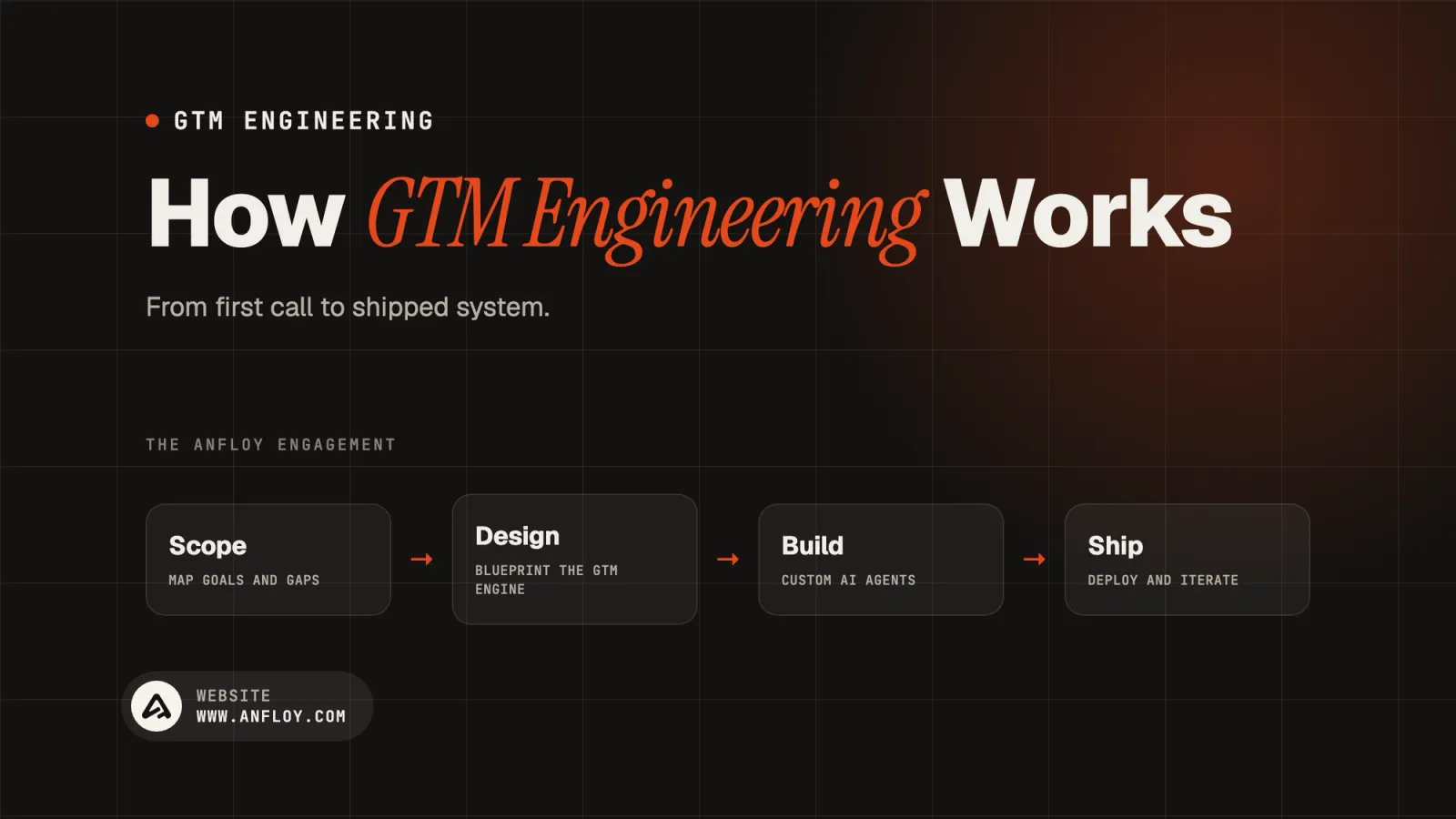
How the engagement actually works?
Discovery call. We start by understanding your sales process, customer journey, operational bottlenecks, and current tech stack, specifically enough to know where the real friction is, not a generic best-practices checklist.
This is also where we tell you honestly if what you need doesn't require a custom build.
Scoping and a fixed-outcome plan.
We define one clear, measurable outcome for the first build rather than a vague, open-ended "improve GTM" mandate.
You get a fixed scope and a fixed price before anything starts, not an open-ended hourly clock.
Build.
We design and ship the system, typically getting a first working agent or workflow live in around two weeks.
Because we're not managing a large account team or a formal enterprise sales process, we spend the time on engineering, not on status decks.
Integration into your stack.
The system is connected directly into your CRM, your sales engagement tools, and whatever else it needs to touch, and it ships into your own repository and infrastructure.
Nothing depends on Anfloy staying involved to keep running.
Measurement and iteration.
We track the system against the outcome it was built for, first measurable results typically inside a month, and iterate based on what the data actually shows, not on a assumption baked in at kickoff.
Handoff and ownership.
Once the system is stable, it's yours outright. No platform fee to keep it running, no dependency on us for it to keep working.
If there's a next system worth building, we scope that separately, on its own merits.
Who this is actually for?
This works best for founders, RevOps leads, and GTM teams who already know roughly where the friction is, messy CRM data, a manual process that doesn't scale, an outbound motion that needs real personalization, and want a working system fast rather than a multi-month enterprise consulting engagement.
It's a weaker fit for organizations that need a large-scale, multi-quarter transformation program with heavy compliance requirements and a big delivery team; that kind of engagement is better served by a larger consultancy built for that scope.
Pricing
We price by fixed scope tied to a defined outcome, not by the hour and not as an ongoing platform subscription. Simple automation projects, a single workflow or a focused agent, typically start around $5,000.
Full GTM engines or a company AI brain build, spanning multiple connected systems, typically start around $10,000.
Every quote is scoped to the specific outcome we're building toward, not a generic package, so the real number depends on what you're actually trying to fix.
Proof this actually works
A 40-person SaaS company replaced Notion as their internal source of truth with a knowledge system we built on retrieval-augmented generation and semantic search, now handling over 200 internal questions a week that used to interrupt the people who actually knew the answers.
A vertical SaaS team without a dedicated SDR function used a signal-based prospecting system we built to surface 38 in-market accounts in 60 days, pipeline that would otherwise have required headcount they didn't have yet.
What makes this different from a typical agency?
A traditional agency model tends to optimize for retainer revenue, which creates a quiet incentive to keep you dependent on ongoing hours.
A SaaS platform model optimizes for subscription revenue, which means the logic behind your workflows lives inside their product, not yours, and stops working the moment you stop paying. Neither model is aligned with getting you to full independence quickly.
We're structured around the opposite incentive: ship something that works, hand you full ownership, and earn the next engagement on its own merits rather than through a locked-in retainer.
That's the same reasoning behind how we think about custom AI versus working with a traditional AI agency, and about hiring a full-time AI engineer versus working with a forward-deployed team like Anfloy: the question isn't which model is universally better, it's which one actually leaves you better off a year from now.
Curious what your first build would actually look like? See a full breakdown of our process before booking anything.
Conclusion
GTM engineering done well is invisible: signals get acted on, data stays clean, and reps spend their time on conversations instead of manual research and reconciliation.
Getting there doesn't require a large retainer or a locked-in platform, it requires a team that ships fast, scopes honestly, and hands you a system you actually own.
That's the whole model behind what we build.
Ready to see what a first build would look like for your team? Book a call, no decks, no demos, just a working session on what to build first.
Frequently Asked Questions
How is this different from hiring a GTM engineering agency that bills hourly?
We price by fixed scope tied to a defined outcome, not hourly time, and every system we build ships into your own repository and infrastructure rather than staying dependent on our continued involvement. Most hourly agency engagements create an incentive to keep billing; ours is structured to get you to ownership as fast as possible.
Do we need to already have a GTM engineer or technical team internally?
No. We handle the engineering directly, and the systems we build are designed to be maintainable by a reasonably technical person on your team afterward, not exclusively by us. If you do have internal technical capacity, we can also work alongside it rather than replacing it.
What if we're not sure what to build first?
That's what the discovery call and the free audit are for. We'd rather tell you honestly that a smaller fix solves the real problem than sell you a larger build you don't need yet.
How fast can something actually be live?
Typical first builds are live in around two weeks, with measurable results usually visible within the first month. Larger, multi-system GTM engines take longer, but we scope and communicate that timeline upfront rather than leaving it open-ended.
What happens after the system is built? Are we locked into an ongoing contract?
No. Once a system is stable and handed off, it's yours outright with no platform fee or ongoing dependency required to keep it running. If you want us to build the next system, that's a separate, standalone engagement scoped on its own merits.
Let's build
what your
company needs.
Drop your email. We'll send The Custom Agent Blueprint on what we'd build first for a company like yours, before you ever take a meeting.