
AI SDR Tools: Evaluate, Compare, Build or Buy
A practical guide to AI SDR tools, what matters when evaluating them, and how to decide between buying a platform or building a custom system.
On this page
- What are AI SDR tools?
- The categories inside "AI SDR Tools"
- 5 AI SDR tools worth evaluating in 2026
- 1. 11x (Alice)
- 2. Artisan (Ava)
- 3. AiSDR
- 4. Regie.ai
- 5. Apollo.io
- The attributes that actually matter
- How to evaluate an AI SDR tool beyond the demo?
- When buying a platform makes sense?
- When building a custom system makes more sense?
- What are the common mistakes when adopting AI SDR tools?
- How Anfloy helps teams choose or build?
- Conclusion
AI SDR Tools: What They Are, How to Evaluate Them, and When to Build Instead of Buy
The AI SDR category grew fast enough that most buyers are evaluating it backward: comparing feature lists and demo polish before ever defining what "good" actually means for their own pipeline.
That's the wrong entry point. An AI SDR tool that books meetings for a company selling a low-touch, single-buyer product is solving a completely different problem than one built for a long, multi-stakeholder enterprise cycle. The category name is the same. The job the tool needs to do is not.
This guide covers what AI SDR tools actually are, the distinct categories they fall into, the attributes worth evaluating regardless of vendor, and the point at which buying a platform stops making sense and building a custom system starts to.
What are AI SDR tools?
AI SDR tools are software products that automate some or all of the work traditionally done by a sales development representative: prospecting, enrichment, personalized outreach, sequencing, and initial qualification.
Some handle a single piece of that chain well. Others attempt to own the whole motion end to end, from finding a prospect to booking a meeting on a rep's calendar.
The category sits downstream of a broader shift already underway in GTM: the same reasoning that separates AI agents from generic AI chatbots applies here. A tool that drafts an email when prompted is an assistant.
A tool that identifies a prospect, enriches the account, writes a message grounded in real context, and enrolls it in a sequence without a human operating every step is closer to an agent acting on a defined outcome.
The categories inside "AI SDR Tools"
The label covers several genuinely different product types, and conflating them is where most evaluation processes go wrong.
Full-stack AI SDR platforms
Products that attempt to own the entire outbound motion: finding prospects, enriching accounts, writing outreach, sequencing, and sometimes even booking meetings autonomously.
These trade flexibility for convenience, a single login and a fast start, in exchange for being constrained to however the vendor modeled the workflow.
Enrichment and data layer tools
Tools focused specifically on populating account and contact data, firmographics, technographics, contact details, from a waterfall of underlying sources.
These usually plug into a broader stack rather than running outreach themselves.
Personalization and copywriting engines
Tools narrowly focused on generating the outreach message itself, using account and signal data as input.
Quality here depends entirely on what data the tool has access to; the best personalization engines are only as good as the enrichment and signal layer feeding them.
Sequencing and engagement platforms
The execution layer: sending emails, managing multi-channel cadences, tracking replies.
Many of these have bolted on AI features for subject lines or send-time optimization without fundamentally changing what the platform does.
Signal and intent layers
Tools that surface buying signals, funding events, job changes, website visits, intent spikes, that feed into a scoring or qualification process elsewhere in the stack. On their own they identify opportunity; they don't act on it.
Most real AI SDR programs end up combining pieces from more than one category, which is exactly where evaluation gets complicated, because a full-stack platform's built-in enrichment is rarely as strong as a dedicated enrichment tool's, and a dedicated tool's output still has to connect back to wherever outreach actually happens.
5 AI SDR tools worth evaluating in 2026
Pricing and packaging in this category shift often, and several vendors don't publish fixed rates, so treat the figures below as a directional starting point to confirm directly before budgeting.
These five represent the range of approaches on the market, from fully autonomous "digital worker" platforms to data-and-engagement suites with AI layered on top.
1. 11x (Alice)
Overview:
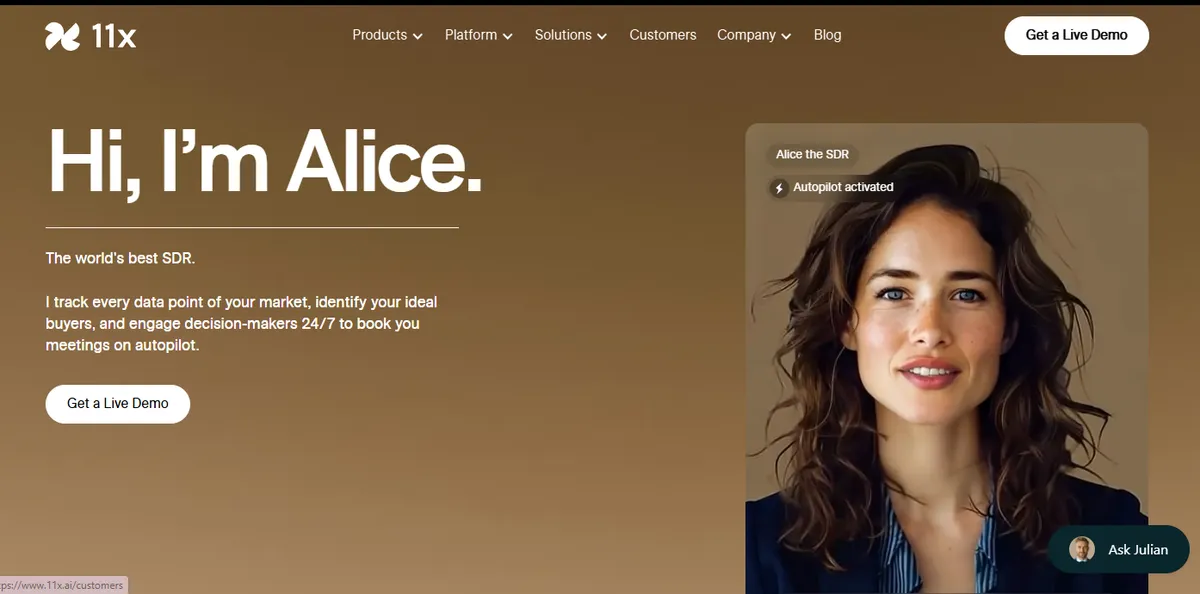
11x positions Alice as a fully autonomous AI SDR, a "digital worker" that runs prospecting, personalized email and LinkedIn outreach, reply handling, and meeting booking with minimal human oversight.
The company also sells Julian, an AI phone agent, as a companion product for inbound voice qualification. It's built for revenue teams that want to consolidate or extend SDR capacity without adding headcount, and it's positioned squarely at mid-market and enterprise buyers rather than lean startups.
Features:
- Autonomous email and LinkedIn prospecting
- AI-personalized outreach at volume
- Automated reply handling and meeting booking
- Optional AI phone agent (Julian) for inbound voice
- Enterprise-oriented onboarding and account support
| Pros | Cons |
|---|---|
| Genuinely autonomous execution, not just assisted drafting | Pricing isn't published and requires a sales conversation |
| Strong ICP-to-outreach targeting when the ICP is well defined | Consistently reported as one of the most expensive tools in the category |
| Broader platform story covering both outbound and inbound voice | No built-in website visitor or intent-signal layer, so it targets broadly rather than prioritizing by live signals |
Pricing:
| Plan | Price | Notes |
|---|---|---|
| Alice (single deployment) | Not publicly listed | Third-party and marketplace data put typical annual contracts around $36,000 to $60,000+ |
| Enterprise / multi-worker | Custom | Scales considerably higher with multiple Alice instances, Julian, and dedicated support |
2. Artisan (Ava)
Overview:
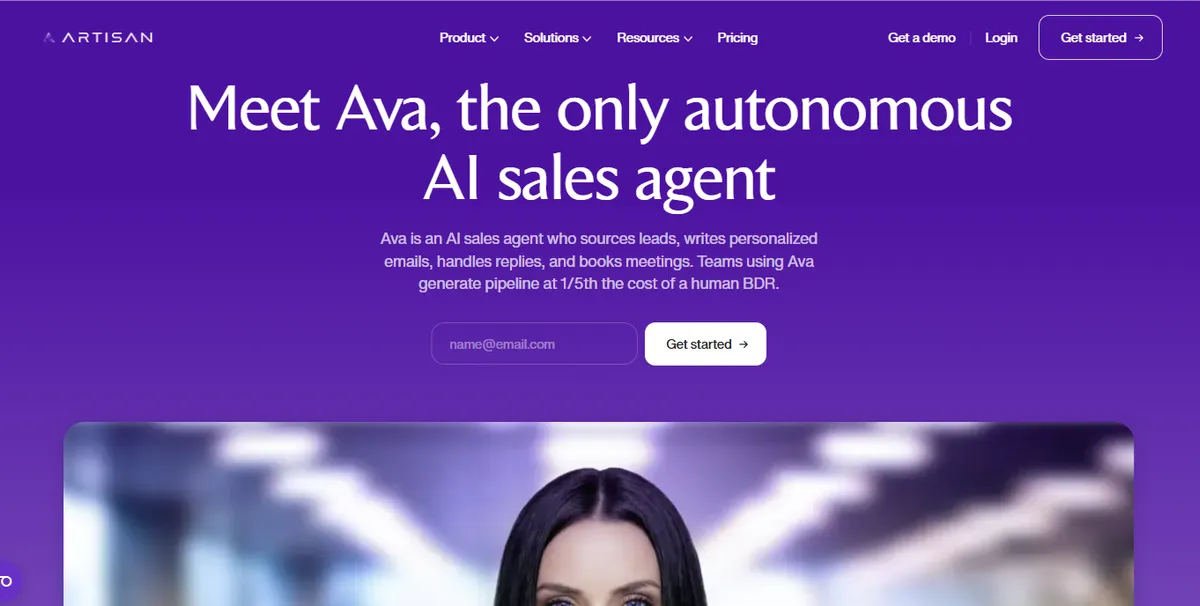
Artisan's Ava is a full-stack autonomous AI BDR bundled with its own contact database, positioned as a replacement for the combination of a data tool plus a junior SDR rather than a bolt-on to an existing stack.
It covers both outbound (sourcing, enrichment, multichannel outreach, autonomous replies, booking) and inbound (working website visitors), which is a broader scope than most competitors in this list.
Features:
- Large proprietary contact database bundled into the platform
- Waterfall enrichment across multiple data sources
- Multichannel outreach, primarily email with LinkedIn touchpoints
- An "autonomy dial" to set how independently Ava operates
| Pros | Cons |
|---|---|
| Consolidates data and outreach into one subscription, offsetting a separate database tool | Requires an annual contract for a still-maturing product category |
| More polished, accessible interface than several competitors | Limited independent case studies and long-term track record |
| Real flexibility in how much autonomy a team hands over | Some users report outreach can read as generic despite personalization claims |
Pricing:
| Plan | Price | Notes |
|---|---|---|
| Entry tier | Roughly $250 to $2,000+/month | Reported figures vary by source; scales with lead and credit volume |
| Typical annual spend | Roughly $18,000 to $57,000/year | Exact pricing requires a sales conversation |
3. AiSDR
Overview:
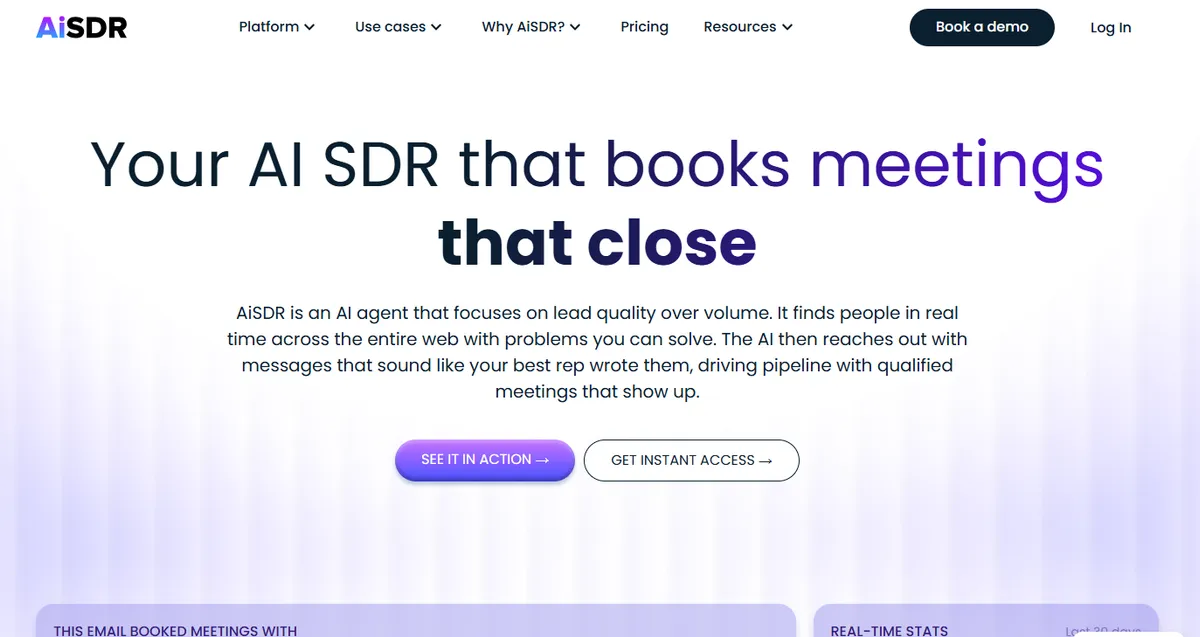
AiSDR is an AI-powered SDR platform built around outbound email and LinkedIn outreach, positioned as a more accessible entry point into autonomous AI SDR territory than enterprise-priced competitors like 11x.
It builds prospect lists from plain-language audience descriptions and live buying signals rather than static list exports, and it handles reply drafting and meeting booking on top of initial outreach.
Features:
- AI-generated prospect lists from natural-language targeting criteria
- Signal-aware list building (job changes, funding events, hiring surges, tech-stack shifts)
- Personalized email and LinkedIn outreach
- AI-drafted reply handling
- Native CRM integration with platforms like HubSpot and Salesforce
| Pros | Cons |
|---|---|
| Meaningfully lower entry price than the fully autonomous enterprise players | Plans above the entry tier require quarterly contracts paid in advance |
| Unlimited seats and mailboxes on its core plans | No native phone dialer |
| Personalization quality frequently cited as a strength in independent reviews | Some users report follow-up messaging can become repetitive over longer sequences |
Pricing:
| Plan | Price | Notes |
|---|---|---|
| Solo / entry tier | From roughly $250/month | Publicly listed, lowest entry point of the fully autonomous tools here |
| Grow / Scale tiers | Up to roughly $750/month+ | Higher tiers add a dedicated onboarding contact and managed services |
4. Regie.ai
Overview:
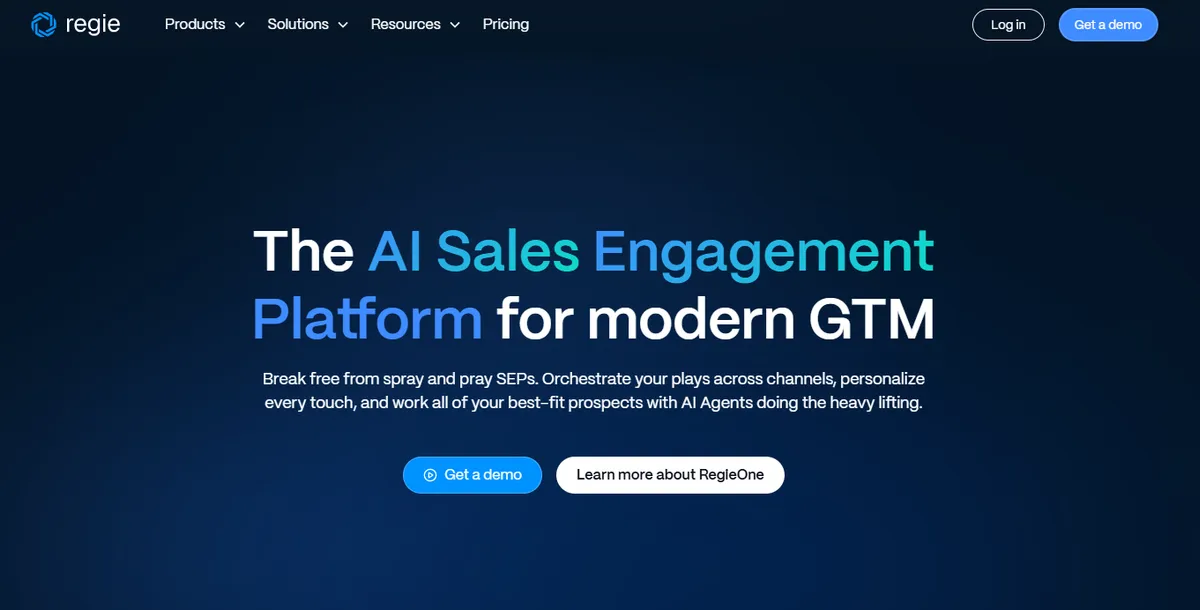
Regie.ai is an AI-first sales engagement platform that combines a large contact database, generative AI sequencing, intent-based prioritization, and a parallel dialer into one system, aimed at replacing a traditional sales engagement platform like Outreach or Salesloft rather than replacing an SDR outright.
It's built around AI agents that continuously research accounts and adjust messaging as new signals arrive.
Features:
- AI-generated email and LinkedIn sequences from prospect and campaign data
- First- and third-party intent signal prioritization
- Parallel dialer supporting multiple simultaneous lines
- CRM integration with major platforms
- Autonomous prospecting agents at higher tiers
| Pros | Cons |
|---|---|
| Sequence and email generation quality frequently praised for needing little manual editing | Entry pricing is high relative to point solutions |
| Parallel dialer meaningfully increases live connect rates for phone-heavy teams | Full autonomous agent capability is reserved for the top tier only |
| Real consolidation play across sequencer, dialer, and enrichment tool | No free trial available |
Pricing:
| Plan | Price | Notes |
|---|---|---|
| AI SEP (core sequencing platform) | $180/user/month | Annual contract; does not include full autonomous prospecting agents |
| Force Multiplier | $499/user/month | Unlocks autonomous prospecting agents, expanded outreach, and priority support |
5. Apollo.io
Overview:
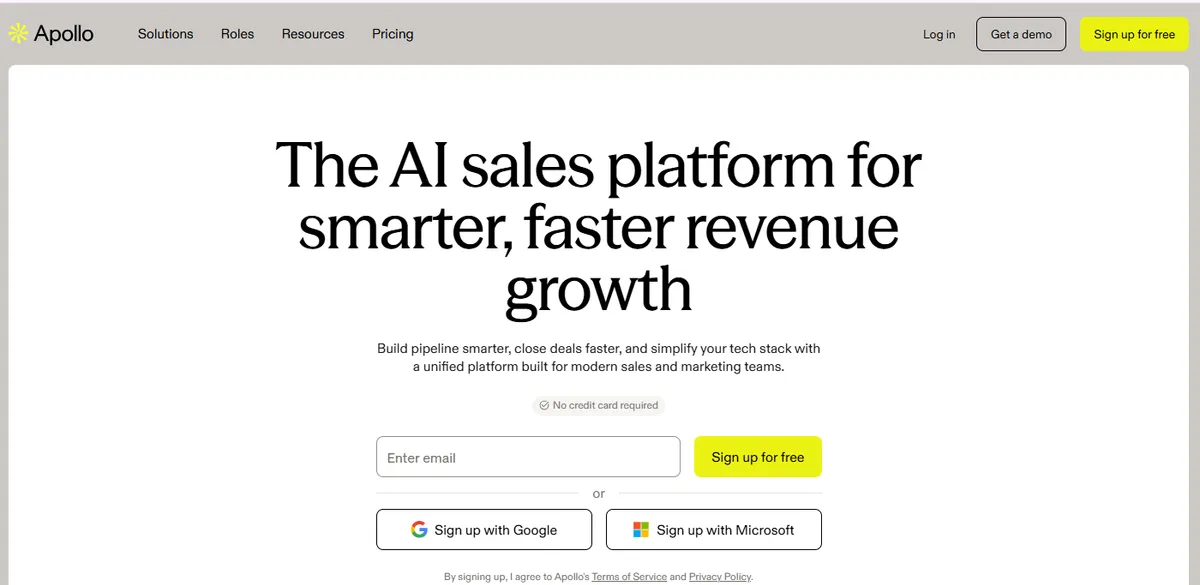
Apollo.io is less a dedicated AI SDR tool and more a sales intelligence and engagement platform with AI features layered on top: a large contact database, email sequencing, a dialer, and AI-assisted writing and call insights.
It's the most widely adopted tool on this list, largely because of its accessible entry price and broad data coverage, and many teams use it as the data and execution layer underneath a more specialized AI SDR or enrichment tool.
Features:
- Very large contact database with credit-based reveals
- Email sequencing and multichannel outreach
- Built-in dialer with call recording insights on higher tiers
- AI-assisted email writing
- Native CRM integrations
| Pros | Cons |
|---|---|
| By far the most affordable entry point among full-featured platforms here | Credit system for contact reveals, enrichment, and dialer minutes can push spend well above the advertised seat price |
| Free tier substantial enough to evaluate before paying | AI-generated outreach frequently described as generic without manual editing |
| Broadest data coverage of any tool on this list | Buying-intent data limited to topic-level signals, not deeper hiring, funding, or tech-stack signals |
Pricing:
| Plan | Price | Notes |
|---|---|---|
| Free | $0/month | 900 credits/year, 2 active sequences, limited AI features |
| Basic | $49/user/month (annual) | No AI features, unlimited sequences |
| Professional | $79/user/month (annual) | Adds AI-assisted writing and dialer |
| Organization | $119/user/month (annual) | Three-seat minimum; advanced reporting and international dialing |
The attributes that actually matter
Feature lists make every AI SDR tool look similar. The attributes below are what actually separate a tool that produces pipeline from one that produces activity.
| Attribute | What to check | Why it matters |
|---|---|---|
| Data quality and sourcing | Where enrichment data actually comes from, and how it's kept current | Personalization built on stale or wrong data reads as generic or, worse, incorrect |
| Signal specificity | Whether the tool can act on account-specific triggers or only static firmographic fit | Static fit alone produces cold-list-quality targeting regardless of how the message is written |
| Output quality at scale | Whether messages sent at volume still read as specific, not templated with a variable swapped in | This is usually where AI SDR tools are judged unfairly favorably in a demo of ten and unfavorably at a real send volume of thousands |
| CRM and stack integration | Whether it reads from and writes back to the systems of record already in place, or becomes its own silo | A tool that doesn't sync cleanly with the CRM creates the exact data fragmentation problem it was meant to solve |
| Governance and control | Whether low-confidence outputs route to a human, and whether every action is logged and auditable | Full autonomy without a review layer is a real risk once the tool has write access to prospect-facing channels and CRM fields |
| Flexibility to your motion | Whether the tool can be configured to your specific ICP, messaging logic, and qualification criteria, or forces your process to match its defaults | A rigid tool built around someone else's assumptions about a "typical" outbound motion rarely fits a specific business without real compromise |
Data quality and signal specificity are worth weighing most heavily. A tool with mediocre copywriting but genuinely strong enrichment and signal detection will usually outperform one with polished output built on generic firmographic targeting, because signal-based prospecting consistently outperforms static list-based targeting regardless of how well the message itself is written.
How to evaluate an AI SDR tool beyond the demo?
A demo is built to look good. Production usage rarely resembles it. A few checks that reveal more than a sales call will:
- Ask to see output against a real segment of your ICP, not the vendor's canned example accounts. Generic industries and roles produce generic-looking personalization; your actual accounts will expose whether the enrichment layer is strong.
- Check what happens on missing or ambiguous data. A tool that guesses silently when a field is empty will eventually send something wrong. One that flags for review or skips is being honest about its limits.
- Trace where the data actually comes from. Some platforms rebrand a single third-party data source as proprietary enrichment. Knowing the real source matters for both accuracy and cost.
- Ask how output quality is measured internally by the vendor, not just what they claim externally. A team that can't describe their own evaluation process for message quality probably isn't rigorously measuring it.
- Model the cost at your actual volume, not the entry tier. Per-contact or per-credit pricing that looks reasonable at a demo volume can shift the economics considerably at real outbound scale, the same calculation covered in AI automation cost more broadly.
Want a second opinion on a tool you're evaluating, or your current stack? Get a free AI infrastructure audit and we'll give you a straight read.
When buying a platform makes sense?
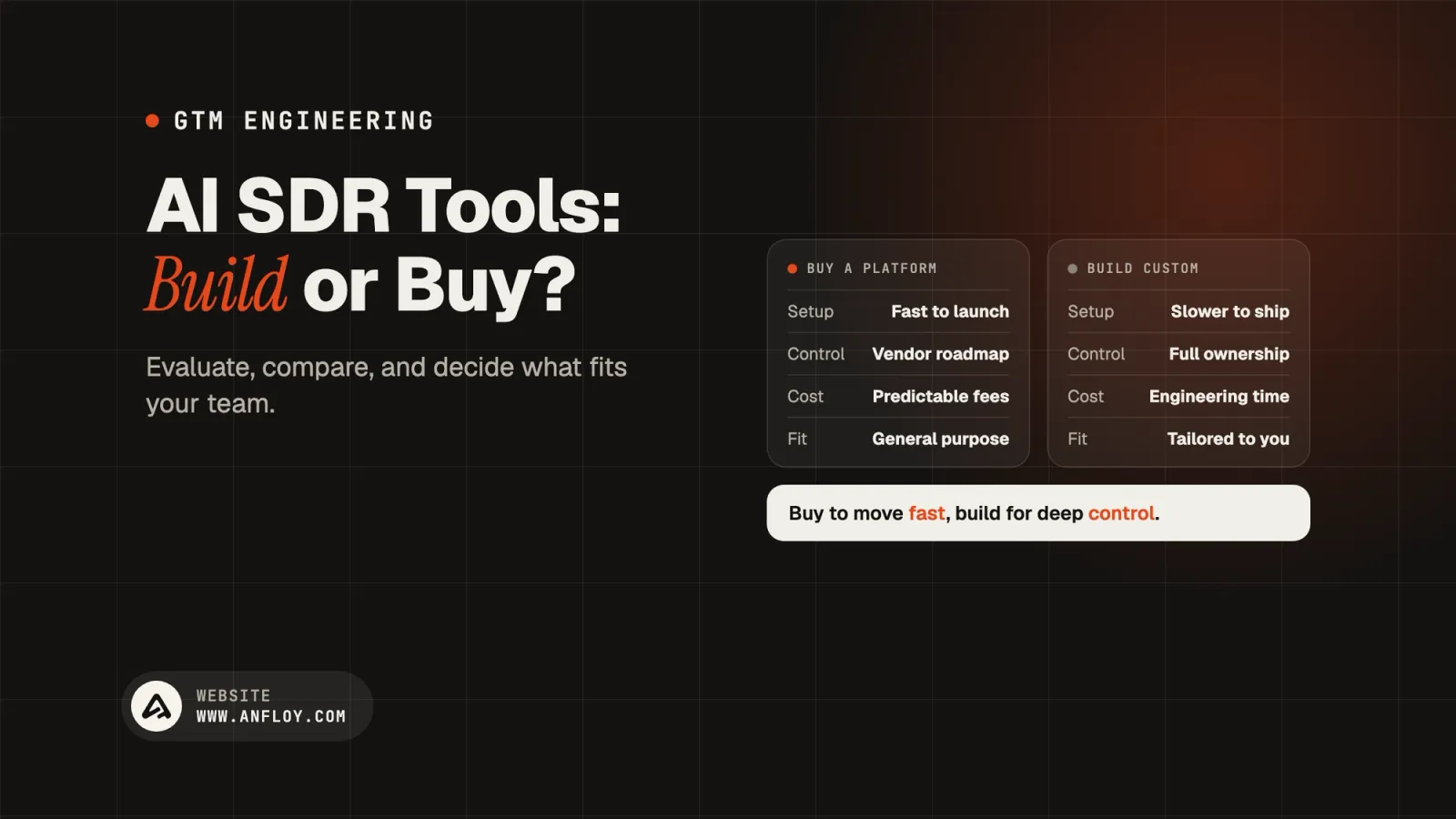
A pre-built AI SDR platform is usually the right call when speed to a working motion matters more than fit, when the outbound motion itself is still relatively standard (single buyer, shorter cycle, well-understood ICP), or when there's no internal capacity to maintain custom infrastructure yet.
Buying compresses time to a working system considerably, the same tradeoff covered in Clay versus custom AI agents and Zapier versus custom AI agents for adjacent categories.
When building a custom system makes more sense?
The calculus shifts once a company's outbound motion has genuine complexity a platform's defaults can't accommodate: a multi-stakeholder buying process, signal sources specific to the business that no off-the-shelf tool integrates with, qualification logic that doesn't map cleanly to a vendor's built-in scoring model, or a need to own the full data pipeline rather than rent access to it through a platform.
This is the same tradeoff explored in replacing SaaS tools with custom AI: a platform's constraints are invisible until a business's actual process runs into them, at which point the team is either working around the tool's assumptions or paying for a system that only does part of the job well.
A custom AI agent built around a company's specific data, signals, and qualification logic doesn't carry those constraints, at the cost of needing someone to build and maintain it.
A useful filter: if the honest answer to "does a standard AI SDR platform's default workflow match how we actually sell" is no, and the gap is significant rather than cosmetic, custom infrastructure is worth pricing out before committing to a platform subscription that will need heavy workarounds within a quarter.
What are the common mistakes when adopting AI SDR tools?
Buying the platform before defining the qualification logic.
A tool can only automate a process that's already been thought through. Teams that adopt a platform hoping it will define their ICP and qualification criteria for them usually end up automating a vague process at higher volume, which is not an improvement.
Judging output quality from a curated demo.
Every vendor demo uses their best examples. The only reliable test is output against real accounts from your own pipeline.
Ignoring where the tool's data actually comes from.
Personalization is only as strong as the underlying enrichment and signal layer, regardless of how polished the generated copy looks.
Skipping governance because the tool "just works."
Any tool with write access to a CRM or send access to prospect inboxes is operating with real permissions.
The same discipline covered in AI agent design best practices, confidence thresholds, human review on ambiguous cases, audit trails, applies to a bought platform exactly as much as a custom-built one.
Assuming AI SDR tools replace the need for a defined ICP and message strategy.
The tool executes a strategy; it doesn't replace having one. A weak targeting and messaging strategy automated at scale just produces more of the same mediocre outreach, faster, which is the same comparison worth understanding in AI SDR versus human SDR.
How Anfloy helps teams choose or build?
Anfloy works with teams on both sides of this decision: evaluating whether an existing or prospective AI SDR platform actually fits their motion, and building custom outbound systems when it doesn't.
Every recommendation starts from the specific qualification logic, signal sources, and buying process a company actually runs, not a generic best-practices list, which is the same approach behind how we build modern outbound engines and AI prospecting systems end to end.
When a custom build is the right call, every system is deployed on infrastructure you own outright, no dependency on a platform vendor's roadmap, pricing changes, or feature deprecations down the line.
Not sure whether to buy a platform or build custom for your motion? See how our process works before committing either way.
Conclusion
AI SDR tools aren't one category with interchangeable options, they're several distinct product types solving different pieces of the outbound problem, and evaluating them well starts with knowing which piece a business actually needs solved.
The teams getting real pipeline out of these tools aren't the ones with the most polished demo. They're the ones that defined their qualification logic and signal sources first, then chose or built the system that actually fits.
Ready to figure out what fits your outbound motion? Book a call, no decks, no demos, just a working session on what to build or buy first.
Frequently Asked Questions
Are AI SDR tools actually replacing human SDRs?
In most organizations, no, not entirely. AI SDR tools tend to absorb the repetitive parts of the role, research, enrichment, first-draft messaging, initial sequencing, while humans still handle complex objections, multi-stakeholder navigation, and judgment calls a tool isn't positioned to make reliably. The mix shifts by company and motion, covered in more depth in AI SDR versus human SDR.
How much do AI SDR tools typically cost?
Pricing varies widely by category and volume, from per-seat platform subscriptions to per-contact or per-credit enrichment costs that scale with send volume. The number that matters isn't the entry-tier price, it's the fully loaded cost at your actual outbound volume, which can look very different from what's quoted in a sales conversation.
What's the biggest risk in adopting an AI SDR tool?
Automating a vague or undefined process at higher volume. A tool executes whatever qualification logic and messaging strategy it's given; if that strategy isn't sound, the tool just produces more of the same mediocre outreach faster, and often at a scale that damages sender reputation before anyone notices the underlying strategy was the problem.
Should a small team buy a platform or build something custom?
Most small teams should start by buying, since speed to a working motion outweighs the flexibility a custom build offers before the outbound process has stabilized. Custom infrastructure becomes worth considering once the team hits genuine friction with a platform's constraints, not before.
Do AI SDR tools integrate with existing CRMs?
Most claim to, but integration depth varies considerably. Some sync bidirectionally with full field-level mapping; others only push a subset of activity data one way. Checking exactly what syncs, and how conflicts are resolved when the same field is touched by multiple systems, is worth doing before committing rather than after.
Let's build
what your
company needs.
Drop your email. We'll send The Custom Agent Blueprint on what we'd build first for a company like yours, before you ever take a meeting.