
How to Enable AI/GTM Engineering for Your Sales and Marketing Processes
Learn how to implement AI and GTM engineering across your sales and marketing processes using AI agents, automation, CRM intelligence, and revenue operations.
On this page
- What is AI/GTM engineering?
- Why traditional sales and marketing processes break down?
- The AI/GTM engineering stack
- How toEnabling AI for Sales?
- How to enabling AI for marketing?
- AI agents for GTM teams
- Revenue intelligence
- KPIs for AI/GTM engineering
- Common implementation mistakes
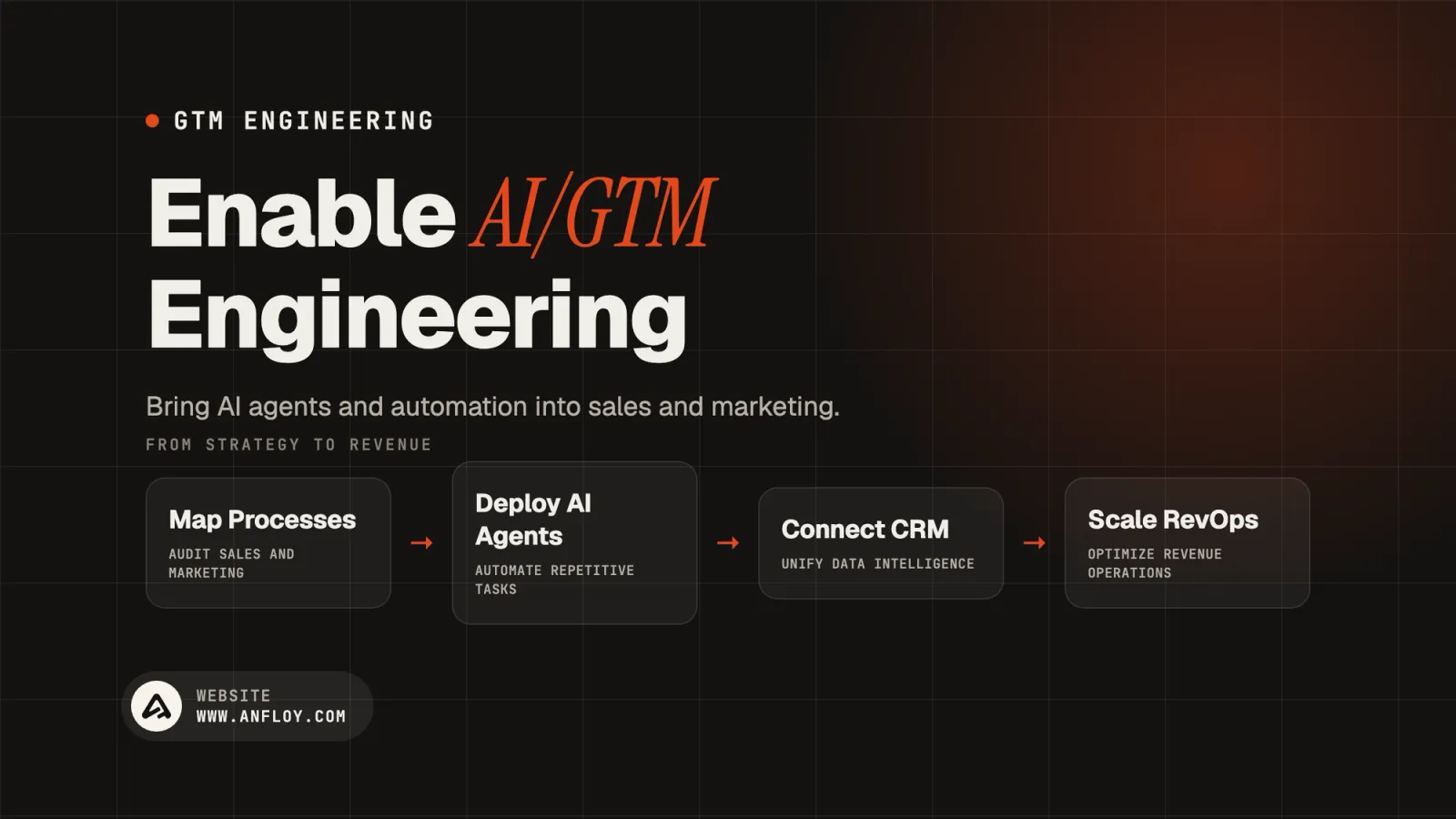
- How Anfloy Enables AI/GTM Engineering for sales and marketing process?
- What is the future of AI/GTM engineering?
- Conclusion
Sales and marketing teams have never had more technology available to them.
The average revenue organization now uses dozens of tools across:
- CRM
- marketing automation
- sales engagement
- analytics
- customer success
- reporting
- customer support
Despite these investments, many teams continue to struggle with the same challenges:
- disconnected systems
- poor CRM hygiene
- manual reporting
- inconsistent personalization
- weak attribution
- operational inefficiencies
The problem isn't necessarily a lack of technology.
It's a lack of infrastructure.
Most organizations have adopted software incrementally over time. They purchased a CRM, added an email platform, implemented marketing automation, and later introduced AI tools.
The result is often a fragmented GTM stack where systems operate independently rather than collaboratively.
Artificial intelligence is changing expectations.
Businesses no longer ask:
"Which tools should we buy?"
They're increasingly asking:
"How do we create intelligent systems that improve how our business operates?"
This is where AI/GTM engineering becomes important.
AI provides intelligence.
GTM engineering provides execution.
Together, they enable businesses to build scalable sales and marketing systems capable of:
- identifying opportunities
- personalizing experiences
- automating workflows
- improving forecasting
- optimizing continuously
In this blo, we'll explore how businesses can implement AI/GTM engineering across their sales and marketing processes and build the infrastructure required for long-term growth.
What is AI/GTM engineering?
AI/GTM Engineering is the practice of designing, building, and optimizing AI-powered systems that support sales, marketing, and revenue operations.
Rather than focusing on individual tools, AI/GTM engineering focuses on creating interconnected systems.
Examples include:
- CRM automation
- AI agents
- workflow orchestration
- Revenue Intelligence
- Company Intelligence
- Company AI Brains
The objective isn't simply to automate tasks.
It's to create a revenue infrastructure capable of continuously improving over time.
A simplified AI/GTM engineering architecture looks like this:

Company AI Brain
       ↓
Company Intelligence
       ↓
CRM Layer
       ↓
AI Agents
       ↓
Sales Automation
       ↓
Marketing Automation
       ↓
Revenue Intelligence
       ↓
AI Orchestration
Each layer contributes to a more intelligent and efficient revenue organization.
Why traditional sales and marketing processes break down?
Most sales and marketing organizations were not designed for AI.
They evolved gradually as new tools became available.
This often creates several challenges.
Disconnected systems
Businesses frequently use separate platforms for:
- CRM
- outbound
- marketing automation
- analytics
- customer support
Without integration, valuable context is lost.
Poor CRM hygiene
Examples include:
- duplicate records
- outdated information
- incomplete profiles
AI systems perform best when supported by accurate data.
Manual reporting
Revenue teams continue to spend significant time preparing:
- dashboards
- reports
- forecasts
These activities create operational overhead without directly contributing to revenue generation.
Weak attribution
Organizations frequently struggle to answer:
- Which campaigns generated pipeline?
- Which channels influenced revenue?
- Which activities created the greatest impact?
Limited personalization
Modern buyers expect relevance.
Generic messaging increasingly produces poor results across both sales and marketing.
AI/GTM engineering addresses these challenges by creating intelligent systems rather than isolated workflows.
The AI/GTM engineering stack
Every organization will implement AI differently.
However, most successful AI/GTM systems include several common layers.
Company AI brain
Acts as the centralized knowledge system.
Examples include:
- CRM records
- customer history
- sales playbooks
- support documentation
- operational knowledge
Company intelligence
Provides visibility into:
- buying signals
- market activity
- technology adoption
- leadership changes
CRM layer
Maintains:
- accounts
- contacts
- opportunities
- customer interactions
AI agents
Examples include:
- Company Intelligence Agents
- CRM Agents
- Revenue Intelligence Agents
- Marketing Agents
Sales automation
Supports:
- lead qualification
- meeting preparation
- outreach personalization
Marketing automation
Supports:
- content distribution
- campaign management
- audience segmentation
Revenue intelligence
Provides:
- forecasting
- pipeline visibility
- attribution
AI orchestration
Coordinates:
- workflows
- approvals
- monitoring
- reporting
Together, these layers create a modern GTM operating system.
How toEnabling AI for Sales?
Sales teams are among the largest beneficiaries of AI.
Modern AI systems support nearly every stage of the sales process.
AI SDRs
AI SDRs can assist with:
- prospect research
- lead qualification
- personalized outreach
- follow-up recommendations
Account research
AI dramatically reduces the time required to understand target accounts.
Examples include:
- employee count
- funding history
- technology stack
- hiring activity
Outreach personalization
AI enables sales teams to personalize:
- subject lines
- introductions
- follow-up messages
- LinkedIn outreach
Meeting preparation
AI can automatically generate:
- account summaries
- stakeholder profiles
- discussion points
- objection handling recommendations
The result is a sales organization that spends less time on administration and more time building relationships.
How to enabling AI for marketing?
Marketing teams are increasingly adopting AI to improve efficiency and scale.
Examples include:
Content generation
AI can support:
- blog outlines
- social media content
- newsletters
- campaign ideas
Audience segmentation
AI helps organizations identify:
- high-value segments
- buying intent
- engagement patterns
Lead scoring
AI models can prioritize leads based on:
- behavior
- ICP fit
- engagement history
Campaign optimization
Examples include:
- subject line testing
- audience selection
- send-time optimization
AI allows marketing organizations to move faster while improving relevance.
AI agents for GTM teams
Modern GTM organizations increasingly deploy specialized AI agents.
Company intelligence agent
Responsible for:
- account research
- buying signal monitoring
- market analysis
CRM agent
Responsible for:
- enrichment
- validation
- duplicate detection
Marketing agent
Responsible for:
- campaign support
- content recommendations
- audience insights
Revenue intelligence agent
Responsible for:
- forecasting
- reporting
- pipeline analysis
Customer success agent
Responsible for:
- onboarding
- retention insights
- renewal opportunities
Together, these agents create an AI-enabled revenue organization. AI Orchestration
AI becomes significantly more valuable when multiple systems work together.
This is where AI orchestration plays a critical role.
AI orchestration coordinates:
- AI agents
- workflows
- approvals
- reporting
- monitoring
- context sharing
A typical AI/GTM workflow may look like this:
Buying Signal
      ↓
Company Intelligence Agent
      ↓
CRM Agent
      ↓
Marketing Agent
      ↓
AI SDR
      ↓
Revenue Intelligence Agent
      ↓
Sales Team
Without orchestration, organizations often create disconnected automations.
With orchestration, businesses create intelligent systems capable of operating continuously.
Examples include:
- automatically enriching CRM AI records
- generating personalized outreach
- updating pipeline reports
- recommending next actions
- escalating opportunities
AI orchestration transforms AI from a collection of tools into an operational layer across the organization.
Revenue intelligence
Revenue Intelligence connects sales and marketing activities to business outcomes.
Examples include:
- pipeline visibility
- forecast accuracy
- attribution
- conversion analysis
- opportunity scoring
Revenue Intelligence helps organizations answer questions such as:
- Which campaigns generate the most revenue?
- Which channels produce the highest ROI?
- Which accounts are most likely to convert?
- Where is pipeline leaking?
Without Revenue Intelligence, organizations frequently optimize for vanity metrics rather than business impact.
Modern Revenue Intelligence systems combine:
- CRM data
- sales activities
- marketing performance
- customer interactions
This creates a more complete understanding of revenue generation.
KPIs for AI/GTM engineering
AI/GTM engineering should be measured using business-oriented metrics.
Sales KPIs
Examples include:
- meetings booked
- conversion rates
- pipeline generated
- deal velocity
Marketing KPIs
Examples include:
- MQLs
- SQLs
- organic traffic
- campaign performance
AI KPIs
Examples include:
- AI adoption
- workflow completion rates
- automation savings
- AI utilization
Revenue KPIs
Examples include:
- Customer Acquisition Cost (CAC)
- Customer Lifetime Value (LTV)
- revenue influenced
- forecast accuracy
Operational KPIs
Examples include:
- CRM health
- workflow reliability
- response time
- process efficiency
Ultimately, organizations should evaluate AI/GTM engineering based on one question:
Did it improve business outcomes?
Common implementation mistakes
Many AI initiatives fail because organizations focus on tools rather than systems.
Implementing AI Without Strategy
AI should support:
- business objectives
- customer outcomes
- operational improvements
Organizations that adopt AI without a strategy frequently struggle to realize value.
Poor data quality
AI systems depend on accurate information.
Examples of common issues include:
- incomplete CRM records
- duplicate contacts
- outdated information
No GTM engineering ownership
Someone must own:
- workflows
- integrations
- AI systems
- reporting
This responsibility increasingly belongs to GTM engineering teams.
Disconnected systems
AI performs best when:
- CRM
- marketing
- sales
- customer success
operate as one coordinated ecosystem.
Lack of measurement
Organizations should continuously monitor:
- adoption
- performance
- business impact
Without measurement, optimization becomes impossible.
How Anfloy Enables AI/GTM Engineering for sales and marketing process?
At Anfloy, we help organizations build AI-powered revenue infrastructure.
Our methodology includes:
Discovery
We identify:
- business objectives
- revenue goals
- GTM challenges
- operational bottlenecks
Company AI brain
We centralize:
- customer history
- CRM data
- documentation
- sales playbooks
This becomes the foundation for every AI system.
GTM engineering
We implement:
- automations
- integrations
- workflow infrastructure
- reporting systems
AI agents
We deploy specialized agents for:
- Company Intelligence
- Revenue Intelligence
- CRM management
- customer success
Revenue intelligence
Every GTM activity is connected to:
- pipeline
- forecasting
- business outcomes
AI orchestration
AI orchestration ensures every system works together effectively.
Continuous optimization
Our implementations improve through:
- testing
- reporting
- AI insights
- customer feedback
The result is a GTM infrastructure designed for long-term scalability.
Build AI-Powered Sales and Marketing Systems
Discover how AI, GTM Engineering, and Revenue Intelligence can transform your sales and marketing processes.
Get Your Free AI Audit
What is the future of AI/GTM engineering?
AI/GTM engineering is still in its early stages.
Over the next decade, several trends will emerge.
AI coworkers
Organizations will increasingly deploy:
- AI SDRs
- AI Analysts
- AI Customer Success Agents
- AI Revenue Intelligence Agents
Autonomous GTM systems
Future systems will automatically:
- identify opportunities
- qualify leads
- personalize outreach
- optimize campaigns
Multi-agent organizations
Businesses will coordinate networks of specialized AI agents through AI orchestration platforms.
AI operating systems
Revenue organizations will increasingly manage:
- sales
- marketing
- customer success
through unified AI operating systems.
The companies that adopt these capabilities early will likely gain significant competitive advantages.
Conclusion
The future of sales and marketing won't be defined by the number of tools a company owns.
It will be defined by how intelligently those tools work together.
AI provides the intelligence.
GTM engineering provides the infrastructure.
Together, they create the foundation for modern revenue organizations.
Businesses that continue relying on disconnected tools and manual processes will increasingly struggle to compete.
Those that invest in AI/GTM engineering will build systems capable of continuously improving, adapting, and generating revenue.
At Anfloy, we help businesses make that transition through Company AI Brains, GTM Engineering, Revenue Intelligence, and AI Orchestration.
Because in the AI era, competitive advantage won't come from having more software.
It will come from building better systems.
Ready to Enable AI/GTM Engineering?
From Company AI Brains and AI Agents to Revenue Intelligence and AI Orchestration, Anfloy helps businesses build scalable GTM systems designed for the future.
Book a Strategy Call
Frequently Asked Questions
How does AI improve sales?
AI improves prospecting, personalization, lead qualification, meeting preparation, and forecasting.
How to use AI in GTM?
Use AI to identify target customers, personalize outreach, automate campaigns, analyze buyer behavior, optimize messaging, predict demand, and improve go-to-market decisions and execution.
How can AI be used in sales and marketing?
AI automates lead scoring, personalizes campaigns, predicts customer behavior, generates content, improves sales forecasting, enhances customer engagement, and boosts conversion rates through data-driven insights.
What is a GTM engineer in AI?
A GTM engineer builds AI-powered sales and marketing workflows, integrates tools, automates processes, manages data, and enables scalable go-to-market execution with technical expertise.
What are the best AI tools for sales in GTM?
Popular AI sales tools include Salesforce Einstein, HubSpot AI, Gong, Clay, Apollo, Lavender, Outreach, and ChatGPT for prospecting, automation, insights, and engagement.

Let's build
what your
company needs.
Drop your email. We'll send The Custom Agent Blueprint on what we'd build first for a company like yours, before you ever take a meeting.