
How to Build a Signal-Based Outbound Engine?
Learn how to build a signal-based outbound engine using AI agents, buying signals, CRM automation, and GTM workflows to generate predictable pipeline.
On this page
- What is a signal-based outbound engine?
- What are buying signals?
- Why traditional outbound falls short?
- Why do static prospect lists fail?
- Why is signal-based selling more effective?
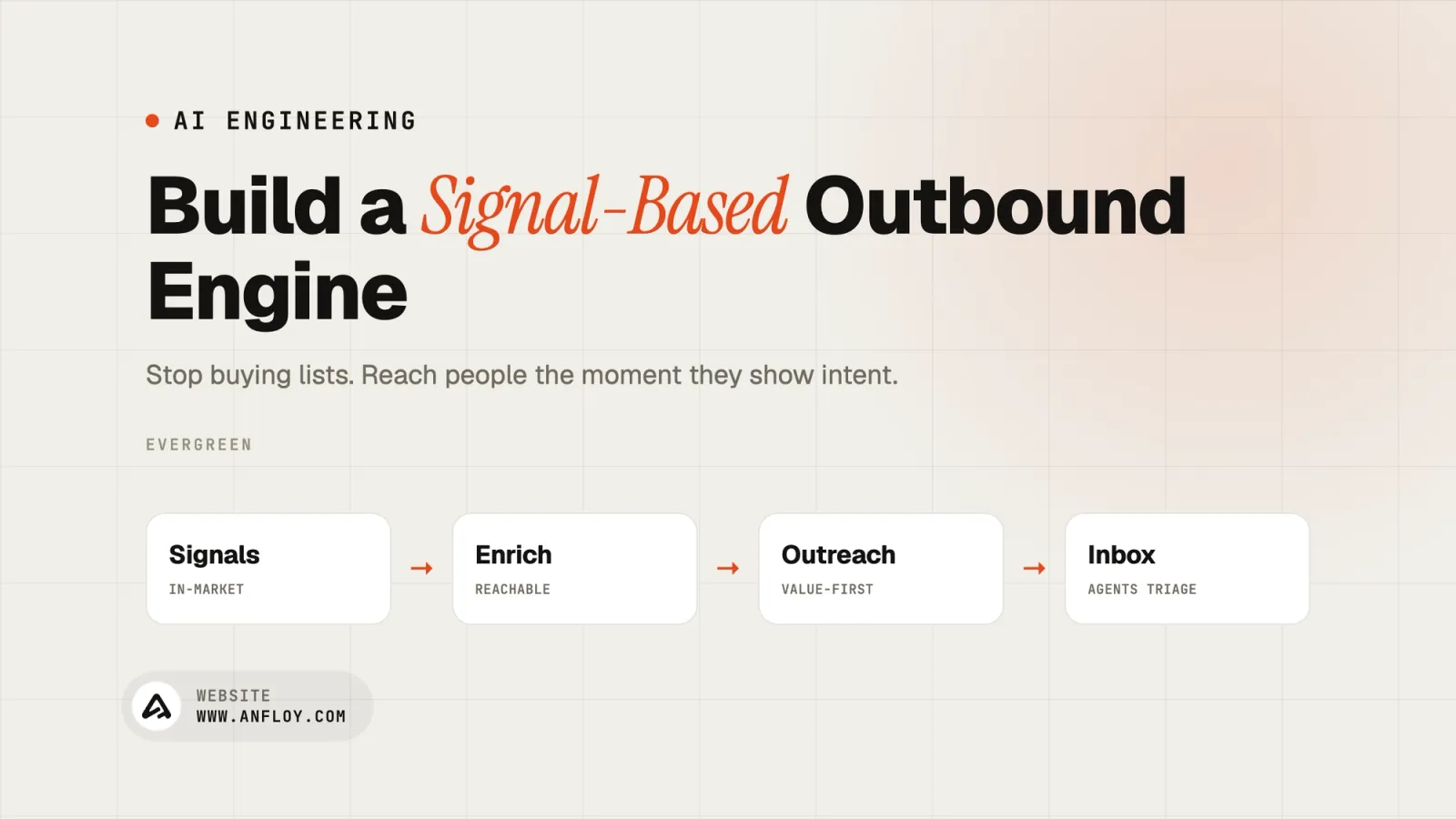
- How to build a signal-based outbound engine?
- What happens behind a signal-based outbound engine?
- What are the benefits of a signal-based outbound engine?
- How does AI create hyper-personalized outreach?
- AI Agents vs Traditional Outbound Automation
- How can AI automate email and Linkedin outreach?
- Common mistakes businesses make
- Why is the future of outbound built on signals instead of lists?
- How Anfloy builds signal-based outbound engines?
- Conclusion
Traditional outbound sales is becoming less effective.
Buying a list, sending thousands of cold emails, and hoping for replies is no longer enough.
Prospects expect relevant outreach that arrives at the right time and solves a real business problem.
The challenge is timing.
Even the best sales message will struggle if the prospect isn't ready to buy.
This is why modern revenue teams are moving toward signal-based outbound.
Instead of reaching out to every company that fits an Ideal Customer Profile (ICP), they focus on businesses showing measurable buying signals.
Examples include:
- raising funding
- hiring new employees
- expanding into new markets
- adopting new technology
- increasing website activity
- engaging with content
These signals indicate that a business may be entering a buying cycle.
When AI continuously monitors these signals and triggers automated workflows, outbound becomes significantly more efficient.
This guide explains how to build a signal-based outbound engine, the technology behind it, and how AI agents can automate the entire process.
What is a signal-based outbound engine?
A signal-based outbound engine is an AI-powered system that identifies buying signals, qualifies opportunities, enriches account data, and triggers personalized outreach automatically.
Unlike traditional outbound campaigns that rely on static prospect lists, a signal-based engine continuously searches for companies showing signs of potential purchase intent.
The objective is simple:
Contact the right company at the right time with the right message.
What are buying signals?
Buying signals are events or behaviors that suggest a company may be evaluating new solutions.
Common examples include:
Company growth
- funding announcements
- office expansion
- mergers and acquisitions
- rapid hiring
Technology changes
- adopting new software
- migrating platforms
- infrastructure upgrades
Hiring activity
Hiring for roles such as:
- SDRs
- RevOps
- Sales Managers
- Marketing Operations
- AI Engineers
often indicates operational investment.
Engagement signals
- website visits
- content downloads
- webinar attendance
- product interactions
Business events
- leadership changes
- product launches
- geographic expansion
- strategic partnerships
Not every signal means a company is ready to buy.
The strength comes from combining multiple signals together.
Why traditional outbound falls short?
Most outbound campaigns follow the same process:
- Build a prospect list.
- Find contact details.
- Send cold emails.
- Wait for replies.
This creates several challenges:
- poor timing
- outdated contact information
- generic messaging
- low reply rates
- wasted sales effort
Signal-based outbound replaces guesswork with context.
Why do static prospect lists fail?
Traditional prospect lists become outdated almost as soon as they are created.
Companies raise funding, hire new executives, adopt new technologies, and change priorities every day. A list generated last month may already contain companies that are no longer actively buying.
As a result, sales teams waste time contacting low-intent prospects while missing businesses that have recently entered a buying cycle.
A signal-based outbound engine continuously refreshes opportunities, ensuring outreach is based on real-time business activity rather than static data.
Why is signal-based selling more effective?
Traditional outbound focuses on who matches your Ideal Customer Profile (ICP).
Signal-based selling focuses on who matches your ICP and is most likely to buy today.
By combining buying signals with AI qualification, CRM intelligence, and workflow automation, businesses can prioritize high-intent accounts, improve personalization, and generate more qualified pipeline with less effort.
How to build a signal-based outbound engine?
A modern outbound engine combines multiple AI-powered components into one connected workflow.
Step 1: Define your ideal customer profile (ICP)
Before monitoring signals, define who you're looking for.
Include factors such as:
- industry
- company size
- revenue
- geography
- technology stack
- business model
- decision-makers
Signals only matter if they come from companies that fit your ICP.
Step 2: Identify high-value buying signals
Choose signals that correlate with purchasing intent.
Examples include:
- new funding rounds
- hiring growth
- executive changes
- new product launches
- technology adoption
- content engagement
Different industries respond to different signals.
Focus on the ones that matter most to your business.
Step 3: Automate signal collection
Instead of manually searching every day, AI agents continuously monitor:
- news sources
- company websites
- hiring platforms
- CRM activity
- marketing engagement
- third-party data providers
This creates a real-time stream of opportunities.
Step 4: Enrich prospect data
Signals alone are not enough.
AI should automatically enrich accounts with:
- company information
- decision-makers
- firmographics
- technographics
- CRM history
This gives sales teams the context they need before outreach begins.
Step 5: Qualify opportunities
Every account should be evaluated before entering the sales pipeline.
AI can assess:
- ICP fit
- buying intent
- engagement level
- account value
- historical activity
Only qualified opportunities move forward.
Step 6: Personalize outreach
Use the collected signals to create relevant messaging.
Instead of saying:
"I thought I'd reach out…"
Reference the business event that triggered the outreach.
For example:
- recent funding
- hiring growth
- product launch
- technology migration
This immediately increases relevance.
Step 7: Automate CRM workflows
Once outreach begins, AI should automatically:
- AI Lead Routing
- create contacts
- update CRM records
- assign opportunities
- trigger follow-ups
- notify sales teams
This keeps the revenue engine synchronized.
What happens behind a signal-based outbound engine?
While sales teams see qualified opportunities arriving in their CRM, several AI-powered processes are working in the background.
AI agents continuously:
- monitor buying signals
- enrich company data
- identify decision-makers
- qualify opportunities
- update CRM records
- trigger workflows
- prioritize accounts
This automated coordination reduces manual work while ensuring every opportunity is evaluated before outreach begins.
What are the benefits of a signal-based outbound engine?
Businesses that adopt signal-driven prospecting often experience:
Better lead quality
Sales teams spend time on companies showing genuine buying intent.
Higher reply rates
Timing and relevance improve engagement.
Faster sales cycles
Prospects already experiencing change often make purchasing decisions faster.
Improved sales productivity
Representatives spend less time researching and more time selling.
Better revenue predictability
A consistent flow of qualified opportunities improves pipeline health.
How does AI create hyper-personalized outreach?
Modern personalization goes far beyond using a prospect's first name.
AI analyzes recent company events, buying signals, hiring activity, technology changes, and industry trends to create outreach that reflects the signal-based outbound prospect's current business situation.
Instead of sending generic emails, sales teams can start conversations that are timely, relevant, and much more likely to receive a response.
AI Agents vs Traditional Outbound Automation
| Traditional Automation | AI Signal-Based Engine |
|---|---|
| Static prospect lists | Continuous signal monitoring |
| Manual research | AI enrichment |
| Generic sequences | Context-aware outreach |
| Rule-based workflows | Intelligent qualification |
| Reactive prospecting | Proactive opportunity detection |
| Manual CRM updates | Automated CRM coordination |
The biggest difference is intelligence.
Instead of reacting to prospects, AI identifies opportunities before competitors.
How can AI automate email and Linkedin outreach?
Once a prospect has been qualified, AI can coordinate outreach across multiple channels.
It can:
- generate personalized emails
- prepare LinkedIn messages
- schedule follow-ups
- update CRM records
- notify sales representatives
- track engagement
Rather than replacing sales professionals, AI removes repetitive administrative work so they can focus on building relationships and closing deals.
Common mistakes businesses make
Monitoring too many signals
Not every signal indicates buying intent.
Focus on quality rather than quantity.
Ignoring ICP fit
A strong signal from the wrong company still creates a poor opportunity.
Personalizing without context
Mentioning a funding announcement isn't enough.
Explain why it matters to the prospect.
Separating sales and RevOps
Signal-based outbound performs best when sales, marketing, and AI for RevOps share the same operational system.
Treating signals as one-time events
Buying intent changes constantly.
AI should continuously monitor and update opportunities.
Why is the future of outbound built on signals instead of lists?
The most successful outbound teams no longer measure success by the number of emails they send.
They measure success by reaching the right companies at the right time.
By combining buying signals, AI qualification, CRM intelligence, and workflow automation, businesses can consistently identify higher-quality opportunities while reducing wasted sales effort.
The future of outbound belongs to organizations that build intelligent systems capable of detecting intent, prioritizing opportunities, and executing personalized outreach at scale.
How Anfloy builds signal-based outbound engines?
At Anfloy, we don't build outbound systems around contact lists. We build them around real-time buying signals, AI agents, and custom GTM infrastructure.
Every outbound engine is designed specifically for your business, integrating with your existing CRM, sales process, and internal tools instead of forcing you into another SaaS platform.
Our implementation follows five stages.
1. Define your ideal customer profile (ICP)
Everything starts with understanding who you want to sell to.
We identify your highest-value customers based on:
- industry
- company size
- revenue
- technology stack
- buying triggers
- decision-makers
This ensures AI agents focus only on accounts that match your growth strategy.
2. Monitor buying signals continuously
Our AI agents monitor signals that indicate purchase intent, including:
- funding announcements
- hiring activity
- leadership changes
- technology adoption
- company expansion
- website engagement
- CRM activity
Instead of relying on static prospect lists, your outbound engine continuously discovers new opportunities as market conditions change.
3. Enrich and qualify every account
Once a signal is detected, AI automatically enriches the account with relevant business information before outreach begins.
The system can retrieve:
- company data
- decision-makers
- firmographics
- technographics
- historical CRM activity
- engagement history
AI agents then evaluate whether the account matches your ICP and prioritize it based on buying intent and potential revenue.
4. Execute personalized GTM workflows
Qualified opportunities move directly into automated GTM workflows.
Depending on your sales process, AI agents can:
- update your CRM
- assign leads to sales representatives
- generate personalized email sequences
- prepare LinkedIn outreach
- trigger follow-up tasks
- notify your sales team
This reduces manual work while ensuring every prospect receives timely, context-aware outreach.
5. Build infrastructure you own
Unlike traditional outbound platforms, Anfloy builds custom AI infrastructure that belongs to your business.
Depending on your goals, we build:
- Agentic Systems that coordinate multiple AI agents across your sales workflows
- Company AI Brains powered by Retrieval-Augmented Generation (RAG), embeddings, hybrid search, and persistent memory
- GTM Engines that connect buying signals, enrichment, qualification, outbound automation, and CRM workflows
- Internal Operations Systems that automate repetitive operational processes across your business
- Full-Stack AI Products deployed on your own cloud infrastructure
You own:
- the code
- the workflows
- the AI logic
- the integrations
- the infrastructure
No vendor lock-in.
No recurring software dependency.
The result is a signal-based outbound engine that continuously identifies high-intent prospects, automates repetitive sales operations, and becomes more valuable as your business grows.
Conclusion
Outbound sales is no longer about sending the highest volume of emails.
It is about identifying the right opportunities before everyone else.
A signal-based outbound engine combines:
- buying signal detection
- AI qualification
- CRM enrichment
- workflow automation
- personalized outreach
- GTM intelligence
into one connected revenue system.
At Anfloy, we help businesses build company-owned outbound infrastructure through:
- GTM engines
- agentic systems
- Company AI Brains
- internal operations systems
- and full-stack AI products
Because the future of outbound isn't built on bigger prospect lists.
It's built on intelligent systems that know who to contact, when to reach out, and how to execute at scale.
Frequently Asked Questions
What are buying signals?
Buying signals are business events or behaviors that suggest a company may be evaluating new solutions, such as funding announcements, hiring activity, technology adoption, or website engagement.
Why is signal-based outbound better than traditional outbound?
It improves timing, personalization, lead quality, and sales productivity by focusing on companies showing real buying intent.
Can AI automate outbound prospecting?
Yes. AI can identify prospects, monitor signals, enrich accounts, qualify leads, update CRM systems, and trigger personalized outreach automatically.
Which businesses benefit most from signal-based outbound?
B2B SaaS companies, agencies, consulting firms, recruiting businesses, and technology companies with outbound sales teams benefit the most.
Let's build
what your
company needs.
Drop your email. We'll send The Custom Agent Blueprint on what we'd build first for a company like yours, before you ever take a meeting.