
Agentic AI for GTM Teams: What It Is & How to Make It Stick
Learn what agentic AI means for GTM teams, how it differs from automation and AI assistants, the components it requires, and how to move from a one-off agent to a system that actually runs.
On this page
- What is agentic AI?
- Agentic AI vs. Automation vs. AI Assistants
- What are the entities behind a GTM agent?
- Where agentic AI fits in a GTM workflow?
- Why one-off agents stop working?
- From a single agent to a system that holds up
- Common mistakes GTM teams make with agentic AI
- How Anfloy builds agentic systems for GTM teams?
- Conclusion
Most GTM teams don't fail at agentic AI because the model was wrong.
They fail because they built one agent, watched it work for a few weeks, then watched it quietly break, and no one owned the fix. The agent didn't get worse. The team's operating discipline around it just never existed in the first place.
This guide covers what agentic AI actually means for a GTM team, how it's different from the automation and AI assistants most teams already have, the components a working agentic system needs, and what separates a team that gets a durable system from a team stuck rebuilding the same demo every quarter.
What is agentic AI?
Agentic AI refers to AI systems built to pursue an outcome, not just respond to a prompt. Instead of waiting for someone to ask a question, an agent can retrieve information, reason through a decision, call tools and APIs, and take action, then adjust based on what happens next.
The distinction matters because it changes what the system is responsible for.
A chatbot answers a question and stops.
An AI assistant helps a person complete a task, but the person still drives the process.
An agent owns a piece of the outcome. Given a new lead, an agent doesn't wait to be asked what to do with it. It enriches the account, checks it against your ICP, evaluates buying signals, and either qualifies it or routes it for review, without a human coordinating every step in between.
Agentic AI vs. Automation vs. AI Assistants
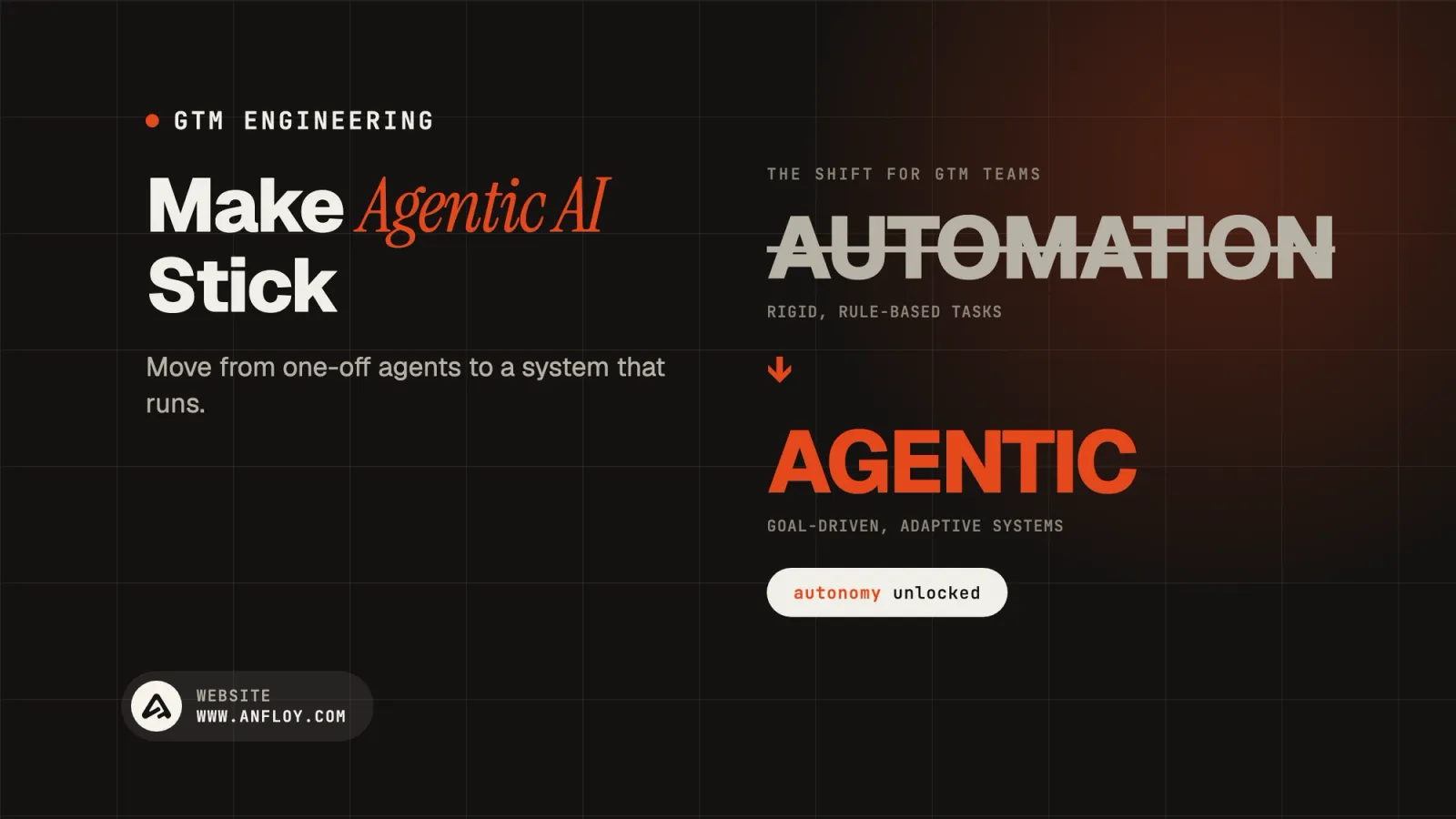
These three get used interchangeably, but they sit at different points on the same spectrum, and the difference determines what kind of GTM problem each one is suited to solve.
| Category | How it decides | Best suited for | Breaks when |
|---|---|---|---|
| Rule-based automation | Fixed logic: if X, then Y | Deterministic, high-volume tasks | Inputs fall outside the rules |
| AI assistant | Responds to a prompt, human drives | One-off tasks, drafting, research | Left unsupervised |
| Agentic AI | Reasons toward a goal, takes action | Judgment-based, multi-step workflows | Governance and monitoring are missing |
A GTM team that's automated its CRM with Zapier-style rules has solved the deterministic layer.
The gap agentic AI fills sits above that: interpreting a signal, classifying sentiment in a reply, deciding whether a lead is worth a human's time, none of which a fixed rule can do reliably.
What are the entities behind a GTM agent?
An agent isn't one thing. It's a small set of connected components, each with its own job.
Understanding these as distinct entities, not one black box, is what makes an agent debuggable instead of mysterious.
The reasoning layer
This is the model itself, the part that interprets input and decides what to do. It's necessary but not sufficient.
A model with no access to your data and no memory of past interactions will produce generic output regardless of how capable it is.
Company knowledge
Your agent is only as good as what it can retrieve about your business. This includes your ICP definition, your pricing, your sales playbooks, and your CRM history.
Without this layer, an agent is reasoning about a business it doesn't actually know, which is a large part of how building a company AI brain became its own discipline rather than a footnote.
Tool access
An agent becomes operational the moment it can call your CRM, your sales engagement platform, your enrichment provider, or Slack.
This is also where AI CRM automation and AI for CRM data enrichment live, an agent reading and writing to the systems your GTM motion actually runs on.
Memory
Business workflows aren't single interactions. An agent that forgets everything between runs can't track a lead across a multi-step qualification process or recognize that a contact was already reached out to last week.
Triggers
What starts the agent. This is usually one of three types: a person asking for something, an event in a connected system (a new lead, a signal, a contract signed), or a schedule (a weekly pipeline review, a daily enrichment pass).
Governance
Permissions, approval steps for high-stakes actions, and audit trails. This is the entity most one-off agents skip entirely, and it's almost always the reason they stop being trusted.
Where agentic AI fits in a GTM workflow?
A useful way to see the relationship between these entities is to trace one workflow end to end.
Take outbound qualification:
- Trigger: A buying signal is detected, a funding round, a job change, a tech stack addition.
- Reasoning + tool access: The agent enriches the account, checks it against ICP criteria, and evaluates whether the signal is strong enough to act on.
- Company knowledge: It pulls relevant context, similar accounts previously closed, positioning that's worked for this vertical.
- Action: It drafts a signal-specific outreach premise and either enrolls the contact or flags it for a rep to review, depending on confidence.
- Memory: The full record, signal, enrichment, decision, output, gets written back to the CRM so the next workflow that touches this account has context.
- Governance: Low-confidence outputs route to a human before anything sends.
No single step here is exotic. What makes it agentic is that the system carries the outcome from signal to CRM update without a human manually operating each handoff, while still keeping a human in the loop where judgment calls are genuinely uncertain.
This is the same pattern behind AI-powered lead qualification and AI lead routing, reasoning and tool access chained together around a single business outcome.
Curious what this would look like in your pipeline? Get a free AI infrastructure audit and we'll map it against your actual stack.
Why one-off agents stop working?
Nearly every GTM team that experiments with agentic AI ends up at the same wall: the agent worked, then it quietly didn't, and nobody noticed until pipeline was affected.
Five gaps show up repeatedly.
- No monitoring. The agent fails silently. A sequence doesn't enroll, a score comes back wrong, and no one knows until a rep asks why a lead never got touched.
- No clear owner. It was built by whoever was curious enough to try, not by someone accountable for the GTM motion it now touches. When it breaks, no one is positioned to fix it.
- No feedback loop. Performance isn't measured against anything, so there's no way to tell if the agent is actually helping or quietly degrading.
- No documentation. The logic lives in one person's head or a prompt buried in a doc no one else can find. It becomes unmaintainable the moment that person moves on.
- No governance. Changes get made ad hoc, and a small tweak upstream breaks something downstream without anyone connecting the two.
None of these are technology problems. They're the same operational discipline gaps that show up anywhere a manual process gets automated without anyone assigned to own it afterward.
Which is exactly the reasoning behind AI agent design best practices and a proper AI agent security checklist: the system needs an owner and a review cadence as much as it needs a good prompt.
From a single agent to a system that holds up
Moving past a one-off agent doesn't require a large team or a platform rebuild.
It requires a small number of concrete additions, roughly in this order:
Connect it to the CRM, if it isn't already.
An agent that outputs to a spreadsheet or a Slack channel and nowhere else isn't part of the GTM motion, it's a side experiment.
Add a failure alert.
A single Slack notification on error is enough to close the "no monitoring" gap. The point isn't sophistication, it's that someone finds out the same day something breaks, not three weeks later.
Assign a named owner.
Not "the tech team." One person, usually in RevOps or GTM Ops, accountable for the agent the way they'd be accountable for CRM data quality.
Add output validation between steps.
If the agent's output feeds into another system or another agent, check the format before it passes forward.
This is the single most common point of silent failure in multi-agent AI architecture, one step's output changes shape and the next step can't parse it.
Write down what changed, and why.
A shared doc with a date, the change, and the reason is enough at this stage. The goal isn't a formal process, it's that a change six weeks ago is still explainable today.
Put agent performance on the same dashboard as everything else.
Once agent output, meetings booked, qualification accuracy, response time, sits next to rep performance and pipeline metrics, it stops being a side project and starts being infrastructure.
Teams that do this consistently tend to end up with something closer to a multi-agent system, where specialized agents handle qualification, enrichment, and outreach separately but share a common knowledge layer, rather than one general-purpose agent trying to do everything and doing none of it particularly well.
Common mistakes GTM teams make with agentic AI
Treating the model as the whole solution.
The reasoning layer is necessary, but company knowledge, memory, tool access, and governance are what make it usable in production.
A powerful model with none of that context still produces generic output.
Starting from the technology instead of the bottleneck.
"What can this agent do" produces demos. "Which of our workflows depends on judgment we currently do manually and inconsistently" produces something worth maintaining.
Building one agent to do everything.
A general-purpose agent handling qualification, enrichment, outreach, and CRM hygiene at once is harder to debug, harder to evaluate, and fails in ways that are difficult to isolate.
Specialized agents with clear boundaries are easier to trust individually.
Skipping human review on high-stakes actions.
Not every decision should be fully autonomous. Sending a contract, communicating with a high-value account, or writing to a financial field should still have a checkpoint, even in a mature system.
Measuring activity instead of outcomes.
More emails sent or more leads scored isn't the goal. Qualified pipeline generated, time saved, and accuracy of the agent's decisions are.
How Anfloy builds agentic systems for GTM teams?
Anfloy builds the full stack around the reasoning layer, the company knowledge base, the tool integrations, the memory, and the governance, so an agent isn't a fragile experiment sitting on top of a prompt.
Every GTM engine we build starts from a specific business outcome, not a demo of what's technically possible, and gets deployed with monitoring, ownership, and audit trails built in from day one rather than added after something breaks.
This is the same approach behind how we think about building agents with Claude more broadly: the model provides the intelligence, but the infrastructure around it, the knowledge layer, the integrations, the governance, is what determines whether it holds up under real usage.
Every system is deployed on infrastructure you own outright. No dependency on a platform's roadmap, no rebuilding from scratch if you switch vendors later.
Want a second opinion on your current setup? See how our process works before committing to anything.
Conclusion
Agentic AI gives GTM teams a way to automate the parts of the pipeline that require judgment, not just the parts that follow a fixed rule. The technology to do this is available and increasingly commoditized.
What separates the teams that get lasting value from it isn't a better model or a cleverer prompt, it's whether someone owns the system, monitors it, and treats it as operational infrastructure rather than a one-time build.
Ready to see where agentic AI fits in your GTM motion? Book a call, no decks, no demos, just a working session on what to build first.
Frequently Asked Questions
Is agentic AI the same as an AI agent?
They describe the same underlying idea. "Agentic AI" refers to the category of systems designed to pursue outcomes autonomously; "AI agent" usually refers to a specific instance of one built for a defined task, like lead qualification or CRM enrichment.
Do we need a dedicated engineering hire to run agentic AI in GTM?
Not necessarily. What's required is a named owner, usually in RevOps or GTM Ops, accountable for monitoring, governance, and iteration. That can be an existing team member with the right support, or an external partner running the system on your behalf.
How is agentic AI different from what we already have in HubSpot or Salesforce?
Native CRM AI features typically operate inside pre-defined workflows specific to that platform. Agentic AI can reason across systems, call multiple tools, and make judgment calls that don't reduce to a fixed rule, which makes it suited to workflows that span your CRM, your enrichment tool, and your outbound platform at once rather than living inside one.
What's the most common reason an agentic AI project gets abandoned?
Missing operational discipline, not model quality. Agents that lack monitoring, a named owner, and a way to measure performance tend to quietly stop being trusted after the first unnoticed failure, regardless of how well they worked initially.
How long does it take to go from a single agent to a governed system?
It depends on how many workflows are involved, but the core additions, CRM connection, failure alerting, a named owner, and basic performance tracking, are usually achievable in a matter of weeks once someone is accountable for doing them. The harder part is rarely technical; it's committing the ownership.
Let's build
what your
company needs.
Drop your email. We'll send The Custom Agent Blueprint on what we'd build first for a company like yours, before you ever take a meeting.