
Free GTM Audit: Find the Gaps in Your Revenue Engine
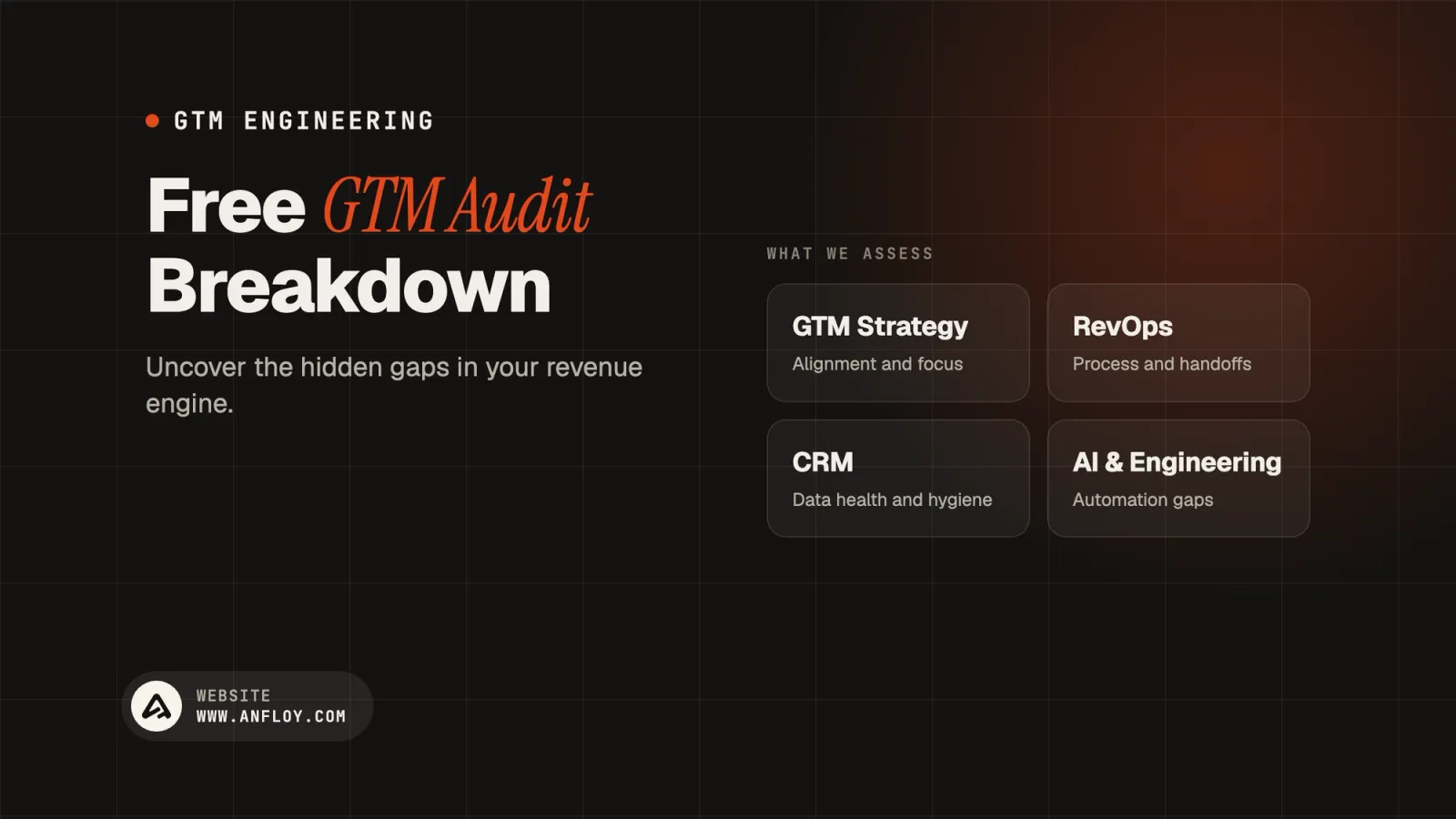
Get a free GTM audit to uncover hidden revenue gaps. Assess GTM strategy, RevOps, CRM, AI & GTM Engineering to grow faster.
On this page
- What is a GTM audit?
- Understanding your revenue engine
- Why businesses need a GTM audit?
- What does a free GTM audit include?
- Why free GTM audits create immediate value?
- The most common revenue engine gaps
- Why traditional audits often miss the real problem?
- How a GTM audit identifies revenue bottlenecks?
- GTM audit framework
- What areas evaluated during a GTM audit?
- Technology stack assessment
- GTM engineering assessment
- What happens after the audit?
- Why businesses choose Anfloy for GTM audits?
- Free GTM audit checklist: score your revenue engine
- What you'll receive from Anfloy's free GTM audit?
- Conclusion
Every revenue team eventually encounters the same challenge.
Marketing generates leads, sales pursues opportunities, customer success manages existing accounts, and leadership reviews dashboards yet growth slows despite increasing investments.
The problem is rarely a lack of effort.
Instead, hidden operational gaps prevent the entire revenue engine from performing at its full potential.
Disconnected CRM systems, inconsistent lead qualification, manual workflows, poor customer data, fragmented reporting, and misaligned Revenue Operations often create friction throughout the customer lifecycle.
Many businesses respond by purchasing additional software or hiring more employees.
However, adding more tools rarely solves structural problems.
The first step toward improving revenue performance is understanding where the gaps actually exist.
A free GTM audit provides a structured evaluation of your go-to-market strategy, GTM Engineering, Revenue Operations, CRM architecture, workflow automation, AI readiness, and customer lifecycle processes to identify opportunities that improve efficiency and revenue growth.
What is a GTM audit?
A GTM audit is a systematic assessment of the people, processes, technology, and operational systems that support a company's go-to-market strategy.
Rather than evaluating marketing or sales independently, a GTM audit examines how every customer-facing function works together to generate, convert, retain, and expand revenue.
The objective is not simply to identify problems.
The objective is to uncover opportunities that improve operational efficiency, customer experience, forecasting accuracy, and long-term business growth.
A comprehensive GTM audit evaluates:
- GTM strategy
- Revenue Operations
- GTM Engineering
- CRM architecture
- Workflow automation
- Sales processes
- Marketing operations
- Customer success
- AI implementation
- Data quality
- Revenue Intelligence
- Technology integrations
Understanding your revenue engine
A revenue engine is an interconnected operational system.
Every department influences the customer journey.
Business Goals
        │
        ▼
Go-to-Market Strategy
        │
        ▼
Revenue Engine
        │
        ├── Marketing
        ├── Sales
        ├── Customer Success
        ├── Revenue Operations
        ├── GTM Engineering
        ├── CRM
        ├── AI Systems
        └── Workflow Automation
        │
        ▼
Customer Acquisition
        │
        ▼
Revenue Growth
When one component becomes inefficient, the entire revenue engine loses effectiveness.
A GTM audit identifies those weak points before they become expensive operational problems.
Why businesses need a GTM audit?
Many organizations only evaluate performance after revenue slows.
By then, operational issues have often existed for months.
Regular GTM audits help businesses identify hidden inefficiencies earlier.
Typical benefits include:
- Improved CRM accuracy
- Faster lead response times
- Better sales and marketing alignment
- Higher-quality customer data
- Improved Revenue Operations
- Better forecasting
- Stronger AI implementation
- Increased workflow automation
- More accurate reporting
- Better customer experiences
Rather than reacting to declining performance, businesses can proactively optimize their revenue systems.
What does a free GTM audit include?
A high-quality GTM audit examines every layer of your go-to-market ecosystem.
GTM strategy assessment
Evaluate whether your strategy clearly defines:
- Target market
- Ideal Customer Profile (ICP)
- Buyer personas
- Positioning
- Pricing
- Sales motion
- Marketing channels
- Customer lifecycle
Without strategic clarity, operational improvements create limited business value.
CRM audit
CRM systems should support every revenue function.
A CRM audit evaluates:
- Data quality
- Pipeline structure
- Custom objects
- Lifecycle stages
- User adoption
- Permissions
- Reporting
- Automation readiness
Poor CRM architecture often creates bottlenecks throughout the customer journey.
Revenue operations assessment
Revenue Operations aligns marketing, sales, and customer success.
The audit reviews:
- Revenue processes
- Forecasting
- KPI reporting
- Pipeline management
- Territory planning
- Operational governance
- Cross-functional alignment
RevOps maturity directly influences scalability.
GTM engineering review
GTM Engineering transforms strategy into operational execution.
Typical review areas include:
- Workflow automation
- CRM architecture
- API integrations
- Customer lifecycle automation
- AI implementation
- Revenue Intelligence
- System scalability
- Technical documentation
This review identifies technical improvements that support long-term growth.
AI readiness assessment
Modern GTM organizations increasingly depend on artificial intelligence.
The audit evaluates opportunities for:
- AI lead scoring
- AI SDR workflows
- Predictive forecasting
- Company AI Brain
- Customer segmentation
- Workflow automation
- Revenue Intelligence
- Executive reporting
Rather than recommending AI for every process, the assessment identifies where AI creates measurable business value.
Why free GTM audits create immediate value?
Even when organizations postpone implementation, the audit itself often reveals operational opportunities that can be addressed immediately.
Examples include:
- Duplicate CRM records
- Inconsistent lead routing
- Missing lifecycle stages
- Manual approval workflows
- Unused automation capabilities
- Disconnected reporting
- Incomplete customer data
- Poor system integrations
These findings frequently improve operational performance without requiring major technology investments.
The most common revenue engine gaps
Across growing B2B companies, several patterns appear repeatedly.
The most common GTM gaps include:
- Undefined ICPs
- Weak positioning
- Sales and marketing misalignment
- CRM data quality issues
- Manual workflows
- Limited automation
- Inconsistent Revenue Operations
- Poor forecasting
- Lack of AI adoption
- Fragmented technology stacks
Identifying these issues early reduces operational complexity while improving revenue predictability.
Why traditional audits often miss the real problem?
Many businesses perform separate audits for marketing, sales, CRM, or customer success.
While useful, these siloed reviews rarely explain why the entire revenue engine underperforms.
A GTM audit evaluates relationships between systems rather than individual departments.
For example:
- Poor lead quality may originate from ICP definition rather than marketing.
- Weak forecasting may result from CRM architecture rather than sales execution.
- Low AI performance may stem from poor customer data rather than the AI platform itself.
This systems-first approach uncovers root causes instead of treating isolated symptoms.
How a GTM audit identifies revenue bottlenecks?
A modern revenue engine consists of dozens of interconnected processes.
A small issue in one system often creates downstream problems across marketing, sales, customer success, and Revenue Operations.
For example, an inaccurate CRM field can affect:
- Lead routing
- AI lead scoring
- Sales reporting
- Pipeline forecasting
- Customer onboarding
- Executive dashboards
Rather than evaluating these systems independently, a GTM audit maps how information moves throughout the organization.
This approach helps identify the root cause of operational friction instead of treating isolated symptoms.
GTM audit framework
A comprehensive GTM audit follows a structured evaluation framework.
Each layer builds upon the previous one.
Business Objectives
        │
        ▼
Go-to-Market Strategy
        │
        ▼
Revenue Operations
        │
        ▼
GTM Engineering
        │
        ▼
CRM Architecture
        │
        ▼
Workflow Automation
        │
        ▼
AI Implementation
        │
        ▼
Revenue Intelligence
        │
        ▼
Continuous Optimization
This framework reduces retrieval complexity for both business stakeholders and AI systems while ensuring every operational dependency is evaluated.
What areas evaluated during a GTM audit?
Market positioning
An audit begins by determining whether the business communicates a clear value proposition.
Evaluation areas include:
- Market positioning
- Competitive differentiation
- Customer messaging
- Pricing alignment
- Product-market fit
Weak positioning often reduces the effectiveness of every downstream marketing and sales initiative.
Ideal customer profile (ICP)
Many organizations target customers that are unlikely to become long-term clients.
The audit evaluates:
- Customer segmentation
- Industry focus
- Company size
- Buying maturity
- Revenue potential
- Expansion opportunities
A refined ICP improves customer acquisition efficiency while reducing wasted sales effort.
Sales process evaluation
The audit reviews the complete revenue journey.
Common evaluation points include:
- Lead qualification
- Opportunity progression
- Pipeline stages
- Win rates
- Sales cycle length
- Follow-up consistency
- Forecast accuracy
The objective is to identify process improvements that increase conversion rates without increasing headcount.
Marketing performance
Marketing evaluation extends beyond campaign performance.
The assessment includes:
- Content strategy
- Organic search
- Paid acquisition
- Lead generation
- Attribution
- Conversion pathways
- Customer education
Strong marketing should support every stage of the customer lifecycle rather than simply generating leads.
Customer success
Revenue growth depends on more than acquiring customers.
The audit also examines:
- Customer onboarding
- Product adoption
- Renewal processes
- Expansion opportunities
- Customer health
- Success automation
Improving retention often produces greater long-term ROI than increasing acquisition spend.
Technology stack assessment
Technology should simplify operations.
Instead, many organizations accumulate disconnected software over time.
A GTM audit evaluates the complete technology ecosystem.
Common platforms include:
- Salesforce
- HubSpot
- Microsoft Dynamics
- Marketo
- Outreach
- Salesloft
- Gong
- Apollo
- Clay
- 6sense
The objective is not to recommend additional software.
Instead, the audit determines whether existing systems work together efficiently.
GTM engineering assessment
Technical implementation plays a critical role in revenue performance.
The audit evaluates whether GTM Engineering supports scalable growth.
Review areas include:
- CRM architecture
- Workflow automation
- API integrations
- Data enrichment
- AI workflows
- Customer lifecycle automation
- Documentation
- System governance
Well-designed GTM Engineering reduces operational friction while increasing organizational agility.
AI readiness assessment
Artificial intelligence should support measurable business outcomes rather than introduce unnecessary complexity.
The audit identifies opportunities for:
- AI lead scoring
- AI SDR workflows
- Predictive forecasting
- Revenue Intelligence
- Company AI Brain implementation
- Customer segmentation
- Workflow optimization
- Executive reporting
Recommendations prioritize initiatives capable of delivering measurable operational improvements.
Measuring GTM maturity
One of the most valuable outcomes of a GTM audit is understanding organizational maturity.
Rather than labeling businesses as "good" or "bad," maturity reflects how effectively systems support sustainable growth.
| Maturity Level | Characteristics |
|---|---|
| Foundational | Basic CRM, limited automation, manual reporting |
| Developing | Standardized sales processes, early RevOps adoption |
| Scaling | Cross-functional alignment, workflow automation, KPI governance |
| Advanced | AI-powered Revenue Operations, GTM Engineering, Revenue Intelligence, continuous optimization |
This maturity assessment helps leadership prioritize improvements based on business impact rather than technology trends.
What happens after the audit?
An effective GTM audit does not end with a report.
The findings become the foundation for a structured improvement roadmap.
Typical next steps include:
- Prioritize high-impact revenue gaps.
- Standardize Revenue Operations.
- Improve CRM architecture.
- Implement workflow automation.
- Clean and enrich customer data.
- Introduce AI where it creates measurable value.
- Build executive reporting dashboards.
- Establish continuous optimization processes.
Rather than attempting to transform every system simultaneously, organizations achieve better outcomes by addressing the highest-value opportunities first.
Why businesses choose Anfloy for GTM audits?
At Anfloy, we evaluate more than individual tools or isolated workflows.
Our GTM audit examines the complete revenue ecosystem to understand how strategy, technology, operations, and AI work together.
Our assessments cover:
- GTM strategy
- GTM Engineering
- Revenue Operations
- CRM architecture
- Workflow automation
- AI implementation
- Data enrichment
- Revenue Intelligence
- Customer lifecycle automation
- Executive reporting
Every recommendation is prioritized based on business impact, implementation complexity, and long-term scalability, helping organizations invest where they will achieve the greatest return.
Free GTM audit checklist: score your revenue engine
Before investing in new software, hiring additional salespeople, or launching new campaigns, evaluate the health of your current GTM system.
Use the checklist below to identify operational gaps.
| Category | Key Question | Healthy State |
|---|---|---|
| GTM Strategy | Is your Ideal Customer Profile clearly defined? | Yes |
| Positioning | Does every department communicate the same value proposition? | Yes |
| CRM | Is customer data accurate and regularly maintained? | Yes |
| Lead Management | Are leads automatically routed to the correct owner? | Yes |
| Revenue Operations | Are marketing, sales, and customer success using shared KPIs? | Yes |
| Workflow Automation | Are repetitive manual tasks automated? | Yes |
| AI Readiness | Does AI support lead scoring, forecasting, or customer insights? | Yes |
| Integrations | Do all GTM tools synchronize data automatically? | Yes |
| Reporting | Can leadership monitor revenue performance in real time? | Yes |
| Customer Lifecycle | Are onboarding, renewal, and expansion workflows standardized? | Yes |
How to interpret your results?
8–10 Yes Answers: Your revenue engine has a strong operational foundation. Focus on continuous optimization, AI adoption, and improving execution efficiency.
5–7 Yes Answers: Your GTM organization is scaling, but operational gaps are likely limiting growth. Prioritize CRM optimization, Revenue Operations, workflow automation, and data quality improvements.
0–4 Yes Answers: Your business is likely relying on manual processes, disconnected systems, and inconsistent execution. A comprehensive GTM audit can help identify the highest-impact improvements before additional investments are made.
What you'll receive from Anfloy's free GTM audit?
Our audit goes beyond identifying surface-level issues. You'll receive actionable recommendations tailored to your business.
Deliverables include:
- Executive summary of your GTM maturity
- Revenue engine health assessment
- CRM architecture review
- Revenue Operations assessment
- GTM Engineering recommendations
- AI readiness evaluation
- Workflow automation opportunities
- Data quality analysis
- Technology stack review
- Prioritized 30-, 60-, and 90-day improvement roadmap
Instead of a generic checklist, you'll receive a practical action plan designed to help your team improve operational efficiency, strengthen customer acquisition, and build a scalable revenue engine.
Conclusion
Revenue challenges rarely originate from a single department.
More often, they emerge from disconnected systems, inconsistent processes, poor data quality, and misaligned execution across the go-to-market organization.
A GTM audit provides a structured way to identify these issues before they slow growth. By evaluating strategy, Revenue Operations, GTM Engineering, CRM architecture, workflow automation, AI readiness, and customer lifecycle management together, businesses gain a complete picture of their revenue engine and a clear roadmap for improvement.
Organizations that continuously audit and optimize their GTM systems are better positioned to improve operational efficiency, accelerate growth, and adapt to changing market conditions.
Request your free GTM audit
Every revenue engine has opportunities for improvement.
The question is whether you can identify them before they impact growth.
Anfloy offers a free GTM audit to help businesses evaluate their go-to-market strategy, GTM Engineering, Revenue Operations, CRM architecture, AI readiness, workflow automation, and customer lifecycle processes.
You'll receive actionable insights, prioritized recommendations, and a practical roadmap for building a more efficient, scalable, and AI-ready revenue organization.
Book Your call!
Frequently Asked Questions
What does a free GTM audit include?
A free GTM audit typically reviews your GTM strategy, CRM health, Revenue Operations, workflow automation, AI opportunities, customer lifecycle processes, reporting capabilities, and technology integrations before identifying areas for improvement.
Who should request a GTM audit?
Startups, SaaS companies, scaling businesses, and enterprise organizations can all benefit from a GTM audit particularly when revenue growth slows, CRM systems become difficult to manage, reporting lacks accuracy, or operational processes become fragmented.
How often should businesses perform a GTM audit?
Many organizations conduct a comprehensive GTM audit annually, while fast-growing companies often review their revenue engine every quarter to ensure systems, workflows, and AI initiatives continue supporting business objectives.
Can a GTM audit improve AI implementation?
Yes. AI performs best when supported by accurate CRM data, standardized Revenue Operations, well-designed workflows, and strong GTM Engineering. A GTM audit identifies the foundational improvements required before expanding AI initiatives.
What are top AI GTM platforms with strong audit trails?
Top AI GTM platforms with strong audit trails include Clari, Gong, 6sense, HubSpot AI, Salesforce Einstein, and Revenue.io for transparent activity tracking and compliance.
How to run a GTM audit?
Review goals, data quality, CRM workflows, attribution, AI outputs, permissions, integrations, and performance metrics. Document gaps, prioritize fixes, implement improvements, and monitor results continuously.
Let's build
what your
company needs.
Drop your email. We'll send The Custom Agent Blueprint on what we'd build first for a company like yours, before you ever take a meeting.