
GTM Engineering Agency vs Outbound Agency: Which Should You Hire?
Compare GTM Engineering Agencies vs Outbound Agencies to find the right fit for your growth goals, sales strategy, and revenue targets.
On this page
- GTM Engineering agency vs outbound agency
- What does an outbound agency actually do?
- What does a GTM engineering agency do?
- The biggest difference: service vs system
- Outbound agency vs GTM engineering agency: Where each fits
- When should you hire an outbound agency?
- When should you hire a GTM engineering agency?
- A real example
- The cost question: Which is more expensive?
- The ownership question matters more than most buyers think
- What about a hybrid model?
- How to decide in 10 minutes?
- A simple decision framework
- Where Anfloy fits?
- The bottom line
- Final takeaway
If your company needs more pipeline, the obvious answer is usually to hire an outbound agency.
They already have SDRs, email infrastructure, prospecting tools, sequences, and a process for booking meetings. You give them your ICP, messaging, and target market, and they start sending.
That model can work.
But there is a different problem showing up in B2B revenue teams now.
You may not actually need more people sending outbound. You may need the system underneath outbound to work better.
Your CRM is incomplete. Lead data needs constant enrichment. Buying signals sit in different tools. Reps manually research accounts. Personalization takes too long. Leads are routed inconsistently. Follow-ups depend on someone remembering them. Sales calls generate valuable information that never makes it back into the system.
At that point, another outbound agency can increase activity without fixing the underlying revenue infrastructure.
That is where a GTM engineering agency becomes a different type of buying decision.
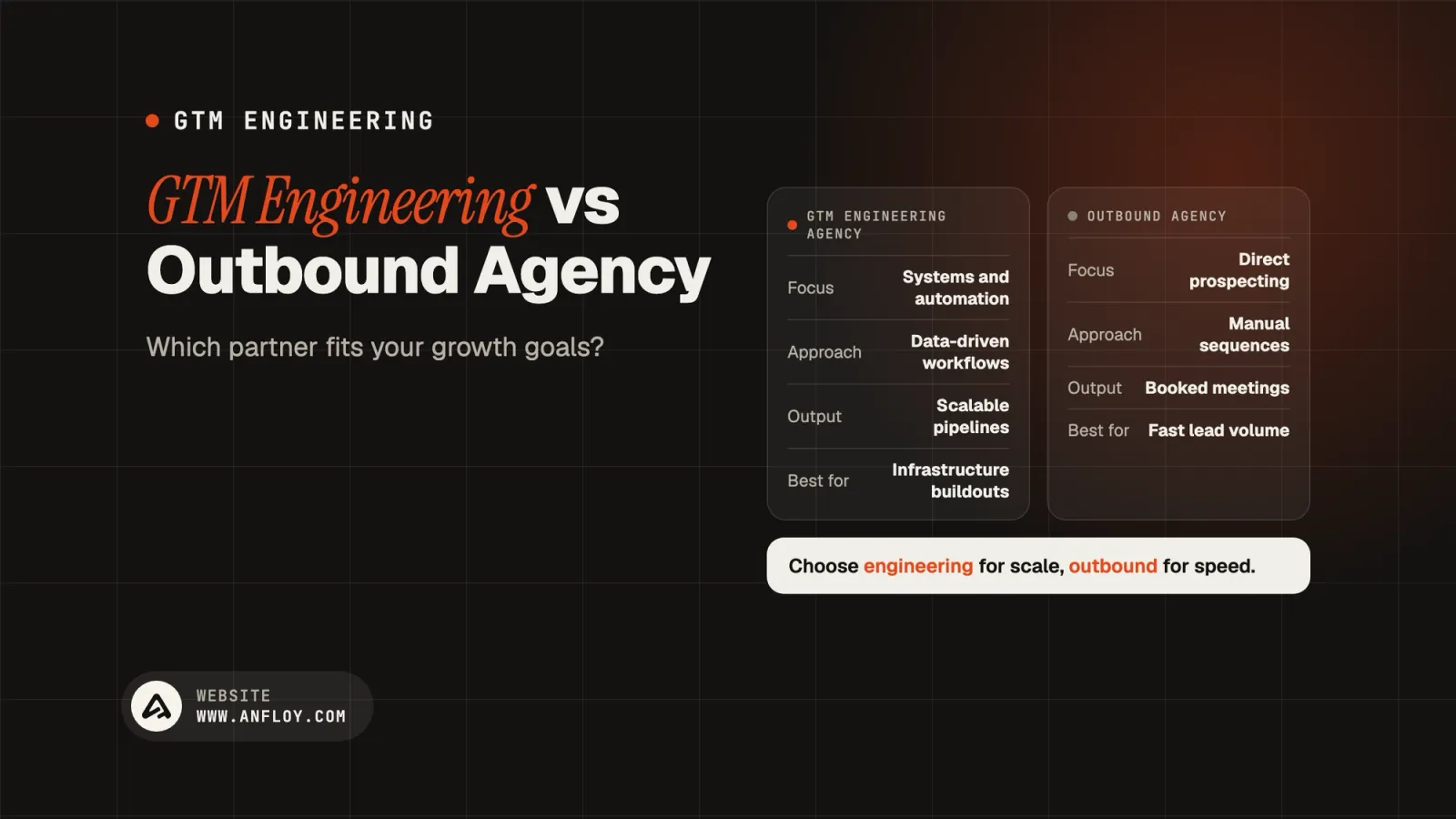
An outbound agency primarily helps you execute a GTM motion.
A GTM engineering partner builds the technical system that makes the motion repeatable, automated, measurable, and increasingly independent of manual work.
The right choice depends on what is actually broken.
GTM Engineering agency vs outbound agency
Choose an outbound agency when your strategy is already proven and you primarily need more execution capacity.
Choose a GTM engineering agency when the bottleneck is your revenue infrastructure, data, automation, signals, CRM, AI workflows, or the ability to turn your GTM strategy into a system.
| Factor | Outbound Agency | GTM Engineering Agency |
|---|---|---|
| Primary job | Execute outbound | Build the GTM system |
| Main output | Leads, conversations, meetings | Infrastructure, workflows, agents, systems |
| SDR capacity | High | Automated or system-assisted |
| Custom engineering | Usually limited | Core capability |
| CRM automation | Usually configuration | Can be engineered end to end |
| Signal detection | May use existing tools | Can build signal-driven systems |
| AI agents | Usually tool-level | Can build custom agents |
| Data architecture | Usually not core | Core responsibility |
| Ownership | Often service-based | System and code can be owned |
| Best for | Immediate outbound execution | Long-term GTM infrastructure |
| Engagement | Often recurring | Often project/fixed-scope |
| Main value | More execution | More leverage |
The important point is that these are not simply two versions of the same service.
They solve different constraints.
What does an outbound agency actually do?
An outbound agency is generally hired to operate a sales development motion for you.
The agency may handle:
- Prospect list building
- Lead sourcing
- Email infrastructure
- Domain and inbox setup
- Email sequencing
- LinkedIn outreach
- Cold email copy
- Personalization
- Follow-ups
- Reply management
- Appointment setting
- Basic reporting
The operating model is straightforward:
Target accounts → prospect list → outreach → replies → qualification → meetings
This is useful when your company already knows:
- Who the ICP is
- Which accounts to target
- What the offer is
- Which messaging works
- Which channel works
- What a qualified opportunity looks like
You essentially need additional execution capacity.
For example, imagine a B2B SaaS company already has a working outbound motion.
It knows that VP Sales at 50-500 employee SaaS companies is the right buyer. It knows the offer converts. It knows cold email generates meetings.
The problem is that the internal team cannot contact enough accounts.
An outbound agency makes sense.
The agency can operate the motion while the internal team focuses on sales conversations and closing.
The mistake is hiring an outbound agency when the underlying motion has not been figured out.
If the ICP is wrong, messaging is weak, data is poor, and routing is broken, increasing outbound volume usually increases the amount of activity without proportionally increasing qualified pipeline.
What does a GTM engineering agency do?
GTM engineering starts one layer deeper.
Instead of asking:
"Who can send more emails?"
you ask:
"What system should identify the right accounts, understand why they are relevant, enrich them, personalize the approach, execute the workflow, and learn from the result?"
That system may connect:
Signals → Data → Enrichment → Qualification → Personalization → Outreach → CRM → Sales → Feedback
This is much closer to software engineering than traditional outsourced sales execution.
A GTM engineering team may build:
- Signal detection systems
- Lead enrichment workflows
- AI research agents
- Lead scoring
- Lead routing
- CRM automation
- Personalized outbound systems
- AI SDR workflows
- Multi-channel sequencing
- Reply classification
- Sales call intelligence
- Pipeline monitoring
- Revenue dashboards
- Company intelligence systems
- AI agents
- Internal GTM tools
The goal is not simply to increase activity.
The goal is to create a revenue system that can execute more of the work with less manual intervention.
That distinction matters.
The biggest difference: service vs system
This is the easiest way to understand the difference.
An outbound agency primarily sells execution as a service.
A GTM engineering partner primarily builds infrastructure as an asset.
Suppose you pay an outbound agency to generate meetings.
The agency might provide:
5,000 prospects → 20,000 emails → X replies → Y meetings
The value is primarily the activity and resulting pipeline.
Now imagine instead that you hire a GTM engineering partner to build:
Buying signal → account identification → enrichment → ICP scoring → research → personalized message → sequence → reply classification → CRM update → meeting routing
Once the system is working, your company owns a repeatable mechanism for producing that output.
That does not mean the system requires zero people.
It means people can spend their time on the parts where human judgment creates the most value.
Outbound agency vs GTM engineering agency: Where each fits
The decision becomes much easier when you look at the revenue process as layers.
Layer 1: Strategy
Who do we target?
What do we sell?
Why should the market care?
Which segment has the highest potential?
Neither type of partner should be expected to magically solve a completely undefined GTM strategy.
You need enough strategic clarity to define the first system.
Layer 2: Data
Which accounts fit?
Who are the decision-makers?
What technologies do they use?
What changed recently?
Are they showing buying intent?
This is where GTM engineering starts becoming especially valuable.
Instead of manually exporting lists, you can build enrichment and signal workflows that continuously identify relevant prospects.
Layer 3: Intelligence
Why should this company buy?
Why now?
What changed?
What problem are they likely experiencing?
This can involve firmographic data, technology signals, hiring activity, funding, website behavior, content engagement, CRM history, and other signals.
The objective is to move from:
"Here are 10,000 companies."
to:
"Here are 87 accounts showing signals that make them worth contacting now."
Layer 4: Execution
Now you need emails, LinkedIn messages, calls, sequences, and follow-ups.
This is where outbound agencies are strongest.
But GTM engineering can automate significant portions of the execution layer as well.
Layer 5: Feedback
What happened?
Which messages generated replies?
Which signals predicted meetings?
Which objections appeared repeatedly?
Which accounts converted?
This information should flow back into the system.
That creates the feedback loop:
Signal → Action → Outcome → Learning → Better Signal → Better Action
This is where a GTM engineering approach can become more valuable over time.
When should you hire an outbound agency?
An outbound agency is usually the better choice when your biggest constraint is execution capacity.
You should consider one if:
1. Your ICP is already validated
You know exactly who you want to reach.
2. Your offer already converts
You have evidence that prospects actually want what you're selling.
3. Your outbound motion already works
You have tested messaging, channels, and targeting.
4. You need meetings now
You don't want to spend months building infrastructure before seeing execution.
5. You don't want to manage SDR operations
An external team can handle prospecting and outreach while your sales team handles qualified conversations.
6. Your process isn't particularly complex
If the workflow is essentially:
List → Email → Follow-up → Meeting
you may not need a custom GTM engineering system.
In this situation, paying an engineering team to build sophisticated infrastructure could simply be overengineering.
When should you hire a GTM engineering agency?
The answer changes when your revenue motion becomes more complicated.
A GTM engineering partner makes more sense when you have problems such as:
Your data is fragmented
You use Apollo, Clay, Salesforce, HubSpot, LinkedIn, enrichment providers, outbound platforms, and spreadsheets, but none of them share the same logic.
Your reps spend hours researching accounts
If a salesperson needs 20 minutes to understand every account before sending an email, the process may be a system problem rather than a staffing problem.
Your signals are disconnected
You have job changes, funding events, website activity, product usage, technology changes, and intent data, but nobody has built the workflow that turns those signals into sales actions.
Your CRM is constantly dirty
Missing fields, duplicate contacts, stale opportunities, incorrect stages, and incomplete activity records create operational drag.
Personalization does not scale
Your team wants highly relevant outreach but cannot manually research hundreds or thousands of accounts.
Your GTM workflow has too many handoffs
For example:
Apollo → spreadsheet → Clay → Slack → SDR → CRM → manager → sales rep
Every handoff introduces delay and failure.
A GTM engineering system can consolidate those steps.
A real example
Consider a cybersecurity SaaS company selling to mid-market businesses.
The outbound-agency approach might look like:
- Build a list of target companies.
- Find security leaders.
- Write an email sequence.
- Send emails.
- Follow up.
- Book meetings.
- Report meetings generated.
That can work.
Now consider a GTM engineering approach.
The system monitors:
- New security leadership hires
- Funding announcements
- Technology changes
- Compliance initiatives
- Relevant job postings
- Website behavior
- Intent signals
- Existing CRM activity
When a relevant signal appears, the system:
- Identifies the account.
- Enriches the company.
- Identifies the right contacts.
- Scores the account against the ICP.
- Researches the signal.
- Generates a reason-to-buy.
- Creates personalized outreach.
- Starts the appropriate sequence.
- Monitors replies.
- Classifies the response.
- Updates the CRM.
- Routes qualified opportunities to sales.
- Generates a pre-call brief.
Now outbound isn't simply a campaign.
It becomes an event-driven revenue system.
That is the fundamental difference.
The cost question: Which is more expensive?
This is where buyers often compare the wrong numbers.
An outbound agency may look cheaper because you're buying a monthly service.
A GTM engineering project may have a larger initial implementation cost because you are paying someone to build infrastructure.
But the correct comparison is not:
Monthly agency fee vs project fee.
It is:
Cost of rented execution vs cost of building an owned capability.
For example:
| Cost consideration | Outbound Agency | GTM Engineering |
|---|---|---|
| Initial setup | Lower | Higher |
| Monthly service | Usually recurring | May be project-based |
| SDR execution | Included | Can be automated |
| Custom engineering | Limited | Core |
| Data infrastructure | Usually external tools | Can be customized |
| AI agents | Usually limited to platforms | Custom |
| Long-term ownership | Lower | Higher |
| Internal maintenance | Lower initially | Some technical ownership required |
| Scalability | Add agency capacity | Expand system capacity |
| Vendor dependency | Higher | Potentially lower |
The economics depend heavily on your situation.
If you need 30 meetings next month, an outbound agency may be the more rational purchase.
If you expect to run the same GTM motion for the next three years and your biggest problem is operational complexity, building the infrastructure may have substantially better long-term economics.
The ownership question matters more than most buyers think
Ask one question before signing either contract:
What do we actually own when this engagement ends?
With an outbound agency, you may own:
- Your CRM
- Your customer data
- Your messaging
- Your accounts
But the operational machine that produced the meetings may remain inside the agency.
With a GTM engineering engagement, the objective can be different.
The workflows, integrations, code, agents, data architecture, and system logic can be deployed into infrastructure your company controls.
That creates a different asset.
Anfloy, for example, positions its GTM engineering model around building systems inside the client's environment and handing over ownership rather than requiring an ongoing platform relationship. Its GTM engineering service includes custom agents, GTM engines, workflow automation, and connected systems spanning signals, enrichment, personalization, sequencing, and CRM.
That model is particularly relevant when the goal is to build an internal capability rather than indefinitely outsource the process.
What about a hybrid model?
You don't necessarily have to choose one forever.
In fact, some companies should use both.
A practical architecture can look like:
GTM Engineering
↓
Builds the infrastructure
↓
Outbound Agency / SDR Team
↓
Executes the human-heavy motion
↓
GTM Engineering
↓
Captures feedback and improves the system
For example, your GTM engineering partner might build:
- Signal detection
- Account scoring
- Enrichment
- Research
- Personalization
- CRM routing
- Reply classification
Your outbound team then focuses on:
- Conversations
- Objection handling
- Relationship building
- Follow-ups
- Meetings
- Closing
This is often more efficient than asking SDRs to spend half their day finding, researching, enriching, and updating prospects.
How to decide in 10 minutes?
Ask these seven questions.
1. Do we need more people or better infrastructure?
If the answer is people, start with outbound.
If the answer is infrastructure, investigate GTM engineering.
2. Is our outbound motion already proven?
If yes, outsource execution.
If no, fix the motion before scaling it.
3. How much manual research happens before every outreach?
Low manual effort suggests a straightforward outbound model.
High manual effort is a strong GTM engineering opportunity.
4. How many systems need to communicate?
If you're operating across CRM, enrichment, intent, outbound, product data, analytics, and AI tools, engineering becomes more valuable.
5. Do we need custom logic?
If your process depends on complex rules, signals, scoring, APIs, AI decisions, or proprietary data, a generic outbound service may not be enough.
6. Do we want to own the system?
If ownership matters, explicitly evaluate what the partner will build, where it will live, and what happens after the engagement.
7. What is the actual bottleneck?
This is the most important question.
Don't buy GTM engineering because AI is interesting.
Don't buy an outbound agency because you need pipeline.
Identify the constraint first.
A simple decision framework
Use this:
Hire an outbound agency if:
You have a working GTM motion + need more execution.
Hire a GTM engineering agency if:
You have a GTM motion + the infrastructure underneath it is limiting growth.
Use both if:
You have a proven motion + significant execution demand + a need to continuously improve the underlying system.
Build internally if:
GTM infrastructure is strategically important + you have the technical leadership and capacity to own it.
The wrong decision is usually caused by treating pipeline generation and GTM infrastructure as the same problem.
They are not.
Where Anfloy fits?
Anfloy sits closer to the engineering side of this decision.
The relevant question is not:
"Can Anfloy send cold emails for us?"
It is:
"Can Anfloy build the system that decides who should be contacted, why they should be contacted, what should happen next, and how the result gets back into our revenue engine?"
That is a different engagement.
Anfloy's GTM AI agent architecture connects signal detection, enrichment, personalization, sequencing, CRM hygiene, reply classification, and sales intelligence into one system. Its current GTM stack describes eight specialized agents working together across the outbound lifecycle.
The company also builds autonomous agents that can plan, use real tools, execute work, evaluate their output, and escalate decisions to humans when necessary.
For a company with a straightforward need for outsourced prospecting, that may be unnecessary.
For a company that has already accumulated a complex GTM stack and wants to turn it into a coordinated revenue engine, that is exactly where the model becomes interesting.
The bottom line
The choice between a GTM engineering agency and an outbound agency comes down to one question:
Do you need someone to perform the work, or do you need someone to build the system that performs the work?
An outbound agency is useful when the problem is execution capacity.
A GTM engineering partner is useful when the problem is infrastructure, automation, data, intelligence, or system design.
Neither is automatically better.
If your outbound motion is proven and you simply need more SDR capacity, hire the outbound agency.
If your team is drowning in enrichment, research, CRM updates, manual routing, fragmented signals, and disconnected tools, adding more outbound capacity may simply scale the inefficiency.
Build the system first.
Then scale the execution.
And if the system becomes valuable enough, make sure you actually own it.
Final takeaway
Don't choose between an outbound agency and a GTM engineering agency based on which one promises more meetings.
Choose based on where your revenue engine is actually breaking.
If you need additional hands, buy execution.
If you need the machinery underneath execution, build the system.
The companies that eventually outperform usually stop treating GTM as a collection of tools and outsourced tasks and start treating it as an engineered system.
That is the real distinction.
Frequently Asked Questions
Is a GTM engineering agency the same as an outbound agency?
No. An outbound agency primarily provides sales execution such as prospecting, outreach, follow-ups, and appointment setting. A GTM engineering agency focuses on building the technical infrastructure, automation, data workflows, AI agents, and systems that support the revenue motion.
Is GTM engineering more expensive than an outbound agency?
Not necessarily. The pricing model is different. Outbound agencies commonly create recurring service costs, while GTM engineering can involve a larger implementation investment for an owned system. Compare total cost, ownership, expected lifespan, and the amount of manual work removed rather than comparing monthly fees alone.
Can a GTM engineering agency replace SDRs?
Sometimes it can automate significant parts of SDR work, but that should not be the default objective. The strongest systems automate repetitive research, enrichment, qualification, routing, personalization, CRM updates, and follow-up while keeping humans involved where judgment and relationships matter.
Should a startup hire an outbound agency or GTM engineering agency?
If the startup has not validated its ICP, offer, messaging, and outbound motion, neither should be used as a substitute for figuring out product-market and GTM fundamentals. Once the motion is validated, choose based on the bottleneck: execution capacity points toward an outbound agency, while infrastructure and automation problems point toward GTM engineering.
Can you use an outbound agency and GTM engineering partner together?
Yes. A GTM engineering partner can build the data, signal, enrichment, routing, personalization, and automation infrastructure while an outbound team handles human conversations and sales execution. This can create a stronger division of labor than asking SDRs to manually operate every step of the revenue workflow.

Let's build
what your
company needs.
Drop your email. We'll send The Custom Agent Blueprint on what we'd build first for a company like yours, before you ever take a meeting.