
How to Become a GTM Engineer (Career Roadmap for 2026)
Learn how to become a GTM Engineer with skills, tools, certifications, salary insights, and a step-by-step career roadmap.
On this page
- What is a GTM engineer?
- Why GTM engineering is a great career?
- What skills you need to become a GTM engineer?
- Learn the GTM tech stack
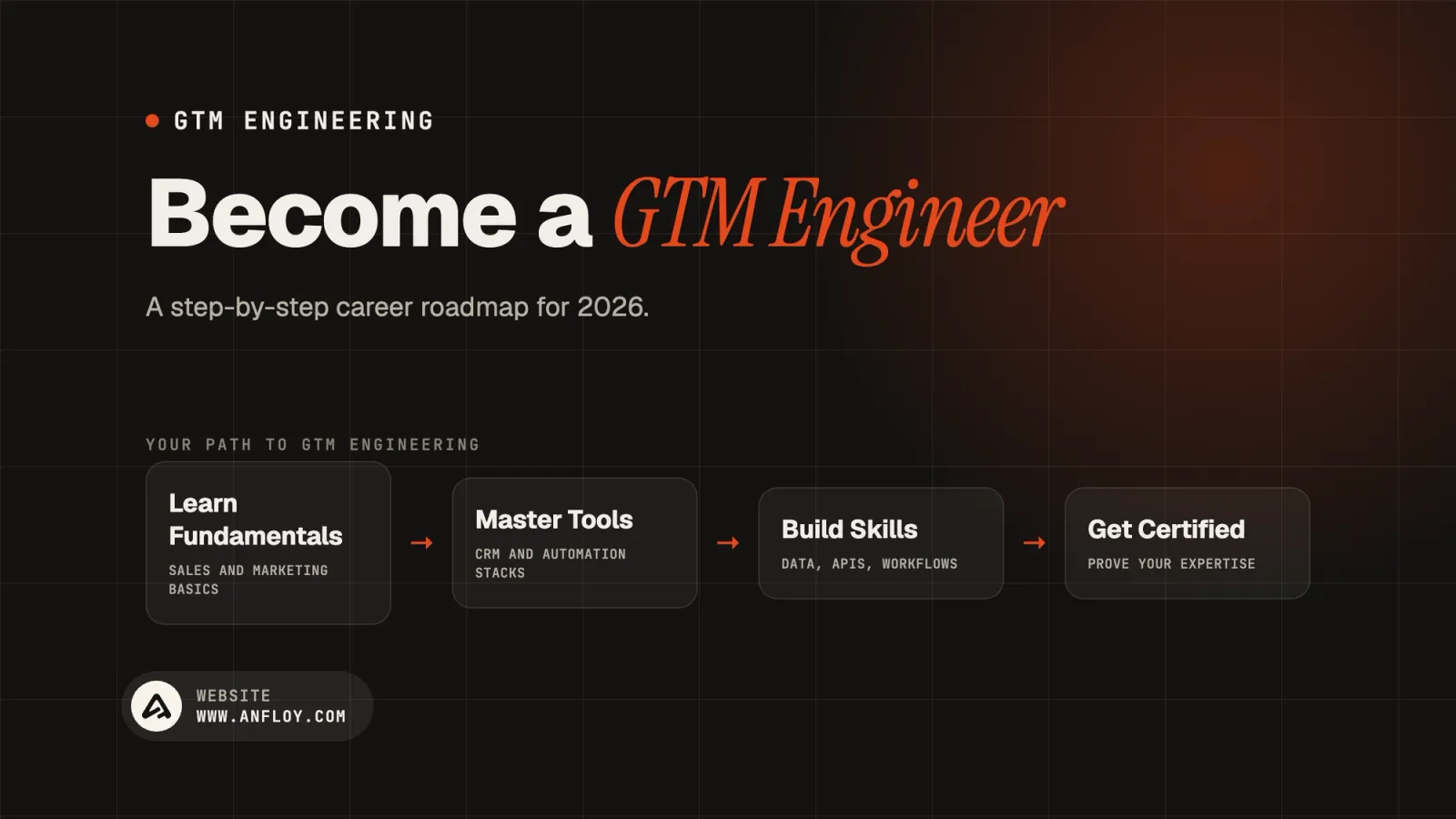
- Step-by-step GTM engineer career roadmap
- Career Roadmap Summary
- What are the best GTM engineer certifications?
- Which certification should you start with?
- How to build a GTM engineer portfolio?
- How to document your portfolio?
- How to build an online presence?
- What are the common mistakes beginners make?
- What is 90-day GTM engineer learning plan?
- How Anfloy helps future GTM engineers?
- What is the future of GTM engineering?
- Conclusion
Revenue teams are changing faster than ever.
Companies no longer rely solely on sales representatives, marketers, and operations managers to drive growth. Instead, they're investing in professionals who can connect technology, automation, artificial intelligence, and business processes into one efficient revenue engine.
That professional is the GTM Engineer.
Over the past few years, GTM Engineering has evolved from a niche operational function into one of the fastest-growing careers in SaaS, AI startups, and modern B2B organizations. Businesses are hiring GTM Engineers to automate workflows, improve CRM systems, deploy AI agents, eliminate manual work, and build scalable go-to-market infrastructure.
As AI reshapes revenue operations, demand for professionals who understand both technology and business continues to rise.
The best part?
You don't necessarily need a traditional software engineering background to become a GTM Engineer.
Many successful GTM Engineers transition from Revenue Operations, Sales Operations, Marketing Operations, Customer Success, Solutions Engineering, CRM Administration, or even digital marketing. What matters most is your ability to solve operational problems using technology.
If you're wondering how to become a GTM Engineer, this guide provides a practical roadmap.
Whether you're starting your first operations role or planning a career transition, this roadmap will help you build the knowledge and experience needed to succeed.
What is a GTM engineer?
A GTM (Go-to-Market) Engineer is responsible for designing, implementing, and optimizing the technology, automation, and data systems that power an organization's revenue operations.
Instead of working within a single department, GTM Engineers support multiple customer-facing teams, including:
- Marketing
- Sales
- Revenue Operations
- Customer Success
- Leadership
Their goal is to create connected systems that help businesses generate more revenue while reducing manual work.
For example, a GTM Engineer might:
- Design CRM architecture
- Build workflow automation
- Connect multiple software platforms
- Improve lead routing
- Implement AI-powered workflows
- Create executive dashboards
- Optimize customer lifecycle processes
- Deploy Revenue Intelligence solutions
Rather than focusing on writing production software, GTM Engineers focus on building systems that make revenue teams more productive.
This combination of technical implementation and business strategy makes GTM Engineering one of the most versatile careers in modern B2B organizations.
Why GTM engineering is a great career?
Demand for GTM Engineers continues to grow because businesses are investing heavily in automation, AI, and Revenue Operations.
Companies no longer want disconnected software.
They want integrated systems that allow marketing, sales, customer success, and leadership to work from the same source of truth.
This shift has created an increasing need for professionals who understand both business operations and technology.
Here are some of the reasons GTM Engineering is becoming such an attractive career.
High demand across industries
Although the role originated primarily within SaaS companies, GTM Engineers are now being hired by:
- AI startups
- Technology companies
- FinTech organizations
- Healthcare technology firms
- E-commerce businesses
- Professional services companies
- Enterprise software vendors
Any organization with a complex sales process can benefit from GTM Engineering.
Excellent salary potential
Because GTM Engineers combine technical expertise with business strategy, compensation is generally higher than many traditional operations roles.
As professionals gain experience with AI, automation, and Revenue Intelligence, salary potential increases significantly.
For a detailed breakdown of salaries by experience level and location, see our GTM Engineer Salary Guide.
AI is creating new opportunities
Artificial intelligence isn't replacing GTM Engineers.
It's making them more valuable.
Businesses still need professionals who can:
- Connect AI tools to CRM platforms.
- Build intelligent workflows.
- Design automation systems.
- Ensure data quality.
- Manage integrations.
- Implement Company AI Brains.
- Optimize revenue operations.
As organizations adopt AI-first strategies, GTM Engineers become the people responsible for turning AI into measurable business results.
Remote-friendly career
Most GTM Engineering work involves cloud-based platforms, collaboration tools, and workflow automation.
As a result, many companies offer:
- Fully remote positions
- Hybrid work arrangements
- Flexible schedules
- Global hiring opportunities
This makes GTM Engineering an attractive career for professionals seeking location flexibility.
What skills you need to become a GTM engineer?
One of the biggest misconceptions about GTM Engineering is that it's purely technical.
In reality, successful GTM Engineers combine three different skill sets:
- Technical skills
- Business knowledge
- Communication and problem-solving abilities
Let's explore each area.
Technical Skills
Technology forms the foundation of GTM Engineering.
While you don't need to become a software engineer, you should understand how modern revenue systems work together.
CRM administration
Every GTM Engineer should become comfortable working with CRM platforms.
Focus on learning how to:
- Configure pipelines
- Manage lifecycle stages
- Create custom properties
- Build workflows
- Create dashboards
- Maintain clean customer data
- Design CRM architecture
Start with platforms such as:
- HubSpot
- Salesforce
- Attio
CRM knowledge forms the foundation for nearly every other GTM skill.
Workflow automation
Automation is one of the highest-impact areas of GTM Engineering.
Learn how to automate repetitive tasks such as:
- Lead routing
- Contact creation
- Customer onboarding
- Email notifications
- Internal approvals
- Task assignments
- Data synchronization
Popular automation tools include:
- n8n
- Zapier
- Make
- Workato
Understanding workflow logic is often more important than mastering a specific platform.
APIs and integrations
Modern businesses use dozens of software applications.
A GTM Engineer should understand how those applications exchange information.
Learn the basics of:
- REST APIs
- Webhooks
- Authentication
- JSON
- Data mapping
- API documentation
You don't need to become an API developer, but understanding how integrations work will make you significantly more effective.
Data management
Automation depends on clean, reliable data.
Learn how to:
- Standardize CRM records
- Remove duplicates
- Build consistent naming conventions
- Manage lifecycle stages
- Maintain data quality
Poor data creates poor automation.
Developing strong data management habits early in your career will save countless hours later.
Analytics
Every GTM Engineer should understand how to measure business performance.
Learn to create reports for:
- Pipeline growth
- Conversion rates
- Lead sources
- Customer acquisition
- Revenue trends
- Marketing attribution
- Sales productivity
Popular reporting platforms include:
- Google Analytics 4
- Looker Studio
- Tableau
- Power BI
- HubSpot Reporting
The ability to transform operational data into actionable insights is a highly valued skill.
AI skills
Artificial intelligence is rapidly becoming a core competency for GTM Engineers.
Focus on learning:
- Prompt engineering
- AI workflow automation
- AI agents
- LLM fundamentals
- AI-powered CRM workflows
- AI-assisted reporting
- Company AI Brain concepts
Hands-on experience with tools such as ChatGPT, Claude, and Gemini will give you a strong advantage in the job market.
Business skills
Technology alone won't make you a successful GTM Engineer.
You also need to understand how revenue organizations operate.
Key areas include:
- B2B sales processes
- Marketing funnels
- Customer lifecycle management
- Revenue Operations
- Sales Operations
- Customer Success
- Pipeline management
- Forecasting
- SaaS metrics
Understanding why a workflow exists is just as important as knowing how to automate it.
Soft skills
GTM Engineers work across multiple departments.
Strong communication and collaboration skills are essential.
Develop abilities such as:
- Systems thinking
- Problem solving
- Documentation
- Project management
- Time management
- Cross-functional collaboration
- Analytical thinking
- Continuous learning
The most successful GTM Engineers are often those who can translate technical concepts into practical business solutions.
Learn the GTM tech stack
One of the fastest ways to accelerate your GTM Engineering career is to become comfortable with the tools that modern revenue teams use every day.
You don't need to master every platform before applying for jobs.
Instead, focus on understanding how each category of software supports the customer journey and how information flows between systems.
Remember, companies hire GTM Engineers to build connected revenue systems not to become experts in a single application.
Below are the core technologies every aspiring GTM Engineer should learn.
1. Customer relationship management (CRM)
The CRM is the heart of every GTM organization.
Nearly every workflow begins or ends with customer data stored inside a CRM.
As a future GTM Engineer, your first priority should be mastering CRM fundamentals.
Learn how to:
- Create pipelines
- Configure lifecycle stages
- Build custom properties
- Design record relationships
- Create reports
- Build workflows
- Manage permissions
- Maintain clean customer data
Recommended platforms:
- HubSpot CRM
- Salesforce
- Attio
- Pipedrive
If you're learning from scratch, HubSpot CRM is an excellent starting point because of its free version and extensive educational resources.
2. Marketing automation
Marketing automation helps companies nurture leads until they're ready to speak with sales.
Understanding these systems will help you build better customer journeys.
Focus on learning:
- Email automation
- Lead scoring
- Landing pages
- Forms
- Customer segmentation
- Campaign attribution
- Behavioral triggers
- Lead nurturing
Popular platforms include:
- HubSpot Marketing Hub
- Marketo
- ActiveCampaign
- Customer.io
Try building a simple workflow that sends a welcome email after someone submits a form. Then expand it by adding lead scoring and CRM updates.
3. Sales engagement platforms
Sales engagement software helps sales teams communicate with prospects efficiently.
Rather than manually sending hundreds of follow-up emails, these platforms automate outreach while maintaining personalization.
Learn how to build:
- Email sequences
- Follow-up cadences
- Meeting scheduling workflows
- Task automation
- CRM synchronization
Popular tools include:
- Apollo
- Outreach
- Salesloft
- Reply.io
Understanding how these tools integrate with CRM systems is far more valuable than memorizing every feature.
4. Workflow automation platforms
Workflow automation is one of the defining skills of a GTM Engineer.
These platforms connect different applications and eliminate repetitive manual work.
For example, a workflow might:
- Capture a website lead
- Create a CRM record
- Enrich company information
- Notify the sales team
- Launch an email sequence
- Update a dashboard
Popular automation tools include:
- n8n
- Zapier
- Make
- Workato
Start with simple automations before progressing to multi-step workflows involving conditional logic and API calls.
5. Data enrichment platforms
Good automation depends on high-quality data.
Data enrichment platforms improve CRM records by adding valuable business information automatically.
Typical enrichment includes:
- Company size
- Industry
- Employee count
- Revenue estimates
- Technology stack
- Funding history
- Buying intent
Popular platforms include:
- Clay
- ZoomInfo
- Clearbit
- People Data Labs
Understanding enrichment helps you create more accurate segmentation, personalization, and lead qualification workflows.
6. Analytics & reporting
Every GTM Engineer should know how to measure business performance.
Reporting isn't just about building dashboards it's about helping leaders make better decisions.
Learn how to report on:
- Pipeline growth
- Funnel conversion
- Marketing attribution
- Sales performance
- Customer acquisition cost (CAC)
- Customer lifetime value (LTV)
- Revenue forecasts
Recommended platforms:
- Google Analytics 4
- Looker Studio
- Tableau
- Microsoft Power BI
- HubSpot Reporting
The ability to connect operational improvements with measurable business outcomes will make you a much stronger candidate.
7. AI tools
Artificial intelligence has become a core component of GTM Engineering.
Future GTM Engineers should understand how AI supports automation rather than viewing it as a separate discipline.
Learn to use AI for:
- Research
- Workflow creation
- CRM assistance
- Sales personalization
- Meeting summaries
- Documentation
- Process optimization
- Knowledge retrieval
Recommended tools include:
- ChatGPT
- Claude
- Gemini
As your skills grow, explore AI agents and orchestration platforms that automate multi-step business processes.
Step-by-step GTM engineer career roadmap
Learning individual tools is important, but becoming a GTM Engineer requires a structured progression.
The roadmap below provides a practical path from beginner to job-ready professional.
Step 1: Understand revenue operations
Before touching any software, learn how modern revenue organizations function.
Study topics such as:
- Marketing funnels
- Sales pipelines
- Customer journeys
- Lead qualification
- Revenue Operations
- Customer Success
- SaaS metrics
Understanding the business context will help you build systems that solve real operational challenges.
Step 2: Master a CRM platform
Choose one CRM and learn it thoroughly.
Recommended starting point:
- HubSpot CRM
Focus on:
- Pipelines
- Contacts
- Companies
- Deals
- Lifecycle stages
- Reporting
- Workflows
Once you're comfortable, explore Salesforce concepts to broaden your expertise.
Step 3: Learn workflow automation
Automation is one of the most valuable GTM Engineering skills.
Start by building practical workflows such as:
- Website form → CRM
- CRM → Slack notifications
- Lead assignment automation
- Meeting scheduling
- Customer onboarding
- Renewal reminders
Aim to understand the logic behind each workflow rather than simply copying tutorials.
Step 4: Learn APIs and integrations
Modern GTM Engineers spend a significant amount of time connecting systems.
Begin by understanding:
- REST APIs
- Webhooks
- JSON
- Authentication
- Request and response structures
Practice integrating two applications without writing complex code.
This knowledge will dramatically expand the types of systems you can build.
Step 5: Learn AI for revenue operations
AI is becoming one of the defining characteristics of modern GTM Engineering.
Learn how to:
- Use LLMs effectively
- Build AI-assisted workflows
- Create AI prompts for business tasks
- Automate CRM updates
- Build simple AI agents
- Summarize sales calls
- Generate personalized outreach
Understanding how AI integrates into revenue systems will set you apart from many candidates.
Step 6: Learn reporting and analytics
Every improvement you make should be measurable.
Practice building dashboards that answer questions such as:
- Where are leads coming from?
- Which campaigns generate pipeline?
- Where are deals stalling?
- Which sales activities produce the highest win rates?
Companies value GTM Engineers who can demonstrate business impact through data.
Step 7: Build real projects
Knowledge becomes valuable when it's applied.
Instead of completing isolated tutorials, build complete GTM systems.
Examples include:
Project 1
CRM implementation for a fictional SaaS company.
Project 2
Automated lead routing using workflow automation.
Project 3
Customer onboarding automation.
Project 4
AI-powered lead qualification workflow.
Project 5
Revenue dashboard with marketing attribution.
These projects demonstrate practical problem-solving skills during interviews.
Step 8: Create a portfolio
A portfolio often carries more weight than certifications.
Document each project by explaining:
- The business problem
- Your solution
- Tools used
- Workflow architecture
- Results achieved
- Lessons learned
Include:
- Workflow diagrams
- Dashboard screenshots
- CRM configurations
- Automation logic
- Documentation
A strong portfolio helps employers evaluate your thinking rather than just your resume.
Step 9: Earn industry certifications
Certifications validate your knowledge and demonstrate commitment to continuous learning.
Some of the most valuable certifications include:
HubSpot academy
- HubSpot CRM
- Revenue Operations
- Marketing Software
- Sales Software
Salesforce trailhead
- CRM fundamentals
- Administrator learning paths
- Automation concepts
Google analytics certification
Learn:
- Website analytics
- Event tracking
- Attribution
- Reporting
Zapier learn
Understand automation fundamentals through practical examples.
AI learning resources
Develop expertise in:
- Prompt engineering
- AI workflows
- LLM fundamentals
- AI automation
Remember that certifications complement hands-on experience they don't replace it.
Step 10: Apply for GTM engineer roles
Once you've built practical experience, begin applying for roles such as:
- GTM Engineer
- Revenue Operations Associate
- Revenue Operations Analyst
- Sales Operations Analyst
- Marketing Operations Specialist
- CRM Administrator
- Automation Specialist
Many professionals enter GTM Engineering through adjacent operations roles before transitioning into dedicated GTM Engineer positions.
Focus your resume on measurable outcomes rather than listing software you've used.
For example:
✔ Built an automated lead routing workflow that reduced response time from two hours to fifteen minutes.
This demonstrates impact far better than simply stating "Experienced with Zapier."
Career Roadmap Summary
Learn Revenue Operations
          │
          ▼
Master CRM
          │
          ▼
Learn Automation
          │
          ▼
Understand APIs
          │
          ▼
Build AI Workflows
          │
          ▼
Create Analytics Dashboards
          │
          ▼
Build Real Projects
          │
          ▼
Develop a Portfolio
          │
          ▼
Earn Certifications
          │
          ▼
Apply for GTM Engineer Roles
By following this roadmap consistently, you'll build the technical foundation, business understanding, and practical experience needed to transition into a successful GTM Engineering career.
What are the best GTM engineer certifications?
While certifications alone won't get you hired, they can accelerate your learning, validate your knowledge, and strengthen your resume especially if you're transitioning from another career.
The best GTM Engineers don't collect dozens of certificates.
Instead, they earn certifications that complement hands-on experience and demonstrate expertise in CRM systems, automation, analytics, and AI.
Below are the certifications worth considering.
HubSpot Academy
If you're new to GTM Engineering, HubSpot Academy is one of the best places to start.
Recommended courses include:
- HubSpot CRM Certification
- Revenue Operations Certification
- Marketing Software Certification
- Sales Software Certification
- Inbound Marketing Certification
These courses teach the fundamentals of CRM management, lead lifecycle management, automation, reporting, and sales enablement.
Because many startups use HubSpot, these certifications are highly relevant for entry-level GTM roles.
Salesforce Trailhead
Salesforce remains one of the most widely used enterprise CRM platforms.
Trailhead offers free learning paths covering:
- Salesforce Administrator
- CRM Data Management
- Automation
- Reports and Dashboards
- Sales Cloud
- Service Cloud
Even if you begin your career with HubSpot, understanding Salesforce concepts significantly expands your career opportunities.
Google Analytics Certification
Analytics is a core part of GTM Engineering.
Google Analytics Certification teaches:
- Event tracking
- Conversion measurement
- Attribution
- User behavior analysis
- Funnel reporting
These skills help GTM Engineers connect operational improvements with measurable business outcomes.
Automation Platform Training
Workflow automation is one of the defining characteristics of GTM Engineering.
Learning resources from platforms such as:
- Zapier Learn
- n8n documentation
- Make Academy
will help you understand:
- Workflow logic
- Triggers
- Actions
- Conditional branches
- Error handling
- Multi-step automations
The goal isn't to memorize interfaces but to understand automation design principles.
AI Learning Resources
Artificial intelligence is becoming essential for GTM Engineers.
Focus on learning:
- Prompt engineering
- AI workflow design
- LLM fundamentals
- AI agents
- Retrieval-Augmented Generation (RAG)
- AI orchestration
- AI automation
Instead of relying solely on courses, build practical AI workflows using tools like ChatGPT, Claude, or Gemini.
Employers increasingly value demonstrated AI projects over certificates alone.
Which certification should you start with?
If you're completely new to GTM Engineering, follow this order:
- HubSpot CRM Certification
- Revenue Operations Certification
- Google Analytics Certification
- Automation platform training
- Salesforce Trailhead
- AI workflow learning
This sequence builds a strong foundation before introducing more advanced concepts.
How to build a GTM engineer portfolio?
If certifications prove what you've learned, a portfolio proves what you can build.
Hiring managers are far more impressed by practical projects than a long list of completed courses.
Your portfolio should demonstrate how you solve real business problems using GTM technology.
Think of it as a showcase of your ability to design systems rather than simply configure software.
Project 1: CRM implementation
Build a CRM for a fictional SaaS company.
Include:
- Contact management
- Deal pipelines
- Lifecycle stages
- Custom properties
- Reporting dashboards
Document why you made each design decision.
Project 2: Lead routing automation
Create an automated workflow that:
Website Form

↓

CRM Contact

↓

Lead Qualification

↓

Sales Assignment

↓

Slack Notification

↓

Welcome Email
Explain how your workflow reduces manual effort while improving response times.
Project 3: Customer onboarding workflow
Design an onboarding system that automatically:
- Creates onboarding tasks
- Sends welcome emails
- Assigns Customer Success Managers
- Schedules check-ins
- Tracks onboarding completion
This project demonstrates lifecycle automation skills.
Project 4: AI sales assistant
Build an AI workflow that can:
- Summarize discovery calls
- Generate follow-up emails
- Update CRM notes
- Recommend next actions
- Retrieve company information
This showcases your ability to integrate AI into revenue operations.
Project 5: Revenue dashboard
Create an executive dashboard displaying:
- Pipeline value
- Conversion rates
- Revenue by source
- Customer acquisition cost
- Sales velocity
- Customer lifetime value
Explain how executives would use these insights to make business decisions.
How to document your portfolio?
A strong portfolio should answer four questions for every project:
What was the problem?
Describe the operational challenge.
Example:
"Sales representatives manually assigned inbound leads, causing delays and inconsistent ownership."
What solution did you build?
Explain your workflow.
Avoid simply listing the tools you used.
Instead, explain how the system works.
Which technologies were involved?
Examples:
- HubSpot
- Zapier
- n8n
- Apollo
- Clay
- Google Analytics
- ChatGPT
This gives employers insight into your technical experience.
What business outcome did it create?
Whenever possible, quantify results.
Examples include:
- Reduced manual work
- Faster lead routing
- Higher CRM accuracy
- Better reporting
- Improved customer onboarding
- Increased sales productivity
Employers care about business impact more than technical complexity.
How to build an online presence?
Your portfolio shouldn't live only on your computer.
Create a professional online presence by sharing your work through:
- GitHub (for code, scripts, or documentation)
- Notion
- Personal website
- Medium or technical blogs
Publishing articles about automation, CRM optimization, AI workflows, or Revenue Operations demonstrates expertise and helps recruiters discover your work.
It also reinforces your ability to communicate complex technical ideas clearly.
What are the common mistakes beginners make?
Many aspiring GTM Engineers slow their progress by focusing on the wrong priorities.
Here are the most common mistakes and how to avoid them.
Trying to learn every tool
The GTM ecosystem changes constantly.
You don't need to master dozens of platforms.
Instead, understand the underlying principles:
- CRM architecture
- Workflow automation
- Data management
- AI integration
- Analytics
Once you understand these concepts, learning new software becomes much easier.
Ignoring business processes
Technology exists to solve business problems.
If you don't understand:
- Sales workflows
- Marketing funnels
- Customer Success
- Revenue metrics
you'll struggle to build effective systems.
Always ask:
"What business problem am I solving?"
before designing a workflow.
Skipping real projects
Watching tutorials creates familiarity.
Building projects creates expertise.
Every new concept should be reinforced through hands-on implementation.
The more practical systems you build, the more confident you'll become during interviews.
Waiting until you feel ready
Many beginners delay applying for jobs because they believe they need to know every tool.
In reality, most companies expect candidates to continue learning after they're hired.
Once you understand the fundamentals and have completed several portfolio projects, start applying.
Experience grows much faster in real-world environments.
Forgetting documentation
Documentation is a core GTM Engineering skill.
Every workflow you build should include:
- Objectives
- Architecture
- Logic
- Dependencies
- Maintenance instructions
Clear documentation makes collaboration easier and demonstrates professionalism.
What is 90-day GTM engineer learning plan?
If you're starting from scratch, the following roadmap can help you build momentum.
Month 1: Build the foundation
Focus on:
- Revenue Operations fundamentals
- CRM basics
- Marketing funnels
- Sales processes
- Customer lifecycle
- HubSpot CRM
Goal:
Understand how modern revenue organizations operate.
Month 2: Learn automation
Focus on:
- Workflow automation
- APIs
- Webhooks
- Data management
- Reporting
- Analytics
Build at least three automation projects.
Goal:
Become comfortable connecting systems and reducing manual work.
Month 3: AI and portfolio development
Focus on:
- AI tools
- Prompt engineering
- AI agents
- Portfolio projects
- Resume improvements
- Certifications
- Interview preparation
By the end of 90 days, aim to have:
- A polished LinkedIn profile
- A portfolio with multiple projects
- Two or more relevant certifications
- Practical CRM and automation experience
- A resume tailored for GTM Engineering roles
Remember, this roadmap is a starting point. Continue building projects, exploring new technologies, and refining your systems as the field evolves.
How Anfloy helps future GTM engineers?
At Anfloy, we believe the best GTM Engineers are developed through real-world problem solving not just theory.
Our approach to GTM Engineering focuses on building connected revenue systems that combine CRM architecture, workflow automation, AI, analytics, and Revenue Operations.
By studying real implementations, aspiring GTM Engineers can better understand:
- Revenue system design
- CRM architecture
- AI workflow implementation
- Automation best practices
- Company AI Brain concepts
- Revenue Intelligence
- Cross-functional collaboration
Learning from practical business scenarios helps bridge the gap between education and real-world execution.
Interested in seeing how GTM Engineering works in real organizations?
Anfloy helps companies design AI-powered GTM systems, automate revenue operations, and build scalable technology infrastructure. Explore our resources and services to learn how modern GTM Engineering is transforming the way businesses grow.
Book your call
What is the future of GTM engineering?
The next generation of GTM Engineers won't spend most of their time manually configuring software.
Instead, they'll design intelligent systems where AI, automation, and connected data work together to support every stage of the customer journey.
Future GTM Engineers will increasingly:
- Design AI-native revenue workflows.
- Manage autonomous AI agents.
- Build Company AI Brains.
- Improve predictive Revenue Intelligence.
- Orchestrate multi-agent business processes.
- Govern AI-powered customer operations.
As organizations continue investing in AI, the demand for professionals who understand both technology and revenue strategy is expected to grow.
Rather than replacing GTM Engineers, AI will elevate the role, allowing professionals to focus less on repetitive configuration and more on architecture, optimization, and strategic decision-making.
Conclusion
GTM Engineering sits at the intersection of technology, operations, and revenue strategy.
It's a career built on solving business problems through connected systems, intelligent automation, and data-driven decision-making.
You don't need to know every tool before getting started. Focus on understanding how revenue organizations operate, master the fundamentals of CRM and automation, build practical projects, and continually expand your skills in analytics and AI.
As businesses continue modernizing their go-to-market strategies, professionals who can design and optimize these systems will remain in high demand.
Whether you're transitioning from Marketing Operations, Sales Operations, Revenue Operations, or starting fresh, the roadmap in this guide provides a practical path toward becoming a successful GTM Engineer.
Download the GTM engineer career roadmap checklist
Want a structured version of this learning path?
Download our GTM Engineer Career Roadmap Checklist to track your progress, organize your projects, and ensure you're developing the technical, business, and AI skills employers are looking for.
Talk to Anfloy
Frequently Asked Questions
How do I become a GTM Engineer?
Start by learning Revenue Operations fundamentals, master a CRM platform, build workflow automation skills, understand APIs and integrations, learn AI tools, create real projects, earn relevant certifications, and build a portfolio that demonstrates practical experience.
Can I become a GTM Engineer without coding?
Yes. Most GTM Engineers don't work as full-time software developers. While basic technical knowledge is valuable, many workflows can be built using low-code or no-code platforms. Learning APIs, automation logic, and data management is generally more important than mastering programming languages.
How long does it take to become a GTM Engineer?
With consistent learning and hands-on practice, many professionals can build the foundational skills needed for entry-level GTM Engineering or Revenue Operations roles within three to six months. Becoming a highly experienced GTM Engineer typically takes several years of practical experience.
What tools should I learn first?
Start with a CRM such as HubSpot, then move on to workflow automation platforms like n8n or Zapier. From there, learn analytics, data enrichment, AI tools, and sales engagement platforms.
Is GTM Engineering a good career?
Yes. GTM Engineering combines technology, business strategy, automation, and AI, making it one of the fastest-growing careers in modern B2B organizations. It offers strong compensation, continuous learning opportunities, and clear long-term career progression.
Can marketers or Sales Ops professionals transition into GTM Engineering?
Absolutely. Many successful GTM Engineers come from Marketing Operations, Sales Operations, Customer Success, CRM Administration, or Revenue Operations. Their existing understanding of business processes provides a strong foundation for learning the technical aspects of GTM Engineering.
Let's build
what your
company needs.
Drop your email. We'll send The Custom Agent Blueprint on what we'd build first for a company like yours, before you ever take a meeting.