
How to Run a Full Personalized Outbound System In-House
On this page
- What is a personalized outbound system?
- Why traditional outbound no Longer works?
- The 10 layers of a modern personalized outbound system
- AI agents for outbound
- What are the KPIs for personalized outbound?
- Common personalized outbound mistakes
- How Anfloy builds personalized outbound systems?
- What is the future of in-house outbound?
- Conclusion
Outbound has changed dramatically over the last decade.
There was a time when businesses could upload a list of prospects into an email tool, send thousands of messages, and generate enough meetings to justify the effort.
That approach no longer works.
Modern buyers receive hundreds of emails every week. They ignore generic messaging, distrust automated outreach, and expect vendors to understand their business before initiating a conversation.
At the same time, revenue teams are under increasing pressure to:
- generate more pipeline
- improve conversion rates
- personalize outreach
- reduce acquisition costs
- scale efficiently
- improve forecast accuracy
These objectives often conflict with one another.
Personalization requires time.
Scale requires automation.
Efficiency requires systems.
This is why leading organizations are moving away from disconnected outbound tools and toward building personalized outbound systems.
A personalized outbound system isn't simply a sales engagement platform.
It's an integrated revenue engine capable of:
- identifying ideal accounts
- monitoring buying signals
- enriching company data
- generating personalized messaging
- orchestrating outreach
- managing responses
- improving over time
The best systems increasingly combine:
- Company Intelligence
- AI Agents
- GTM Engineering
- Revenue Intelligence
- AI Orchestration
- CRM automation
- knowledge retrieval
The result is an outbound process that feels human while operating at machine scale.
In this guide, you'll learn:
- what a personalized outbound system is
- why traditional outbound is failing
- the 10 layers of modern outbound infrastructure
- how AI changes personalization
- which KPIs matter most
- how to build outbound capabilities in-house
- how Anfloy designs AI-powered outbound systems
By the end, you'll understand how to create an outbound engine that becomes a long-term competitive advantage rather than another software subscription.
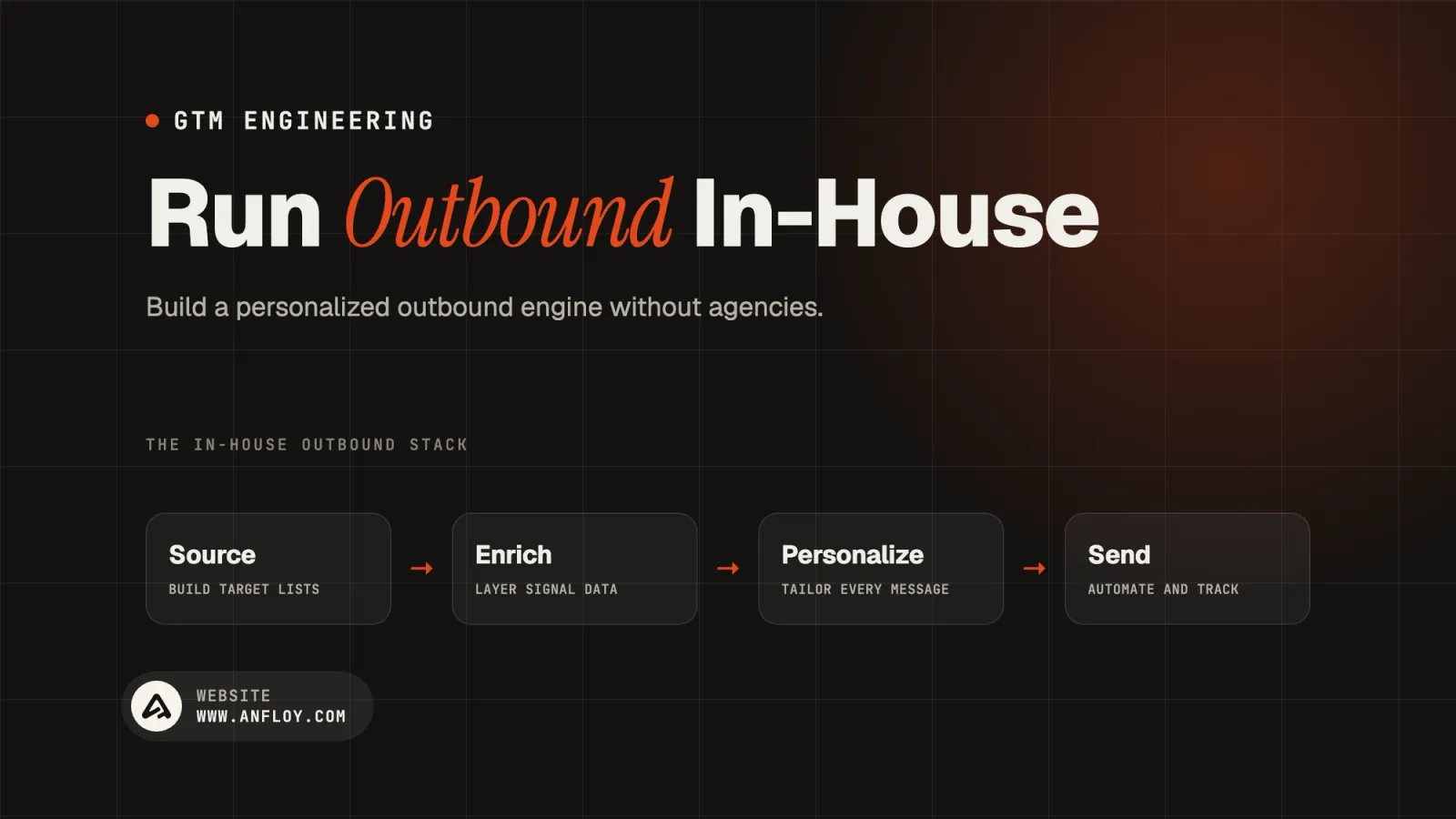
What is a personalized outbound system?
A personalized outbound system is a collection of people, processes, technology, and intelligence designed to identify, engage, and convert prospects using highly relevant outreach.
Unlike traditional outbound, personalized systems adapt messaging based on:
- company context
- buying signals
- customer history
- industry trends
- organizational changes
- account intelligence
A modern outbound workflow looks like this:
ICP Definition
        ↓
Buying Signals
        ↓
Company Intelligence
        ↓
Data Enrichment
        ↓
AI Personalization
        ↓
Email + LinkedIn
        ↓
Reply Management
        ↓
Revenue Intelligence
        ↓
Optimization
Each layer contributes to a more relevant customer experience.
The goal isn't to send more emails.
The goal is to send the right message to the right person at the right time.
Why traditional outbound no Longer works?
Traditional outbound relied on three assumptions:
- More volume equals more opportunities.
- Generic messaging is acceptable.
- Prospects have limited alternatives.
These assumptions no longer hold true.
Modern buyers expect relevance.
They want vendors that understand:
- their business
- their industry
- their challenges
- their objectives
Common outbound mistakes include:
- generic templates
- poor targeting
- incomplete CRM records
- no buying signal monitoring
- weak personalization
- inconsistent follow-up
As a result:
- response rates decline
- deliverability suffers
- pipeline quality decreases
- acquisition costs increase
Personalized outbound solves these challenges by introducing intelligence into every stage of the workflow.
The 10 layers of a modern personalized outbound system
High-performing outbound systems typically include ten layers.
Layer 1: ICP definition
Everything begins with the Ideal Customer Profile (ICP).
Without a clearly defined ICP, even the best outbound infrastructure produces poor results.
Your ICP should include:
- industry
- company size
- geography
- revenue range
- technology stack
- operational challenges
- buying behavior
Examples:
| Attribute | Example |
|---|---|
| Industry | SaaS |
| Employees | 50–500 |
| Geography | North America |
| Revenue | $5M–$50M |
| Stack | Salesforce + HubSpot |
| Pain Point | GTM inefficiency |
The more precise your ICP, the more effective your personalization becomes.
Layer 2: Buying signals
Buying signals indicate that a prospect may be more likely to engage.
Examples include:
- funding announcements
- leadership changes
- hiring activity
- product launches
- geographic expansion
- technology adoption
Buying signals significantly improve outbound performance because they answer an important question:
Why now?
Examples:
- "Congratulations on your Series B."
- "I noticed you're hiring SDRs."
- "I saw your recent expansion into Europe."
Timing frequently matters more than messaging.
Layer 3: Company intelligence
Company Intelligence provides context.
Examples include:
- employee count
- funding history
- technology stack
- customer reviews
- recent news
- executive profiles
This intelligence allows organizations to create highly relevant messaging.
Instead of saying:
"I'd love to learn more about your business."
You can say:
"I noticed your team has grown by 40% over the last year and recently adopted Salesforce. Many companies at this stage begin evaluating Revenue Intelligence workflows."
Specificity builds credibility.
Layer 4: Data enrichment
Personalization depends on accurate data.
Common enrichment fields include:
- name
- title
- company
- LinkedIn URL
- industry
- revenue
- employee count
- technology stack
Poor data leads to:
- irrelevant messaging
- low response rates
- poor customer experiences
High-performing outbound teams continuously enrich and validate their CRM records.
Layer 5: Deliverability infrastructure
Many outbound programs fail before prospects ever see the message.
Deliverability infrastructure includes:
- domains
- SPF
- DKIM
- DMARC
- inbox monitoring
- reputation management
Without proper infrastructure, even exceptional personalization cannot generate results.
Successful outbound requires both relevance and deliverability.
Layer 6: AI personalization
AI is transforming outbound.
Modern systems can generate personalized messaging using:
- company intelligence
- buying signals
- CRM history
- industry context
- previous interactions
Examples include:
- personalized subject lines
- email introductions
- LinkedIn messages
- follow-up recommendations
The best AI doesn't replace human judgment.
It accelerates it.
Instead of spending twenty minutes researching an account, AI can provide a comprehensive briefing in seconds.
Layer 7: Sequencing
Personalized outbound isn't a single email.
It's a coordinated sequence of touchpoints delivered across multiple channels.
High-performing outbound teams typically combine:
- phone calls
- social engagement
- personalized videos
- direct mail (for enterprise accounts)
A common sequence may look like this:
Day 1: Personalized Email
Day 3: LinkedIn Connection Request
Day 5: Follow-up Email
Day 8: LinkedIn Engagement
Day 10: Personalized Video
Day 14: Final Email
The objective is consistency rather than persistence.
Modern buyers rarely respond to the first touchpoint. Sequencing ensures your organization remains visible without becoming intrusive.
AI can further optimize sequencing by recommending:
- best send times
- channel selection
- sequence length
- follow-up timing
Layer 8: Reply management
Generating replies is only half the challenge.
Organizations must also determine:
- Which replies indicate interest?
- Which require follow-up?
- Which should be routed to sales?
- Which should be removed from future outreach?
Reply management systems commonly categorize responses as:
- Positive
- Neutral
- Referral
- Objection
- Unsubscribe
- Not Interested
AI agents can classify replies automatically and trigger workflows such as:
- meeting scheduling
- CRM updates
- account assignment
- follow-up recommendations
The goal is to reduce response time while maintaining a high-quality prospect experience.
Layer 9: Revenue intelligence
Revenue Intelligence connects outbound activity to business outcomes.
Instead of tracking vanity metrics, organizations should monitor:
- pipeline generated
- meetings booked
- conversion rates
- deal velocity
- revenue influenced
- customer acquisition cost (CAC)
Revenue Intelligence answers questions such as:
- Which buying signals perform best?
- Which industries convert most frequently?
- Which sequences generate revenue?
- Which channels produce the highest ROI?
Without Revenue Intelligence, outbound becomes difficult to optimize.
Layer 10: Optimization
Personalized outbound systems should continuously improve.
Examples of optimization include:
- subject line testing
- sequence testing
- channel experimentation
- ICP refinement
- signal prioritization
- AI prompt optimization
High-performing organizations treat outbound as a system rather than a campaign.
Every interaction creates additional data that improves future performance.
AI agents for outbound
AI agents are becoming a core component of modern outbound infrastructure.
Rather than relying on one generalized assistant, organizations increasingly deploy specialized agents.
Company intelligence agent
Responsible for:
- account research
- buying signal monitoring
- executive profiling
CRM agent
Responsible for:
- enrichment
- duplicate detection
- data validation
Personalization agent
Responsible for:
- email generation
- LinkedIn messaging
- subject line creation
- AI for Outbound Prospecting
Revenue intelligence agent
Responsible for:
- reporting
- forecasting
- opportunity analysis
Customer success agent
Responsible for:
- onboarding
- retention insights
- expansion opportunities
Together, these agents create an outbound ecosystem capable of operating continuously.
AI orchestration
AI agents create value individually.
AI orchestration creates value at scale.
An orchestrated outbound workflow may look like:

Buying Signal
      ↓
Company Intelligence Agent
      ↓
CRM Agent
      ↓
Personalization Agent
      ↓
Outreach Engine
      ↓
Reply Management Agent
      ↓
Revenue Intelligence Agent
      ↓
Sales Team
The orchestration layer manages:
- workflow sequencing
- context sharing
- approvals
- monitoring
- reporting
Without orchestration, organizations simply create additional tools.
With orchestration, they create intelligent systems.
What are the KPIs for personalized outbound?
Every outbound program should measure performance.
Recommended KPIs include:
| KPI | Purpose |
|---|---|
| Open Rate | Message visibility |
| Reply Rate | Engagement |
| Positive Reply Rate | Interest level |
| Meeting Rate | Pipeline creation |
| Conversion Rate | Revenue impact |
| CAC | Cost efficiency |
| Pipeline Generated | GTM performance |
| Revenue Influenced | Business impact |
| Deliverability Rate | Infrastructure quality |
| Sequence Performance | Optimization |
The most important metric remains:
Revenue generated from outbound.
Everything else supports that objective.
Common personalized outbound mistakes
Many organizations fail because they optimize for scale rather than relevance.
Common mistakes include:
Generic messaging
Prospects immediately recognize template-based outreach.
No buying signals
Timing matters.
Without buying signals, personalization lacks urgency.
Poor deliverability
Ignoring:
- SPF
- DKIM
- DMARC
can significantly reduce performance.
Weak CRM hygiene
Personalization is only as effective as the underlying data.
No revenue attribution
If you can't connect outbound to revenue, optimization becomes difficult.
No AI strategy
AI should enhance:
- research
- personalization
- routing
- optimization
Organizations without an AI strategy frequently struggle to scale.
Build Your Personalized Outbound System
Discover how AI, Company Intelligence, and GTM Engineering can improve your outbound performance.
Get Your Free AI Audit
How Anfloy builds personalized outbound systems?
At Anfloy, we don't build outbound campaigns.
We build outbound infrastructure.
Every implementation follows a structured methodology.
Step 1: Discovery
We identify:
- ICP
- TAM
- GTM objectives
- revenue goals
Step 2: Company AI brain
We centralize:
- CRM data
- customer history
- sales playbooks
- operational knowledge
This becomes the intelligence layer for every AI workflow.
Step 3: Company intelligence
We implement systems capable of monitoring:
- funding
- hiring
- technology adoption
- market activity
Step 4: Agentic systems
We deploy specialized agents for:
- intelligence
- enrichment
- personalization
- reporting
Step 5: AI orchestration
AI orchestration coordinates every stage of the outbound process.
Step 6: Revenue intelligence
We connect outbound activities to:
- pipeline
- forecasting
- business outcomes
Step 7: Infrastructure you own
Every implementation is deployed on infrastructure owned by the client.
You own:
- workflows
- AI systems
- Company AI Brain
- operational data
- orchestration logic
No lock-in.
No recurring dependency.
What is the future of in-house outbound?
Outbound is becoming increasingly autonomous.
Over the next decade, organizations will deploy:
- AI SDRs
- AI Revenue Analysts
- Company Intelligence Agents
- Revenue Intelligence platforms
- multi-agent GTM systems
The future outbound organization will look less like a sales team and more like an intelligence platform.
Human teams will continue to own:
- relationships
- strategy
- negotiations
AI will increasingly own:
- research
- enrichment
- personalization
- reporting
- optimization
Organizations that build these capabilities internally today will have significant advantages tomorrow.
Conclusion
The future of outbound isn't about sending more emails.
It's about building systems that understand your market, identify opportunities, personalize communication, and continuously improve.
Organizations that continue relying on generic templates and disconnected tools will struggle to compete.
Those that invest in Company Intelligence, AI Agents, Revenue Intelligence, and AI Orchestration will create scalable outbound engines capable of generating consistent pipeline for years to come.
At Anfloy, we help businesses build these systems from the ground up designed around ownership, intelligence, and long-term growth.
Because in 2026, the companies that win outbound won't be the ones that send the most messages.
They'll be the ones that build the smartest systems.
Ready to Build an AI-Powered Outbound Engine?
From Company AI Brains and Agentic Systems to Revenue Intelligence and GTM Infrastructure, Anfloy helps businesses build outbound systems they fully own.
Frequently Asked Questions
How does AI improve outbound?
AI improves research, personalization, CRM enrichment, reply management, and revenue intelligence.
What are buying signals?
Buying signals are events indicating increased purchase intent, such as funding announcements, hiring activity, or leadership changes.
Should outbound be built in-house?
For many organizations, owning critical outbound capabilities creates long-term competitive advantages.
Can AI replace SDRs?
AI will augment SDRs rather than completely replace them in most organizations.
Why does deliverability matter?
Poor deliverability prevents prospects from seeing your messages, reducing the effectiveness of even the best personalization strategies.
Let's build
what your
company needs.
Drop your email. We'll send The Custom Agent Blueprint on what we'd build first for a company like yours, before you ever take a meeting.