
AI Agent Workflows: The Core Patterns and How to Choose One
A practical breakdown of AI agent workflow patterns, prompt chaining, routing, parallelization, orchestrator-worker, and autonomous agents, and how to choose the right one for a given task.
On this page
- Workflows vs. Autonomous agents
- The core workflow patterns
- Choosing the right pattern
- The entities behind any AI agent workflow
- Designing an AI agent workflow that holds up in production
- What are the common mistakes in AI agent workflow design?
- A worked example: combining patterns in a real GTM workflow
- How Anfloy builds AI agent workflows?
- Conclusion
The word "agent" gets used for two genuinely different things, and mixing them up is where a lot of AI projects go wrong before they even start.
Sometimes it means a fixed sequence of steps with an AI model doing the reasoning at one or two points along the way. Sometimes it means a system making its own decisions about what to do next, with no predetermined path at all. Both are legitimate, useful architectures.
They are not the same thing, and picking the wrong one for a given task is one of the most common reasons an AI system ends up either underpowered or unpredictably expensive.
An AI agent workflow is the structure that connects a model's reasoning to the steps, tools, and decisions a task actually requires.
This guide covers the core workflow patterns, the tradeoffs between them, and how to pick the right one instead of defaulting to whichever pattern happens to be the most talked about.
Workflows vs. Autonomous agents
This distinction is worth establishing before anything else, because it determines which patterns are even in scope for a given task.
A workflow is a system where the path is largely predefined: the steps, their order, and the decision points are set by the person building it, with a model handling the reasoning at specific, bounded points along that fixed path.
A fully autonomous agent is a system where the model itself decides what to do next at each step, including which tools to call and when the task is actually complete, with no fixed path defined in advance.
Neither is universally better. Workflows are more predictable, easier to test, and cheaper to run, because the model isn't making open-ended decisions about control flow.
Autonomous agents handle open-ended, unpredictable tasks better, because they can adapt to situations a fixed workflow wasn't designed to anticipate, at the cost of being harder to predict, harder to constrain, and typically more expensive to run reliably.
The core workflow patterns
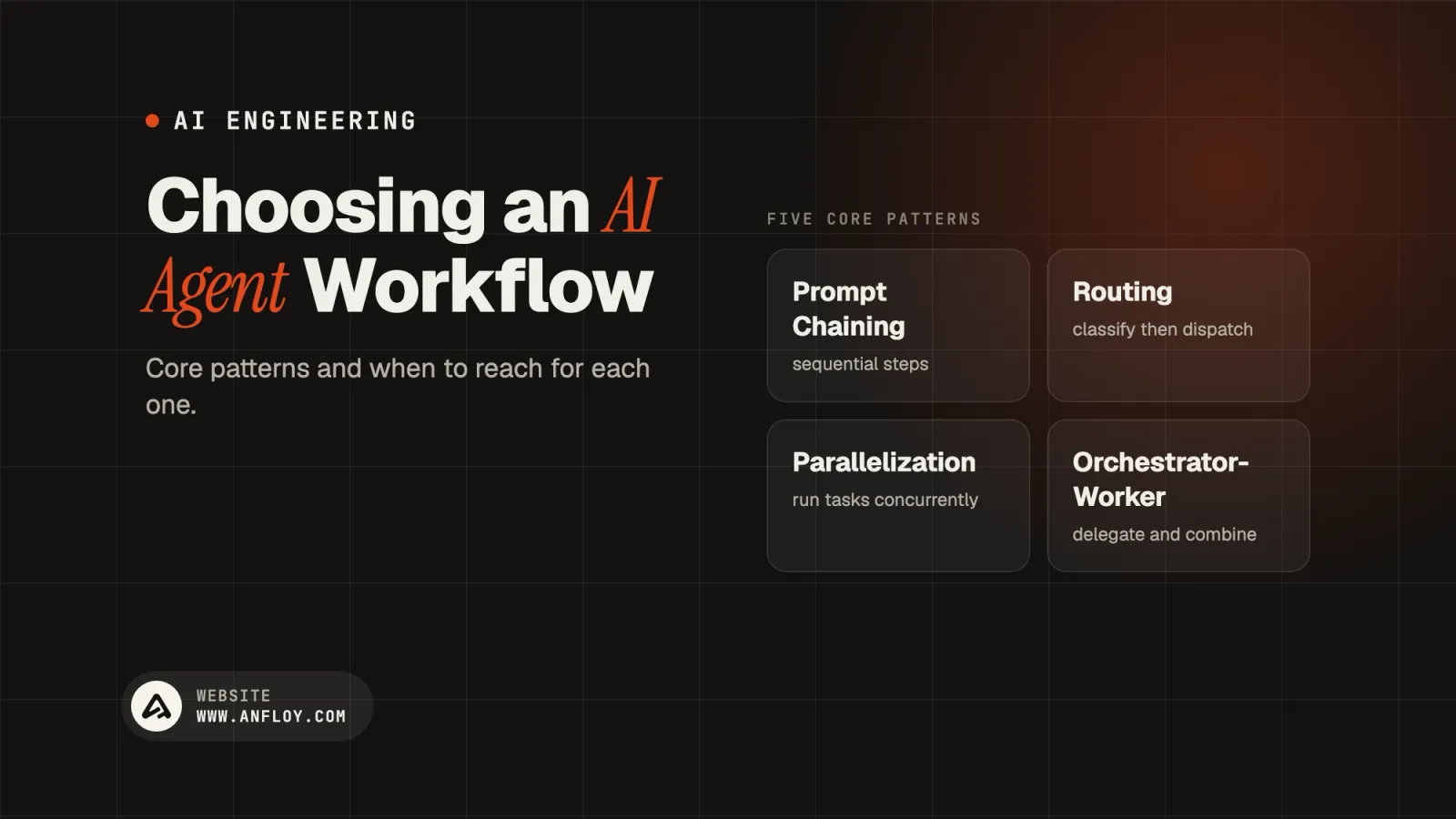
Prompt chaining (sequential workflows)
The simplest pattern: a task is broken into a fixed sequence of steps, with the output of one step becoming the input to the next.
A lead qualification workflow that enriches a record, then scores it, then drafts an outreach message, each step handled by a separate, focused call, is a chain.
Best for: tasks that decompose cleanly into a fixed sequence of subtasks, where each step benefits from a narrower, more focused prompt than trying to do everything in one call.
Weakness: rigid, doesn't adapt if a step's output doesn't fit what the next step expects.
Routing
A model first classifies the input, then hands it off to one of several specialized downstream paths built for that specific category.
A customer inquiry workflow that first classifies a message as a support question, a sales question, or a billing question, then routes to a specialized handler for each, is a router.
Best for: tasks with distinct categories of input that each benefit from a different specialized approach, rather than one generic prompt trying to handle every case adequately but none particularly well.
Weakness: entirely dependent on classification accuracy; a misrouted input gets handled by the wrong specialist.
Parallelization
Multiple instances of a task run simultaneously, either splitting a task into independent subtasks that run at once, or running the same task multiple times and combining or voting on the results.
An account research task that simultaneously pulls firmographic data, recent news, and tech stack information in parallel, then combines all three into one enriched record, is a parallelization pattern.
Best for: tasks with independent subtasks that don't depend on each other's output, where running sequentially would waste time, or tasks where running several attempts and combining results improves reliability over a single attempt.
Weakness: more complex to coordinate and combine results correctly than a simple sequential chain.
Orchestrator-worker
A central orchestrating model breaks a complex task into subtasks dynamically, dispatches each to specialized worker agents, and synthesizes their outputs into a final result.
Unlike a fixed chain, the orchestrator can decide the specific subtasks at runtime based on what the input actually requires, rather than following the same fixed steps every time.
This is the architecture behind most real multi-agent systems.
Best for: complex tasks where the specific subtasks needed can't be fully predicted in advance and genuinely depend on the input, like researching an account where the relevant questions vary company to company.
Weakness: significantly more complex to build, debug, and control cost on than a fixed pattern.
Evaluator-optimizer
One model generates a response, a second model evaluates it against defined criteria, and the loop repeats with feedback until the output meets the bar or a retry limit is reached.
A message-drafting workflow where a first model writes outreach copy and a second model checks it against brand voice and factual accuracy before it's allowed to send is an evaluator-optimizer pair.
Best for: tasks where output quality benefits meaningfully from a distinct critique step, and where clear evaluation criteria can be defined.
Weakness: doubles the model calls per task, and needs a hard retry cap to avoid the same uncontrolled-loop cost risk covered in mitigating the costs of AI agents.
Autonomous agents
The model operates in a loop, planning its own next action, executing it (often via tool calls), observing the result, and deciding what to do next, continuing until it determines the task is complete or hits a defined stopping condition.
This is the architecture behind systems like Claude Code, which reads its own errors and iterates rather than following a fixed path.
Best for: genuinely open-ended tasks where the number of steps and the right sequence can't be known in advance, and where the cost of unpredictability is outweighed by the value of adaptability.
Weakness: the hardest pattern to govern, test, and keep cost-bounded; requires real guardrails to run safely in production.
Choosing the right pattern
| Pattern | Predictability | Best suited for | Typical cost profile |
|---|---|---|---|
| Prompt chaining | High | Fixed, well-understood sequences of subtasks | Low, proportional to step count |
| Routing | High | Distinct input categories needing different handling | Low, one classification call plus one handler call |
| Parallelization | Moderate | Independent subtasks, or reliability via multiple attempts | Moderate, scales with parallel branches |
| Orchestrator-worker | Moderate | Complex tasks with input-dependent subtasks | Moderate to high, variable by task complexity |
| Evaluator-optimizer | High (with cap) | Tasks where a critique step meaningfully improves quality | Moderate, doubles calls per task |
| Autonomous agent | Low to moderate | Genuinely open-ended tasks with unpredictable steps | High and variable, needs strict guardrails |
The general principle worth internalizing: start with the simplest pattern that could plausibly solve the task, and only move to a more complex, less predictable pattern when the simpler one demonstrably can't handle the real variation in the input.
Reaching for a fully autonomous agent when a sequential chain would do the job reliably is one of the most common sources of unnecessary cost and unpredictability in production AI systems.
Not sure which pattern fits a workflow you're trying to build? Get a free AI infrastructure audit and we'll help you scope it.
The entities behind any AI agent workflow
Regardless of pattern, every AI agent workflow is built from the same underlying components.
Nodes: the individual steps or calls in the workflow, whether a model call, a tool call, or a deterministic function.
Control flow: the logic determining what happens next, fixed in a chain, conditional in a router, dynamic in an orchestrator or autonomous agent.
State: the information carried between steps, what the workflow currently knows, and how much of it persists versus resets between runs.
Tools: the external systems a workflow can call, a CRM, an enrichment API, a search function, and the permissions each tool call carries.
Stopping conditions: what determines the workflow is finished, a fixed number of steps in a chain, a confidence threshold in an evaluator loop, or the model's own judgment in an autonomous agent.
Designing an AI agent workflow that holds up in production
Pick the pattern based on the actual task, not the most impressive-sounding option.
A fixed chain that reliably handles ninety-five percent of cases well beats an autonomous agent that handles all cases adequately but unpredictably, for most production GTM workflows.
Define stopping conditions explicitly, especially for loop-based patterns.
An evaluator-optimizer loop or an autonomous agent without a hard cap on iterations is a direct cost and reliability risk, the same failure mode covered in mitigating the costs of AI agents.
Scope tool permissions to what each step actually needs.
A worker agent in an orchestrator pattern that has write access to systems it doesn't need for its specific subtask is unnecessary risk, the same discipline covered in AI agent design best practices.
Add human review at the points where confidence matters most, not everywhere or nowhere.
A router that occasionally misclassifies, or an evaluator loop that occasionally can't resolve a quality issue after several attempts, should escalate to a person rather than either blocking entirely or proceeding with a low-confidence output.
Log the actual path taken, not just the final output.
For any pattern beyond a simple fixed chain, understanding why a workflow made the choices it made, which route it took, which subtasks an orchestrator dispatched, is essential for debugging when something goes wrong, the same production discipline covered in deploying AI agents into production.
What are the common mistakes in AI agent workflow design?
Defaulting to a fully autonomous agent for a task a simple chain could handle.
This is the most common overcorrection: reaching for the most flexible, most talked-about pattern when the actual task is well-understood and repeatable enough for something far simpler and cheaper to run.
No fallback when a pattern's core assumption breaks.
A router assumes accurate classification; an orchestrator assumes its worker agents return usable output.
Neither assumption holds one hundred percent of the time, and a workflow with no defined behavior for that failure case breaks unpredictably in production.
Combining too many patterns without a clear reason.
A workflow that chains, routes, and parallelizes all within one task is harder to debug than the sum of its parts would suggest, and often the complexity isn't actually earning its keep against a simpler alternative.
Treating an autonomous agent as unsupervised by default.
Autonomy in decision-making doesn't mean an absence of guardrails. The same governance, scoped tool access, confidence thresholds, audit logging, that applies to simpler patterns applies with even more importance to autonomous agents, since there's no fixed path to reason about ahead of time.
This is the same gap covered in failure modes that kill multi-agent systems.
A worked example: combining patterns in a real GTM workflow
A lead qualification system for a mid-market SaaS company combines several patterns rather than relying on just one.
A router first classifies an inbound lead by source, form fill, chat inquiry, or a detected product signal, since each source warrants a different handling path.
Within the product-signal path, a parallelization step simultaneously pulls firmographic enrichment and recent account activity, since neither depends on the other's output. Those results feed into a sequential chain: score the lead, then draft a personalized outreach message.
Before that message sends, an evaluator step checks it against brand voice and factual accuracy, with a retry cap of two attempts before escalating to a human for review rather than looping indefinitely.
No part of this system is a fully autonomous agent, and it doesn't need to be. Every step's task is well-understood enough to be handled by a bounded pattern, which makes the whole system more predictable, more debuggable, and considerably cheaper to run than if it had been built as one open-ended autonomous loop from the start.
How Anfloy builds AI agent workflows?
Anfloy designs every AI agent workflow starting from the actual shape of the task, not a default preference for the most sophisticated available pattern.
Where a task is well-understood and repeatable, we build fixed chains and routers that are fast, cheap, and predictable.
Where a task is genuinely open-ended, we build the orchestration and guardrails a more autonomous pattern needs to run safely, the same reasoning behind our broader work on multi-agent AI architecture and AI orchestration.
Every workflow we build ships with defined stopping conditions, scoped tool permissions, and logging built in from day one, deployed on infrastructure you own outright.
Want a second opinion on how a workflow you're planning should actually be architected? See how our process works before you start building.
Conclusion
AI agent workflows aren't one architecture, they're a spectrum from fully predetermined chains to fully autonomous loops, and the right choice depends entirely on how predictable the task actually is.
Prompt chaining and routing sit at the disciplined end of that spectrum: cheap, testable, and reliable for tasks that are well-understood in advance.
Orchestrator-worker and evaluator-optimizer patterns trade some of that predictability for the ability to handle input-dependent complexity or genuinely improve output through critique.
Fully autonomous agents sit at the far end, the most adaptable option and also the hardest to govern, test, and keep cost-bounded.
None of these patterns is inherently better than the others, and that's worth repeating because the instinct in most teams runs the opposite direction, toward whichever pattern sounds the most advanced.
The actual engineering judgment is in matching the pattern to the task, not in maximizing sophistication. A fixed chain that reliably handles the real distribution of inputs a business sees every day is a better system than an autonomous agent that can technically handle more edge cases but does so unpredictably and at meaningfully higher cost.
The teams building reliable, cost-effective AI systems aren't the ones defaulting to the most sophisticated pattern available.
They're the ones who start with the simplest pattern that could plausibly work, add complexity only when the task genuinely demands it, and put real guardrails, stopping conditions, scoped tool access, logging, around every pattern regardless of how autonomous it is.
Reserve full autonomy for the tasks that actually need it, and let the rest of the system stay as boring and predictable as the work allows.
Ready to architect an AI agent workflow that actually fits your task? Book a call, no decks, no demos, just a working session on what to build.
Frequently Asked Questions
What's the difference between an AI workflow and an AI agent?
A workflow follows a predefined path with a model reasoning at specific, bounded points. An agent decides its own path dynamically, choosing what to do next, including which tools to use, without a fixed sequence set in advance. Many production systems described as "AI agents" are actually structured workflows with an agent-like interface, which is a meaningful distinction for both cost and reliability.
Is a fully autonomous agent always more powerful than a workflow?
More flexible, not necessarily more powerful for a given task. A well-designed fixed workflow often outperforms an autonomous agent on tasks that are well-understood and repeatable, because the fixed structure removes an entire category of unpredictability the autonomous version has to navigate on every run.
How do I know which pattern to use for a specific task?
Start by asking whether the steps and their order can be reasonably predicted in advance. If yes, a chain, router, or parallelization pattern is usually sufficient and considerably cheaper to run. If the steps genuinely depend on the specific input in ways that can't be predicted ahead of time, an orchestrator or autonomous pattern becomes worth the added complexity.
Can multiple workflow patterns be combined in one system?
Yes, and most real production systems do. A single lead qualification system might use routing to classify input, parallelization to gather data, a sequential chain to process it, and an evaluator step to check the output, all within one overall workflow rather than relying on a single pattern for everything.
What's the biggest risk with autonomous agent workflows specifically?
Unbounded cost and unpredictable behavior without proper guardrails. Because the model is making its own decisions about what to do next, an autonomous agent without defined stopping conditions, tool scoping, and cost caps can behave in ways that are difficult to predict or control, which is why governance matters more for this pattern than any other.
Let's build
what your
company needs.
Drop your email. We'll send The Custom Agent Blueprint on what we'd build first for a company like yours, before you ever take a meeting.