
How to Mitigate the Costs of AI Agents?
AI agent costs rarely blow up from the model bill alone. Learn the real cost risk factors, from retry loops to scope creep, and the specific mitigation tactics for each.
On this page
- Why AI agent costs are different from traditional software costs?
- What are the real cost risk factors?
- A cost risk summary table
- Designing for cost control from the start
- Build vs. Buy: Where the cost risk actually differs
- Common mistakes that drive up AI agent costs
- A worked example
- How Anfloy builds cost-controlled AI agent systems?
- Conclusion
The bill that surprises a team almost never comes from the line item they were watching.
A company budgets for model usage, gets a reasonable number, deploys an agent, and three months later the actual cost is several times higher, not because the model got more expensive, but because the agent is calling tools far more often than expected, retrying failed steps in a loop nobody noticed, or quietly expanding in scope past what anyone originally approved.
Mitigating AI agent costs isn't primarily a pricing negotiation. It's a risk-management problem, identifying the specific places cost tends to leak, and building the guardrails that catch it before a small inefficiency compounds into a real budget overrun.
This guide covers the actual cost risk factors behind runaway AI agent spend and the specific mitigation for each one.
Why AI agent costs are different from traditional software costs?
Traditional software has a mostly fixed cost structure: a license fee, hosting, maybe a per-seat charge. The cost is knowable before you deploy.
AI agent costs are usage-driven and compound across multiple layers, model inference, tool and API calls, retries, human review time, at once, which means the same workflow can cost dramatically different amounts depending on how many steps it takes.
How often it fails and retries, and how much oversight it actually needs in practice versus what was assumed during scoping.
This is also why cost mitigation has to happen at design time, not just at the invoice review stage.
A workflow architected without cost awareness from the start tends to be expensive in ways that are hard to fix retroactively without a real rebuild, the same reasoning behind treating cost as a first-class constraint in AI agent design best practices, not an afterthought layered on once something's already in production.
What are the real cost risk factors?
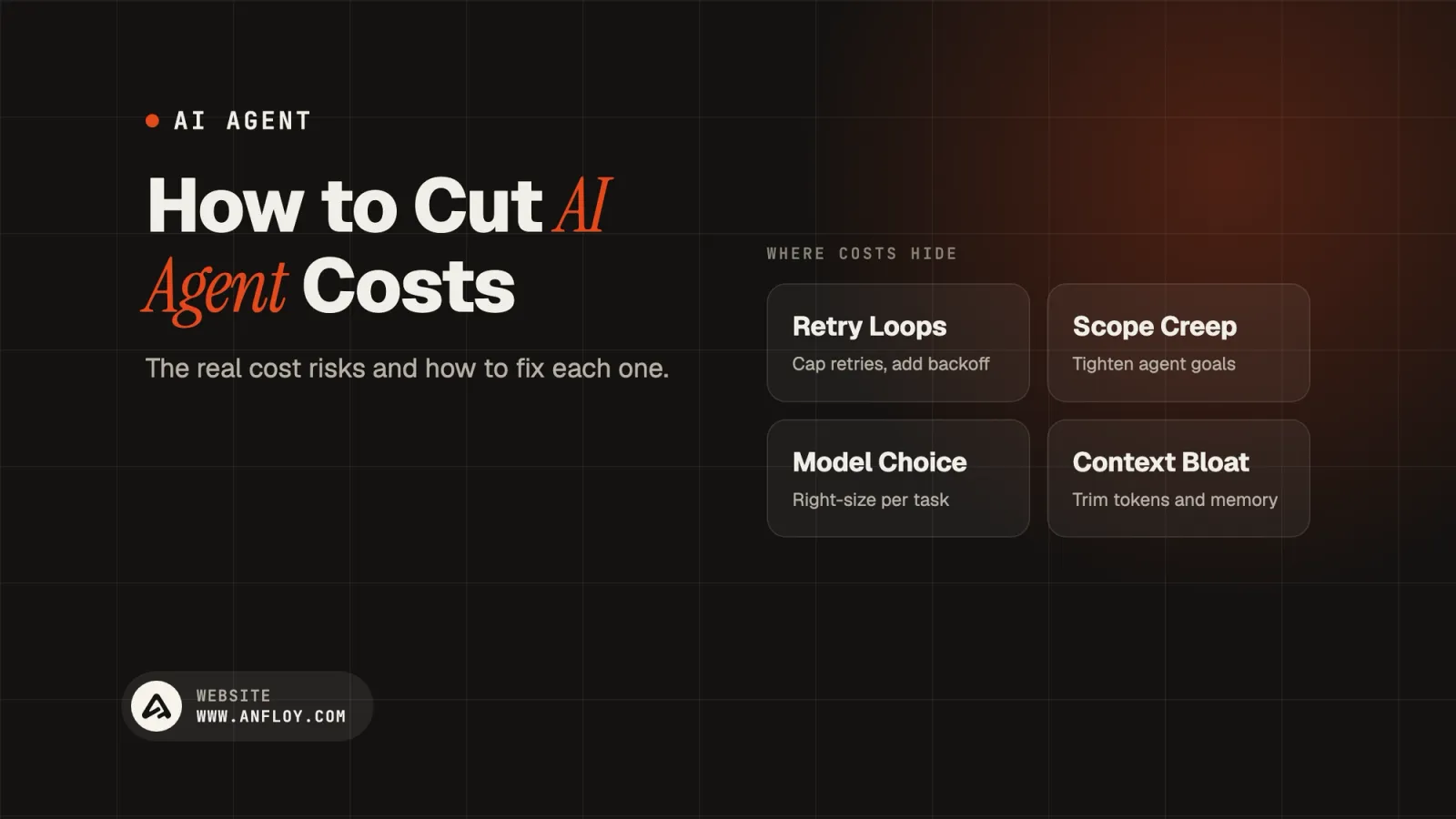
Most AI agent budget overruns trace back to a small set of recurring causes, and each one has a distinct mitigation, not a single generic fix.
Uncontrolled retry loops
An agent that fails a step and retries automatically, without a cap, can burn through a meaningful share of a monthly budget on a single stuck workflow before anyone notices.
This is one of the most common and most avoidable cost risks in production AI systems.
Mitigation:
cap retries at a small, defined number, log every retry attempt, and route anything that exceeds the cap to a human or a dead-letter queue instead of retrying indefinitely.
Excessive or unnecessary tool calls
An agent that calls an enrichment API, a search tool, or another paid service more often than the task actually requires, sometimes calling the same tool redundantly within a single run, inflates cost without improving output quality.
Mitigation:
Cache results within a session so the same lookup isn't paid for twice, set a defined maximum number of tool calls per task, and review tool-call logs periodically to catch redundant patterns before they become expensive habits baked into the workflow.
Scope creep after deployment
A workflow scoped for one narrow task quietly expands, someone asks it to also handle a related edge case, then another, until it's doing meaningfully more than what the original cost estimate accounted for, without anyone revisiting the budget.
Mitigation:
Treat scope changes as a formal decision, not an informal drift. Any meaningful expansion in what an agent handles should trigger a fresh cost estimate, the same discipline behind why AI automation cost needs to be modeled against actual usage rather than the original demo scope.
Over-provisioned model selection
Using the most capable, most expensive model available for every step in a workflow, including simple classification or extraction tasks a smaller, cheaper model would handle just as reliably, is one of the most common unforced costs in agent design.
Mitigation:
Match model capability to task complexity step by step within a workflow, not uniformly across the whole pipeline.
Reasoning-heavy steps warrant a stronger model; simple extraction or formatting steps often don't.
Human review overhead scaling faster than expected
Confidence thresholds that route more output to human review than anticipated quietly shift cost from compute onto headcount time, which is real cost even when it doesn't show up on a model usage invoice.
Mitigation:
Track the actual percentage of outputs requiring human review against the assumption made at design time, and treat a persistently high review rate as a signal the underlying model, prompt, or data quality needs work, not just an ongoing labor cost to absorb indefinitely.
Idle or "zombie" agents
Agents built for a pilot or a specific campaign that keep running on a schedule long after the original use case ended, quietly consuming budget for output nobody is using anymore.
Mitigation:
Set an explicit review or expiration date for every deployed agent at launch, and audit active agents on a defined cadence to confirm each one is still tied to a real, current business need.
Vendor and platform lock-in costs
Building on a platform with usage-based pricing that isn't fully transparent, or one that makes switching providers difficult once a workflow is deeply integrated, can turn a reasonable initial cost into leverage the vendor holds over future pricing.
Mitigation:
Favor architectures that keep the core workflow logic portable across model providers where possible, and understand a platform's full pricing model, not just the headline rate, before committing significant workflow logic to it.
A cost risk summary table
| Risk factor | Where it shows up | Mitigation |
|---|---|---|
| Uncontrolled retries | A single stuck workflow burns budget silently | Cap retries, log attempts, route overflow to a human queue |
| Excessive tool calls | Redundant lookups within the same task | Cache within-session results, cap calls per task, audit logs |
| Scope creep | Cost grows past original estimate without anyone noticing | Treat scope changes as a formal, re-costed decision |
| Over-provisioned models | Expensive models used for simple steps | Match model tier to task complexity per step |
| Review overhead growth | Cost shifts from compute to unplanned headcount time | Track review rate against design-time assumptions |
| Idle agents | Ongoing spend on output nobody uses anymore | Set expiration dates and audit active agents regularly |
| Vendor lock-in | Pricing leverage shifts to the platform over time | Keep logic portable, understand full pricing model upfront |
Want a read on where your current AI spend is actually leaking? Get a free AI infrastructure audit and we'll trace it.
Designing for cost control from the start
Set a cost ceiling per workflow run before deployment, not after the first invoice.
A defined maximum cost per execution, enforced programmatically, is a far more reliable control than reviewing a monthly bill after the fact and hoping to catch anomalies retroactively.
Instrument cost alongside performance, not separately.
A workflow's dashboard should show cost per successful outcome, not just completion rate or accuracy, so a workflow that's technically working but quietly expensive gets flagged the same way a workflow that's failing does.
Build in confidence thresholds that route intelligently, not by default to the most expensive path.
Low-confidence outputs should generally route to a cheaper resolution path, human review or a fallback rule, rather than to another expensive model call hoping for a better result.
Review cost architecture at the same cadence as everything else in production.
The same governance discipline covered in an AI agent security checklist, regular audits, defined ownership, logged decisions, applies directly to cost control, since an unmonitored agent is a cost risk in the same way it's a security risk.
Build vs. Buy: Where the cost risk actually differs
A pre-built AI SDR or automation platform typically has a more predictable subscription cost, but less visibility into what's actually driving usage inside it, and less ability to cap or redesign a specific expensive step once it's identified.
A custom-built system costs more to design correctly upfront, but gives full visibility and control over exactly where cost is being spent and the ability to fix a specific leak surgically rather than accepting a platform's built-in inefficiency.
Neither model eliminates cost risk; they distribute it differently, which is the same tradeoff worth weighing in custom AI agent development versus a subscription platform more broadly.
Common mistakes that drive up AI agent costs
Estimating cost from a demo instead of real production volume.
A workflow that looks cheap running against ten test records can behave very differently at real send volume, where retries, edge cases, and tool-call patterns emerge that a small test never surfaces.
Treating cost monitoring as a finance function rather than an engineering one.
By the time a monthly invoice review catches an anomaly, the underlying workflow may have been leaking budget for weeks.
Cost visibility needs to live in the same dashboards as the engineering team already watches.
Optimizing prompt length while ignoring architecture.
Shortening prompts saves a marginal amount. Fixing an uncapped retry loop or an over-provisioned model choice saves considerably more, and most teams spend disproportionate effort on the smaller lever.
No clear owner for cost the way there's an owner for uptime.
Reliability tends to have a named owner. Cost, just as capable of quietly degrading, often doesn't, which is the same ownership gap covered in failure modes that kill multi-agent systems.
A worked example
A team deploys an agent to qualify inbound leads, estimated at a modest per-lead cost based on a pilot of fifty test records. At production volume, the actual cost comes in several times higher.
Tracing it back: the agent was calling an enrichment API on every lead, including duplicates already enriched in a prior run, because there was no session-level caching.
It was also using the most capable available model for a simple industry-classification step that a smaller model would have handled just as accurately at a fraction of the cost. And a retry loop, uncapped, was silently reattempting a failing API call up to a dozen times on roughly one in twenty leads before giving up.
Fixing all three, caching, right-sizing the classification model, and capping retries, brought the real cost down close to the original estimate without touching output quality at all.
None of the fixes required a smaller or weaker system, they required identifying where the actual leak was instead of assuming the model bill itself was the problem.
How Anfloy builds cost-controlled AI agent systems?
Anfloy designs cost visibility and control into every agent we build from the start, not as a retrofit once a bill comes in higher than expected.
This means capped retries, session-level caching, model selection matched to task complexity step by step, and cost-per-outcome tracking built into the same monitoring as performance and reliability, the same discipline behind our broader work on deploying AI agents into production and AI agent cost optimization.
Every system we build is deployed on infrastructure you own outright, with full visibility into exactly where cost is being spent, so a leak, if one appears, is something you can trace and fix directly rather than a black box you have to take a vendor's word on.
Not sure whether your current AI spend matches what it should actually cost? See how our process works before scoping a fix.
Conclusion
AI agent costs rarely blow up because the underlying model got more expensive. They blow up because of retry loops nobody capped, tool calls nobody cached, scope that crept past the original estimate, models chosen for capability rather than fit, and agents left running long after the use case that justified them ended.
None of these are exotic failure modes. Each one is a known, specific risk with a known, specific mitigation, which is exactly why they're avoidable rather than an inherent cost of running AI in production.
The pattern underneath all seven risk factors is the same: cost that isn't visible can't be controlled. A team that only checks cost when a monthly invoice arrives is always reacting after the fact, sometimes weeks after a leak actually started.
A team that instruments cost per outcome alongside performance and reliability, the same way they'd track uptime or error rate, catches the leak while it's still small enough to fix in an afternoon rather than a rebuild.
This is also why cost mitigation works best as a design-time discipline rather than a cleanup project. Retrofitting caps, caching, and model right-sizing onto a system already in production is possible, but it's slower and riskier than building those controls in from the first version.
The teams getting the most predictable, sustainable AI agent costs aren't the ones spending the most time negotiating vendor rates, they're the ones who treated cost as a first-class design constraint from day one, with the same seriousness they'd apply to security or uptime, and who keep reviewing it on a real cadence instead of assuming a system that worked last quarter is still working the same way today.
Ready to find out exactly where your AI agent costs are actually going? Book a call, no decks, no demos, just a working session on what to fix first.
Frequently Asked Questions
What's the biggest hidden cost in running AI agents?
Uncontrolled retry loops and excessive tool calls are the most common and most underestimated. Unlike the model bill itself, which is usually forecasted upfront, these tend to compound silently and often aren't caught until a monthly invoice comes in meaningfully higher than expected.
Does using a cheaper model always reduce cost without hurting quality?
Not universally, but selectively, yes. Matching model capability to task complexity, using a smaller model for simple classification or extraction steps and reserving a more capable model for genuine reasoning steps, typically reduces cost without a meaningful quality tradeoff, since the expensive model's extra capability wasn't needed for the simple step in the first place.
How often should AI agent costs be reviewed?
At minimum, monthly, alongside a review of active agents to catch any that are still running past their original use case. High-volume or newly deployed workflows benefit from more frequent review, at least weekly, during the first month in production, when unexpected cost patterns are most likely to surface.
Is it cheaper to build a custom AI agent or buy a platform?
It depends on the workflow's complexity and volume. Platforms offer more predictable subscription costs but less ability to fix a specific expensive step once identified. Custom builds cost more upfront but give full visibility and control over exactly where spend is going, which tends to pay off at higher volume or with more complex workflows.
What's the first thing to check if AI agent costs are higher than expected?
Retry logs and tool-call frequency, in that order. These two factors account for a large share of unexpected cost overruns, and both are typically visible in existing logs without needing to rebuild anything, making them the fastest place to check before assuming the model itself is the problem.
Let's build
what your
company needs.
Drop your email. We'll send The Custom Agent Blueprint on what we'd build first for a company like yours, before you ever take a meeting.