
AI Agents vs AI Chatbots: What's the Difference?
Compare AI agents and AI chatbots, including capabilities, automation, business use cases, costs, and when to use each solution.
On this page
- What is an AI chatbot?
- What is an AI agent?
- AI agents vs AI chatbots: The simplest explanation
- How AI chatbots work?
- How AI agents work?
- Where AI chatbots win?
- Where AI agents win?
- Why businesses eventually outgrow chatbots?
- Can AI agents replace AI chatbots?
- AI chatbot vs AI agent costs
- Which should your business choose?
- How Anfloy builds AI agents beyond chatbots?
- Conclusion
As AI adoption accelerates, two terms appear in almost every conversation:
- AI chatbots
- AI agents
Many people use them interchangeably.
That is a mistake.
While both use artificial intelligence and natural language processing, they solve very different problems.
An AI chatbot is designed to communicate.
An AI agent is designed to execute.
This distinction is becoming increasingly important as businesses move beyond simple AI experiments and start building operational AI systems.
The question is no longer:
"Should we add a chatbot to our website?"
The question is:
"Do we need an AI assistant or an AI worker?"
Understanding the difference can help organizations choose the right solution and avoid investing in technology that cannot support long-term business goals.
What is an AI chatbot?
An AI chatbot is a conversational interface designed to interact with users through natural language.
Its primary purpose is communication.
Modern AI chatbots can:
- answer questions
- provide information
- support customers
- book appointments
- retrieve knowledge
- guide users through processes
Most businesses encounter AI chatbots through:
- website support
- customer service
- FAQs
- virtual assistants
- live chat systems
The chatbot receives a question and generates a response.
The interaction is largely conversational.
What is an AI agent?
An AI agent is a software system that can understand goals, gather information, make decisions, and take actions to complete tasks with minimal human intervention.
Unlike chatbots, AI agents are designed to execute workflows.
An AI agent can:
- retrieve data
- analyze information
- qualify leads
- update CRM records
- coordinate workflows
- trigger actions
- interact with business systems
Instead of simply responding to users, AI agents perform work.
This is why they are becoming a core part of modern business automation, particularly for organizations deploying AI agents across sales, operations, and customer-facing workflows.
AI agents vs AI chatbots: The simplest explanation
The easiest way to understand the difference is this:
AI chatbot = conversation
Its primary job is talking.
AI agent = execution
Its primary job is getting work done.
A chatbot answers questions.
An agent completes tasks.
That is the fundamental distinction.
AI agents vs AI chatbots comparison
| Feature | AI Chatbots | AI Agents |
|---|---|---|
| Primary Purpose | Answer questions and communicate | Complete tasks and achieve goals |
| User Interaction | Conversational | Conversational + operational |
| Decision-Making | Limited | Advanced |
| Workflow Execution | Minimal | Extensive |
| CRM Integration | Basic | Deep integration |
| Multi-Step Actions | Limited | Yes |
| Memory & Context | Session-based | Persistent memory possible |
| Autonomy | Low | High |
| Business Impact | Customer support and engagement | Revenue, operations, and automation |
| Human Supervision | Usually required | Minimal supervision |
| Scalability | Moderate | High |
| Best For | FAQs, support, appointment booking | Lead qualification, CRM automation, GTM systems, internal operations |
The biggest difference is what happens after the conversation.
How AI chatbots work?
AI chatbots are designed around interaction.
A typical process looks like:
- User asks a question.
- Chatbot interprets intent.
- Chatbot retrieves information.
- Chatbot generates a response.
The workflow usually ends there.
The objective is helping users find answers quickly.
This makes chatbots valuable for:
- customer support
- lead capture
- FAQs
- appointment booking
- basic assistance
How AI agents work?
AI agents operate differently.
Instead of simply responding, they can execute multi-step workflows using agentic architectures that reason, retrieve information, and take action across multiple systems.
A typical AI agent workflow may look like:
- Receive a task.
- Gather information.
- Analyze context.
- Make decisions.
- Execute actions.
- Update systems.
- Report results.
The focus is outcomes rather than conversation.
This makes AI agents valuable for:
- revenue operations
- CRM automation
- lead qualification
- onboarding
- internal operations
- workflow automation
Where AI chatbots win?
AI chatbots remain extremely useful in many scenarios.
Customer support
Instant responses improve customer experience.
FAQ automation
Common questions can be handled automatically.
Appointment scheduling
Chatbots can assist with booking and scheduling workflows.
Lead capture
Website visitors can be engaged immediately.
User guidance
Chatbots help users navigate products and services.
For communication-focused workflows, chatbots are often sufficient.
Where AI agents win?
AI agents become valuable when execution matters.
Lead qualification
Agents can evaluate prospects automatically.
CRM automation
Agents can update records and trigger workflows.
Revenue operations
Agents can monitor signals and prioritize opportunities.
Internal operations
Agents can retrieve knowledge, execute SOPs, and coordinate tasks.
Workflow orchestration
Agents can connect multiple systems together.
This is where operational leverage begins.
Why businesses eventually outgrow chatbots?
Many organizations start with chatbots.
This is often the right first step.
Eventually, however, limitations appear.
Common challenges include:
- repetitive manual work
- disconnected systems
- operational bottlenecks
- workflow complexity
- growing data volume
At this point, the business no longer needs better conversations.
It needs better execution.
This is often the point where companies move from standalone chat interfaces to custom AI agents built around business workflows and operational goals.
This is where AI agents become valuable.
Can AI agents replace AI chatbots?
Sometimes.
But not always.
In many cases, the best solution combines both technologies.
The chatbot becomes the interface.
The AI agent becomes the engine behind the interface.
For example:
A customer asks a question through a chatbot.
The AI agent:
- retrieves information
- updates records
- triggers workflows
- completes actions
behind the scenes.
The user sees a conversation.
The business benefits from automation.
AI chatbot vs AI agent costs
One of the biggest differences between AI chatbots and AI agents is cost.
The reason is simple.
A chatbot is primarily designed to communicate.
An AI agent is designed to execute work across multiple systems.
As functionality increases, so does implementation complexity.
What is AI chatbot costs?
Most AI chatbots focus on:
- customer support
- FAQ automation
- appointment booking
- lead capture
- knowledge retrieval
A basic AI chatbot connected to your website and knowledge base is typically the least expensive AI project a business can deploy.
Typical AI chatbot pricing
| Chatbot Type | Estimated Cost |
|---|---|
| Basic website chatbot | $1,000 – $5,000 |
| Custom AI chatbot | $3,000 – $15,000 |
| CRM-connected chatbot | $5,000 – $20,000 |
| Enterprise AI chatbot | $20,000 – $75,000+ |
Pricing depends on:
- integrations
- data sources
- custom workflows
- security requirements
- conversation complexity
For many small businesses, a chatbot may be all they need.
The primary goal is improving communication.
What is AI agent costs?
AI agents are significantly more complex because they go beyond conversation.
Instead of answering questions, they perform operational work.
Examples include:
- qualifying leads
- enriching prospect data
- updating CRM records
- monitoring buying signals
- coordinating workflows
- triggering automations
- generating reports
These systems often require:
- multiple integrations
- workflow orchestration
- retrieval systems
- vector databases
- memory layers
- custom business logic
As a result, implementation costs are higher.
Typical AI agent pricing
| AI Agent Type | Estimated Cost |
|---|---|
| Single-purpose AI agent | $5,000 – $15,000 |
| CRM automation agent | $5,000 – $20,000 |
| Lead qualification agent | $7,500 – $25,000 |
| GTM AI agent system | $10,000 – $50,000+ |
| Multi-agent architecture | $20,000 – $100,000+ |
| Custom AI product | $25,000 – $250,000+ |
Pricing increases based on:
- workflow complexity
- number of integrations
- volume of data
- security requirements
- operational scope
Why AI agents cost more?
Many businesses initially compare chatbots and AI agents as if they are competing products.
In reality, they solve different problems.
A chatbot might answer:
"What services do you offer?"
An AI agent might:
- Qualify the lead.
- Enrich company information.
- Check ICP fit.
- Update the CRM.
- Assign the opportunity.
- Trigger follow-up workflows.
- Notify the sales team.
The second workflow creates substantially more business value because it directly impacts operations and revenue generation.
Which provides better ROI?
For businesses focused on customer support, a chatbot often delivers a fast return on investment.
For companies looking to:
- generate pipeline
- automate operations
- reduce manual work
- improve RevOps performance
- scale without adding headcount
AI agents typically create significantly higher long-term ROI.
The upfront investment is larger, but so is the operational leverage.
That is why many growth-stage companies start with chatbots and eventually move toward AI agents and full agentic systems as their automation needs mature.
Which should your business choose?
Choose an AI chatbot if you need:
- customer support
- FAQ automation
- lead capture
- conversational assistance
Choose AI agents if you need:
- workflow automation
- CRM coordination
- lead qualification
- operational execution
- internal process automation
The decision depends on the business objective.
Communication or execution.
How Anfloy builds AI agents beyond chatbots?
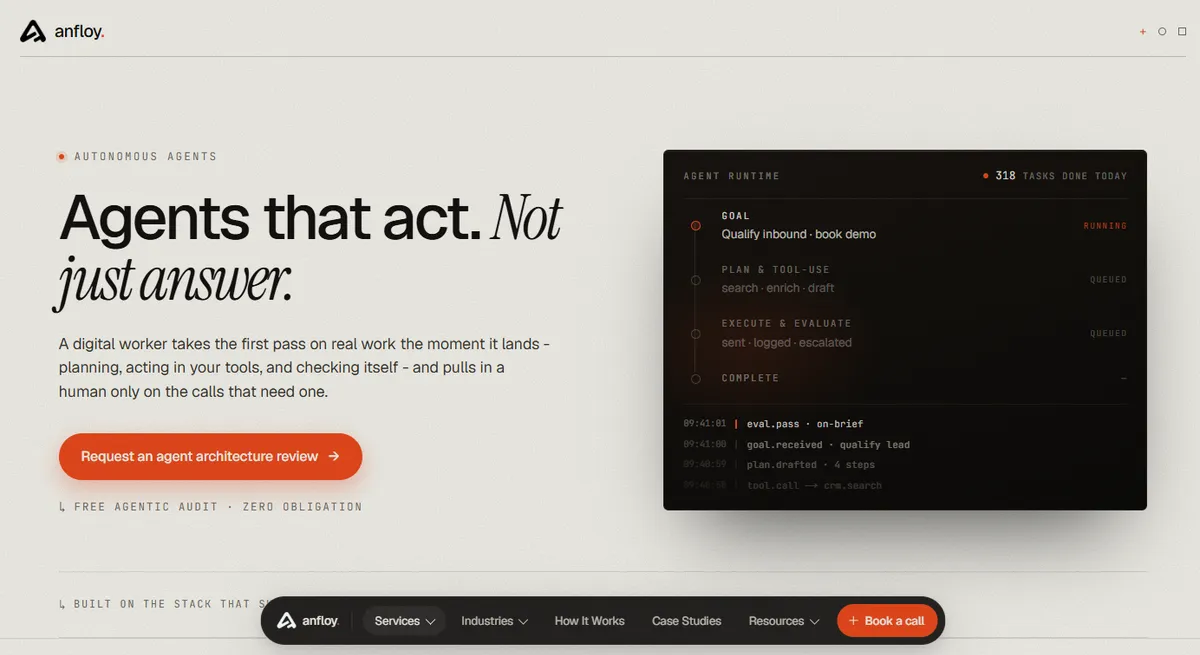
Many companies come to Anfloy looking for an AI chatbot.
What they usually need is a business system.
A chatbot can answer questions.
An AI agent can complete work.
As companies grow, the bottleneck is rarely communication. The real challenge is execution.
Revenue teams need faster prospecting and lead qualification.
Operations teams need repetitive workflows automated.
Employees need instant access to company knowledge.
Founders need scalable systems that reduce operational overhead without increasing headcount.
This is where Anfloy focuses.
Instead of building standalone chatbots, we build company-owned AI infrastructure that integrates directly into your business operations.
Understanding the workflow before the technology
Every project starts with understanding how work moves through the organization.
We analyze:
- GTM processes
- lead generation workflows
- CRM operations
- customer onboarding
- internal knowledge management
- operational bottlenecks
- repetitive manual tasks
The objective is simple.
Identify where time is being lost, where execution slows down, and where AI can create measurable business impact.
Building agentic systems around business outcomes
Once the workflow is mapped, we design custom agentic systems around the desired outcome.
Depending on the use case, this may include:
- prospecting agents
- lead qualification agents
- CRM agents
- onboarding agents
- support agents
- internal operations agents
- knowledge retrieval agents
Unlike traditional automation, these systems can retrieve information, reason through tasks, make decisions, and execute actions across multiple tools.
Instead of isolated automations, businesses get connected workflows that operate end-to-end.
Creating a company AI brain
One of the biggest challenges growing companies face is fragmented knowledge.
Critical information often lives across:
- Notion
- Slack
- Google Drive
- SOP documents
- CRM platforms
- internal databases
Employees spend hours searching for answers that already exist.
To solve this, Anfloy builds Company AI Brains powered by retrieval systems, vector databases, embeddings, hybrid search, and reranking technology.
This creates a centralized knowledge layer that allows AI agents and employees to access company information instantly.
The result is persistent business memory rather than disconnected conversations.
Connecting your existing technology stack
AI systems become valuable when they work inside the tools your team already uses.
Agents can connect directly with:
- HubSpot
- Salesforce
- Slack
- Notion
- Google Workspace
- outbound platforms
- internal databases
- custom software
This allows agents to retrieve data, update records, trigger actions, and coordinate workflows automatically.
Building GTM engines that generate pipeline
For many clients, the highest ROI comes from revenue automation.
This is where Anfloy's GTM Engines come in.
A typical GTM workflow includes:
Signal → Enrichment → Qualification → Personalization → Outreach → CRM
AI agents continuously monitor buying signals, enrich prospect data, identify decision-makers, qualify opportunities, support outbound execution, and update CRM systems automatically.
Instead of relying on disconnected SaaS tools, the entire revenue workflow operates as a unified system.
Automating internal operations
Revenue generation is only one part of the equation.
Many organizations lose significant time to internal operational processes.
AI agents can automate:
- employee onboarding
- knowledge retrieval
- document management
- reporting
- workflow coordination
- operational support
The objective is reducing repetitive work so teams can focus on higher-value activities.
Infrastructure you actually own
Most AI software platforms create dependency.
The more your business relies on them, the more difficult and expensive it becomes to leave.
Anfloy follows a different approach.
We build infrastructure that belongs to the client from day one.
You own:
- AI agents
- workflows
- integrations
- operational logic
- knowledge systems
- deployment architecture
No lock-in.
No platform dependency.
No recurring software hostage situation.
What we build?
Depending on the business objective, projects typically fall into five categories:
Agentic systems
Multi-agent architectures that reason, coordinate, and execute workflows across your business.
GTM engines
AI-powered prospecting, qualification, enrichment, outreach, and CRM systems designed to generate pipeline.
Company AI brains
Persistent knowledge systems powered by retrieval infrastructure and company-specific context.
Internal operations systems
AI workflows that reduce manual work and improve operational efficiency across teams.
Full-stack AI products
Custom internal SaaS platforms, member-facing products, and AI-powered applications deployed directly on your cloud infrastructure.
The end result is not another chatbot.
It is a company-owned AI system that helps your business generate revenue, improve operations, and scale more efficiently over time.
Conclusion
The conversation around AI agents and AI chatbots often creates unnecessary confusion.
Both technologies have value.
Both play important roles.
The difference lies in what they are designed to accomplish.
Chatbots help businesses communicate.
AI agents help businesses operate.
As organizations move beyond basic AI adoption, many discover that the greatest opportunities come from automation, execution, and operational leverage rather than conversation alone.
At Anfloy, that means building systems that go far beyond chat interfaces through:
- agentic systems
- GTM engines
- company AI brains
- internal operations infrastructure
- and full-stack AI products
Because the future of AI is not simply talking to software.
It is building software that can work alongside your team and help move the business forward.
Frequently Asked Questions
What is the difference between an AI agent and an AI chatbot?
An AI chatbot primarily communicates with users, while an AI agent can make decisions, execute workflows, and perform tasks automatically.
Are AI agents better than chatbots?
Not necessarily. They solve different problems. Chatbots focus on conversation, while AI agents focus on execution.
Can an AI chatbot become an AI agent?
Yes. Many advanced systems combine chatbot interfaces with AI agents operating behind the scenes.
Do AI agents use large language models?
Yes. Many AI agents use LLMs for reasoning, decision-making, and communication.
Should businesses start with chatbots or AI agents?
It depends on the use case. Customer support often starts with chatbots, while operational automation typically requires AI agents.
Is an AI agent the same as a chatbot?
No. A chatbot mainly responds to user conversations and questions. An AI agent can make decisions, use tools, perform actions, and complete tasks autonomously to achieve specific goals.
Let's build
what your
company needs.
Drop your email. We'll send The Custom Agent Blueprint on what we'd build first for a company like yours, before you ever take a meeting.