
AI Agents vs CRM Automation: What's the Difference?
Compare AI agents vs CRM automation, including workflows, decision-making, CRM management, automation capabilities, and business use cases.
On this page
- What is CRM automation?
- What are AI agents?
- AI agents vs CRM automation: The core difference
- How CRM automation works?
- How AI agents work?
- Where CRM automation wins?
- Where AI agents win?
- Why CRM automation alone is no longer enough?
- What are the common mistakes businesses make?
- Automating poor processes
- How Anfloy builds AI systems around CRM platforms?
- Conclusion
Customer Relationship Management (CRM) systems have been automating sales processes for years.
Businesses use platforms like HubSpot and Salesforce to:
- manage contacts
- assign leads
- track deals
- trigger workflows
- automate follow-ups
These capabilities have helped sales teams become more organized and efficient.
But today's revenue teams are facing new challenges.
Sales representatives spend hours researching prospects.
AI-powered lead qualification remains inconsistent.
Buying signals are missed.
CRM records become outdated.
Revenue teams rely on dozens of disconnected tools to keep operations running.
Traditional CRM automation was never designed to solve these problems.
This is where AI agents are changing the conversation.
Instead of simply automating predefined workflows, AI agents can understand context, retrieve information, make decisions, and execute operational tasks across multiple systems.
The question is no longer:
"Should we automate our CRM?"
It is:
"Should we build AI systems that work alongside our CRM?"
This guide explains the differences between AI agents and CRM automation, where each performs best, and why businesses are increasingly combining both.
What is CRM automation?
CRM automation uses predefined rules to automate repetitive activities inside a CRM platform.
Typical examples include:
- assigning leads
- sending follow-up emails
- updating deal stages
- creating reminders
- triggering workflows
- scheduling notifications
CRM automation reduces manual work by executing predefined rules created by administrators, making it ideal for repetitive and predictable business processes.
If a specific condition is met, the system performs a predefined action.
This approach has become standard across modern CRM platforms.
What are AI agents?
AI agents are intelligent software systems that can understand goals, analyze information, make decisions, and complete tasks with minimal human intervention.
Unlike traditional automation, AI agents can adapt to changing situations.
They can:
- qualify leads
- retrieve company knowledge
- analyze buying signals
- enrich CRM records
- prioritize opportunities
- coordinate workflows
- execute multi-step business processes
Instead of simply following rules, AI agents use reasoning to determine the best course of action.
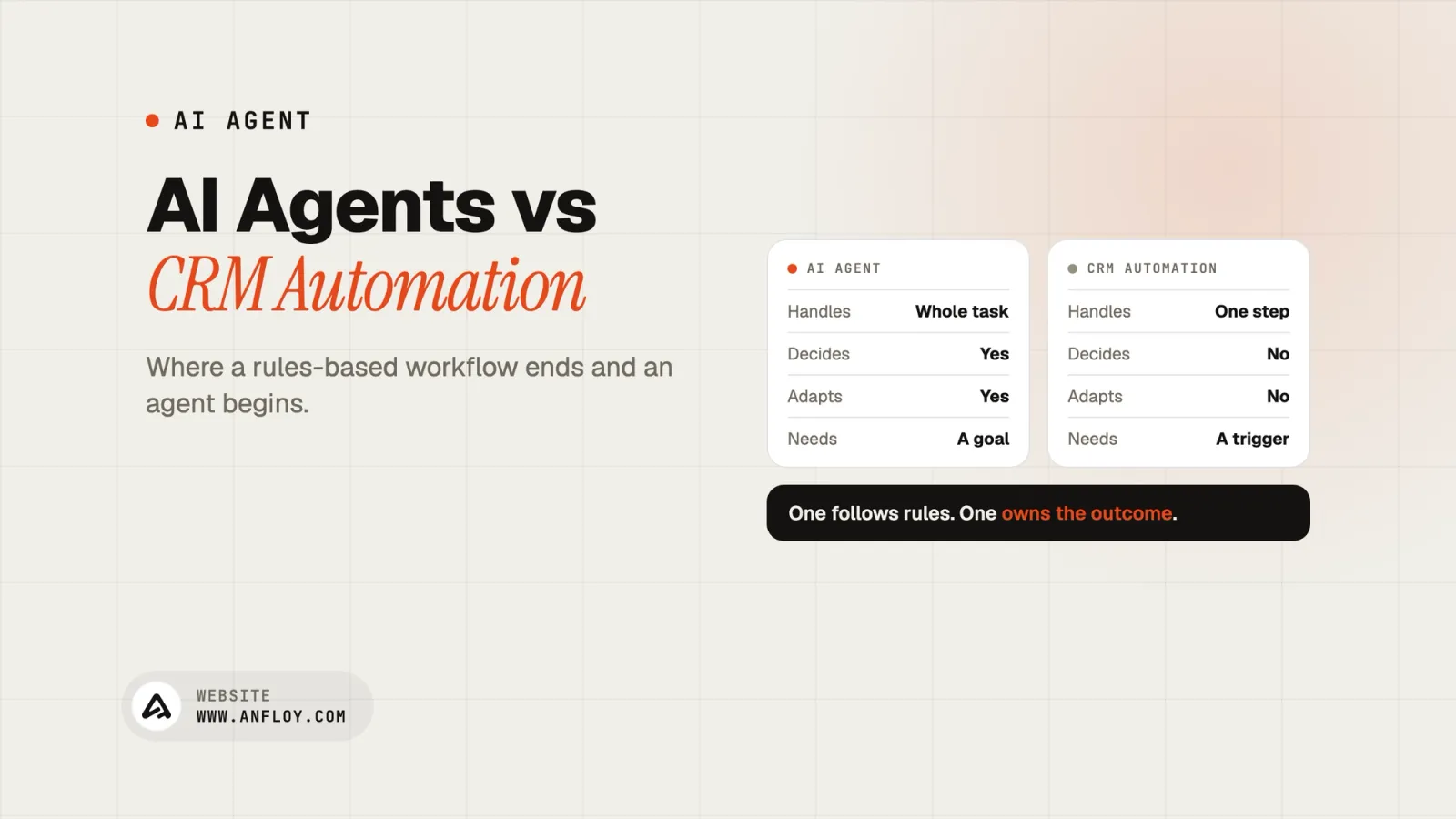
AI agents vs CRM automation: The core difference
The simplest explanation is this:
CRM Automation Follows Rules
If a condition is met, a workflow runs.
AI Agents Make Decisions
They evaluate context before deciding what action should happen next.
This allows AI agents to automate workflows that would be impossible using static business rules alone.
AI agents vs CRM automation comparison
| Category | CRM Automation | AI Agents |
|---|---|---|
| Rule-Based Workflows | Excellent | Excellent |
| Decision-Making | Limited | Excellent |
| Lead Qualification | Basic | Advanced |
| CRM Data Enrichment | Limited | Excellent |
| Buying Signal Analysis | No | Yes |
| Multi-Step Workflows | Limited | Excellent |
| Workflow Adaptability | Limited | Excellent |
| Business Reasoning | No | Yes |
| Cross-System Execution | Moderate | Excellent |
| Operational Intelligence | Limited | Excellent |
The biggest difference is intelligence.
CRM automation follows instructions.
AI agents determine the best action.
How CRM automation works?
CRM automation follows predefined business rules.
A typical workflow might look like this:
- A lead submits a form.
- The CRM creates a contact.
- A follow-up email is sent.
- A task is assigned.
- The sales representative receives a notification.
The workflow is predictable.
If the conditions remain the same, the outcome remains the same.
How AI agents work?
AI agents add reasoning before execution.
A workflow may look like this:
- A lead enters the CRM.
- The AI enriches company information.
- Buying signals are analyzed.
- The lead is qualified.
- Priority is assigned.
- The CRM is updated.
- The correct sales representative receives the opportunity.
- Personalized outreach is generated.
The system adapts based on business context.
Where CRM automation wins?
CRM automation remains highly valuable for structured processes.
Task automation
Automatically create reminders and follow-up tasks.
Email workflows
Send predefined email sequences.
Deal stage updates
Move opportunities through the pipeline using business rules.
Notifications
Keep sales teams informed of important events.
For repetitive workflows with clear logic, CRM automation is often sufficient.
Where AI agents win?
AI agents become valuable when workflows require judgment.
They are especially effective when decisions depend on multiple data sources, changing customer behavior, or business context that cannot be captured with simple if/then rules.
Lead qualification
Evaluate AI lead qualification:
- ICP fit
- buying intent
- company growth
- engagement history
before assigning opportunities.
CRM data enrichment
Automatically gather and validate customer information from multiple sources.
Buying signal detection
Monitor:
- hiring activity
- funding announcements
- technology adoption
- website behavior
to prioritize accounts.
Opportunity prioritization
AI identifies which deals deserve immediate attention on revenue intelligence.
Workflow coordination
AI agents connect CRM systems with sales, marketing, customer success, and internal operations.
Why CRM automation alone is no longer enough?
CRM automation was built for predictable processes.
Modern revenue operations involve customer data, sales engagement platforms, enrichment tools, marketing automation, product usage signals, and internal knowledge bases all of which require systems that can reason across multiple sources.
Businesses now need systems that can:
- analyze customer behavior
- evaluate account quality
- retrieve company knowledge
- coordinate multiple tools
- adapt to changing situations
Static workflows cannot solve these problems effectively.
AI agents provide the flexibility needed for modern revenue operations.
Should AI Agents Replace CRM Automation?
No.
For most businesses, the best approach is combining both.
CRM automation remains excellent for repetitive rule-based workflows.
AI agents become the intelligence layer that determines:
- what should happen
- when it should happen
- why it should happen
The CRM continues managing structured workflows while AI agents improve decision-making.
Together, they create a significantly stronger revenue system.
What are the common mistakes businesses make?
Automating poor processes
AI cannot fix broken workflows.
Strong operational design comes first.
Treating CRM as the entire revenue system
The CRM is only one component of a modern revenue technology stack, which also includes enrichment platforms, outbound tools, marketing automation, internal documentation, analytics, and AI systems.
Ignoring data quality
AI depends on accurate CRM data.
Poor records reduce automation quality.
Building too many static rules
As workflows become more complex, rule-based automation becomes difficult to maintain.
Adding more software instead of better systems
Operational complexity often comes from disconnected tools rather than missing features.
How Anfloy builds AI systems around CRM platforms?
Most businesses already have a CRM.
The challenge is making it intelligent.
At Anfloy, we don't replace CRM platforms.
We build AI infrastructure around them.
Every project starts by understanding:
- your CRM architecture
- qualification process
- sales workflows
- revenue goals
- operational bottlenecks
From there, AI agents become the intelligence layer that supports your existing systems.
GTM engines
AI agents monitor buying signals, enrich customer records, qualify leads, and coordinate CRM workflows automatically.
Company AI brain
Every agent has access to centralized company knowledge, customer history, internal documentation, and operational playbooks through persistent retrieval systems.
Intelligent CRM operations
Instead of relying only on static automation rules, AI agents continuously:
- validate customer records
- prioritize opportunities
- recommend actions
- improve sales pipeline visibility
- automate operational decisions
Multi-agent workflow orchestration
Specialized multi-agent AI architecture collaborate across:
- CRM management
- lead routing
- qualification
- forecasting
- reporting
creating a connected operational system.
Infrastructure you own
Every AI system is built directly on infrastructure owned by the client.
You own:
- the code
- the workflows
- the integrations
- the operational logic
- the AI infrastructure
No platform lock-in. Your AI infrastructure evolves alongside your business instead of being limited by third-party software capabilities.
No recurring software dependency.
The result is a CRM that becomes smarter without becoming more complicated.
Conclusion
CRM automation transformed how businesses manage customer relationships by reducing repetitive administrative work.
AI agents represent the next stage of that evolution.
Instead of simply following rules, AI agents understand context, analyze opportunities, and execute workflows that improve how revenue teams operate every day.
By combining:
- CRM automation
- AI agents
- buying signal intelligence
- workflow orchestration
- Company AI Brains
businesses can build revenue systems that are faster, smarter, and more scalable.
At Anfloy, we help organizations move beyond rule-based automation by building:
- GTM engines
- agentic systems
- Company AI Brains
- internal operations systems
- and full-stack AI products
Because the future of CRM is not replacing your existing platform.
It is adding an intelligent operational layer that helps your entire business make better decisions and execute with greater efficiency.
Frequently Asked Questions
Can AI agents replace CRM automation?
Not entirely. CRM automation remains valuable for structured workflows, while AI agents enhance decision-making and operational intelligence.
Do AI agents work with CRM platforms?
Yes. AI agents commonly integrate with CRM systems such as HubSpot and Salesforce to improve automation and data quality.
Which is better for lead qualification?
AI agents typically provide better lead qualification because they evaluate buying signals, CRM data, company context, and engagement before making decisions.
Should businesses combine AI agents with CRM automation?
Yes. Combining both creates a more intelligent revenue operation than relying on either approach alone.
Let's build
what your
company needs.
Drop your email. We'll send The Custom Agent Blueprint on what we'd build first for a company like yours, before you ever take a meeting.