
AI Content Engineering: How to Structure Content So AI Engines Cite You
Master AI content engineering with GEO/RAG, a step-by-step framework, and a checklist to improve AI retrieval and citations.
On this page
- What is AI content engineering?
- Why it matters now: how AI engines actually choose sources?
- The disciplines of AI content engineering
- A step-by-step framework for AI content engineering
- AI content engineering vs. traditional SEO
- What are the common mistakes to avoid?
- The future: content as an AI-ready system
- How I design content structure for AI retrieval and citation?
- Build your AI content engine with Anfloy
- Conclusion
AI content engineering is the practice of designing the structure, semantics, and metadata of content so that AI answer engines ChatGPT, Perplexity, Google AI Overviews can retrieve it, trust it, and cite it as the source of their answers.
It merges classic content engineering (models, schema, taxonomy) with the retrieval mechanics of large language models. Done well, it turns your content from a page a human might find into the passage a machine chooses to quote.
That distinction now decides who gets found. Gartner projects a ~25% drop in traditional search volume as users get answers directly from AI. If your content isn't engineered for retrieval, your "page one" ranking won't matter no one will click "read more."
This guide is written for engineering and product leaders who own content systems. We'll cover what AI content engineering actually is, how AI retrieval works under the hood, the disciplines involved, a step-by-step framework, and a checklist you can act on.
What is AI content engineering?
AI content engineering is the discipline of organizing the shape, structure, and semantics of content so it performs in two audiences at once: humans who read it and machines that retrieve and synthesize it.
Traditional content engineering a practice long predating LLMs is about turning static content into structured, reusable, "omnipurpose" assets using models, metadata, markup, schema, taxonomy, topology, and graphs. Its goal was reuse across channels and machine-readability for search engines.
AI content engineering raises the stakes. The consuming machine is no longer just a crawler that ranks links; it's a language model that reads a passage, decides whether to trust it, and rewrites it into an answer. That changes what "good structure" means: content must be chunkable, self-contained, answer-first, and richly signposted with entities and schema.
Content engineering vs. content strategy vs. copywriting
Content strategy decides the who/what/why (the CEO of content).
Content engineering decides the how structure, models, systems (the CTO of content).
Copywriting produces the words.
AI content engineering is the layer that makes those words machine-legible to LLMs.
Why it matters now: how AI engines actually choose sources?
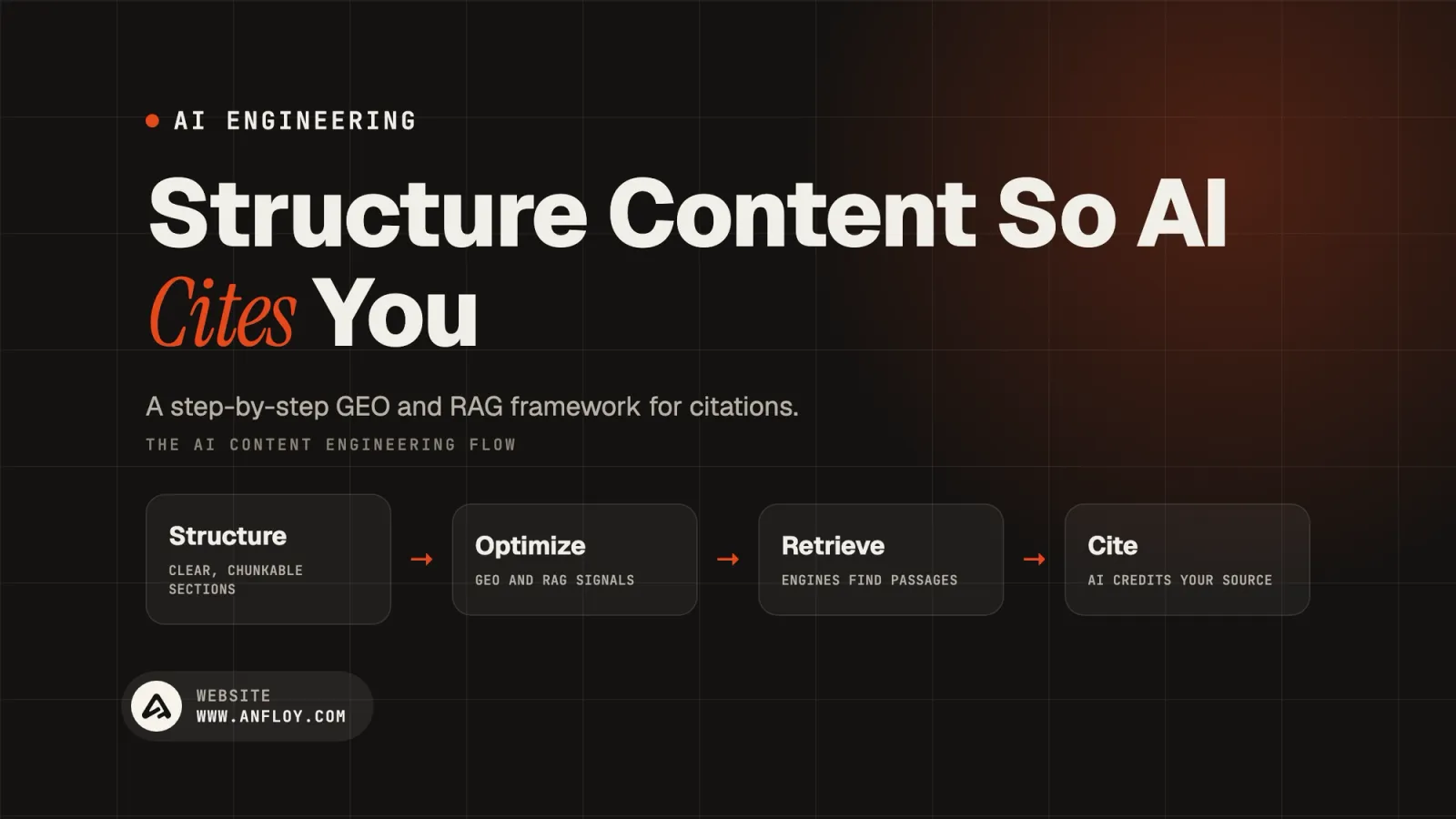
AI answer engines use Retrieval-Augmented Generation (RAG). Simplified, the pipeline is:
- Chunk & embed: the web is split into passages, each converted to a vector (a mathematical representation of meaning).
- Retrieve: when a user asks a question, the engine fetches the passages whose vectors are closest to the query.
- Synthesize: the model composes an answer from the retrieved passages and cites the cleanest, most authoritative ones.
Three consequences fall directly out of this, and they are the job of AI content engineering:
- The engine reads passages, not pages. A brilliant point buried in paragraph 14 of a 3,000-word essay may never be retrieved. Each section must stand on its own.
- Muddy passages get discarded. If one paragraph mixes two topics, its vector becomes ambiguous and the engine skips it. Clarity is a retrieval signal, not just a style preference.
- The engine rewards the path of least resistance. A clean, pre-synthesized 50-word answer is easier to lift and cite than fluff. Give the model the answer and it attributes the citation to you.
The disciplines of AI content engineering
AI content engineering services inherits seven classic disciplines and adds a modern retrieval layer on top.
The classic foundation:
Discipline
What it does
AI-era relevance
Model
Defines content types, elements, relationships
Lets you generate consistent, structured content at scale
Metadata
Machine-readable info about content
Feeds entity recognition and disambiguation
Markup
Semantic HTML wrapping content
Clean HTML5 (<article>, <section>) aids parsing
Schema
schema.org / JSON-LD vocabularies
Tells engines exactly what a passage is
Taxonomy
Tag maps connecting concepts
Powers topic clusters and internal linking
Topology
Structure across the CMS/system
Enables scalable, reusable content operations
Graph
Node-based relationships between entities
Mirrors how LLMs relate concepts
The AI retrieval layer (what's new):
- Semantic chunking: every H2/H3 is a self-contained unit of value, so each maps to a clean vector.
- Answer-first structure: a direct 40–60 word answer immediately after each heading (the "direct answer slot").
- Entity richness: name the entities (brands, products, standards) explicitly and consistently so the model can ground them.
- Content density: high signal-to-noise; every sentence carries a fact, not filler ("fluff tax").
- E-E-A-T & provenance: original data, author schema, citations, and consistent phrasing build the trust the model uses to pick a source.
A step-by-step framework for AI content engineering
Use this five-step loop to engineer any page new or existing.
Step 1 Audit for extractability
Go through the page as an AI would. For each section ask: Is it citable (a clean definition or data point)? Is it structured (headings, lists, short paragraphs)? Is it answer-first (key info at the top)? Is it authoritative (evidence, sources, author identity)? Flag every section that fails.
Step 2 Research latent intent & entities
Map the conversational and follow-up questions real users ask, not just the head keyword. Identify the entities the model must recognize to answer, and the sub-intents it might branch into. This is what you'll structure the page around.
Step 3 Model the structure
Design the page as modular chunks: one question or concept per H2/H3, each opening with a direct answer, then expanding. Plan your schema types up front (Article, FAQPage, HowTo, Defined Term) and your internal links to the pillar and cluster pages.
Step 4 Engineer the content
Write for humans, structure for machines:
- Open each section with a 40–60 word direct answer in definitive language.
- Use tables, numbered steps, and comparison blocks formats engines lift into answers.
- Run a fluff audit: cut 20% of words while keeping 100% of facts.
- Add JSON-LD schema matching the content type.
- Link to authoritative sources and cite original data.
Step 5 Test, measure, iterate
Simulate retrieval: ask the target questions in ChatGPT, Perplexity, and Google AI Mode and see whether your passages surface and get cited. Track AI-citation visibility over time and revisit passages that lose ground. AI content engineering is a loop, not a launch.
AI content engineering vs. traditional SEO
| Dimension | Traditional SEO | AI Content Engineering |
|---|---|---|
| Optimizes for | Ranking in search results ("blue links") | Being retrieved, understood, and cited in AI-generated answers |
| Unit of value | The entire page | Individual passages or content chunks |
| Winning signal | Keywords, backlinks, and technical SEO | Structure, semantics, entities, context, and trust |
| Primary output | Ranked search listing | Synthesized AI answer with cited sources |
| Success metric | Rankings, clicks, and organic traffic | Inclusion, citations, and influence in AI responses |
SEO isn't dead Google's AI Overviews still favor pages that already rank. But ranking is now the entry ticket, not the prize. AI content engineering is what wins the citation.
What are the common mistakes to avoid?
- Treating AI as a writing tool, not a system. Generating drafts with a generic LLM produces "AI slop" low-density, undifferentiated content engines learn to distrust. Engineering is about structure and operations, not just generation.
- Walls of text. Long, mixed-topic paragraphs produce muddy vectors that never get retrieved.
- Burying the answer. A "witty" 200-word intro before the point tells the model your content is low signal.
- Skipping schema. Without JSON-LD, engines guess what your content is and often guess wrong.
- No measurement. If you're not tracking AI citations, you can't tell engineering from guessing.
The future: content as an AI-ready system
The organizations that win won't just publish articles they'll operate content systems where structure, schema, and retrieval-readiness are engineered in by default, and where AI handles research, drafting, and repurposing under human governance.
Content stops being a pile of static assets and becomes a living, machine-legible source of truth. That's the shift AI prompt engineering for content creation delivers.
How I design content structure for AI retrieval and citation?
Then cover the structure as:
Search Intent
   ↓
Primary Entity
   ↓
Entity Attributes
   ↓
Direct Answer
   ↓
Supporting Evidence
   ↓
Related Entities
   ↓
Semantic Relationships
   ↓
Internal Links
   ↓
Structured Data
   ↓
Citation / Source Signals
Build your AI content engine with Anfloy
AI content engineering is a systems problem models, schema, pipelines, and measurement working together not a one-off rewrite. That's exactly what Anfloy builds.
We audit your existing content for extractability, engineer the structure and schema, and stand up the AI content operations that keep you cited as AI search reshapes discovery.
DIY vs. building with Anfloy
DIY / generic AI tools
With Anfloy
Approach
Ad-hoc drafts from a content engineering platform.
Engineered content system (model → schema → pipeline → measurement)
Structure & schema
Manual, inconsistent, often skipped
Semantic chunking + JSON-LD engineered in by default
Retrieval readiness
Hit or miss passages rarely tuned for RAG
Every passage tested against real AI engines
Content operations
Breaks as volume grows
Human-in-the-loop pipeline that scales
Measurement
Keyword rankings only
AI-citation visibility tracked and iterated
Time to impact
Months of trial and error
Weeks proven framework applied to your content
Talk to Anfloy about engineering your content for AI search →
Related reading: AI Content Engine for B2B SaaS: How to Scale Content Operations · How to Use AI Engineering for Your Content Systems
Conclusion
AI content engineering is the next evolution of content strategy. In an AI-first search landscape, success is no longer determined solely by where your page ranks, but by whether AI systems can retrieve, understand, trust, and cite your content.
That requires a different mindset. Instead of publishing pages optimized only for keywords, organizations need content systems built around semantic structure, machine-readable metadata, modular content, and retrieval-ready passages. The goal is no longer just visibility in search results it's becoming the trusted source behind AI-generated answers.
The companies that adapt early will build durable visibility across ChatGPT, Google AI Overviews, Perplexity, and whatever answer engines come next. Those that don't risk creating content that's technically discoverable but practically invisible.
The future belongs to content that is engineered not just written.
Frequently asked questions
How do you scale content with AI engineering?
Scale content by combining structured content models, AI-assisted drafting, reusable templates, human review, and automated publishing workflows to maintain quality, consistency, and retrieval readiness.
What are the best platforms for AI content engineering?
The best platforms combine AI, CMS, automation, schema, and analytics. Common choices include Contentful, Sanity, WordPress, OpenAI, Anthropic, n8n, and custom AI pipelines.
How do you use AI for content engineering?
Use AI to research, draft, optimize, classify, generate metadata, create schema, identify entities, and automate workflows, while humans oversee strategy, accuracy, and governance.
What is context engineering for AI content?
Context engineering is the practice of structuring content, metadata, entities, and supporting information so AI models receive the right context to generate accurate, relevant responses.
How do you use AI for content engineering?
AI supports content engineering by accelerating research, drafting, semantic optimization, schema generation, internal linking, and content maintenance within a structured, human-reviewed workflow.
what is the cited framework in content engineering?
A cited framework in content engineering structures content around entities, relationships, evidence, context, and clear information paths, making claims easier for AI engines to understand, verify, retrieve, and cite.
How to scale content with AI engineering?
Scale content with AI engineering by combining structured content models, reusable templates, entity relationships, automated research, human quality controls, internal linking, structured data, and evaluation systems that maintain consistency across thousands of pages.
How can I design my content structure so AI systems can easily retrieve and cite it?
Use clear headings, direct answers, explicit entities, concise factual statements, supporting evidence, contextual relationships, structured data, and logical internal links so AI systems can identify, understand, retrieve, and attribute important information.
How to design content that performs well for crawlers, human readers, and AI retrieval models?
Build content around clear information architecture, descriptive headings, concise answers, semantic relationships, supporting evidence, internal links, structured data, readable formatting, and genuinely useful information that satisfies both human intent and machine retrieval.
How should content be written for AI search environments?
Write content with explicit entities, unambiguous language, answer-first sections, factual evidence, contextual relationships, structured headings, and supporting sources so AI systems can efficiently understand, extract, verify, and potentially cite the information.
How can content engineers help scale a site’s AI visibility across thousands of pages?
Content engineers scale AI visibility by creating reusable content architectures, entity models, templates, internal-linking systems, structured data, automated quality checks, and evaluation workflows that preserve semantic consistency across large content inventories.
How do content engineers use structured data to improve LLM extractability?
Content engineers use structured data to clarify entities, attributes, relationships, products, organizations, authors, and other page concepts, giving search engines and AI systems additional machine-readable context for understanding and connecting information.

Let's build
what your
company needs.
Drop your email. We'll send The Custom Agent Blueprint on what we'd build first for a company like yours, before you ever take a meeting.