
How Do You Use AI in GTM Systems? Guide to Building AI-Powered Revenue Engines
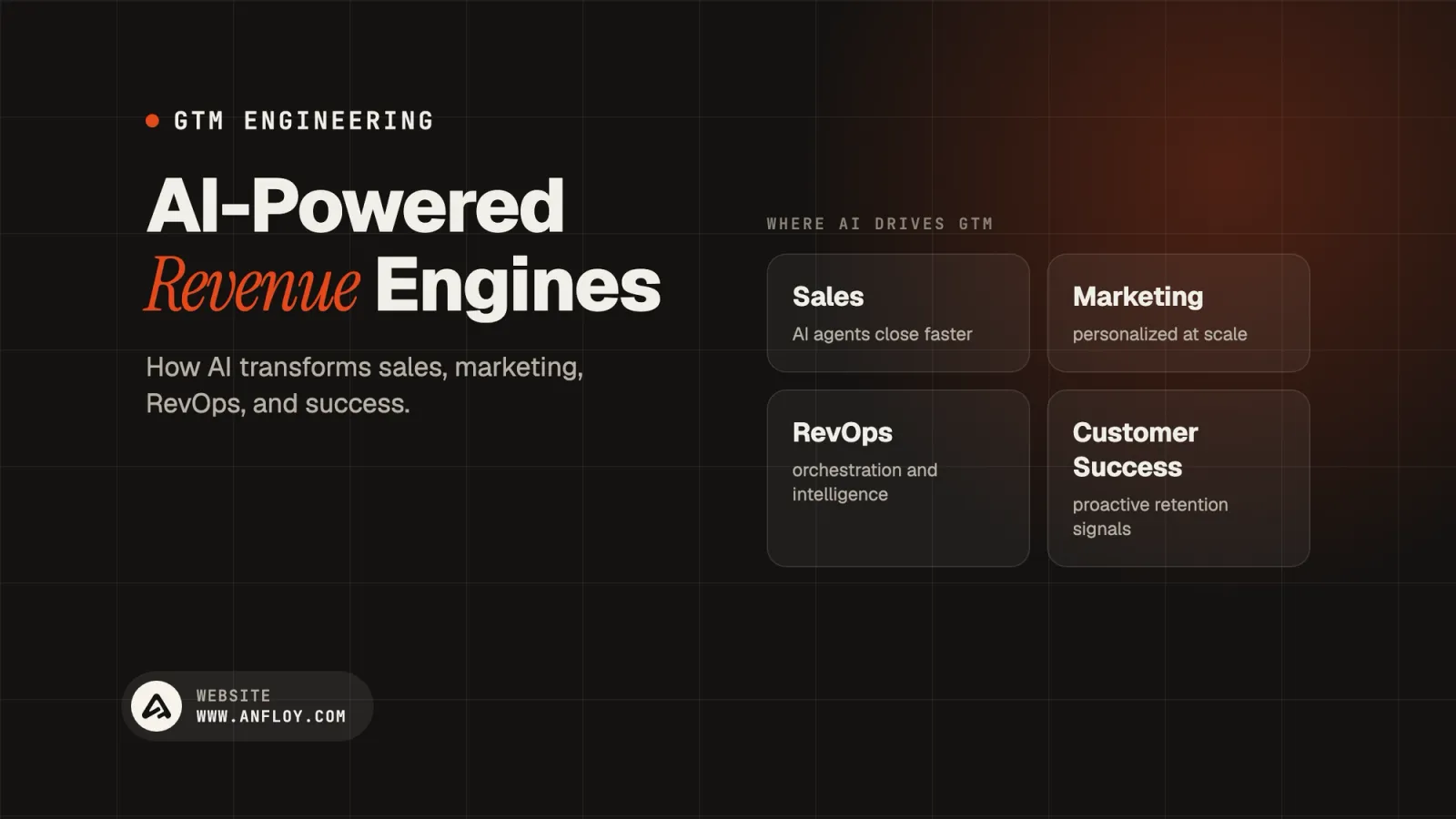
Learn how AI powers sales, marketing, RevOps, and customer success with AI agents, revenue intelligence, orchestration, and GTM engines.
On this page
- What is a GTM system?
- What is AI in GTM?
- Why businesses are adding AI to GTM systems?
- How AI Is used across the GTM lifecycle?
- AI for company intelligence
- AI agents in GTM systems
- How AI orchestration powers GTM systems?
- What are the benefits of AI-powered GTM systems?
- What are the top common GTM mistakes?
- What are the best practices for AI in GTM?
- How Anfloy builds AI GTM systems?
- What is the future of AI in GTM?
- Conclusion
Go-to-market (GTM) teams have never had access to more data.
Every day, businesses generate signals across their website, CRM, product analytics, support platforms, email campaigns, and social channels. Prospects change jobs, raise funding, expand into new markets, hire aggressively, adopt new technologies, and engage with content long before speaking to a salesperson.
The challenge isn't finding information.
The challenge is turning information into action.
Traditional GTM systems struggle because they're built around disconnected tools and manual processes. Sales teams spend hours researching accounts, updating CRM records, qualifying leads, writing outreach emails, and preparing pipeline reports. Revenue leaders often lack visibility into which opportunities deserve immediate attention and where pipeline leakage occurs.
Artificial intelligence is changing that.
Instead of treating GTM as a series of independent tasks, businesses are increasingly using AI to build connected systems that identify opportunities, enrich customer data, personalize outreach, prioritize pipeline, and improve revenue forecasting.
This shift is creating a new category of enterprise infrastructure: AI-powered GTM systems.
Modern GTM systems combine:
- AI agents
- Company Intelligence
- Retrieval-Augmented Generation (RAG)
- CRM enrichment
- workflow orchestration
- revenue intelligence
- pipeline analytics
- autonomous outreach
Together, these technologies help businesses move faster while improving decision-making across the entire customer lifecycle.
In this guide, you'll learn:
- what a GTM system is
- how AI is used in GTM
- where AI delivers the most value
- how AI agents improve revenue operations
- best practices for implementing AI in GTM
- common mistakes businesses make
- how to build a scalable AI GTM infrastructure
Whether you're leading sales, RevOps, marketing, or customer success, understanding how AI fits into your GTM strategy is becoming essential for maintaining a competitive advantage.
What is a GTM system?
A Go-to-Market (GTM) system is the combination of people, processes, technology, and workflows that help a business acquire, convert, and retain customers.
A GTM system typically spans multiple functions, including:
- marketing
- sales
- revenue operations
- customer success
- partnerships
- account management
Its purpose is simple:
Deliver the right message to the right customer at the right time through the right channel.
Historically, GTM systems relied on:
- CRM platforms
- marketing automation tools
- spreadsheets
- sales engagement platforms
- business intelligence tools
- manual account research
While these systems remain valuable, they often create fragmented experiences.
For example:
- Marketing owns lead generation.
- Sales owns qualification.
- RevOps owns reporting.
- Customer Success owns retention.
Each team uses different tools and maintains separate datasets.
AI-powered GTM systems change this by introducing a centralized intelligence layer that connects every part of the revenue organization.
What is AI in GTM?
AI in GTM refers to the use of artificial intelligence, AI agents, and intelligent workflows to improve how businesses attract, qualify, convert, and retain customers.
Instead of relying solely on manual effort, AI continuously analyzes customer data, identifies opportunities, and automates operational tasks across the GTM lifecycle.
Examples include:
- identifying buying signals
- enriching CRM records
- prioritizing accounts
- generating personalized outreach
- forecasting revenue
- scoring opportunities
- monitoring pipeline health
- recommending next actions
AI doesn't replace GTM teams.
It augments them.
The goal is to help employees spend less time on administrative work and more time building relationships, closing deals, and delivering customer value.
Why businesses are adding AI to GTM systems?
Organizations are investing in AI because modern GTM has become increasingly complex.
Revenue teams are expected to:
- manage larger pipelines
- personalize outreach at scale
- improve forecasting accuracy
- respond faster to buying signals
- maintain CRM automation quality
- increase conversion rates
Achieving all of this manually is difficult.
AI helps businesses scale without proportionally increasing headcount.
Improved efficiency
AI automates repetitive tasks such as:
- account research
- CRM updates
- lead scoring
- meeting summaries
- reporting
This allows teams to focus on higher-value activities.
Better personalization
Modern buyers expect relevant experiences.
AI can personalize:
- email outreach
- LinkedIn messaging
- sales sequences
- onboarding communications
- customer success interactions
This improves engagement while increasing conversion rates.
Faster decision-making
AI provides revenue teams with real-time insights into:
- account activity
- deal health
- buying intent
- pipeline risks
- revenue trends
Leaders can make more informed decisions without waiting for manual reports.
Greater pipeline visibility
Revenue leaders often ask:
- Which deals are most likely to close?
- Which accounts deserve attention?
- Where is pipeline leaking?
- Which activities drive revenue?
AI helps answer these questions continuously rather than periodically.
How AI Is used across the GTM lifecycle?
AI creates the greatest value when it supports the entire GTM journey rather than isolated activities.
A modern AI-powered GTM system typically looks like this:

Market Intelligence
        ↓
Company Research
        ↓
Lead Generation
        ↓
Lead Qualification
        ↓
CRM Enrichment
        ↓
Outbound Prospecting
        ↓
Personalized Outreach
        ↓
Pipeline Management
        ↓
Revenue Intelligence
        ↓
Customer Success
Let's examine each stage.
AI for market intelligence
Every successful GTM strategy begins with understanding the market.
AI helps businesses identify:
- emerging trends
- competitive activity
- target industries
- total addressable market (TAM)
- ideal customer profiles (ICP)
For example, AI can monitor:
- funding announcements
- hiring activity
- product launches
- market expansion
- technology adoption
These signals help GTM teams prioritize opportunities before competitors.
AI for company intelligence
Company intelligence is becoming one of the most valuable applications of AI.
Rather than manually researching accounts, AI continuously gathers information about target companies.
This may include:
- employee count
- funding history
- technology stack
- leadership changes
- expansion activity
- recent news
- social engagement
By combining multiple data sources, businesses gain a richer understanding of customer intent.
At Anfloy, Company Intelligence forms the foundation of many AI GTM systems because it enables better qualification, outreach, and revenue forecasting.
AI for lead generation
Lead generation remains a top priority for most revenue teams.
AI improves this process by automatically:
- identifying prospects
- matching ICP criteria
- prioritizing accounts
- removing duplicates
- enriching contact data
Instead of generating large volumes of low-quality leads, AI helps teams focus on opportunities most likely to convert.
This shift from quantity to quality improves both sales efficiency and customer experience.
AI for CRM enrichment
Poor CRM hygiene remains one of the biggest challenges in revenue operations.
Incomplete records often lead to:
- inaccurate reporting
- poor forecasting
- missed opportunities
- duplicate accounts
- ineffective outreach
AI continuously enriches CRM systems by adding:
- company information
- contact details
- buying signals
- relationship data
- account activity
A well-maintained CRM becomes significantly more valuable when every record reflects current business information.
AI for outbound prospecting
Outbound prospecting is one of the most time-consuming activities in sales.
AI dramatically improves outbound by helping teams:
- identify buying signals
- prioritize accounts
- personalize messaging
- generate email sequences
- create LinkedIn outreach
- automate follow-ups
For example, an AI-powered outbound workflow might:
- Detect a company expanding internationally.
- Retrieve company intelligence.
- Identify relevant decision-makers.
- Generate personalized messaging.
- Schedule outreach.
- Update the CRM.
- Notify the account executive.
This allows sales teams to operate with greater speed while maintaining personalization at scale.
AI for pipeline management
Pipeline visibility remains a major challenge for growing organizations.
AI helps revenue teams monitor:
- deal health
- opportunity risk
- stage progression
- conversion rates
- forecast accuracy
- pipeline coverage
Rather than relying on intuition, teams gain access to continuous insights that improve revenue planning and execution.
AI for revenue intelligence
AI Revenue intelligence has become one of the most impactful applications of AI in GTM systems.
Traditionally, revenue leaders relied on spreadsheets, CRM reports, and periodic reviews to understand pipeline performance. By the time issues were identified, opportunities were often lost.
AI changes this by continuously analyzing revenue-related data across the organization.
Modern AI-powered revenue intelligence platforms can:
- identify deals at risk
- predict pipeline coverage
- improve forecast accuracy
- analyze sales performance
- detect buying signals
- recommend next actions
- measure revenue attribution
Instead of asking, "What happened last quarter?" revenue teams can ask:
- Which deals are likely to close this month?
- Which accounts need immediate attention?
- Which activities contribute most to revenue?
- Where is pipeline leakage occurring?
This shift from historical reporting to predictive intelligence helps organizations make faster and more informed decisions.
AI agents in GTM systems
AI GTM systems are becoming increasingly agentic.
Rather than relying on one large AI assistant, businesses are deploying specialized AI agents that collaborate across the revenue organization.
Each agent owns a specific responsibility.
Company intelligence agent
Responsible for:
- researching target accounts
- monitoring buying signals
- tracking funding activity
- identifying market opportunities
Lead qualification agent
Responsible for:
- ICP matching
- lead scoring
- opportunity prioritization
- qualification recommendations
CRM Agent
Responsible for:
- account enrichment
- contact updates
- duplicate detection
- data validation
Outreach agent
Responsible for:
- generating personalized emails
- creating LinkedIn sequences
- scheduling follow-ups
- monitoring engagement
Revenue intelligence agent
Responsible for:
- forecasting
- pipeline analysis
- opportunity scoring
- performance reporting
Customer success agent
Responsible for:
- onboarding
- account monitoring
- churn prediction
- renewal recommendations
Specialized agents are easier to manage, easier to evaluate, and significantly more scalable than one general-purpose assistant.
How AI orchestration powers GTM systems?
AI agents create value individually.
AI orchestration creates value at scale.
AI orchestration coordinates how multiple agents, business systems, and workflows collaborate to achieve GTM objectives.
A typical orchestration workflow might look like this:
Buying Signal
      ↓
Company Intelligence Agent
      ↓
CRM Agent
      ↓
Lead Qualification Agent
      ↓
Outreach Agent
      ↓
Revenue Intelligence Agent
      ↓
Sales Team
This orchestration layer manages:
- workflow sequencing
- context sharing
- knowledge retrieval
- approvals
- exception handling
- monitoring
- reporting
Without orchestration, businesses often end up with disconnected AI tools that duplicate effort and create inconsistent experiences.
With orchestration, AI becomes a coordinated revenue engine.
What are the benefits of AI-powered GTM systems?
Organizations implementing AI across GTM consistently experience improvements across efficiency, revenue generation, and customer experience.
More qualified pipeline
AI helps teams identify and prioritize opportunities with the highest likelihood of conversion.
Instead of pursuing every lead equally, revenue teams focus on accounts that demonstrate strong intent signals.
Faster execution
AI reduces the time required to:
- research accounts
- enrich CRM records
- generate outreach
- prepare reports
- qualify opportunities
Work that previously required hours can often be completed in minutes.
Improved personalization
Modern buyers expect personalized interactions.
AI enables businesses to personalize:
- emails
- LinkedIn outreach
- onboarding experiences
- customer communications
- account strategies
This improves engagement without sacrificing scalability.
Better forecasting
AI continuously analyzes pipeline activity, allowing revenue leaders to make more accurate predictions.
Improved forecasting supports:
- hiring decisions
- budget planning
- resource allocation
- sales strategy
Lower operational costs
AI reduces manual effort across the revenue organization.
Common cost savings come from:
- fewer administrative tasks
- improved productivity
- reduced operational inefficiencies
- faster workflow execution
Stronger customer experiences
Customers benefit from:
- faster responses
- more relevant interactions
- improved onboarding
- proactive support
- personalized communications
Ultimately, AI GTM systems improve both internal operations and external customer experiences.
What are the top common GTM mistakes?
Many businesses adopt AI without rethinking their GTM architecture.
This often leads to fragmented implementations that fail to deliver meaningful results.
Disconnected tools
Organizations frequently use separate tools for:
- CRM
- outreach
- reporting
- lead enrichment
- customer success
Without a centralized intelligence layer, these systems create operational silos.
Poor CRM hygiene
AI performs best when supported by accurate data.
Unfortunately, many CRMs contain:
- incomplete records
- outdated information
- duplicate accounts
- inconsistent fields
Improving CRM quality should be a priority before scaling AI.
Generic outreach
Mass outreach remains one of the biggest mistakes in GTM.
AI should improve personalization, not automate irrelevant messaging.
Successful AI systems use:
- Company Intelligence
- buying signals
- customer history
- account context
to create highly relevant interactions.
Missing buying signals
Buying signals often represent the highest-value GTM opportunities.
Examples include:
- funding announcements
- leadership changes
- hiring activity
- geographic expansion
- technology adoption
Organizations that fail to monitor these signals frequently miss opportunities that competitors identify first.
No orchestration layer
Deploying multiple AI tools without orchestration creates complexity.
Businesses should think beyond individual applications and design an architecture where AI systems collaborate seamlessly.
What are the best practices for AI in GTM?
Organizations achieving the greatest success with AI GTM systems tend to follow similar principles.
Start with business objectives
Focus on measurable outcomes such as:
- pipeline growth
- conversion rates
- revenue generation
- customer retention
Build a company AI brain
Centralize business knowledge before deploying AI agents.
This ensures every system retrieves accurate information.
Design specialized AI agents
Avoid building one oversized assistant.
Specialized agents improve reliability, scalability, and governance.
Orchestrate workflows
Think in terms of end-to-end business processes rather than individual tasks.
Secure every integration
Implement:
- role-based access controls
- approval workflows
- audit logging
- secure APIs
Measure business impact
Track:
- qualified pipeline
- forecast accuracy
- customer satisfaction
- operational efficiency
- revenue influenced
AI should always be measured by business outcomes.
How Anfloy builds AI GTM systems?
At Anfloy, we don't view AI as another sales tool.
We view it as the intelligence layer that connects every part of the revenue organization.
Most businesses already have valuable customer data, operational knowledge, and established GTM processes. The challenge is that this information is often spread across CRMs, spreadsheets, marketing platforms, support systems, and internal documentation.
Our goal is to transform these disconnected assets into a unified, AI-powered GTM system.
Every implementation follows a structured methodology.
Step 1: Business discovery
Before recommending technology, we seek to understand:
- business objectives
- revenue goals
- customer journey
- GTM processes
- existing software stack
- operational bottlenecks
- success metrics
This ensures AI supports measurable business outcomes rather than isolated experiments.
Step 2: Build the company AI brain
Every GTM system requires trusted knowledge.
We create a centralized Company AI Brain that connects:
- CRM records
- customer history
- sales playbooks
- pricing documentation
- onboarding materials
- support documentation
- operational policies
Using Retrieval-Augmented Generation (RAG), vector embeddings, semantic search, hybrid retrieval, and reranking, every AI agent retrieves information from the same source of truth.
Step 3: Deploy specialized agentic systems
Rather than building one large assistant, we design specialized AI agents for business specific GTM responsibilities.
Examples include:
- Company Intelligence Agent
- CRM Agent
- Lead Qualification Agent
- Outreach Agent
- Revenue Intelligence Agent
- Customer Success Agent
Each agent focuses on one responsibility while collaborating through shared business context.
Step 4: Implement AI orchestration
AI orchestration acts as the control layer across the GTM ecosystem.
It coordinates:
- agent communication
- workflow sequencing
- tool execution
- approvals
- monitoring
- reporting
This transforms disconnected automations into one coordinated revenue engine.
Step 5: Optimize continuously
AI GTM systems should improve over time.
We continuously evaluate:
- pipeline growth
- conversion rates
- outreach effectiveness
- forecast accuracy
- operational efficiency
- customer outcomes
The result is an AI GTM platform that becomes more valuable as your business grows.
Step 6: Infrastructure you own
Every AI GTM implementation is deployed on infrastructure owned by the client.
You own:
- the code
- the workflows
- the Company AI Brain
- the orchestration logic
- the integrations
- the operational data
There is no vendor lock-in or dependency on proprietary AI platforms.
Your GTM infrastructure remains a long-term business asset.
What is the future of AI in GTM?
AI is changing how businesses acquire, convert, and retain customers.
The next generation of GTM won't rely solely on human teams supported by software.
It will combine humans with specialized AI coworkers.
Several trends are shaping this future.
Autonomous GTM systems
Businesses are moving toward autonomous systems capable of:
- monitoring buying signals
- qualifying leads
- updating CRM records
- generating outreach
- prioritizing opportunities
- recommending next actions
Rather than waiting for instructions, AI will proactively support revenue teams.
AI SDRs and AI account executives
Sales organizations are increasingly adopting AI-powered SDRs.
Future AI systems will assist with:
- account research
- prospecting
- qualification
- meeting preparation
- pipeline analysis
Human sales teams will continue to own relationships while AI manages much of the operational workload.
Multi-agent revenue organizations
Revenue teams will deploy networks of specialized AI agents working alongside employees.
Examples include:
- SDR Agents
- Revenue Intelligence Agents
- Customer Success Agents
- Company Intelligence Agents
- CRM Agents
AI orchestration platforms will coordinate these digital coworkers across the organization.
AI operating systems for revenue teams
Businesses will increasingly manage GTM activities through AI operating systems that combine:
- Company AI Brains
- Agentic Systems
- AI orchestration
- workflow automation
- revenue intelligence
- governance
This shift will transform GTM from a collection of tools into a connected intelligence platform.
Conclusion
AI is fundamentally changing how businesses approach go-to-market execution.
Rather than relying on disconnected tools and manual processes, organizations are beginning to build intelligent GTM systems capable of identifying opportunities, orchestrating workflows, and continuously improving revenue performance.
The companies that benefit most from AI won't necessarily have the largest sales teams or the most software.
They'll have the strongest intelligence layer.
By combining Company Intelligence, AI Agents, Revenue Intelligence, CRM enrichment, workflow orchestration, and GTM automation, businesses can create scalable systems that improve efficiency while delivering better customer experiences.
At Anfloy, we help businesses design production-ready AI GTM infrastructure powered by Company AI Brains, Agentic Systems, AI Orchestration, and Revenue Intelligence.
Every implementation is tailored to your business, integrated with your existing systems, and deployed on infrastructure you own.
The future of GTM isn't just digital.
It's intelligent.
Build an AI-Powered GTM System with Anfloy
Whether you're looking to improve outbound prospecting, automate revenue operations, enrich CRM data, or build a complete AI GTM platform, Anfloy can help.
From Company AI Brains and GTM Intelligence to Agentic Systems and Revenue Operations, we design scalable AI infrastructure that drives measurable business growth.
Book a Strategy Call
Frequently Asked Questions
How does AI improve GTM systems?
AI improves GTM systems by automating repetitive tasks, improving personalization, monitoring buying signals, increasing pipeline visibility, and enabling faster, more informed decision-making.
Can AI replace SDRs?
AI is unlikely to fully replace SDRs in the near future. Instead, AI SDRs will automate research, qualification, and administrative work while human representatives focus on relationships and complex sales conversations.
What tools are commonly used in AI GTM systems?
Common technologies include: CRM platforms Large Language Models (LLMs) Retrieval-Augmented Generation (RAG) vector databases workflow automation tools AI orchestration platforms analytics systems
How do businesses implement AI GTM systems?
Most businesses begin by identifying high-impact workflows, centralizing business knowledge, deploying specialized AI agents, and integrating AI into existing revenue operations.

Let's build
what your
company needs.
Drop your email. We'll send The Custom Agent Blueprint on what we'd build first for a company like yours, before you ever take a meeting.