
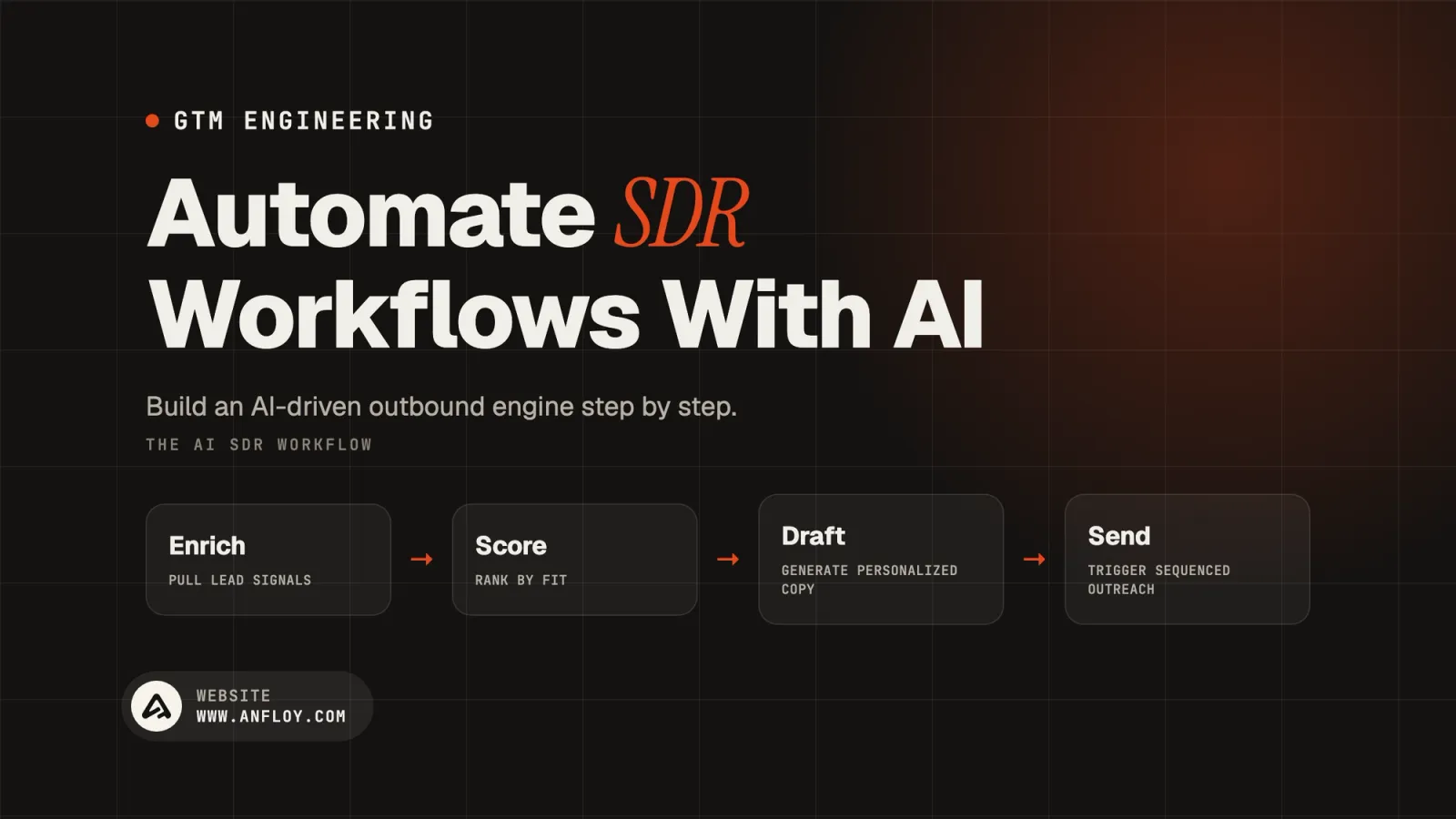
How to Automate SDR Workflows With AI?
Learn how to automate SDR workflows with AI. Discover AI tools, workflow examples, best practices, and GTM Engineering strategies to improve outbound sales productivity.
On this page
- What is AI SDR workflow automation?
- What are the benefits of AI SDR workflow automation?
- What are the top common SDR workflows that can be automated?
- How AI automates SDR workflows?
- Step-by-step guide to automating SDR workflows
- AI workflows every SDR team should automate
- Recommended AI tools for SDR workflow automation
- AI SDR workflow example
- AI SDR automation in GTM engineering
- Measuring the success of AI SDR workflows
- What are the best practices for AI SDR workflow automation?
- What are the common mistakes to avoid?
- Using too many disconnected tools
- What is the future of AI SDR workflows?
- How Anfloy helps?
- Conclusion
Sales Development Representatives (SDRs) spend a significant portion of their day on repetitive administrative work instead of engaging with prospects.
Researching accounts, qualifying leads, updating CRMs, sending follow-up emails, scheduling meetings, and routing prospects are all essential activities but they consume valuable selling time.
Artificial Intelligence (AI) is changing this.
Modern AI tools can automate many SDR workflows, enabling sales teams to spend more time building relationships while reducing manual effort, improving response times, and increasing pipeline generation.
AI doesn't replace SDRs. Instead, it acts as an intelligent assistant that handles repetitive work, surfaces insights, and recommends the next best actions throughout the sales process.
What is AI SDR workflow automation?
AI SDR workflow automation uses artificial intelligence, workflow automation, and CRM integrations to streamline repetitive sales development activities.
Instead of manually performing every task, AI analyzes customer data, triggers workflows, and completes routine actions automatically.
Examples include:
- Lead qualification
- CRM updates
- Contact enrichment
- Email personalization
- Meeting scheduling
- Follow-up reminders
- Lead routing
- Sales research
- Activity logging
The goal is to eliminate repetitive work so SDRs can focus on conversations that move opportunities forward.
Why AI matters for SDR teams?
Modern B2B buyers interact with businesses across multiple channels before speaking with sales.
During this journey, SDRs must manage large volumes of information from CRM systems, websites, marketing campaigns, product usage, and customer engagement platforms.
Without automation, teams often struggle with:
- Slow lead response times
- Manual CRM updates
- Inconsistent follow-ups
- Administrative overload
- Poor lead prioritization
- Duplicate work
- Data entry errors
AI helps solve these challenges by automating routine processes and enabling faster, data-driven decision-making.
What are the benefits of AI SDR workflow automation?
Organizations adopting AI-powered SDR workflows often experience measurable improvements across the revenue organization.
Faster lead response
AI immediately routes qualified leads, notifies sales representatives, and launches automated workflows as soon as a prospect enters the CRM.
Responding quickly increases the likelihood of engaging buyers while purchase intent is high.
Higher SDR productivity
By reducing repetitive administrative work, SDRs can dedicate more time to prospecting, relationship building, and discovery calls.
This increases the number of meaningful sales conversations each week.
Better lead qualification
AI evaluates behavioral, firmographic, and intent signals to identify the prospects most likely to convert.
This improves sales efficiency and reduces time spent on low-quality opportunities.
Improved personalization
AI analyzes company information, buyer behavior, and historical interactions to generate personalized outreach recommendations.
This helps SDRs create more relevant conversations at scale.
More accurate CRM data
Automated workflows keep customer records updated by synchronizing contact information, activity history, lifecycle stages, and sales interactions.
Clean CRM data improves reporting, forecasting, and Revenue Operations.
What are the top common SDR workflows that can be automated?
Nearly every repetitive SDR task can be partially or fully automated using AI and workflow automation platforms.
The most common workflows include:
| SDR Activity | AI Automation Opportunity |
|---|---|
| Lead qualification | AI lead scoring |
| Contact research | AI research agents |
| Data enrichment | Automated enrichment platforms |
| CRM updates | AI-generated record updates |
| Email drafting | AI writing assistants |
| Meeting scheduling | AI scheduling assistants |
| Lead routing | Workflow automation |
| Follow-up reminders | AI task automation |
| Activity logging | Automatic CRM synchronization |
| Pipeline reporting | AI dashboards |
Rather than replacing SDRs, these automations remove repetitive work and allow representatives to spend more time interacting with qualified prospects.
How AI automates SDR workflows?
A typical AI-powered SDR workflow connects multiple systems across the GTM technology stack.
Inbound Lead
      │
      ▼
CRM
      │
      ▼
Data Enrichment
      │
      ▼
AI Lead Scoring
      │
      ▼
Lead Qualification
      │
      ▼
Workflow Automation
      │
      ├── Assign SDR
      ├── Generate Email
      ├── Schedule Follow-up
      ├── Update CRM
      └── Notify Sales Team
      │
      ▼
SDR Outreach
Instead of relying on manual coordination, AI continuously evaluates customer data and automatically triggers the next best action.
Step-by-step guide to automating SDR workflows
Successful AI implementation starts with improving existing sales processes rather than simply adding new tools.
Step 1: Map your current SDR process
Document every step an SDR performs during a typical workday.
Examples include:
- Reviewing inbound leads
- Researching companies
- Updating CRM records
- Writing outreach emails
- Scheduling meetings
- Logging activities
- Creating follow-up tasks
This helps identify repetitive tasks that are ideal candidates for automation.
Step 2: Identify high-impact automation opportunities
Not every workflow should be automated.
Focus first on repetitive, time-consuming tasks such as:
- Lead enrichment
- Lead scoring
- CRM updates
- Calendar scheduling
- Meeting reminders
- Prospect research
- Internal notifications
- Sales reporting
Automating these processes typically delivers the fastest return on investment.
Step 3: Connect your GTM technology stack
AI workflows perform best when business systems share data seamlessly.
Common integrations include:
- CRM platforms
- Marketing automation software
- Data enrichment tools
- Calendar applications
- Email platforms
- Sales engagement tools
- Workflow automation platforms
- Business intelligence dashboards
A connected GTM stack enables AI to make informed decisions using complete customer information.
Step 4: Implement AI assistants
AI assistants can automate or accelerate many daily SDR activities.
Examples include:
- Prospect research
- Email drafting
- Meeting summaries
- CRM note generation
- Call transcription
- Follow-up recommendations
- Opportunity summaries
These assistants reduce administrative work while improving consistency across the sales process.
Step 5: Automate lead qualification and routing
Once AI assistants are in place, the next step is automating lead qualification and distribution.
Instead of manually reviewing every incoming lead, AI can evaluate buying intent, firmographic fit, engagement history, and behavioral signals to determine the next action.
Automated workflows can:
- Assign enterprise accounts to senior SDRs
- Route SMB leads to inside sales teams
- Prioritize high-intent prospects
- Trigger personalized nurture campaigns
- Escalate strategic accounts immediately
This ensures every lead reaches the right representative without delays.
Step 6: Monitor, Optimize, and scale
AI workflow automation is not a one-time implementation.
Regularly evaluate workflow performance using metrics such as:
- Lead response time
- Meetings booked
- Lead-to-opportunity conversion rate
- Opportunity win rate
- Email response rate
- SDR productivity
- Pipeline contribution
As your GTM strategy evolves, continuously refine workflows, prompts, AI models, and automation rules.
AI workflows every SDR team should automate
The following workflows provide the highest return on investment for most B2B sales teams.
1. AI lead qualification
Instead of manually reviewing inbound leads, AI evaluates:
- Company fit
- Industry
- Buying signals
- Website behavior
- CRM history
- Product engagement
Qualified leads are automatically prioritized for immediate outreach.
2. Prospect research automation
Research often consumes a large portion of an SDR's day.
AI can automatically gather:
- Company background
- Recent funding announcements
- Hiring activity
- Technology stack
- Executive profiles
- Industry news
This enables SDRs to personalize outreach without spending hours researching every account.
3. AI email personalization
Generative AI can create personalized outreach emails using:
- Company information
- Job role
- Industry trends
- Previous interactions
- Product interests
Instead of sending generic templates, SDRs can review and refine AI-generated drafts before sending them.
4. Automated meeting scheduling
AI scheduling assistants eliminate the back-and-forth involved in booking meetings.
Workflows can automatically:
- Check calendar availability
- Suggest meeting times
- Send invitations
- Confirm appointments
- Deliver reminders
- Reschedule when necessary
This reduces administrative work and speeds up the sales process.
5. CRM data entry automation
Updating CRM records manually is one of the most repetitive SDR tasks.
AI can automatically:
- Log emails
- Record meeting notes
- Update opportunity stages
- Capture call summaries
- Create follow-up tasks
- Synchronize customer interactions
This keeps CRM data accurate while reducing manual effort.
6. Follow-up automation
Consistent follow-up significantly improves conversion rates.
AI can automatically trigger follow-up workflows based on:
- Email engagement
- Meeting outcomes
- Website visits
- Trial activity
- Product usage
- Time since last interaction
Automation helps ensure promising prospects never fall through the cracks.
7. AI call summaries
After every sales conversation, AI can generate structured summaries that include:
- Customer pain points
- Buying intent
- Key objections
- Decision-makers
- Next steps
- Action items
These summaries improve collaboration between SDRs, account executives, and customer success teams.
8. Pipeline reporting
AI can automatically generate dashboards showing:
- Pipeline growth
- SDR activity
- Lead conversion
- Meetings booked
- Sales velocity
- Forecast updates
Real-time reporting provides leadership with immediate visibility into pipeline performance.
Recommended AI tools for SDR workflow automation
Several platforms help automate different stages of the SDR workflow.
| Category | Popular Tools |
|---|---|
| CRM | Salesforce, HubSpot |
| Workflow Automation | n8n, Zapier, Make |
| AI Writing | ChatGPT, Claude, Gemini |
| Sales Engagement | Outreach, Salesloft |
| Meeting Scheduling | Calendly, Chili Piper |
| Data Enrichment | Clay, Clearbit, Apollo.io |
| Revenue Intelligence | Gong, Clari, 6sense |
| Conversation Intelligence | Gong, Fireflies.ai, Avoma |
Most organizations combine multiple tools to build a complete AI-powered SDR workflow.
AI SDR workflow example
Below is an example of a fully automated outbound workflow.
Website Visitor
        │
        ▼
Lead Captured
        │
        ▼
CRM
        │
        ▼
Data Enrichment
        │
        ▼
AI Lead Scoring
        │
        ▼
Lead Routing
        │
        ├── Assign SDR
        ├── Generate Personalized Email
        ├── Schedule Follow-up
        ├── Create CRM Tasks
        └── Notify Slack
        │
        ▼
SDR Outreach
        │
        ▼
Meeting Booked
This workflow reduces manual coordination while ensuring every qualified prospect receives timely engagement.
AI SDR automation in GTM engineering
AI workflow automation has become a foundational capability within GTM Engineering.
Rather than automating isolated tasks, GTM Engineers build connected systems that allow customer data to flow seamlessly between marketing, sales, customer success, and Revenue Operations.
A modern GTM Engineering team typically manages:
- CRM architecture
- AI lead scoring
- Workflow automation
- API integrations
- Data enrichment
- Revenue Intelligence
- Customer lifecycle automation
- AI agent orchestration
By connecting these systems, GTM Engineers create scalable sales processes that reduce manual work while improving operational efficiency.
Measuring the success of AI SDR workflows
Implementing AI is only valuable if it improves business outcomes.
Organizations should monitor KPIs such as:
| KPI | Why It Matters |
|---|---|
| Lead Response Time | Measures sales speed |
| Meetings Booked | Indicates SDR productivity |
| Lead-to-Opportunity Rate | Evaluates qualification quality |
| Opportunity Win Rate | Measures sales effectiveness |
| Email Reply Rate | Indicates outreach quality |
| Pipeline Velocity | Tracks revenue efficiency |
| Administrative Hours Saved | Quantifies automation ROI |
| CRM Data Accuracy | Supports forecasting and reporting |
These metrics help teams optimize workflows while demonstrating the business value of AI automation.
What are the best practices for AI SDR workflow automation?
Successful AI automation is not about replacing SDRs. It is about removing repetitive work, improving data quality, and helping sales teams spend more time building relationships with qualified prospects.
The following best practices will help you maximize the value of AI-powered SDR workflows.
Start with process optimization
Before introducing AI, document your existing SDR workflows.
Ask questions such as:
- Which tasks are repetitive?
- Where do delays occur?
- Which activities require manual data entry?
- What causes prospects to fall through the cracks?
Optimizing the process first ensures AI automates efficient workflows rather than inefficient ones.
Keep CRM data clean
AI relies on accurate customer information to make intelligent decisions.
Maintain CRM quality by:
- Removing duplicate records
- Standardizing lifecycle stages
- Enriching company data
- Verifying contact information
- Defining required fields
- Performing regular data audits
Clean CRM data improves lead qualification, personalization, and workflow automation.
Use AI as a sales assistant
AI should enhance SDR productivity rather than replace human interaction.
Allow AI to handle activities such as:
- Prospect research
- Email drafting
- Meeting summaries
- CRM updates
- Task creation
- Follow-up reminders
Meanwhile, SDRs should focus on:
- Discovery conversations
- Relationship building
- Objection handling
- Qualification calls
- Personalized outreach
This balance combines AI efficiency with human expertise.
Automate only high-volume tasks
Not every workflow benefits from automation.
Prioritize repetitive, time-consuming activities with clear rules, including:
- Lead routing
- Contact enrichment
- Calendar scheduling
- CRM synchronization
- Follow-up reminders
- Sales reporting
Complex negotiations and strategic customer conversations should remain human-led.
Monitor workflow performance
AI workflows should be reviewed regularly to ensure they continue delivering value.
Track metrics such as:
- Workflow completion rate
- Automation success rate
- Lead response time
- SDR productivity
- CRM accuracy
- Email engagement
- Meetings booked
- Pipeline contribution
Continuous monitoring helps identify opportunities for optimization.
What are the common mistakes to avoid?
Organizations often encounter challenges when introducing AI into sales development.
Avoid these common mistakes.
Automating broken processes
If the existing workflow is inefficient, AI will simply automate inefficiency.
Review and simplify processes before implementing automation.
Ignoring human oversight
AI-generated emails, summaries, and recommendations should still be reviewed when appropriate.
Human oversight improves accuracy and protects customer relationships.
Using too many disconnected tools
Adding multiple AI applications without proper integration creates operational complexity.
Instead, build a connected GTM technology stack where CRM, automation platforms, AI assistants, and reporting tools share information seamlessly.
Neglecting change management
Successful adoption depends on people as much as technology.
Provide:
- Documentation
- Training
- Workflow guidelines
- AI usage policies
- Performance reviews
This helps SDRs understand how AI supports their daily work.
Measuring activity instead of outcomes
The goal is not to automate the highest number of tasks.
Instead, evaluate business outcomes such as:
- Pipeline growth
- Conversion rates
- Revenue influenced
- Time saved
- Sales productivity
- Customer experience
These metrics provide a clearer picture of automation success.
What is the future of AI SDR workflows?
AI is rapidly transforming sales development from workflow automation to intelligent execution.
Several trends are expected to shape the next generation of SDR operations.
AI sales agents
AI agents will increasingly perform tasks such as:
- Prospect qualification
- Meeting scheduling
- CRM updates
- Follow-up coordination
- Opportunity management
Human SDRs will focus on relationship building and strategic conversations.
Real-time sales recommendations
Instead of static workflows, AI will continuously analyze customer interactions and recommend:
- Next-best actions
- Personalized messaging
- Cross-sell opportunities
- Follow-up timing
- Account prioritization
These recommendations will help SDRs make better decisions throughout the sales process.
Autonomous workflow orchestration
Future AI systems will coordinate activities across multiple applications without requiring manual intervention.
Examples include:
- Updating CRM records
- Triggering marketing campaigns
- Assigning leads
- Scheduling meetings
- Notifying sales managers
- Creating executive reports
This level of orchestration will significantly reduce administrative work.
Company AI brains
Organizations are increasingly building centralized AI knowledge systems that connect CRM records, product documentation, customer conversations, internal playbooks, and operational data.
AI SDR workflows will use these Company AI Brains to deliver more accurate prospect research, personalized messaging, and contextual recommendations.
How Anfloy helps?
At Anfloy, we help B2B organizations automate sales development through modern GTM Engineering.
Our expertise includes:
- AI workflow automation
- CRM architecture
- Revenue Operations
- Lead routing
- AI lead scoring
- Data enrichment
- API integrations
- Customer lifecycle automation
- Revenue Intelligence
We build connected systems that reduce manual work, improve data quality, and help SDR teams focus on the conversations that generate revenue.
Conclusion
AI is redefining how SDR teams operate by automating repetitive tasks, improving lead qualification, and enabling faster, more personalized engagement with potential customers.
Rather than replacing sales representatives, AI removes administrative bottlenecks so SDRs can focus on conversations that drive pipeline and revenue.
By combining CRM data, workflow automation, AI assistants, data enrichment, and Revenue Operations, organizations can build scalable sales development processes that improve productivity while delivering better customer experiences.
As AI agents, autonomous workflows, and Revenue Intelligence continue to mature, SDR workflow automation will become a core capability within every modern go-to-market organization.
Scale your SDR team with Anfloy
Building a high-performing SDR team requires more than hiring great salespeople it requires intelligent systems that eliminate manual work and accelerate revenue generation.
Anfloy helps businesses automate SDR workflows through GTM Engineering, CRM optimization, AI lead scoring, workflow automation, data enrichment, Revenue Operations, and API integrations.
We build scalable AI-powered sales systems that improve productivity, shorten response times, and help revenue teams close more opportunities.
Book your call!
Frequently Asked Questions
How can I automate my SDR workflows using AI?
AI automates SDR workflows by qualifying leads, prioritizing prospects, drafting personalized outreach, scheduling follow-ups, updating CRM records, and triggering actions across your sales stack automatically.
How SDR team leads automate workflows with CRM and Zapier?
SDR team leads use CRM and Zapier to automate lead routing, contact creation, follow-up reminders, email sequences, task assignments, and real-time notifications between connected sales tools.
How SDR team leads automate workflows with CRM?
SDR team leads automate CRM workflows by assigning leads, updating records, triggering follow-up tasks, sending personalized emails, tracking engagement, and prioritizing opportunities using AI-powered automation.
Which SDR tasks should be automated first?
Most organizations begin with high-volume tasks including lead routing, CRM updates, contact enrichment, meeting scheduling, activity logging, and follow-up reminders because these deliver the fastest productivity gains.
How does GTM Engineering support AI SDR workflows?
GTM Engineers design the underlying systems that connect CRM platforms, workflow automation, AI assistants, data enrichment, Revenue Operations, and reporting tools, ensuring AI workflows operate reliably across the revenue organization.
Let's build
what your
company needs.
Drop your email. We'll send The Custom Agent Blueprint on what we'd build first for a company like yours, before you ever take a meeting.