
Sales GTM Engineering: How Anfloy Built the Role From Scratch
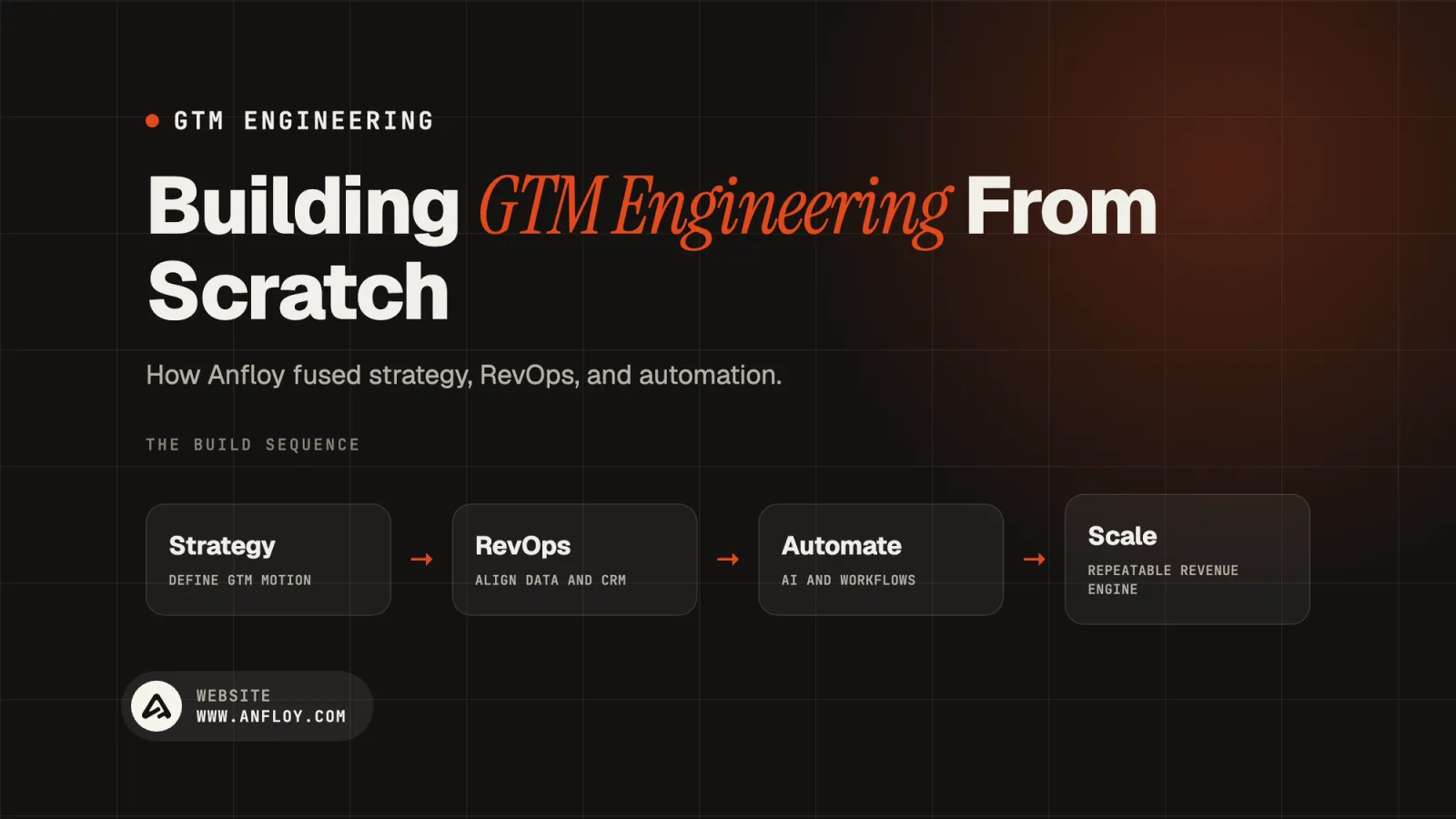
Discover how Anfloy built a Sales GTM Engineering function from scratch by combining GTM strategy, RevOps, AI, CRM & workflow automation.
On this page
- Why traditional revenue teams started breaking down?
- The missing link between strategy and execution
- What is sales GTM engineering?
- Our philosophy: revenue systems before revenue software
- The sales GTM engineering operating model
- Why we built the role instead of expanding RevOps?
- How we built the sales GTM engineering function at Anfloy?
- The core principles behind our sales GTM engineering model
- What are the responsibilities of a sales GTM engineer?
- What are the top skills that matter more than software?
- Measuring success
- Where sales GTM engineering is headed?
- When should companies build a sales GTM engineering function?
- The Business outcomes we've seen
- Common misconceptions about sales GTM engineering
- How to start building a sales GTM engineering capability?
- Why businesses choose Anfloy?
- Conclusion
Sales GTM Engineering: How Anfloy Built the Role From Scratch
Every major shift in business creates new roles.
The rise of cloud computing created cloud architects.
The growth of data science created analytics engineers.
Artificial intelligence introduced prompt engineers and AI engineers.
Today, the rapid evolution of Revenue Operations, AI automation, and modern go-to-market execution is creating another discipline:
Sales GTM Engineering.
At Anfloy, we didn't create this role by simply combining sales and engineering responsibilities. We built it because we repeatedly observed the same operational problem across growing B2B companies.
Marketing generated leads.
Sales managed pipelines.
Customer Success handled onboarding.
Revenue Operations tracked performance.
Engineering built products.
Yet no single team owned the operational systems connecting these functions together.
The result was fragmented customer journeys, disconnected CRM platforms, manual workflows, inconsistent reporting, and increasing operational complexity.
Instead of solving these issues independently, we designed a new operating model.
That model became Sales GTM Engineering.
This article explains why we created the role, how it evolved, what responsibilities it owns, and why we believe GTM Engineers will become one of the most valuable positions inside modern revenue organizations.
Why traditional revenue teams started breaking down?
Go-to-market organizations have changed dramatically over the last decade.
Modern B2B companies now rely on dozens of applications across their revenue stack.
A typical organization may use:
- CRM platforms
- Marketing automation
- Sales engagement software
- Customer success platforms
- Product analytics
- AI assistants
- Data enrichment tools
- Revenue Intelligence platforms
- Workflow automation software
Individually, each platform solves a specific problem.
Collectively, they create operational complexity.
The challenge is rarely the technology itself.
The challenge is ensuring every system works together.
Without shared ownership, businesses experience:
- Duplicate customer data
- Inconsistent lead routing
- Manual handoffs
- Broken workflows
- Conflicting reports
- Poor CRM adoption
- Slow revenue execution
These operational inefficiencies often reduce growth more than poor marketing or weak sales performance.
The missing link between strategy and execution
Most organizations already have talented teams.
They have:
- Product Marketing
- Demand Generation
- Sales
- Revenue Operations
- Customer Success
- Engineering
However, each function typically optimizes its own responsibilities.
Very few roles own the complete operational journey.
For example:
Marketing creates demand.
Sales converts opportunities.
Customer Success manages adoption.
Revenue Operations measures performance.
Engineering develops products.
Who designs the operational systems connecting all of them?
That question became the foundation of Sales GTM Engineering.
What is sales GTM engineering?
At Anfloy, Sales GTM Engineering is the discipline responsible for designing, implementing, optimizing, and continuously improving the technical systems that enable revenue teams to execute a go-to-market strategy efficiently.
Rather than focusing on a single department, Sales GTM Engineering manages the operational infrastructure supporting the entire revenue lifecycle.
Core responsibilities include:
- CRM architecture
- Workflow automation
- Revenue Operations implementation
- AI workflow orchestration
- API integrations
- Customer lifecycle automation
- Revenue Intelligence
- Sales enablement systems
- Data enrichment
- Operational governance
Instead of replacing marketing, sales, or RevOps, Sales GTM Engineering connects these functions through scalable operational systems.
Our philosophy: revenue systems before revenue software
One of the first principles we adopted at Anfloy was simple:
Software does not create operational excellence. Systems do.
Many businesses respond to growth challenges by purchasing additional tools.
Unfortunately, adding software often increases complexity instead of reducing it.
We believe businesses should first design the operating system behind revenue.
Only then should they decide which technology best supports that system.
This philosophy influences every implementation decision.
Instead of asking:
Which CRM should we buy?
We ask:
- How should leads move through the organization?
- Where should automation replace manual work?
- Which data should AI analyze?
- Which workflows generate the highest operational leverage?
- Which metrics actually predict revenue growth?
Technology becomes an enabler rather than the strategy itself.
The sales GTM engineering operating model
The role connects strategy with execution.
Business Goals
        │
        ▼
Go-to-Market Strategy
        │
        ▼
Sales GTM Engineering
        │
        ├── CRM Architecture
        ├── Revenue Operations
        ├── Workflow Automation
        ├── AI Systems
        ├── Data Enrichment
        ├── API Integrations
        ├── Revenue Intelligence
        └── Customer Lifecycle
        │
        ▼
Marketing • Sales • Customer Success
        │
        ▼
Predictable Revenue Growth
Rather than acting as another operational department, Sales GTM Engineering becomes the connective layer that ensures every revenue function works from the same data, follows consistent workflows, and supports shared business objectives.
Why we built the role instead of expanding RevOps?
A common question we receive is:
Why not simply expand Revenue Operations?
Revenue Operations is essential.
However, RevOps primarily governs processes, reporting, forecasting, and cross-functional alignment.
Sales GTM Engineering extends beyond operational governance.
It includes:
- Technical implementation
- AI engineering
- Workflow architecture
- CRM engineering
- Automation design
- API orchestration
- Data engineering
- Revenue system optimization
In other words:
RevOps defines how revenue teams should operate.
Sales GTM Engineering builds the systems that make those operations possible.
This distinction became increasingly important as AI, automation, and modern GTM technology stacks introduced new implementation challenges that traditional RevOps teams were not always designed to manage.
How we built the sales GTM engineering function at Anfloy?
We didn't begin by writing job descriptions or purchasing additional software.
We started by mapping the entire revenue journey.
Instead of asking, "Which tool should own this process?", we asked a different question:
"How should information move from the first customer interaction to long-term revenue expansion?"
That single question changed how we approached GTM execution.
Rather than optimizing individual departments, we optimized the relationships between them.
Every workflow, CRM object, API integration, AI model, and automation was evaluated based on one principle:
Does this reduce friction across the revenue engine?
If the answer was no, it didn't belong in the system.
Step 1: We Mapped the Entire Revenue Lifecycle
Before designing technology, we documented every customer interaction.
The lifecycle included:
- Anonymous visitor
- Marketing lead
- Marketing Qualified Lead (MQL)
- Sales Qualified Lead (SQL)
- Opportunity
- Customer
- Onboarding
- Product adoption
- Expansion
- Renewal
- Advocacy
Each stage required clear ownership, defined success criteria, and standardized data.
This became the operational blueprint for every future automation.
Step 2: We designed the CRM around the customer journey
Many CRM implementations mirror an organization's internal structure.
We took the opposite approach.
The CRM should reflect how customers move through the buying journey not how departments are organized.
That meant designing:
- Lifecycle stages
- Account hierarchies
- Contact relationships
- Opportunity pipelines
- Activity tracking
- Customer health indicators
- Expansion signals
- Renewal workflows
The CRM became the operational source of truth rather than a reporting database.
Step 3: We automated high-friction processes
After mapping the customer journey, we identified repetitive tasks that slowed execution.
Examples included:
- Manual lead assignment
- CRM updates
- Meeting scheduling
- Lead qualification
- Pipeline stage progression
- Internal notifications
- Customer handoffs
- Renewal reminders
Rather than automating everything, we prioritized workflows that produced the greatest operational leverage.
Automation should remove repetitive work while preserving human decision-making where context matters.
Step 4: We embedded AI into operational workflows
AI was never treated as a standalone feature.
Instead, it became another operational layer inside the GTM system.
Examples include:
- AI lead scoring
- AI SDR assistance
- Company research
- Opportunity prioritization
- Forecast analysis
- Customer segmentation
- Executive reporting
- Workflow recommendations
This approach ensured AI enhanced existing workflows rather than introducing disconnected processes.
Step 5: We standardized revenue data
AI, automation, and reporting depend on reliable data.
Without governance, every downstream system becomes less effective.
We standardized:
- Field naming conventions
- Lifecycle definitions
- Pipeline stages
- Customer attributes
- Revenue metrics
- Activity tracking
- Reporting dimensions
This reduced ambiguity while improving consistency across departments.
The core principles behind our sales GTM engineering model
Over time, several principles emerged that continue to guide every implementation.
Systems before tools
Technology should support business processes not define them.
The operational model always comes first.
Customer journey before internal structure
Revenue systems should reflect how customers buy, not how departments are organized.
When systems follow customer behavior, handoffs become simpler and reporting becomes more accurate.
Automation with purpose
Not every process should be automated.
We automate repetitive, rules-based work while preserving human judgment for strategic decisions, relationship building, and complex problem solving.
AI as an operational layer
Artificial intelligence should strengthen CRM architecture, Revenue Operations, forecasting, customer segmentation, and workflow automation.
It should not exist as a disconnected experiment.
Continuous optimization
Sales GTM Engineering is never "finished."
Customer behavior changes.
Products evolve.
Markets shift.
AI capabilities improve.
The operating system must evolve continuously alongside the business.
What are the responsibilities of a sales GTM engineer?
Because the discipline combines multiple operational areas, Sales GTM Engineers require a broad set of responsibilities.
Typical ownership includes:
Strategy
- Translate GTM strategy into operational systems
- Support market expansion
- Improve revenue scalability
CRM
- Design CRM architecture
- Standardize lifecycle stages
- Improve CRM governance
Automation
- Build workflow automation
- Eliminate manual tasks
- Improve operational efficiency
AI
- Implement AI lead scoring
- Design AI workflows
- Support Revenue Intelligence
- Evaluate AI tools
Revenue operations
- Improve forecasting
- Standardize reporting
- Support cross-functional alignment
Integrations
- Connect GTM platforms
- Manage APIs
- Improve data synchronization
Rather than specializing in one platform, Sales GTM Engineers understand how the entire revenue ecosystem functions together.
What are the top skills that matter more than software?
Organizations often hire based on platform certifications.
We prioritize systems thinking.
Important capabilities include:
- Revenue process design
- Customer journey mapping
- CRM architecture
- Workflow engineering
- API fundamentals
- Automation design
- AI literacy
- Data modeling
- Business analysis
- Cross-functional communication
Software platforms evolve.
Systems thinking remains valuable regardless of which tools an organization adopts.
Measuring success
Traditional GTM roles often measure departmental performance.
Sales GTM Engineering measures the health of the overall revenue system.
Key performance indicators include:
- Lead response time
- CRM adoption
- Workflow completion rate
- Automation coverage
- Forecast accuracy
- Data quality
- Sales cycle duration
- Pipeline velocity
- Customer onboarding efficiency
- Revenue influenced by automation
These metrics reflect improvements across the entire customer lifecycle rather than isolated departmental outcomes.
Where sales GTM engineering is headed?
The next evolution of the role extends beyond workflow automation.
Future responsibilities will increasingly include:
- Multi-agent AI systems
- Autonomous revenue workflows
- Predictive Revenue Intelligence
- AI-powered CRM management
- Company AI Brains
- Real-time operational optimization
- Adaptive customer journeys
- Cross-platform orchestration
As these capabilities mature, Sales GTM Engineers will become architects of intelligent revenue systems rather than administrators of business software.
In the final section, we'll explore when companies should build this function, the business outcomes we've observed, practical implementation advice, frequently asked questions, and how Anfloy helps organizations establish Sales GTM Engineering as a strategic capability.
When should companies build a sales GTM engineering function?
Not every business needs a dedicated Sales GTM Engineering team from day one.
However, there are clear indicators that a company has reached the point where operational complexity requires specialized ownership.
Organizations should consider building this function when they experience challenges such as:
- Rapid growth in inbound leads
- Multiple disconnected GTM tools
- Manual CRM processes
- Poor sales and marketing alignment
- Inconsistent reporting
- Slow lead response times
- Increasing AI initiatives
- Complex customer journeys
- Multiple revenue teams
- Difficulty scaling operations
These challenges often signal that the business has outgrown ad hoc operational management.
Instead of adding more software or hiring additional administrators, companies benefit from creating systems that scale efficiently.
The Business outcomes we've seen
Although every organization is different, our approach consistently focuses on improving operational capabilities rather than simply deploying technology.
When Sales GTM Engineering is implemented successfully, businesses typically achieve improvements in several areas.
Better operational visibility
Leadership gains clearer insight into:
- Pipeline health
- Revenue forecasts
- Customer lifecycle performance
- Workflow completion
- Sales productivity
- Marketing attribution
Better visibility leads to faster, more informed business decisions.
Higher sales productivity
Sales teams spend less time on administrative work and more time engaging qualified prospects.
Operational improvements often include:
- Automated lead routing
- Faster qualification
- Reduced CRM updates
- Improved account intelligence
- AI-assisted prioritization
The result is greater efficiency without increasing team size.
Stronger cross-functional alignment
Marketing, Sales, Customer Success, and Revenue Operations begin working from the same operational framework.
Shared systems reduce:
- Duplicate work
- Conflicting reports
- Manual handoffs
- Data inconsistencies
Alignment improves customer experience throughout the revenue lifecycle.
AI that supports real business processes
Many organizations experiment with AI without integrating it into daily operations.
Our philosophy is different.
AI should support measurable business outcomes by improving:
- Lead qualification
- Opportunity prioritization
- Workflow automation
- Forecasting
- Customer insights
- Executive reporting
When AI becomes part of the operational system rather than an isolated experiment, adoption and business impact improve significantly.
Common misconceptions about sales GTM engineering
As the discipline continues to evolve, several misconceptions persist.
"It's just another CRM administrator"
CRM administration is only one responsibility.
Sales GTM Engineering includes system architecture, workflow engineering, Revenue Operations, AI implementation, API integrations, customer lifecycle optimization, and operational strategy.
"RevOps already covers this"
Revenue Operations and Sales GTM Engineering are complementary disciplines.
RevOps focuses on governance, forecasting, and operational alignment.
Sales GTM Engineering builds and optimizes the systems that enable those operational processes to function efficiently.
"AI will replace GTM engineers"
AI will automate repetitive technical work.
However, designing revenue systems, defining operational logic, governing customer data, and aligning business objectives still require human expertise.
The role is likely to evolve not disappear.
How to start building a sales GTM engineering capability?
Organizations do not need to build an entire department immediately.
A phased approach typically produces better results.
Phase 1: Standardize strategy
Align leadership around:
- GTM objectives
- Ideal Customer Profile (ICP)
- Customer lifecycle
- Revenue KPIs
Phase 2: Build the operational foundation
Implement:
- CRM architecture
- Revenue Operations
- Workflow automation
- Data governance
Phase 3: Introduce AI
Deploy AI where it creates measurable value:
- Lead scoring
- SDR assistance
- Forecasting
- Revenue Intelligence
- Customer segmentation
Phase 4: Continuously optimize
Review:
- Workflow performance
- AI recommendations
- Customer feedback
- Revenue metrics
- Operational bottlenecks
Sales GTM Engineering should become a continuous business capability rather than a one-time implementation project.
Why businesses choose Anfloy?
Sales GTM Engineering was born from our experience helping B2B organizations bridge the gap between strategy and execution.
At Anfloy, we combine:
- GTM strategy
- GTM Engineering
- Revenue Operations
- CRM architecture
- Workflow automation
- AI implementation
- Data enrichment
- Revenue Intelligence
- Customer lifecycle automation
Our objective isn't simply to implement software.
We help businesses build operational systems that remain scalable as markets, customers, and technology continue evolving.
By integrating strategy, operations, and engineering into one connected framework, organizations gain the agility required to compete in increasingly AI-driven markets.
Conclusion
Modern go-to-market organizations require more than talented marketing, sales, and customer success teams. They need connected operational systems capable of supporting scalable, AI-enabled revenue growth.
Sales GTM Engineering emerged because no traditional role fully owned the intersection of strategy, technology, automation, and operational execution.
At Anfloy, we built this discipline by focusing on systems rather than software, customer journeys rather than departmental boundaries, and continuous optimization rather than one-time implementation.
We believe Sales GTM Engineering will become a foundational capability for modern B2B organizations because it enables every revenue function to work from the same operational framework.
As AI, automation, and Revenue Operations continue to evolve, businesses that invest in connected revenue systems not isolated tools will be better positioned to scale efficiently and adapt to changing market conditions.
Build Your Sales GTM Engineering Function with Anfloy
Whether you're modernizing Revenue Operations, implementing AI, redesigning your CRM architecture, or building your first GTM Engineering capability, Anfloy helps transform strategy into scalable operational systems.
Our team combines GTM strategy, GTM Engineering, workflow automation, AI implementation, CRM architecture, Revenue Intelligence, and customer lifecycle optimization to create revenue engines built for long-term growth.
Book Your Call!
Frequently Asked Questions
Why did Anfloy create the Sales GTM Engineering role?
We created the role because traditional GTM teams often lacked a single owner responsible for connecting strategy, technology, and operational execution. Sales GTM Engineering fills that gap by building scalable revenue systems instead of managing isolated departments.
Is Sales GTM Engineering different from Revenue Operations?
Yes. Revenue Operations focuses on governance, reporting, forecasting, and process alignment. Sales GTM Engineering builds the technical infrastructure including CRM architecture, automation, AI workflows, and integrations that enables Revenue Operations to function effectively.
What skills does a Sales GTM Engineer need?
Strong Sales GTM Engineers combine business strategy with technical expertise. Core skills include CRM architecture, workflow automation, API integrations, Revenue Operations, AI implementation, customer journey mapping, data modeling, and systems thinking.
Which companies should build this role?
Businesses experiencing rapid growth, increasing GTM complexity, AI adoption, multiple CRM integrations, or expanding Revenue Operations often benefit from establishing a Sales GTM Engineering function.
Let's build
what your
company needs.
Drop your email. We'll send The Custom Agent Blueprint on what we'd build first for a company like yours, before you ever take a meeting.